
Fishing & Hunting
Fishing
Hunting
Foraging & Wild Harvest
"The lazy do not roast any game, but the diligent feed on the riches of the hunt."
— Proverbs 12:27
The Oldest Way In
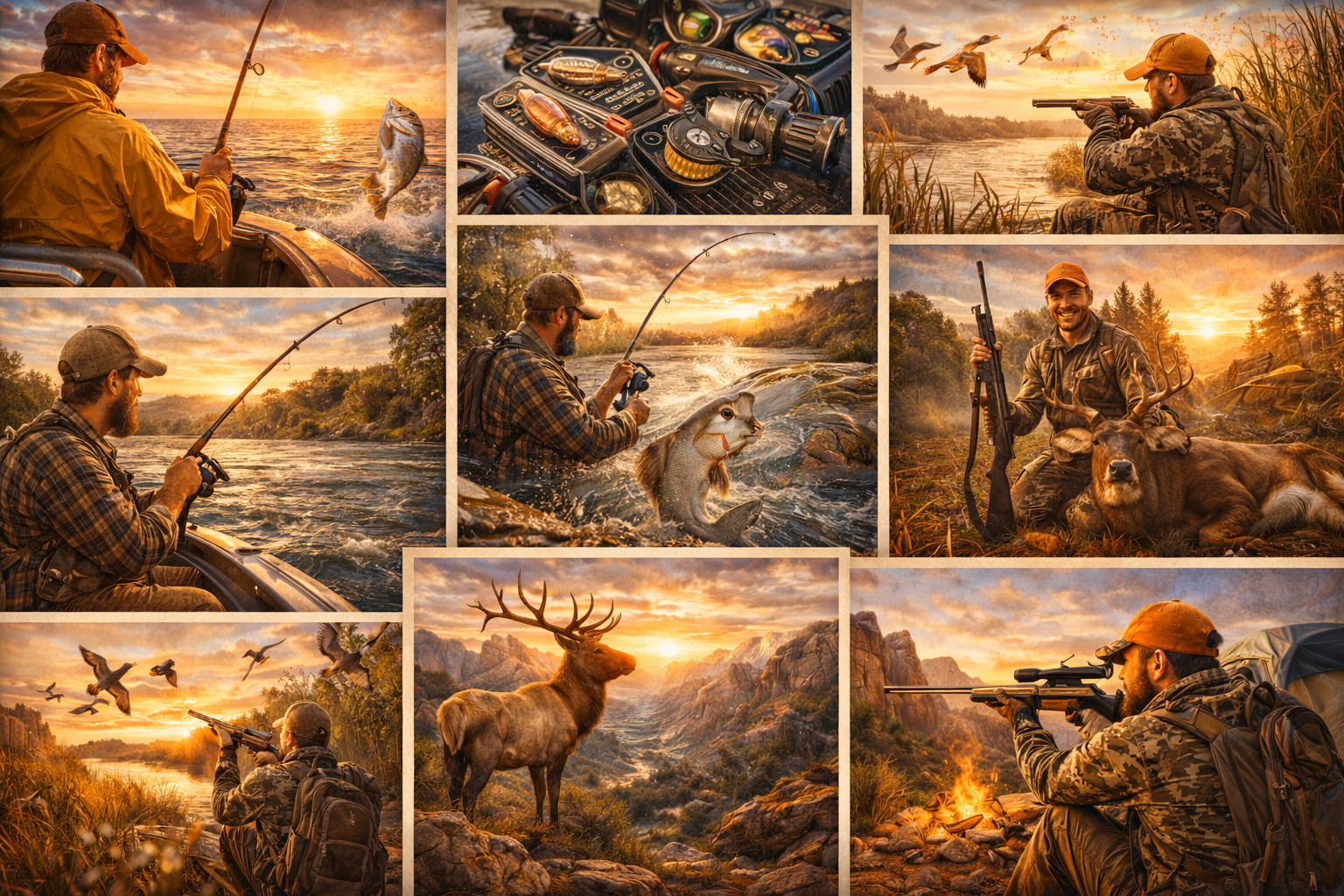
The outlet pool below camp is still in shadow when the Adventurer wakes you with a cup of coffee and a short rod already rigged. He doesn't explain anything. He points at a seam where the fast water slides past the slow, flicks a small spinner upstream of it, lets it swing, and hands you the rod. Your first five casts land in the willows. Your sixth lands where he pointed. On the ninth the line goes tight and alive, and for about four seconds you forget every single thing you were worried about when you left home. It's a trout the length of your hand. He kneels, wets his hands, slips the hook out, and holds the fish in the current until it kicks free. "The fish don't care about your schedule," he says. "That's the first lesson. The rest take years."
Later that morning the mentor finds tracks at the edge of the meadow above the lake, split hearts pressed into the mud, and the three of you crouch over them a long time without saying much. The Adventurer reads them like a newspaper: a doe and a yearling, crossing at first light, headed for water. On the walk back he stops at a rockslide grown over with wild raspberries, eats a handful, and holds out his palm to you. "Out here," he says, "everything is hunting, hiding, or eating. Men used to know that without being told."
People have fed themselves from wild country this way for as long as there have been people, and Fishing & Hunting walks the three ways they did it, in order. Fishing opens the ground, since a kid with a bobber can catch his own supper and a lake shrugs off almost any mistake. Hunting follows, asking for a steadier hand, stronger legs, and a heavier conscience, and climbing from squirrels and birds to elk and, last of all, bear. Foraging & Wild Harvest comes third, the gathering that every hunting people also did: berries, greens, nuts, and finally mushrooms, where the stakes are life and death and the search takes a man off the trail with his eyes on the ground. None of these are hobbies the way the Workshop's crafts are hobbies. They're the originals, the work every generation before this one did to eat, and the place where, more than anywhere else a man goes, one generation hands itself to the next.
Why These Are the Oldest Things a Man Does
Start with what has been lost. Most modern men have no contact with their own food. Meat comes under plastic, fish comes as a fillet, and berries come in a clamshell from another hemisphere. A man can live his whole life without seeing the creature alive, without watching it die, and without once picking something to eat off a plant he could name. He has the cleanest, most convenient relationship with food any people has ever had, and it has left him more distant from it than any people has ever been. He may think of himself as too civilized to kill an animal while paying, three times a day, for someone else to kill animals out of his sight. That isn't innocence. It's distance.
The fisherman, the hunter, and the gatherer close that distance, and it changes a man. A trout cleaned on a gravel bar, an elk quartered by headlamp with a long pack-out ahead, a gallon of huckleberries picked with purple fingers on a hot August slope: a man who has done those things knows what his life costs. The meat he brings home is about as honest as meat gets, an animal that lived wild and died quickly by the hand of the man who will feed it to his family.
These pursuits also teach a patience the modern world has nearly bred out of men. The fish comes when it comes. The deer walks out when it walks out. The morels come up the week the ground is warm enough, and not a day sooner. A man can sit in a blind for six hours and go home with nothing but cold in his bones, and come back the next morning anyway, because the country owes him nothing and he knows it. A screen trains a man to expect a reward every few seconds. The blind trains him back into an older rhythm, where he gives a morning his full attention and accepts whatever it gives him.
Then there is the death, which sets this ground apart from every other one. To hunt is to take a life. A man who does it well neither flinches from that nor glories in it. He makes the shot clean, because a clean kill is the one mercy he can offer. He uses the whole animal, because waste insults the life he took. And the thing a man who has never hunted rarely believes is that the hunter who has cleaned a hundred animals usually ends up more reverent toward life, not less. The weight does that.
And there is knowledge that almost vanished in two generations. A great-grandmother knew which greens came up first in spring, which berries were safe, and which mushrooms went in the pan. Most of her great-grandchildren couldn't name three wild plants. A man who learns the country's plants learns to see the land as full, not empty, and that kind of seeing is hard to lose once he has it.
How a Man Gets This Ground Wrong
The oldest pursuits have the oldest traps, and most of them grab the trophy while skipping the substance.
The Trophy Chaser. He hunts for the rack on the wall and treats the meat as an afterthought, or as garbage. He has turned a way of feeding a family into a way of feeding an ego. Let the antlers be the memory of good meat honestly taken, never the reason for taking it.
The Man Who Bought the Hunt. He pays an outfitter to do everything but the last ten seconds: the scouting, the stand, the ranging, the tracking. He comes home with an animal he can't honestly say he hunted. A guide has a place in country a man doesn't know. The man who only ever hunts that way never builds the skill, and the skill was the point.
The Catch-and-Photograph Man. His fishing exists for the feed. The fish gets held out of the water for the perfect angle, squeezed, dropped on the rocks, and released half dead. A fish is food, or it goes back fast and unharmed. It isn't a prop.
The Guesser. He's pretty sure that mushroom is the one from the video. He's almost positive about the berries. Almost is how people end up on a transplant list. On this ground, a man either knows exactly what something is, or it doesn't go in his mouth.
The Man Who Never Brings Anyone. Thirty years of hunting and fishing, and he has never once taken a child, a nephew, or a new friend. His skill is real, and the deepest thing this ground makes has gone unmade.
The Man With No Weight. He kills carelessly: mocks the animal, wounds it and doesn't track it, wastes the meat, strips a berry patch bare. This is the man who gives these pursuits their bad name, and his failure is in his character, not his aim.
The Man Who Bites the Hand. He sneers at conservation, grumbles about his license fee as a tax, and acts as if the game were endless. The truth runs the other way. Hunters and anglers asked to have their own gear taxed, in 1937 and again in 1950, and that money and their license fees still pay for a large share of the wildlife work in this country.
The Three Rooms of This Ground
Fishing — the patient water. Reading water, the knots for the line, landing a fish, releasing it well or keeping it for the table, and a child's first morning on a dock. Three rooms beneath it: Bait & Tackle, the rod, reel, line, and lures that actually matter; Fresh Water Fishing, the ponds, rivers, lakes, and ice most men fish their whole lives; and Salt Water Fishing, the surf, the flats, and the deep water off the coast.
Hunting — the harder woods. Hunter education, tags and draws, the four rules in the field, the ethical shot, and the work after it. Two rooms beneath it, each with a harder hunt tucked underneath: Small Game Hunting, the squirrel woods and rabbit brush where most hunters take their first animal, with Bird & Fowl Hunting beneath it; and Big Game Hunting, the deer and elk country that asks everything of a man's legs and patience, with Bear Hunting beneath it. The one teacher standing on this ground stands in the big-game room.
Foraging & Wild Harvest — the gathering. The rules that keep a forager alive and the patch alive after him, then two rooms: Wild Plants, the greens, berries, nuts, and sap a family can learn to gather safely; and Wild Mushrooms, where one wrong identification can kill, and where the search leads a man farther off the trail than anything else on this ground.
Ten Things Every Serious Sportsman Holds
1. The license, the law, and the name come first. Buy the license, learn the regulations, and keep the limits and the seasons. And nothing wild goes in your mouth until you can name it for certain.
2. Provision over trophy. The animal is taken for food first. The mount is a memory of the meal.
3. Only the shot you can make. At the range and angle you can make every time. Pass the rest. A wounded animal belongs to the man who chose the shot.
4. Knowledge of the country compounds. The water fished for twenty seasons, the ridge hunted for fifteen, the old burn where the morels come up every third spring. It can only be built, one year at a time.
5. Practice happens between seasons. The rifle, the bow, and the cast get practiced in the off months, so November's shot isn't the first since last year.
6. Take what the land can give. Let the big spawners go, pick part of the patch and leave the rest, and treat the fishery and the woods as something your grandson will inherit.
7. The child comes along at the right age. A first fish at five or six. A first berry-picking trip at any age. A first hunt when the child can sit still, handle a firearm safely, and has passed the course. Daughters too, whenever they want to come.
8. Field to table is the whole job. Cleaning the fish on the bank, field-dressing the deer, getting the meat cold, butchering it, cooking it, and turning the berries into jam. The man who has done the whole chain stands in a different place than the man who only pulled a trigger.
9. Bring the next one. The curious friend, the nephew with no father to take him, the neighbor kid. The tradition survives only if someone hands it on.
10. The country is on loan. Leave it better than you found it. A serious hunter and a serious conservationist are the same man.
The Three Pillars on the Water and in the Woods
The same three questions follow a man into the boat, the blind, and the berry patch. TRUTH. LOVE. LAW. Always in that order.
TRUTH — Am I glorifying God in this, or has it become an idol? The reverence a man feels with a clean-killed animal at his feet is meant to run all the way up to the One who made the animal, the country, and the man, and who gave a man the right to take food from it. That permission was handed down. It was never seized. There's a plainer truth too: tell the story straight. The fish was the size it was, and the hunt was as hard as it was.
LOVE — Am I out here enjoying this, or performing it? One father's hunt is for his family: the meat on their table and the boy in the blind beside him. Another man's every cast and every kill is staged for an audience who isn't there. The son's first fish, the daughter's first deer, the old friend's last elk season, and the whole family picking berries on a hillside: that's where this ground pays out.
LAW — Am I honoring the season and the country, or taking more than my share? Keep the season, respect the limit, make the kill clean, use the whole animal, and leave some of every patch. The law God gave Israel reached even a bird's nest beside the road: do not take the mother with the young. You may take the young, but be sure to let the mother go, so that it may go well with you and you may have a long life — Deuteronomy 22:6-7. Take what the land can give, and leave what keeps it giving. That's conservation, written down three thousand years before anyone used the word.
Hold all three and a man feeds his family from country he honors, with the people he loves beside him, and points the whole old business back up at the One who gave it.
This Ground Inside the Backcountry
This ground stands on the one before it. The man who came down off the mountain to a basin lake with a rod in his pack could only get there because he could walk in and sleep out. The elk live where the roads don't go, and so do the best trout and the best berry slopes.
And it reaches across the whole journey. DEFENSE's Firearms hall teaches the four rules in full, Outdoor & Hunting Knives covers the blade that does the field work, and Hunting & Trapping covers the same skills for the day food from the land isn't a choice. HEALTH's Canning & Dehydration keeps the harvest past the season. On the Estate, Humane Handling & Harvest carries the same respect for an animal's death onto the homestead, and Raising Canines raises the dog that may one day hold a point on a covey of quail. And on the Hearth, Fishing & Fatherhood tells the long arc of the water from the son's side.
Where This Ground Stops and Scripture Continues
A man who hunts, fishes, and gathers long enough starts to think of himself as a provider in the oldest sense, and he's right to. He puts meat in the freezer. He knows where the fish hold and where the berries ripen first. His family eats because he got up at four.
Then one season he sits in a blind for eleven days and sees nothing. He fishes a river he knows by heart and gets skunked for a week. And a question God once asked a man who thought he understood the world starts to sound very personal. Do you hunt the prey for the lioness and satisfy the hunger of the lions when they crouch in their dens or lie in wait in a thicket? Who provides food for the raven when its young cry out to God and wander about for lack of food? — Job 38:39-41.
The answer isn't the hunter. Every animal a man has ever taken, and every berry he ever picked, was fed and grown by Someone else first. The best provider on this ground is still a man being provided for, and the good seasons were always a gift before they were a harvest.
Where This Ground Leads
The oldest pursuits taught a man to read wild country cold, to be patient in it, and to take from it honestly. But this is the oldest way into the country, not the farthest. Past where any game trail goes, there's water running white through canyons, rock going straight up, openings in hillsides that lead down into the dark, and old workings left by men who came looking for something else entirely. The provider's pursuits put a man deep in the wild. The last ground of the Backcountry takes him past the edge of what most men ever see.
How many are your works, LORD! In wisdom you made them all; the earth is full of your creatures — Psalm 104:24. Not all of it can be caught, shot, or picked. Some of it is only there to be found.