
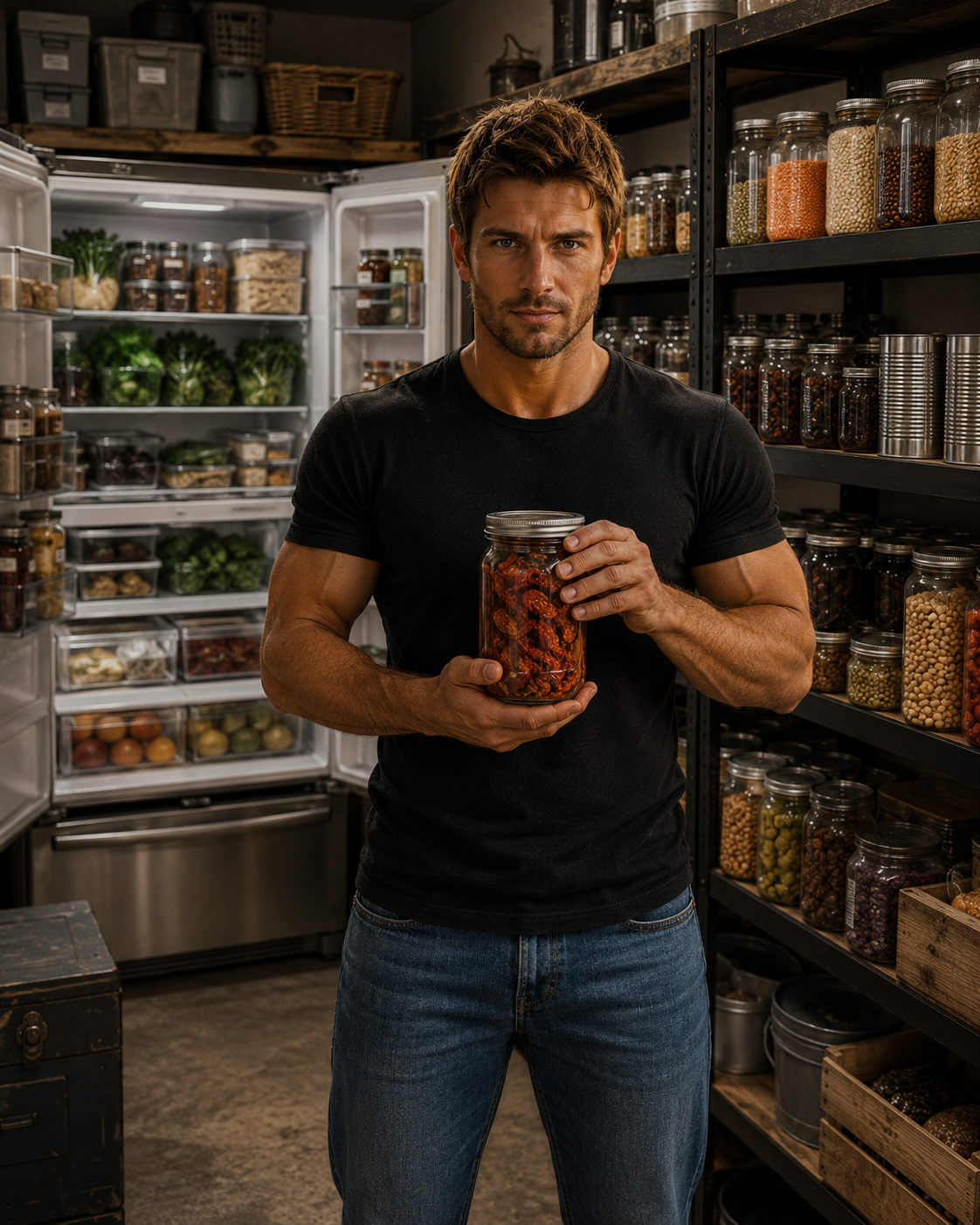
Food Storage
Tupperware & Vacuum Sealing
Cold Storage & Deep Freezing
Canning & Dehydration
The Walk-In Tells the Truth
Here's the honest math. A man who feeds himself well is throwing away almost nothing. A man with a chaotic fridge is throwing away food constantly — the bag of spinach that turned to soup, the chicken he prepped and forgot, the leftovers that cycled to the back and died there. Call it fifty dollars a month, and for most households that's a gentle estimate. That's six hundred dollars a year, quietly, into the bin. Over a decade of feeding a family, it's a used car.
But the money isn't even the worst of it. The worst of it is what waste does to your will. A man who spends three hours prepping meals and then watches half of them spoil starts asking why he bothers — and pretty soon he doesn't. Most men don't quit meal prep because it's hard. They quit because the results kept dying in the fridge before they could eat them. Fix the keeping, and the whole system finally pays what it promised.
And there's one more thing the walk-in teaches: you eat what you can see. A prepped meal sitting at eye level, labeled, front and center — that meal gets eaten. The same meal buried behind a ketchup bottle and two takeout boxes might as well not exist. Come seven o'clock, tired and hungry, you will grab what's visible. So the game isn't just keeping food alive. It's keeping the right food in your line of sight.
The quietest station in the kitchen is the one that decides whether the loud ones counted.
On the show that made him famous, the chef would walk into a failing restaurant, and the first place he went was never the dining room. It wasn't the books, and it wasn't the menu. It was the walk-in cooler. He'd pull open that big steel door, start lifting lids and pulling out trays — and there it was, every time. Slime on the vegetables. Gray meat with no date on it. Something in the back nobody could identify anymore. He'd hold it up and say some version of the same line: your fridge just told me everything I need to know about your kitchen.
Your fridge tells the same story about you. You planned the menu. You shopped the list. You gave up a Sunday afternoon to the prep block. You stood at the stove and cooked. Every bit of that work now lives or dies inside a cold box — and if the box is chaos, the work rots in the dark and you pay for it twice: once at the store, and once in the trash. This is the keeping. It is not glamorous, and it is absolutely essential.
Every Stored Thing Answers Three Questions
Before any technique, understand what the keeping is actually asking of you, because all of it reduces to three questions that every single item in your kitchen has to be able to answer.
What is it? If you cannot tell at a glance, it is already lost. Not spoiled — lost, which costs exactly the same. The frozen brick nobody can identify gets thrown out by a man who cannot afford to guess, and he is right to throw it out.
When did it go in? Food does not announce its age. A container of soup looks identical on day two and day nine, and only one of those is dinner. A man who has to guess will either eat something he should not have or bin something he should have eaten, and he will do one or the other several times a month.
Where does it live? Not "where did it fit" — where does it live. Food with an assigned place gets found. Food that went wherever there was a gap goes to the back, and the back is where food goes to die.
Three questions, and almost every pound of food wasted in an ordinary household failed one of them. Notice that not one is about spoilage. Most food is not lost to bacteria. It is lost to disorganization, and that is a far more fixable problem.
How Good Food Dies
Walk into most men's kitchens and the same handful of causes show up, over and over.
The archaeology dig. The fridge is layers of history. New groceries get shoved in front, everything older slides toward the back, and weeks later he finds the casualties and throws them out with the container still on them.
The mystery freezer. Unlabeled containers, unmarked bags, frost-covered shapes of unknown age. He cannot tell what anything is or when it went in, so he never touches any of it. The freezer stops being part of his food supply and becomes a graveyard with a light in it.
Trusting the packaging. Everything stays in whatever it came in. Some packaging is fine; a lot of it was built to survive a truck ride, not to keep food alive once it is open. A bag folded over with a chip clip is not storage. It is a slow-motion funeral.
Cooking with no plan for the second half. He makes a generous pot of something at eight at night, eats, and leaves the rest on the stove to deal with later. Later is the next morning, and by then the decision has been made for him. The storage plan belongs to the cooking, not to the cleanup.
Buying more than the house can keep. The bulk deal that made sense in the aisle and does not fit in the fridge. The case of produce with no plan attached. Capacity is real, and food bought past it is not a saving.
None of these are character flaws. They are just habits nobody ever taught you to replace — so the rest of this section replaces them.
Four Places Food Can Live
The three rooms below teach the techniques. Before any of them, learn the map — because the most common storage mistake in a home kitchen is not bad technique, it is putting a thing in the wrong place to begin with, and no amount of good equipment recovers from that.
Every item you bring home belongs in one of four environments.
The counter — and far less belongs here than men think. This is the shortest horizon in the house: days, sometimes hours. But a specific short list of produce genuinely keeps better out of the cold, and refrigerating it is a common and expensive habit. Tomatoes lose their flavor permanently below about 55°F and never get it back. Potatoes convert their starch to sugar in the fridge and turn gritty and sweet. Onions and garlic want dark, dry and airy; in the fridge they go soft. Bananas, avocados, peaches and stone fruit stop ripening the moment they get cold, so they go on the counter until ripe and then into the fridge if you need to buy a few days. And keep onions away from potatoes — onions give off gases that sprout them.
The pantry — months, and the environment nobody manages. Dry goods live here: rice, oats, flour, beans, pasta, nuts, oil, spices, and the jars from the canning room. Three things ruin a pantry and all three are avoidable. Air, which turns oils and nuts rancid and makes everything stale. Light, which degrades oil and dried food faster than most men would believe, and which is why good olive oil comes in a dark bottle and should not be stored beside the stove. And warmth, which accelerates all of it. So: airtight containers rather than the bag with the top rolled down, in the dark, away from the oven. Do that and you also solve the problem you only discover once — pantry moths, which arrive inside a bag of grain from the store, chew through paper and thin plastic, and take over a whole shelf. A sealed glass or hard plastic container ends the argument. Then keep it in categories with older items in front, the same way the fridge runs.
The cold — days in the fridge, months in the freezer. The bulk of what you cook and most of what you prep. It has its own room below.
The sealed jar — years. The harvest layer, for the surplus that cannot be eaten in its season. Also its own room.
And there is a practical consequence to the map that most men learn the expensive way: buying in bulk only pays if you have somewhere to keep it. The case of chicken at a good price is a saving only if there is freezer space and a sealer; the twenty pounds of rice is a saving only if there is an airtight container; the flat of berries is a saving only if somebody is freezing them this week. A deal you cannot store is not a deal. It is food you paid a discount for and threw away at full price.
Three Rooms, In Order
The keeping runs in three rooms, and they are walked outward from where you actually live — from the containers you open tonight, to the food that has to survive the month, to the jars that outlast the year.
That order is deliberate. The room that is costing you food this week is the first one, not the most impressive one, and a man who starts at the far end builds a shelf of jars while Sunday's chicken is still going soft in a bad lid.
Tupperware & Vacuum Sealing — days. The layer you touch every single day, the cheapest part of the whole system, and the one that fails more of it than anything else. One matched set instead of a landslide of lids. One container, one meal. What a vacuum sealer genuinely buys you, and the hard limit almost nobody is told: sealing is not preserving, and sealed food still goes in the cold.
Cold Storage & Deep Freezing — months. The two coldest boxes in your house and the ones most men are running wrong. Real temperatures rather than the dial you have never checked. Zones, so the right food is at eye level and the raw meat is sealed at the bottom where nothing can drip. What freezes beautifully, what comes back as mush, and the one physical fact that lets you predict which is which. Cooling hot food fast, and the only three safe ways to thaw anything.
Canning & Dehydration — years. The oldest preservation there is, the only kind that does not need electricity, and the room for a man with a garden, a hunt, a freezer full of fish, or a case of something at a price that will not repeat. Jars on a shelf, jerky, dried fruit and herbs. It also carries the one genuine safety rule in this entire section — the line between water-bath and pressure canning — which is not a preference and has never been negotiable.
Even the Manna Had Rules
When God fed Israel in the wilderness, bread showed up on the ground every morning — a straight miracle, no prep block required. And even that bread came with storage rules. Gather what you need for the day; hold it overnight against instructions and by morning it bred worms and stank. Except on the sixth day, when they were told to gather double and keep it for the Sabbath — and kept the right way, at the right time, it stayed perfectly good. Same bread. The difference was whether the keeping was done God's way.
That's worth sitting with. Food has a design. It keeps when you honor the design and rots when you don't, and no amount of good intentions at the grocery store changes that. Getting the keeping right is a small, daily way of respecting how things actually work instead of how you wish they worked.
And it protects the craft you just learned. Every technique in Grilling & Cooking is worth more to a man whose ingredients are still good when he reaches for them, and worth nothing at all to a man whose fridge quietly ruined them first.
And it is not just about you. Open your fridge and ask who else eats out of it. A kitchen where the food is visible, labeled, and good means your wife isn't digging past science experiments to make dinner, and your kids grab something real instead of something wrapped in foil from a gas station. The man who keeps his kitchen well is quietly serving everyone who eats from it — provision doesn't end at the checkout line. It ends at the table.
Where This Goes Next
Set this up once and it barely costs anything to maintain — seconds a day, not hours. That's the mark of a good system: heavy to build, light to carry.
And with it, the kitchen is finished. Planned, drawn from a repertoire, shopped, prepped, cooked and kept — six stations, and a man who runs all six is feeding himself and his household better than almost anyone he knows.
Which is exactly when the last two rooms matter, and they are not more discipline. They are the two deliberate places where the discipline gives — because a system built with no give in it is one bad week from being abandoned entirely, and the man who abandons it does not go back to eating slightly worse. He goes back to eating by accident.