
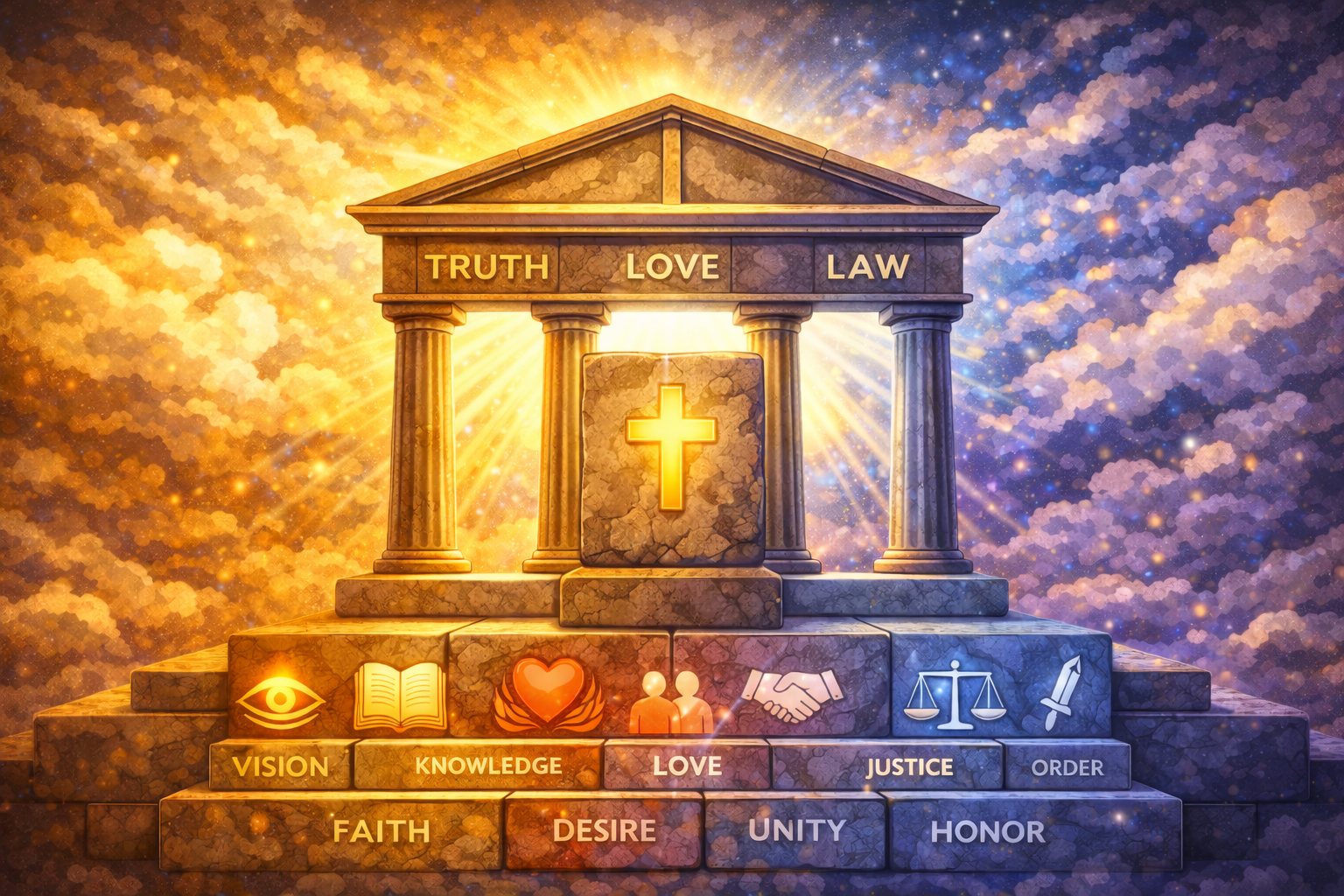
Free Will
You are aware that you have the ability to choose your own will. That awareness is not a small thing. Most of what surrounds a man — his upbringing, his neurochemistry, his social environment, the gravitational pull of habit — works against the experience of genuine choice. And yet the awareness persists: something in here is deciding. Something is weighing options, considering consequences, and committing to a direction. That something is not the sum of external forces acting on a passive receiver. It is agency — and it is real.
Free will is the capacity to choose — not the absence of influence, but the presence of genuine deliberation and genuine decision. The freedom to choose. The right to choose. The option to choose, including the option to choose neither of the options presented. These are the three layers of agency: the freedom that makes choice possible, the right that makes it meaningful, and the option that makes it actual.
A man who does not understand his own agency cannot exercise it wisely. A man who mistakes determinism for humility and refuses to hold himself accountable is not sophisticated — he is evading the most significant responsibility he has been given.
What Free Will Is
Free will is not the ability to do anything, uninfluenced by anything, from a position of pure neutrality. That is not freedom — that is a philosophical abstraction that no actual human being occupies.
Free will is the capacity to deliberate between options and commit to one — with genuine ownership of the choice. It is the difference between a thermostat, which responds to temperature according to its design, and a man, who can consider what he wants to do, what he should do, what the consequences will be, and choose accordingly — including choosing against what he wants, against what is easiest, against what everyone around him is doing.
The philosophical debate between free will and determinism is long and unresolved. But it is practically irrelevant. Every human being lives as though his choices matter. Every legal system treats human beings as responsible for their actions. Every meaningful relationship is built on the assumption that the other person chooses to be there. Even the committed determinist — the man who believes all human behavior is the product of prior causes — cannot live his life without acting as though his next decision is genuinely his to make.
The experience of agency is the one thing the philosophical debate cannot dismiss. A man who lives from that experience — who owns his choices, holds himself accountable for them, and exercises deliberate direction over the course of his life — will build something. A man who explains away his agency will not.
Agency, Autonomy, Sovereignty
Three dimensions of free will operate at different scales.
Agency is the individual level — the freedom to choose in a specific situation. Red or blue. Stay or leave. Speak or remain silent. Agency is exercised in real time, in specific circumstances, with specific options. It is the lived reality of free will — the moment-to-moment experience of being the one making the decision.
Autonomy is the broader level — the freedom to govern one's own life according to one's own values and direction, rather than being governed by external authority, social pressure, or someone else's agenda. Autonomy is not independence from all influence. It is the capacity to be self-directing — to set a course from the inside rather than being steered entirely from the outside. Leaving a broken home. Exiting an abusive relationship. Choosing a path that no one around you understands. These are acts of autonomy.
Sovereignty at the individual level is the ownership of one's own life — the recognition that a man is the primary authority over the choices within his own domain, responsible before God for what he does with what he has been given. Sovereignty does not mean doing whatever a man wants. It means that no other human being gets to make his choices for him or strip him of responsibility for them.
Self-governance and independence are not the same as isolation. A man can submit voluntarily to authority, build within community, and remain under covenant — and still be fully sovereign in the sense that every choice he makes is genuinely his.
The Biblical Frame — Agency and Accountability
God created human beings with genuine agency because rule through creatures that are free to choose is a categorically different thing than rule through machines that cannot. The universe God built is not a clockwork mechanism running a predetermined program. It is a creation populated with beings who can genuinely choose — and who are genuinely accountable for what they choose.
This is what the Garden of Eden establishes. God placed man in the garden with a command — do not eat of the tree of the knowledge of good and evil — and the actual capacity to do it anyway. The prohibition is meaningless without genuine freedom to violate it. The accountability that follows the violation is meaningless without genuine freedom to have chosen otherwise.
God still wants to govern the world through human beings. Humans are the designated stewards of creation — made in God's image, delegated creative authority, given dominion. But humans are also the problem: "All have sinned and fall short of the glory of God." (Romans 3:23) The solution is not a different species or a different set of rules. It is a new human — the second Adam — who does what the first Adam did not: chooses perfect obedience to the Father, crushing the serpent, restoring the capacity for genuine human agency to be exercised rightly rather than against itself.
The choice every man faces is the same one the garden presented: autonomy in alignment with God, or autonomy in rebellion against him. Garden of Eden or Babylon. Every life is being built in one direction or the other — and the choice is real.
Garden of Eden vs. Babylon
Eden and Babylon are the two poles of human civilization in Scripture — and the two poles of the choice every man faces.
Eden is the state of alignment: man in right relationship with God, with creation, and with himself. The mandate is clear — cultivate and keep. The authority is delegated. The provision is complete. The communion is real. Eden is not a state of passivity or ignorance — it is a state of purposeful agency exercised within the order God established. It is what freedom was designed to look like.
Babylon is the state of autonomous self-direction organized against God. "Come, let us build ourselves a city and a tower with its top in the heavens, and let us make a name for ourselves." (Genesis 11:4) The resources are human. The goal is human glory. The effort is organized apart from and against the direction of God. Babylon does not lack ambition, energy, or sophisticated organization. What it lacks is the right foundation — and what it produces, eventually, is confusion.
Every man is building something. The question is which city he is building toward. Eden is not a return to a lost past — it is the direction of the Kingdom of God coming on earth as it is in heaven. Babylon is the direction of human civilization organized for its own glory at God's expense. The man who understands these two poles knows which direction his choices are moving him, and that knowledge is itself a form of freedom.
Red or Blue
"You take the blue pill — the story ends, you wake up in your bed and believe whatever you want to believe. You take the red pill — you stay in Wonderland, and I show you how deep the rabbit hole goes."
The choice Morpheus presents in The Matrix is the same choice every man who engages this program is making: remain comfortable with the constructed version of reality, or choose the harder, clearer, more demanding encounter with what is actually real. The red pill is not a reward. It is a responsibility. The man who chooses it cannot un-choose it. He cannot un-see what he sees.
Leaving a broken home is a red pill. Exiting a relationship built on a false premise is a red pill. Confronting an addiction that has been explained away as a personality trait is a red pill. Choosing a harder, truer path when the comfortable path is available is always a red pill — because comfort and truth do not always occupy the same location, and the man who has to choose between them cannot have both simultaneously.
The red pill does not guarantee better outcomes in the short term. It guarantees a more accurate map. And a man navigating with an accurate map — however difficult the terrain — will eventually reach a place that the man with a comfortable false map will never find, because the false map was not leading there.
The Responsibility of Choice
Agency is not a gift with no strings. It is a delegation with full accountability.
A man who is free to choose is responsible for what he chooses. Not for everything that happens to him — some things are outside his control, and honesty requires acknowledging that. But for what he does with what he has been given: the circumstances he was handed, the resources available to him, the time, the relationships, the capacities. The accountability is proportional to the freedom — which is why a man with more resources, more influence, and more opportunity is held to a higher standard, not a lower one.
"Everyone to whom much was given, of him much will be required." (Luke 12:48)
Self-governance is the practical exercise of this accountability — the discipline of governing one's own life in alignment with what one knows to be true, rather than defaulting to whatever the external environment is pushing. A man who cannot govern himself will be governed by whatever happens to be loudest. His agency will be real in theory and absent in practice.
The project7 man exercises his agency with full awareness of the cost and full ownership of the consequences. He does not blame his circumstances for the choices he made within them. He does not credit his choices for the outcomes he did not produce. He holds the line accurately — owning what is his to own — and builds from there.
The operational discipline that follows from this agency is treated in Extreme Ownership — including the reconciliation between the deterministic case (Sapolsky's Determined) and the ownership case (Jocko Willink's Extreme Ownership), the high-utility-frame meta-principle, and the calibration of ownership against the hardwired layer that is not actually the man's to own.
One more thing before this room closes. A man exercises his agency alone — the deliberation happens in one skull, the commitment in one will. But he is never only alone. Every choice he makes lands inside structures that other men built long before he arrived — money, law, language, reputation, the invisible rules of every room he walks into — all of it held up by nothing more solid than agreement. The signature is written there too: in what men build together, and in what holds it up.