
General Education
"Education is the most powerful weapon which you can use to change the world."
— Nelson Mandela
The Classroom
First door on the left, and you can tell from the hallway that something is off about it. There is noise coming out. Not disorder — argument. Somebody in there is being pressed on something and is enjoying it.
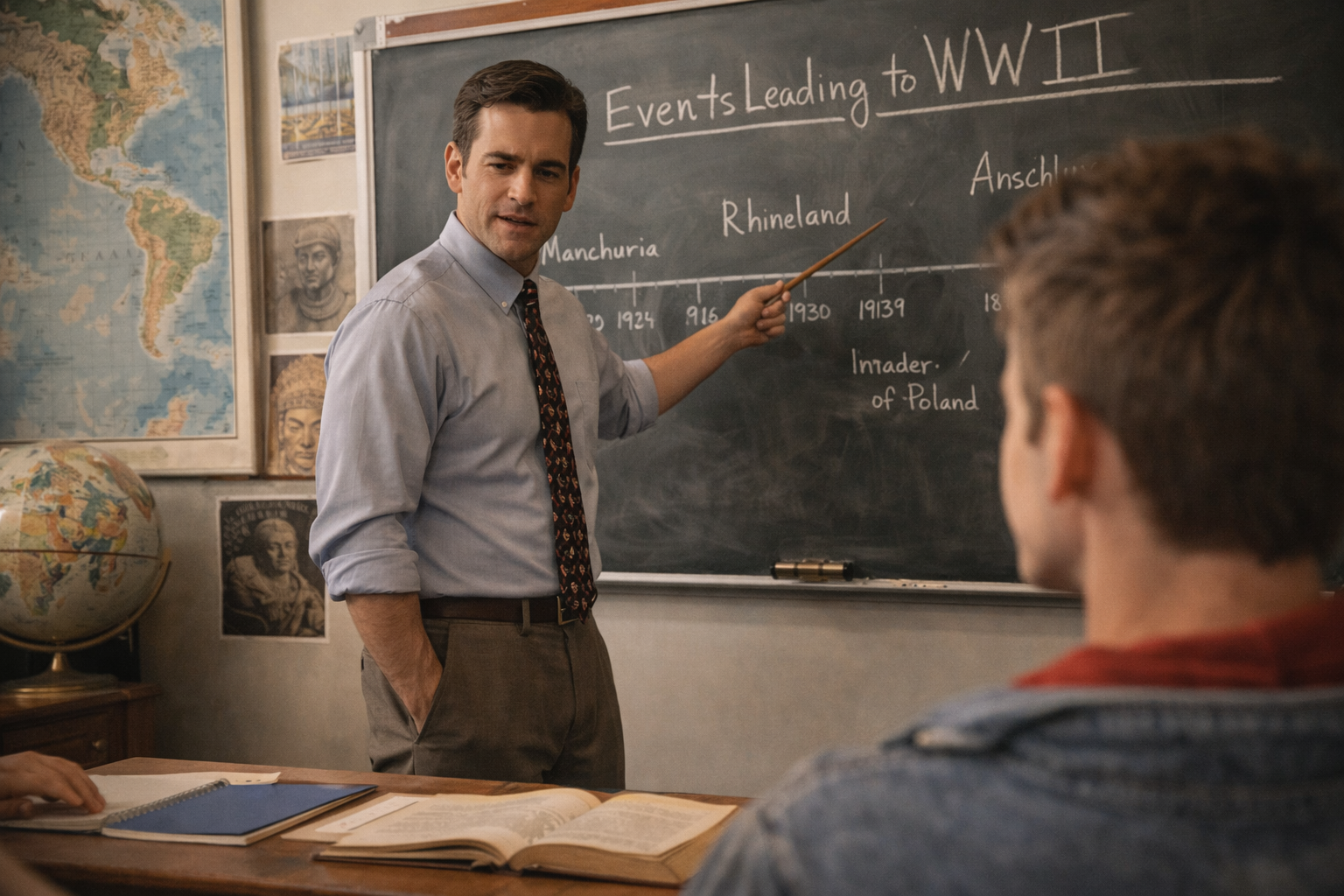
The man at the board is not the teacher you remember. Chalk on his sleeve, tie loose, a wooden pointer he uses like a conductor's baton. He does not take attendance. He does not hand out a syllabus. What he does, roughly ninety seconds after you sit down, is say something you are almost certain is wrong and then look at you and wait to see whether you will say so.
That is the class. Not dates. Not a list of wars in order. This is the man who makes the dead stand up and argue their own case, who turns a dry treaty into a room full of exhausted men trying to get home, who asks a question so good you forget the clock is running. He is not here to fill you with facts. He is here to make you hard to fool.
Welcome to General Education — the base layer, taught the way it should have been the first time.
Understand what you actually got the first time, because naming it is half the repair. Most men were handed history as a list with no causes, so nothing connected to anything and it all evaporated by August. They were handed a semester of reasoning that taught them to identify a syllogism on a worksheet and never once to catch a live one being run on them. And they were handed nothing at all on the present — no method, no sourcing, no way to weigh one account against another — which meant that the moment they left school, whatever arrived on their screen became, by default, the world.
That is not a small gap and it does not close on its own. A man with a thin base is not merely under-informed. He is steerable, permanently, by anyone willing to do the work of framing things for him. And there is no shortage of people willing.
This classroom is the repair, in three parts and in this order. First the lie detector, because a man who starts reading before he can test what he reads simply absorbs whatever the first confident author handed him and calls it his own view. Then the long record, because reasoning with nothing to reason about is a sharp tool cutting air. Then the present, last, because today only means something set against everything that came before it.
Chalk's already moving. Sit down.
What the Base Layer Actually Buys You
The world you grew up into was quietly rebuilt to do your thinking for you. Read no history, and the algorithm feeds you the historical comparisons it wants you to draw. Build no reasoning skill, and you are handed conclusions already formed by whoever paid for your attention. Track no news on your own, and you only ever see the events your platform decided were events. The swap is invisible — the feed's pick of what even counts as news gets taken as plain, neutral reporting. It is not.
The way out is to build the picture yourself. The man who has actually read a serious account of the Cold War already has his own context for the next Russia–NATO flare-up; he does not need a talking head to tell him what it means. The man who has built even the basic tools of logic carries his own filter against being played — he sees the manipulation as it happens instead of waiting for someone to label it for him. The man who follows the world through real sources instead of an outrage feed holds his own steady picture of the moment, not the panicked one he was handed.
And it compounds, hard. Ten years of building real context, and you read the world in a completely different way than the man who only ever scrolled — and the difference shows in conversation within minutes. You place today inside a longer story. You recognize the pattern instead of treating every new thing as the end of the world. You are harder to scare, harder to surprise, harder to manipulate. That calm a well-read man has when the headlines are screaming is not a personality trait. It is the direct payoff of how much groundwork he laid.
What's on the Board
The world you grew up into was quietly rebuilt to do your thinking for you, and it did not do it by lying. It did it by curating.
Read no history and you will still get historical comparisons — you will just get whichever ones somebody chose for you, aimed wherever they wanted you pointed. Build no reasoning and you will still reach conclusions — they will just be conclusions that were finished before they reached you, delivered in a shape designed to feel like your own thought. Follow no method on current events and you will still have a picture of the world — assembled entirely out of what an algorithm calculated would hold your attention, which is a completely different selection criterion than what matters. "The discerning heart seeks knowledge, but the mouth of a fool feeds on folly." (Proverbs 15:14) Both men in that sentence are consuming. Only one of them chose what.
The swap is invisible. Nobody experiences the feed as an editorial decision. It arrives feeling like the news, plain and neutral, and the enormous power in it is not the power to lie about an event but the power to decide which events you ever hear about at all. That power is exercised on you daily, and you cannot detect it from inside — only from outside, with your own material to check against.
The way out is to build the picture yourself, and the return on it is not subtle. The man who has actually read a serious account of the Cold War already owns his own context for the next flare-up on that border and does not need a commentator to tell him what it means. The man who can name a false dilemma when he hears one has a filter running in real time rather than a delayed realization three days later that he was handled. The man who follows the world through sources he chose holds a steady picture instead of the panicked one that was issued to him this week.
And it compounds hard. Ten years of this and you are not slightly better informed than the man who scrolled — you are reading the world through a different instrument, and the difference shows within about four minutes of conversation. You place today inside a longer story. You recognize the shape instead of treating everything as unprecedented. You are harder to scare, harder to surprise, harder to sell. That steadiness a well-read man has when the headlines are screaming is not a temperament. It is a purchase, and he paid for it in reading hours, and anybody can buy it on the same terms.
What’s on the Board
Logic & Reasoning— the lie detector, and it goes on first. The thinking tools a man uses to weigh a claim, test evidence, notice when he is being worked, and reach a conclusion that is genuinely his instead of one he absorbed. This is where you learn what an argument actually is, so that agreeing and disagreeing stop being reactions and start being judgments. The room carries the two anchors a man uses constantly and rarely names — Decision-Making Skills, for the moment there are several defensible options and one of them has to be chosen, and Problem-Solving, for the moment something is broken and nobody is coming. Alongside them sits the plainest and most useful filter in the kingdom, the question Is this a Stupid Idea?, which a man runs over his own next move before he commits money, time, or his name to it. This is also where the Cognitive Engine stops being a diagram and gets practiced on real material.
History — the long story you are standing inside. Not a list. The living record of how humans got here and what they keep doing: how power concentrates, how institutions rot from the inside while looking fine from the outside, what actually starts wars as opposed to what gets written on the monument afterward, and which inventions quietly flipped the whole board. It runs across four eras. Ancient History is the bedrock — Greece, Rome, and the ideas still running underneath every argument you will have this year. World History widens the frame past your own civilization, including the long strange machinery of the British Monarchy and why a country would keep a crown it has stripped of power. Modern History covers the post-1500 reshaping that produced the exact world you woke up in, and carries the Catastrophic Events shelf — the Pandemics, the fires, the financial collapses that keep arriving in recognizable shapes. And U.S. History is the specific national story an American man is living inside, with hard case studies like the Crash of 1929, which is not a history lesson so much as a warning that has been reissued about every thirty years since.
Current Events — reading right now without getting played. The discipline of tracking what is actually happening on terms you set. Where History hands you patterns across centuries, this hands you method for the thing still in motion: which sources have earned weight and which have not, how to triangulate when two credible accounts conflict, how to tell a genuine development from a manufactured one, and how much any single event deserves against the longer trend. Live cases like the Iran Conflict get worked here as they unfold — the way a good teacher pulls the morning paper into the lesson and shows you how to read it before the conclusion has been decided for you.
How the Sharp Ones Actually Read the World
Go to the source when it counts. Not always — nobody has time to read every primary document, and pretending otherwise is its own kind of theater. But when a topic touches a decision you are actually making, stop reading about it and read the thing: the actual statement, the actual filing, the actual study's methods section, the actual text of the law. Then read the commentary as commentary. It is slow and it costs you, which is exactly why so few men do it, which is exactly why it separates you.
Name the shape before you react. Refuse to treat anything as unprecedented until you have asked what it resembles. Bank runs have a shape. Currency debasements have a shape. A great power managing its own decline has a shape, and so does a movement in the year it stops being about its stated cause. The man who can name which old story today belongs to is operating with something the panicking consumer does not have and cannot buy in a hurry.
Hold the long view while the short view is loud. One question cuts through most of it: does this matter in five years? Usually it does not, and the honest answer is available at the time if a man is willing to ask. This is brutal the first hundred times, because the feed is engineered to make the five-year question feel like indifference. It is not indifference. It is the difference between a steady man and a reactive one, and everyone around him can tell which he is.
Read the ones you disagree with, at their best. Not the clipped version, not the dumbest person on that side, not the summary written by their opponents. The most serious version of the case against yours. A man who cannot state the other side well enough that its holders would recognize it does not actually understand his own position — he has only never had it tested.
How a Man Gets This Wrong
The skim that feels like study. One popular paperback on a subject, and a man believes he now understands it. The accessible book gives the feeling of having learned, delivered faster and more pleasantly than the learning itself. Feeling and having are not the same, and only one of them holds up under a question from someone who went further.
Outsourcing the whole job to four voices. Three podcasters and a columnist doing all the reading, and their blind spots silently becoming his. Use them as inputs. Check them against something. Never hand off the job of holding your own picture of the world, because the day they are wrong you will be wrong with them and will not have any way to find out.
Living inside the cycle. Letting whatever is being amplified this week set his mood, his money, and the temperature at his own dinner table. That is the consumer's posture with extra steps. The steady man reads it, places it, and decides whether it has earned a reaction. Most of it has not.
History with no logic. Reading widely and never once asking who is telling this and what it costs them to tell it that way — swallowing an author's frame whole and carrying it around for twenty years as though it were the neutral record. Read with the detector running: whose account is this, what is missing, and what did the people alive at the time actually see, as opposed to what the story settled into afterward?
Logic with no history. The mirror failure, and the more annoying one. A man who can dismantle any argument and cannot place a single one in a larger pattern — sharp, fast, and working on nothing. The tools need material. Build both or neither is worth much.
Believing this moment is the center of history. Reading nothing older than the last decade and concluding that the present is the most consequential era ever, on the sole evidence that it is the one he happens to be alive for. Almost every generation has felt that, and almost none of them were right.
The Three Pillars in the Classroom
TRUTH — what happened, not the usable version. Nearly all of history has been told and retold by people with a stake in how it came out, including the people you agree with. Read enough of the actual record — especially the parts that are inconvenient for your own side — that your picture lands near what occurred rather than near what was convenient to remember. The same filter applies to this morning: the curated present is not automatically the true one, and it is not automatically false either. That is what the work is for.
LOVE — read men as men, including the ones you would have fought. Refuse to flatten the people of the past, or the people across today's argument, into cartoons. The Soviet clerk, the Confederate private, the operative whose politics you cannot stand — each was a real man under real pressure with real information and real fear. This does not soften a true moral judgment by one degree. It makes the reading accurate, and contempt has never once read a situation better than charity did.
LAW — keep a spine while you do it. The opposite error, and just as available: dissolving every past wrong into that was simply the era. Some things were evil then, were known to be evil then by people who said so at the time, and are evil now. Name it. And hold the same standard forward — some of what this era is comfortable with will read badly in eighty years, and pretending otherwise is the exact arrogance every previous generation had.
Where General Education Stops and Scripture Continues
Understanding what is actually happening is a genuine capacity, and most men never acquire it. This classroom hands it over. Where it goes silent is on what to do about what you can now see. A man can read deeply across three centuries, build a razor of a mind, track the present with discipline — and still not know whether to move his family, sell the business, speak at the meeting, or hold his peace one more year. Knowing what is happening and knowing what to do are separate faculties, and this room only produces the first.
There is also something waiting for the man who reads far enough, and it is not what he expected.
"What has been will be again, what has been done will be done again; there is nothing new under the sun." — Ecclesiastes 1:9
That sentence was written by the most educated man of his world, at the end of a life spent studying everything he could reach, and it is not a shrug. It is a finding. Read enough history and you will arrive at it yourself, usually somewhere around the fourth or fifth serious book, when you realize you are watching the same machinery run again with different names on it. Every generation believed it was the one that would finally fix the thing. Not one of them did. The reform came, the reform curdled, the new arrangement grew the same disease in a different organ.
A man can take that badly and become a cynic, which is the standard exit and the reason so many well-read men are unpleasant. Or he can take it as the room's most honest lesson: that the pattern in human affairs is remarkably stable, that no amount of information has ever broken it, and that whatever is finally going to interrupt it will not be arriving from inside the pattern. The classroom cannot say more than that. It can only get you far enough to notice.
Read the world clearly. Then keep reading, because clarity about the world has never yet been the same thing as knowing what to do in it.
Where General Education Leads
You leave this classroom literate — able to test a claim, place an event, and read the present without being carried by it. That is a real and uncommon thing and it is not enough.
Breadth is a foundation, and nobody has ever hired a foundation. The man who only ever goes wide can hold a conversation in any room and command none of them; he is pleasant company at dinner and the last person anyone calls when something is actually on the line. Being interesting and being needed are different achievements, and only one of them pays.
The next classroom is at the back of the building, past the general room, and it is a different kind of work — narrow, slow, unglamorous, measured in years instead of semesters. It is where a man quits sampling and commits — one field, chosen on purpose, worked until the people who need it have to come to him. Wide made you hard to fool. Deep is what makes you hard to replace.