
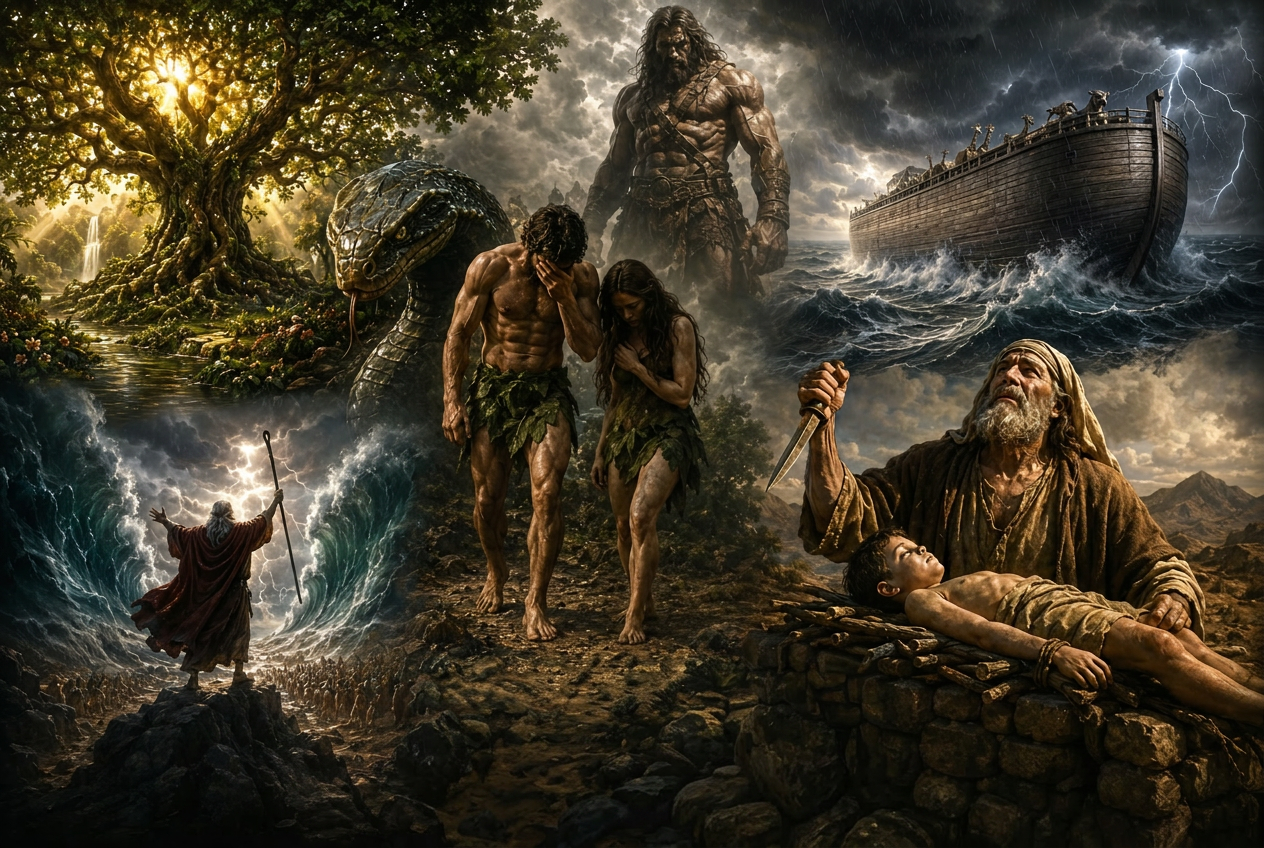
Genesis
Paradise Lost
East of Eden
The Antediluvian World
The Book of Origins
Every fight over the Bible eventually walks backward into this book. Where men came from, what went wrong, who the serpent was, what the sons of God did, why there were giants — the first eleven chapters of Genesis are the most contested ground in the most contested book in history. This is where the investigation goes deep.
Ask ten men where humanity came from and you will get ten answers — and every one of them, whether he knows it or not, is answering Genesis. The atheist is arguing against it. The evolutionist is routing around it. The ancient-astronaut theorist is rewriting it. The occultist is inverting it. Nobody ignores it. For a document this old to still be setting the terms of the argument tells you something before you read a single verse: this book makes claims that will not stay buried.
So we do here what we said we would do when we opened this section of the library. We investigate. First the text itself — what Genesis actually says about the origin of man, on its own terms, before anyone else gets to talk. Then the strange passages — the ones the documentaries circle, the ones that spawned a thousand theories: the seed of the serpent, the sons of God, the giants in the earth, the divine council, the Anunnaki tablets that skeptics wave at Noah. We will walk into every one of those rooms with the lights on, weigh what is textually real against what is invented, and name which is which. And then, with the noise sorted, we go under the storylines to what the book is actually doing — because Genesis is not a collection of campfire origin stories. It is the opening move of a war, and the rest of the Bible is that war fought to its finish.
Bring your questions. This book has heard worse.
Genesis
"In the beginning, God created the heavens and the earth." — Genesis 1:1
The first book of the Bible. Fifty chapters running from the creation of the cosmos to a coffin in Egypt. The Greek name means origin; the Hebrew name, Bereshit, is the book's first phrase — in the beginning. Both names tell you what you are holding: the book that explains where everything comes from. Three origins, nested inside each other like a telescope closing: the origin of the world, the origin of the nations, and the origin of one covenant family through whom the broken world would be repaired.
The Origin of Man — What the Text Actually Says
Before the theories, the text. Genesis makes four claims about human origins, and every fight that follows is a fight with one of these four.
Man is made, not accidental. The universe does not stumble into humanity. God speaks a cosmos into order across six days of forming and filling — light, sky, land, lights, creatures — and then slows down. Everything else is spoken into existence at a distance. For man, the language changes: let us make man in our image, after our likeness (Genesis 1:26). The camera moves in close. Chapter 2 gets closer still: God forms the man from the dust of the ground and breathes into his nostrils the breath of life. Dust and breath. Earth and heaven, joined in one creature. No other being in the account gets made that way.
Man is the image of God. Not an image among idols — the image. In the ancient world, a king would plant statues of himself in distant provinces to declare this territory is mine. Genesis says every human being is that statue — a living declaration of whose world this is, installed in creation to rule it as a steward, not to be enslaved by it. Male and female, both image-bearers, given dominion, given vocation, given each other. This single claim is the foundation under every serious doctrine of human dignity the world has ever produced. Erase it and men become either animals or machines — and both erasures have been tried, at the cost of oceans of blood.
Man is given a boundary. One tree withheld out of an entire garden of yes. The prohibition is not arbitrary cruelty; it is the difference between a creature and a Creator made visible. The knowledge of good and evil — the right to define good and evil rather than receive the definition — belongs to God. The test of the garden is whether man will live as the image or reach for the throne.
Man falls — and is promised a rescue. A serpent enters the garden already speaking, already hostile, already at war with God before man ever sins. The woman is deceived; the man, standing there, eats with his eyes open. And the world breaks — shame, blame, exile, thorns, sweat, death. But before a single curse lands on the humans, God turns to the serpent and makes the promise the entire rest of the Bible unfolds: I will put enmity between you and the woman, and between your offspring and her offspring; he shall bruise your head, and you shall bruise his heel (Genesis 3:15). Two seeds. One war. A wounded victor. The church has called this verse the protoevangelium — the first preaching of the gospel, delivered in the garden, to the enemy, as a declaration of war.
Hold that verse. Every strange theory we are about to examine is, at bottom, somebody's answer to the question Genesis 3:15 raises: who exactly is the seed of the serpent?
The Architecture — Ten Family Lines and a Narrowing Lens
One structural key before the disputed rooms, because you will need it inside them.
Genesis organizes itself around a Hebrew formula the English reader can walk past without seeing: eleh toledot — these are the generations of... The phrase appears ten times, and each appearance opens a new section: the generations of the heavens and the earth, of Adam, of Noah, of Noah's sons, of Shem, of Terah, of Ishmael, of Isaac, of Esau, of Jacob. A prologue (the seven days) plus ten family histories. That is the whole book. (The structural seed here came through Wade Orsini at Apologia Utah; the map is worth memorizing.)
Watch what the structure does. The lines God is not following — Ishmael, Esau, the seventy nations — get compressed into brief genealogies: acknowledged, recorded, set aside. The line carrying the promise of Genesis 3:15 gets the camera: Noah, Abraham, Isaac, Jacob, each a full narrative cycle. And section by section the scope narrows — from the heavens and the earth, to humanity, to one son of Noah, to one family in Ur, to one son, to one son again, until the book that opened with the creation of the cosmos closes on one man's coffin in Egypt. The telescope is the argument. Genesis is tracking a single bloodline through the wreckage of the world — the seed of the woman, moving through history toward the serpent's head.
Which means the genealogies you were tempted to skip are the battle map. Now, into the disputed rooms.
Room One — The Serpent Seed
The theory: when Genesis 3:15 speaks of the serpent's seed, it means literal, biological offspring. On this reading, Eve's sin in the garden was sexual — the serpent seduced her — and Cain was the child of that union: half-human, half-serpent, the devil's son by blood. Humanity ever since divides into two physical bloodlines, Satan's children and Adam's, walking the earth side by side.
It is an old idea. Threads of it appear in some ancient Jewish midrash, which speculated that the serpent-angel defiled Eve; the Gnostic writings we will meet in the Non-Canonical room played with Cain's paternity; and the theory has been rebuilt in the modern era more than once — most infamously by the "Christian Identity" movement of the twentieth century, which used the two-bloodline doctrine to declare entire ethnic groups, the Jewish people above all, the literal children of the devil, and to sanctify racial hatred as theology.
Now the text. Genesis 4:1 closes the question in a single verse: Now Adam knew Eve his wife, and she conceived and bore Cain, saying, "I have gotten a man with the help of the LORD." Adam is Cain's father. The scripture states it without ambiguity. When the New Testament calls Cain a child of the evil one (1 John 3:12), it is using the same language Jesus used against the Pharisees — you are of your father the devil (John 8:44) — men whose physical descent from Abraham he never disputed. The paternity in view is spiritual, not genetic. A man becomes the serpent's seed the way Cain did: by envy, by hatred, by murder in the heart — by whose works he does, not whose DNA he carries.
So mark the finding, because the pattern will repeat in every room ahead. The theory saw something real: Genesis really does divide humanity into two warring seeds, and the rest of the book really does track them — Cain against Abel, the line of Cain's violence against the line of Seth's calling on the LORD's name. The war is real. The theory's error was to drag a spiritual and covenantal war down into biology — and the fruit of that error, wherever it has taken root, has been the oldest lie of all: that some men, by blood, are not men. Genesis 1 already sentenced that lie to death. Every human being is the image of God. There are two seeds in the earth, but the line between them runs through every human heart — and it can be crossed, in either direction, which is the whole hope of the gospel.
Room Two — The Sons of God and the Giants
Then comes the passage that has generated more speculation than any other paragraph in the Old Testament. Genesis 6:1-4: the sons of God saw the daughters of men, took wives of all they chose, and fathered children by them — and the Nephilim were on the earth in those days... the mighty men who were of old, the men of renown. Four verses. Then God announces the flood.
Who are the sons of God? Three answers have contended for two thousand years.
The supernatural reading — and it is the oldest. The sons of God are heavenly beings — the same phrase used in Job for the angelic host who shouted at creation (Job 38:7) and who present themselves before the LORD (Job 1:6). On this reading a company of them abandoned their station, crossed the boundary between heaven and earth, took human women, and produced the Nephilim — the giants. This is how virtually every ancient reader took it: the Septuagint translators, the Jewish historian Josephus, and the earliest church fathers. The book of 1 Enoch — sitting on the Extra-biblical shelf next door — expands the event into the full Watchers narrative: two hundred rebel angels descending on Mount Hermon, teaching mankind forbidden arts, breeding giants that filled the earth with violence. Enoch is not scripture, and this library does not treat it as scripture — but the New Testament authors knew it, and both Peter and Jude speak of angels who sinned, who did not stay within their own position of authority, and who are held in chains for judgment (2 Peter 2:4; Jude 6). Whatever happened in Genesis 6, the apostles treat it as a real supernatural crime with real prisoners.
The Sethite reading. The sons of God are the covenant line of Seth intermarrying with the corrupt line of Cain — godly men taking pagan wives until the whole earth rotted. Championed by Augustine and dominant through the medieval and Reformation church. Its strength is theological tidiness; its weakness is that it must quietly change what sons of God means, and it struggles to explain why ordinary mixed marriages produced giants.
The royal reading. The sons of God are ancient god-kings — tyrant rulers claiming divine sonship and stocking harems. It fits the ancient world's politics; it strains the language least well of the three.
The text will not let the question stay small, because the giants do not stay in Genesis 6. When Israel's spies scout Canaan centuries later, they report the Anakim, from the Nephilim, and feel like grasshoppers (Numbers 13:33). Og king of Bashan sleeps in a bed thirteen feet long (Deuteronomy 3:11). The Rephaim haunt the conquest narratives. And a boy named David walks into a valley to face a man from Gath standing over nine feet tall. Read structurally, the giant clans are not folklore residue — they are the serpent's counterattack made visible, an attempt to corrupt, intimidate, and choke off the seed-line the telescope of Genesis is tracking. Which is why the flood falls where it does in the book, and why the conquest is commanded with the severity it is. The war of the two seeds has a body count.
This library's verdict, held with open hands: the supernatural reading has the oldest pedigree, the strongest textual parallels, and the apostles' apparent endorsement — and men of sound doctrine have differed. What is not optional is the point every reading agrees on: something crossed a line God had drawn, the corruption was real, and God judged it. The passage is in the Bible to be weighed, not skipped. The deeper dive lives at Genesis 6 Theory.
Room Three — The Divine Council
The sons of God open a door most churchgoers have never been walked through — and this room, unlike the last two, is not fringe at all. It is mainstream biblical scholarship, recovered for the church in recent decades most visibly through the work of the scholar Michael Heiser.
Read the verses in sequence. God has taken his place in the divine council; in the midst of the gods he holds judgment (Psalm 82:1). Micaiah the prophet sees the LORD on his throne and all the host of heaven standing beside him on his right hand and on his left, deliberating (1 Kings 22:19). Job opens with the sons of God presenting themselves before the LORD. And Genesis itself: let US make man in OUR image. Scripture presents a God who is utterly without rival — and who nonetheless rules through a staffed court, a heavenly host with rank, assignment, and the freedom to rebel. Some did. The serpent in the garden was the first. Genesis 6 describes others.
Now the verse that reorganizes the whole map. Deuteronomy 32:8-9, in its oldest manuscript reading: When the Most High gave to the nations their inheritance... he fixed the borders of the peoples according to the number of the sons of God. But the LORD's portion is his people, Jacob his allotted heritage. Set that beside Babel. At Babel the nations gathered to build their own gateway to heaven, and God scattered them — seventy nations, catalogued in Genesis 10 — and, Deuteronomy says, allotted them to members of the heavenly host, spiritual custodians who in time set themselves up as the gods of the nations and harvested their worship (Deuteronomy 4:19-20; Psalm 82 is God sentencing them for it). The pagan pantheons were not pure fiction, on this reading. They were treason.
And then watch what Genesis does next, because the timing is the argument: the very next chapter after Babel, God calls one man out of the disinherited nations — Abram of Ur — and begins building a nation that will belong to no lesser power. The LORD's portion is his people. The narrowing telescope of the toledot structure and the divine-council worldview are the same story told at two altitudes: the nations handed over, one family called out, and a promise laid on that family that through it all the families of the earth shall be blessed (Genesis 12:3) — the disinherited nations won back, one seed at a time. This is the war Genesis 3:15 declared, seen from heaven's side of the battlefield.
Room Four — The Anunnaki and the Tablets of Babylon
Last room, and the skeptic is already inside it waiting for us, holding a clay tablet. Your Genesis, he says, is plagiarized.
Here is what is actually true, and we will not flinch from it. Mesopotamia — the civilization of Sumer, Akkad, and Babylon, the very world Abraham was called out of — left behind creation and flood accounts older than Moses. The Enuma Elish describes the gods making the world from the carcass of a slain rival and creating mankind from a god's blood to be the gods' slaves — so the gods could rest. The Atrahasis epic and tablet eleven of Gilgamesh describe a divine council annoyed by noisy humanity, a secret warning to one man, a great boat, a flood, birds sent out, a sacrifice after. The parallels to Noah are real. The tablets are real. The Anunnaki are real too — as the name of the senior gods of the Mesopotamian pantheon, attested across thousands of genuine cuneiform texts.
What is not real is what the twentieth century did with them. In 1976 an author named Zecharia Sitchin published The Twelfth Planet, claiming the tablets secretly describe the Anunnaki as alien astronauts from a hidden planet, Nibiru, who genetically engineered mankind as a slave race to mine gold — and that Genesis is a garbled memory of it. The theory has sold millions of books and colonized late-night documentaries. It survives on one condition: that the reader cannot check the Sumerian. Those who can — the entire field of Assyriology, with Michael Heiser (the same scholar from the last room) leading the public demolition — report the same finding: Sitchin's translations are invented. No tablet describes Nibiru as a planet beyond Pluto. No tablet describes rockets, gold-mining expeditions, or genetic laboratories. The ancient-astronaut Anunnaki are not a suppressed discovery; they are a modern fiction wearing ancient jewelry.
But dismiss Sitchin and the skeptic's better question still stands: why does Genesis resemble Babylon's stories? Lean in, because the resemblance is the point. Genesis shares Babylon's furniture — a divine council, a flood, a surviving family — and inverts everything the furniture means. Babylon's gods make man from a slain god's blood to be their slave; Genesis's God forms man from dust with His own breath to be His image and son. Babylon's gods send the flood because mankind is noisy; Genesis's God sends it because the earth is filled with violence, and it grieves Him to His heart. Babylon's gods swarm the survivor's sacrifice like flies, starving; Genesis's God needs nothing, and hangs His war-bow in the clouds as a promise. Genesis is not copying the tablets. Genesis is answering them — a polemic, written to a people surrounded by Babylon's theology, dismantling it claim by claim. Moses is not plagiarizing Babylon. He is correcting the record Babylon corrupted — and the correction is the earliest and fiercest defense of human dignity in the ancient world. You were not made to be a slave of the gods. You were made to be the image of God. The tablets, read honestly, do not embarrass Genesis. They make its glory visible by contrast.
Under the Storylines — What Genesis Is Actually Doing
Now step back out of the rooms and look at the whole floor, because the deeper meanings only surface when the episodes are seen as one campaign.
Genesis is a war chronicle. Genesis 3:15 declared two seeds and one enmity, and every storyline after it is a battle in that war. Cain against Abel — the serpent's first attempt to cut the line, answered by Seth. The corruption of Genesis 6 — an attack on the human bloodline itself, answered by the flood and one preserved family. Babel — the nations seduced into a counterfeit heaven, answered by the call of Abram. Pharaoh taking Sarah, famine stalking Isaac, Esau's murderous rage, the massacre bait at Shechem, twenty years of Laban's cheating, Joseph in the pit and the prison — read them in sequence and the pattern stops hiding: at every generation, the seed of the woman is nearly extinguished, and at every generation it survives by grace, not by the strength of the men carrying it. The patriarchs are not moral heroes; they are liars, cowards, and schemers whom God carries anyway. That is not sloppy storytelling. That is the doctrine: the war is the LORD's.
Genesis is a narrowing prophecy. The telescope closes on purpose. From all humanity to Shem, from Shem to Abraham, from Abraham to Isaac and not Ishmael, from Isaac to Jacob and not Esau — and then, on Jacob's deathbed, to one son among twelve: the scepter shall not depart from Judah... until tribute comes to him, and to him shall be the obedience of the peoples (Genesis 49:10). The seed now has a tribe and a throne. When the New Testament opens with the book of the generations of Jesus Christ — deliberately echoing the toledot formula — Matthew is announcing that the telescope has finished closing. The seed of the woman has a name. The heel was bruised at the cross; the head was crushed there too. Genesis wrote the first chapter of a war the empty tomb won.
Genesis is a mirror. And this is where the investigation turns and looks at the investigator. The reach for the forbidden fruit — the itch to define good and evil on your own terms — is not ancient history; it is this morning. Cain's fallen face, warned that sin is crouching at the door and its desire is for him, is every man who has ever nursed a grievance toward violence. The tower of Babel is every empire and every platform that promises men a name apart from God. You do not read Genesis from a safe distance. You are in it. The two seeds are not out there in someone else's bloodline — the enmity runs through your own chest, and the only question the book leaves you with is the one it has been asking since the garden: whose seed are you? Not by birth. By allegiance.
How to Walk This Ground
Read the book itself first — straight through, one or two sittings, with the ten-family map in hand, before returning to any of the disputed rooms. The theories only stay in proportion when the storyline owns the foreground. Then go deep where the text goes deep: the Abraham cycle and the Joseph cycle reward a lifetime. A solid study Bible (Reformation Study Bible, ESV Study Bible) supplies the ground-level notes; Waltke or Wenham on Genesis for the man who wants scholarly depth; Heiser's The Unseen Realm for the divine-council material, read with your own Bible open beside it and everything tested against the text.
And keep the investigator's discipline you have used in every room here: honor what is textually real, name what is invented, and watch the fruit. Any theory about Genesis that ends by unmaking the image of God in some class of men has already told you whose seed it serves.
"I will put enmity between you and the woman, and between your offspring and her offspring; he shall bruise your head, and you shall bruise his heel."
— Genesis 3:15