
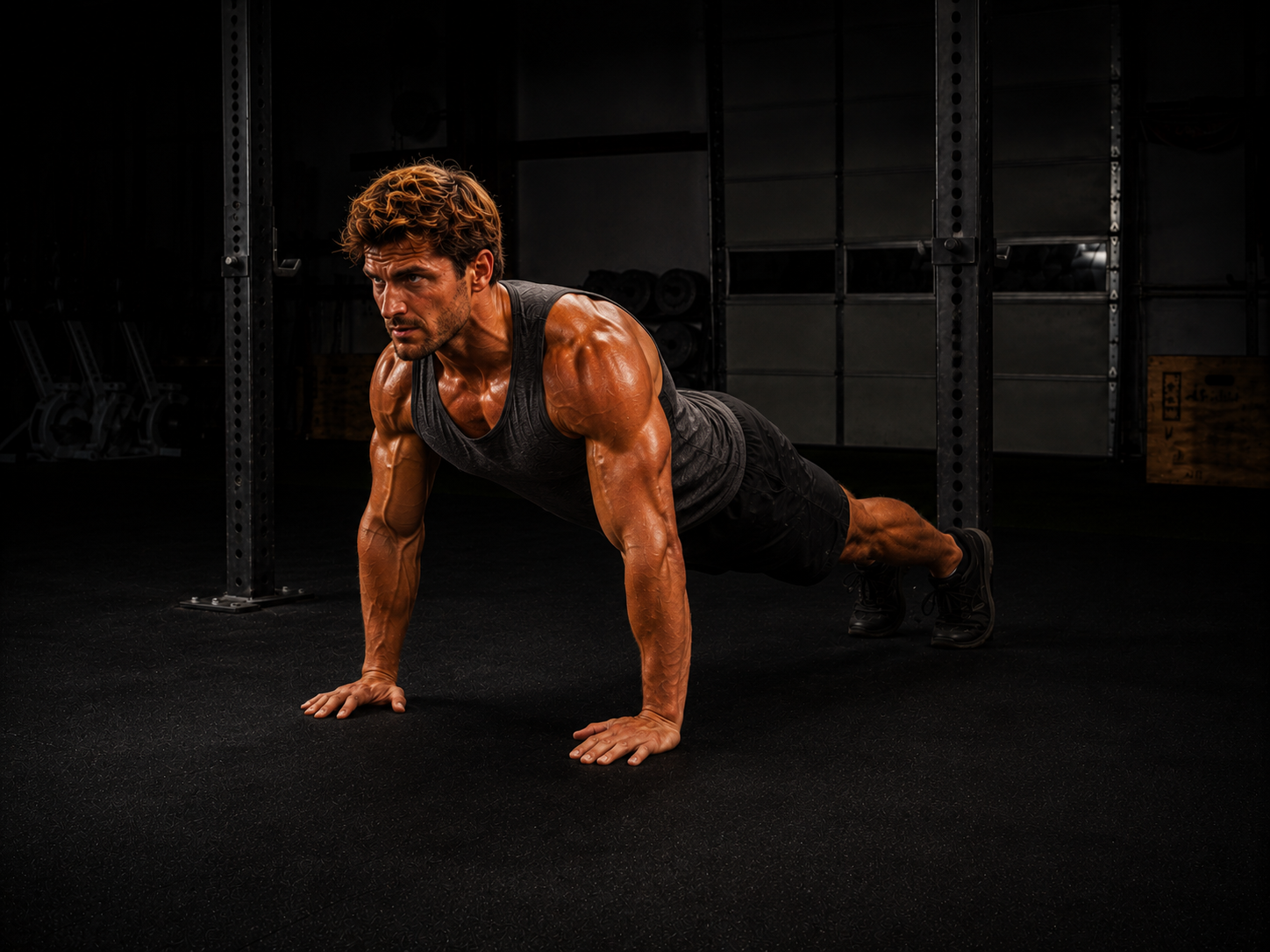
Isometrics
Pushing Exercises
Pulling Exercises
Holding Exercises
Force with nowhere to go.
The Wall
There is a man in the corner of the gymnasium with his back flat against the wall, thighs level with the floor, in a chair that is not there. He has been in that position for a minute and a half. Nothing about him is moving. His legs are shaking hard enough to see from across the room.
From the outside, this is the least impressive thing happening in the building. A stranger would say he is resting.
Go stand next to him and count to ninety.
That is the whole subject of this room, and it is the one a man cannot understand by reading about it. Everything else in the gymnasium produces an event — a bar goes up, a body leaves the ground, a distance gets covered. Here, the output is zero. All the force is being produced and none of it is going anywhere, and the only instrument that reports anything at all is a clock.
The Third Thing a Muscle Does
A muscle has exactly three jobs and most men have trained two of them.
It can shorten while producing force — that is the lift, the push, the pull, the part everybody counts.
It can lengthen while producing force — lowering the weight, absorbing the landing, the phase the previous room was built around.
And it can produce force while changing length not at all. Held. The joint angle stays exactly where it is, the tension is maximal, and from outside nothing happens.
Western gym culture trains the first two and largely skipped the third. The Soviet and Eastern European strength tradition did not, and neither did gymnastics, and neither did any grappling art. The gap is one of the more consequential differences between how most American men train and how strength has actually been built across the wider history of the thing — and it shows up, decades later, as strong men with fragile joints.
What Holding Actually Builds
Three things, and the first one is the reason this room exists.
Tendon. Tendons adapt to load applied across time, and dynamic training barely gives them any. A repetition takes a second or two; the tendon is loaded briefly and then released. A hold loads it continuously for ten, thirty, sixty seconds, and that accumulated time under tension is what drives the adaptation. The chronic tendon problems that derail serious men in their thirties and forties — the patellar, the Achilles, the elbow, the shoulder — are overwhelmingly problems in men whose tendons were never trained this way.
The joint itself. Holding a position recruits the small stabilizing musculature around a joint in a way that moving through the position does not, because there is nothing else keeping you there. Train it and a joint holds its shape under load it did not expect. Skip it and the joint is only as stable as the last rep it happened to survive.
The capacity to stay put. An enormous share of real physical demand is static and nobody notices. The grappler holding position. The climber gripping. The carpenter bracing overhead while he drills. The soldier steady behind a rifle. The man on the other end of a couch on a staircase, waiting while somebody figures out the corner. None of that is a repetition. A man who has only trained movement is using movement patterns to do a stationary job, and he fatigues fast and wonders why.
Where It Came From, and Why Your Gym Skips It
The method has a specific origin and an honest ledger, and both are worth knowing.
Alexander Zass — a Russian strongman who performed as the Amazing Samson — is generally credited with formalizing it. The story as it comes down to us is that he was captured during the First World War and, in a cell with nothing to lift, spent his time pushing and pulling against the bars and the chains that were holding him. He came out convinced that the muscle was not the thing that mattered. The tendon is the strength. He built a career on feats that rewarded exactly that — bending bars, breaking chains, holding loads other men could not.
Then, in the early 1960s, it was oversold. American training culture discovered isometrics and briefly presented it as a near-magical shortcut: enormous strength gains for a few seconds of effort a day, no equipment required. The published results were spectacular. What was not published, and emerged later, was that some of the athletes producing those numbers had access to newly available anabolic drugs, and that the honest effect — while real — was nothing like the claim.
The correction went too far, which is what corrections do. Isometrics did not become one useful tool among several; it became the thing serious lifters quietly dropped, and two generations of men learned to train without it. That is why a method with a genuine and well-supported effect on tendon and joint health is missing from almost every commercial gym program in the country.
Three Doors Off This One
Three rooms open off this one and none of them is the way forward. They are here to teach what each kind of hold actually does to a body — the mechanism and the payoff, not a session to run. The routines belong on the shelf, over in the Fitness Library, where the movements and the programs live.
They divide by what the force is doing.
Pushing Exercises — driving into something that will not move. Force produced outward, against a wall, a pinned bar, an immovable object. Nothing gives. This is the category that produces the highest voluntary force output a body can generate, for reasons the room explains, and it does it with almost no recovery cost.
Pulling Exercises — the same thing in the opposite direction. Force produced inward, against something anchored. This is where grip lives, and where the back and the whole posterior line get loaded in the direction real life keeps asking for — hauling, holding on, arresting something that is falling.
Holding Exercises — refusing to be moved. The other half entirely. Here the load acts on you, and the job is to not give ground. The wall sit, the dead hang, the loaded carry held in place, the paused position at the bottom of a lift. Push and pull are about producing. Holding is about resisting, and it is the category that most directly turns into everyday capability.
The Two Numbers That Decide What You Get
More than in any other room, what a man receives here is determined by two variables he probably does not know exist.
The angle. Isometric strength is largely specific to the joint angle it was trained at, and it carries only a modest distance on either side of it. Train a hold at the bottom of a squat and you get much stronger at the bottom of a squat, somewhat stronger a little above it, and not much stronger near lockout. This is not a flaw — it is the most useful fact in the room, because it means a man can aim the work at the exact position where he is weakest, which no other method in the gymnasium lets him do so precisely. It also means a man who only ever holds one position has built one narrow window of strength and assumed it was general.
The duration. How long a hold lasts changes what it produces, and the bands are distinct enough to matter.
Short and maximal — a handful of seconds at everything a man has. This trains the nervous system to recruit hard and fast, and it is where the pure strength effect lives.
Medium — tens of seconds at high but sustainable tension. This is the tendon and connective-tissue band, and it is why the room exists at all.
Long — a minute and beyond. This trains endurance under tension and the postural capacity to stay in a shape all day, which is a genuinely different thing from being strong in it.
A man who only ever trains one band has accessed one third of what the method offers and usually does not know the other two were on the table.
How Men Go Wrong Holding Still
He never does it at all. By a wide margin the most common failure. Most men have not done deliberate static work since a high-school gym class, and the gap is so universal that it barely registers as a gap.
He dismisses it as not real training. It looks like nothing, it produces no numbers anyone can compare, and there is no way to demonstrate it to a room. A man who needs his training to be legible to other people will not do this.
He holds one position forever. The angle problem above, in practice. Wall sits at the same depth, planks in the same shape, for years — and he has built a narrow band of strength and a great deal of tolerance for boredom.
He goes through the motions. A hold with no intent behind it is a posture, not an exercise. Sitting in a wall sit while scrolling a phone is not training the wall sit; the position is the same and the tension is not, and only one of those does anything.
He holds his breath. The instinctive response to hard static tension is to lock the breath, and it drives up intra-abdominal and blood pressure for no benefit while making the whole thing harder to sustain. Breathing through tension has to be learned; almost nobody arrives with it.
He turns it into a circuit. Wall sit, then plank, then hang, one after another with no rest, chasing the burn. That is conditioning, and it is fine, and it will not build the tendon adaptation he came for — for that the tension has to be high and the recovery real.
The Three Pillars at the Hold
This room has a property no other one in the gymnasium has: there is no output. Nothing moves, nothing gets counted, nothing can be photographed, and there is no result to point at afterward. Which makes the three questions unusually sharp here.
Truth — Is it true? Nobody can verify effort in a static hold, including from six feet away. Two men in identical positions, one driving everything he has into the floor and one simply occupying the shape, look exactly alike — and only one of them is training. There is no bar speed to give it away and no rep that fails. The clock reports duration and duration is not effort. This is the most private work in the building, which makes it the purest test of whether a man works when it cannot be seen.
Love — Is it loving? Almost everything this builds gets spent as an absence of something — a man who did not have to shift, set down, put down, or hand off. Nobody notices the hold that lasted. They notice the one that did not, and by then it is somebody else's problem as well as his. That is a strange and specific way to be useful: the entire payoff is that a moment stayed uneventful, and no one will ever know there was a reason for it.
Law — Is it right? Two things. Breathe through the tension rather than against it — the body is not designed to produce maximal effort behind a closed throat, and the pressure spike is a real cost paid for nothing. And train the position honestly: the angle you train is the angle you get, so aim it at your actual weakness rather than at the hold you are already comfortable in. The comfortable hold is the one that will not change you.
Where This Goes Next
Push, pull, and refuse. Take the three doors if you want the mechanism behind each one; they return you here when you are done.
Then look at what this room and the last one did together. Room three asked how fast you can produce force. Room four asked whether you can produce it and go nowhere. Between them they have mapped the two ends of a single measurement, and a man who owns both is honest at every speed his body will ever be asked to work at.
Something has been quietly assumed by all four rooms so far, though, and it has not once been trained directly. Every hold in here — every plank, every wall sit, every hang, every braced position — was transmitting force through a spine and a midline that nobody has yet built on purpose. It has been doing the work the entire time, uncredited, and it is the reason some men can hold a position and some men's lower backs simply opt out at forty seconds.
That structure is the fifth room, and it is the last door before anything external gets picked up.