
Portfolio Income
Investment Portfolio
Securities & Exchange
Precious Metals
Cryptocurrencies
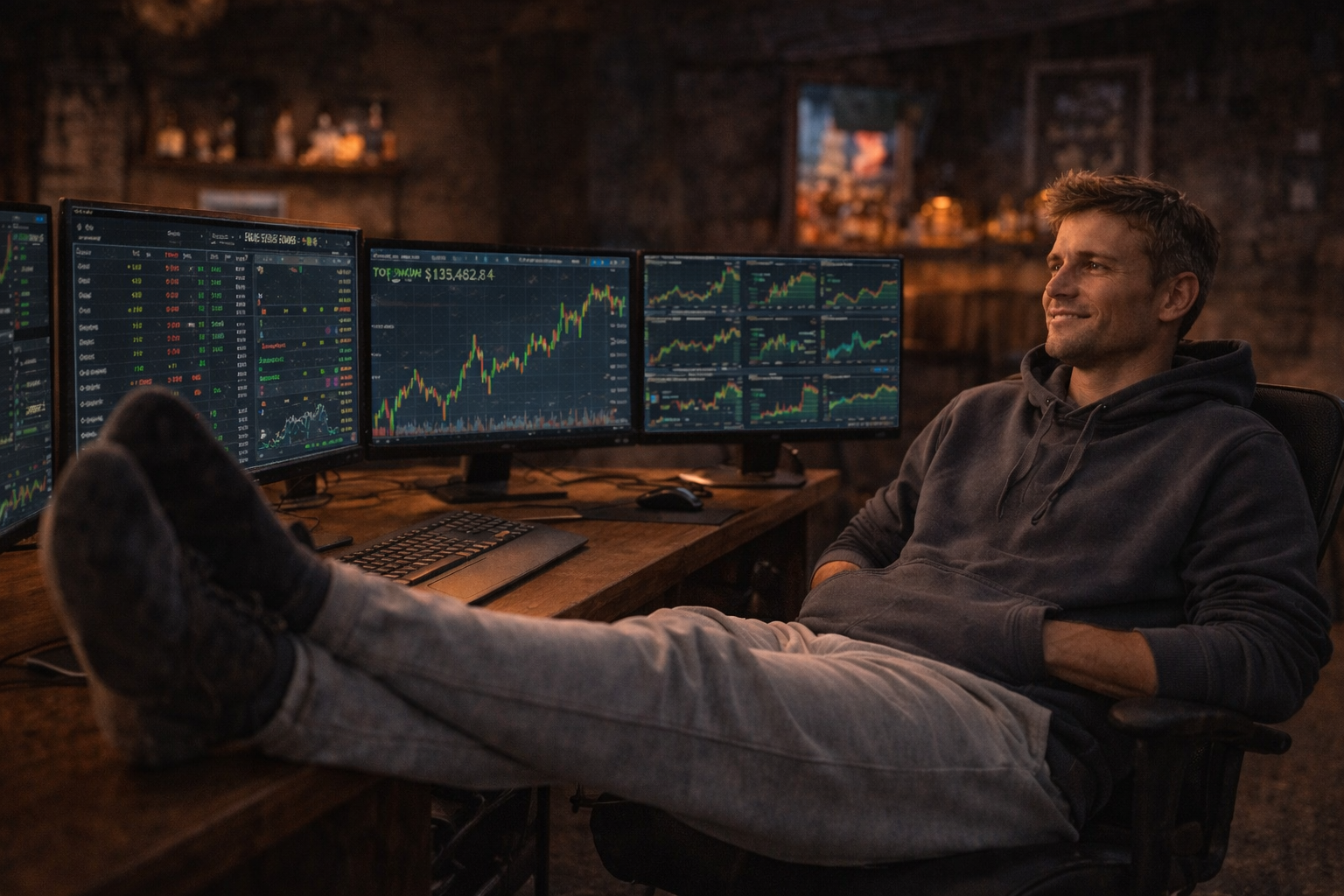
The Boiler Room
"The stock market is a device for transferring money from the impatient to the patient." — Warren Buffett
The Open Field
The second field the Managers work is the most open ground there is. Any man with an ID and a phone can plant here by morning. The account is free to open, the trades cost almost nothing now, and the information that used to be locked in the towers downtown is sitting on the same phone, free for anyone willing to read it. This is the public market — stocks, bonds, funds, and the newer, wilder ground beside them — and the Managers call it the most democratic field in the whole building, because the door is open to the broke man and the rich man alike. That openness is the miracle of it.
And here the Managers stop and tell a man the hard truth before he plants a dollar, because it is the truth that decides everything on this field. The open door does not lead to open results. Year after year, the ordinary man who invests here earns less than the very market he is invested in — not a little less, meaningfully less — and he does it to himself. He buys when everyone is excited and the prices are high. He sells when everyone is scared and the prices are low. He chases whatever just ran and bails right before the rebound. The market did its job; the man undid it with his own hands. So on this field, more than any other, the lesson is not what to buy. It is who to be. The men who get rich on this open ground are not the smartest. They are the most patient. Buffett said it plainly: this field transfers money from the impatient to the patient. The Managers are going to teach you to be the one it flows toward.
Why the Open Field Pays — And Why Most Men Lose On It
The case for planting here is a hundred years of record. Across the long haul, the broad market has grown a man's money at roughly seven percent a year after inflation — which, left alone to compound, turns one dollar into many across a working life. A dollar planted at twenty-five and left for forty years grows to something the man who started at forty-five can never match, because the engine is time and the field does the growing while a man sleeps. The return is not a promise — there are brutal years, whole stretches of red, and the next century may not pay like the last — but the long pattern is real, and the volatility is simply the price of admission.
The case against it, for the unprepared man, is that behavior gap. The studies all say the same thing: the average investor underperforms his own funds by a wide margin, and the cause is not stupidity — it is nerve. He sells in the crash and misses the recovery. He piles into whatever is hot just as it cools. The Managers drive this home because it reframes the entire field: the work that matters here is not finding the genius pick. It is building the temperament to plant well and then leave it alone through the seasons that would shake a weaker man out. The analysis is necessary. The discipline is decisive.
What Grows on the Open Field
The Managers walk a man through the ground and the seed.
Investment Portfolio — the spread, built on purpose. Investing is not owning one thing; it is building a deliberate mix across many, matched to a man's age, his nerve, and his timeline — the classic stock-and-bond balance, the all-stock spread for the young man with decades ahead, and the rebalancing discipline that trims the winners and tops up the laggards to hold the mix steady. It carries Investment Accounts — the decision of which dollar goes in the taxable account, which in the retirement accounts, which in the rest — and the Investment Strategy that ties it together, with the heavier ground like Hedge Funds named for what it is.
Securities & Exchange — how the market actually works. The plumbing under the field: the exchanges, the rules that force companies to disclose the truth a careful man can read, and how an order actually gets filled. It carries the three kinds of seed most men plant — Stocks, a piece of a real business; Bonds, a loan to a government or a company that pays you back with interest, down to Treasury Bonds and Municipal Bonds; and the basket funds, Exchange-Traded Funds (ETF's) and Index Funds and Mutual Funds, that hand a man the whole field cheaply in one buy. It carries Commodities & Futures too, the harder ground of raw materials and leverage.
Cryptocurrencies — the newest, wildest ground. The youngest field and the most argued-over — Bitcoin, Ethereum, and the rest down to Solana and XRP. The Managers hold it with clear eyes, neither swallowing the evangelist's hype nor refusing it outright: real technology and a real monetary argument sit next to wild swings and a great deal of pure speculation. The disciplined man, if he plants here at all, plants modestly, and only after he has done the work to understand what he is buying.
Precious Metals — the old hedge. Gold and Silver and the rest. They throw off no harvest — they grow nothing on their own — but they hold value when paper money gets shaky, and that is their job: insurance against debasement and crisis, not an engine of wealth. A modest slice, and no more. The Managers have no patience for the gold-bug who bets the farm on metal that just sits there.
The Boiler Room — the logbook for the active man. For the man who picks individual positions rather than just buying the whole field, this is where he keeps his honest records — Personal Trading Logs of why he bought, what he risked, and what actually happened — alongside the tools of the trade like Price to Earnings Ratio and the hard lesson of Timing the Market. The log is how trading turns into learning instead of just motion.
Ten Things the Managers Say Before a Man Plants
The old bench card for this field listed ten rules. The Managers kept the ten and sharpened each, because a rule stated flat is a rule a man nods at and forgets.
Know what the three seeds are. A stock is ownership of a business. A bond is a loan to one. A fund is a basket holding either or both, and it is not a third thing. A man who cannot say which of the three he holds does not know what he owns.
Spread the seed across kinds, not names. Twenty companies in one industry is one bet. Ownership and lending and property and cash behave differently in the same weather, and that difference is the only thing that makes a bad season survivable.
Know your own nerve before the market tests it. A man's risk tolerance is not what he says on a calm Tuesday. It is what he does at down thirty. Size the field to the second man, because he is the one who will be holding the shovel.
Read before you buy. The fund's holdings list, not its name. The company's filings, not the analyst's summary. The fee, in dollars over thirty years, not in a percentage that sounds like nothing.
Plant for decades. The long return belongs to the man still holding at the end. Every impulse to act on this week's move is an impulse to hand the harvest to someone more patient.
Rebalance on a rule, not a feeling. Trim what grew, add to what lagged, on a date or a percentage band written down in advance. It is uncomfortable every time, which is why it works.
Count the fees as the enemy they are. One percent a year, forever, is a third of the harvest across a working life, and it is never once presented as a bill.
Buy on a schedule. A fixed sum on a fixed day, whatever the price is doing. The schedule does the timing so the man does not have to, and he was never going to do it well.
Stay informed about what you own, not about the news. The headline is designed to make a man act. The annual report is designed to tell him the truth. Read the second and treat the first as weather.
When you hire help, ask one question first. How are you paid on this? A man who is compensated for the product he recommends is not a neutral advisor. He may still be a good one. But the question comes before the trust, not after.
The One Decision Every Man Makes — Active or Passive
Before a man plants here, the Managers make him face one fork. Do I buy the whole field cheaply and hold it — or do I try to pick the winners myself?
For most men, most of the time, the humble road wins, and the Managers say so without flinching. Buy the broad index at rock-bottom cost and simply own the market. The record is brutal on this point: the great majority of professional pickers fail to beat the plain index over the long haul once their fees are counted, and the fees themselves quietly eat a third of a man's wealth across the decades. Bogle built his life on this insight, and he was right for nearly everyone. The man with no real edge should stop pretending he has one and just own the field.
The picking road is legitimate only for the man who has built a genuine edge — real depth in a corner he actually understands, the way Lynch told the ordinary man to invest in the businesses he already knows from his own life — and even then, the disciplined man picks around a solid index core, never instead of it. The Managers do not decide this for a man. They make sure he chooses it on purpose, with his eyes open, instead of drifting into expensive picking because it felt like what investors are supposed to do.
How the Open Field Goes Wrong
Six ways a man bleeds on this ground, and the Managers have watched all six.
Chasing what just ran. Buying the hot sector after it climbed, selling the cold one after it fell — and getting the timing exactly backwards, over and over. Rebalance toward your plan, not toward the headlines.
Panic-selling the crash. The single biggest source of the behavior gap. Selling in 2008 or the 2020 crash turns a paper dip into a locked-in loss, and most who sell never get back in for the recovery. Build the nerve to hold through the bad season — and, better, to buy into it.
Concentrating with no real edge. Dumping half a man's net worth into one stock because he read that the greats concentrate. They concentrate when the odds scream and they have done the homework — not because concentration sounds brave. Without the edge, own the index.
Letting fees eat the harvest. Paying one percent a year, forever, for picking that does no better than the cheap fund — and watching that fee compound against you the way returns are supposed to compound for you. Across thirty years it can cost a third of everything. Cut fees ruthlessly.
Trading because it feels productive. Constant buying and selling that generates taxes, friction, and exhaustion without beating a man who did nothing. On this field, think often and act rarely.
Betting the farm on the new and the wild. Pouring serious money into crypto at the top of its hype, or into options and lottery tickets, and calling it investing because he read about it first. Speculation gets a small, walled-off corner. It never gets the whole field.
The Three Pillars on the Open Field
TRUTH — is the claim actually true? Verify everything. The fund's real return after fees, not the gross number on the brochure. The company's actual filings, not the analyst's summary. The crypto project's real adoption, not the influencer's enthusiasm. The open field is full of men paid to tell a man a story; the disciplined investor checks the story against the numbers before he plants.
LOVE — steward, not extractor. Owning a share is owning a piece of a real business. The disciplined man plants his money in businesses he is willing to be associated with, joins their long compounding instead of strip-mining quick swings, and keeps his capital out of enterprises whose conduct he could not put his name to.
LAW— honor every obligation the planting creates. The taxes on gains reported straight. The line against trading on inside knowledge never crossed. The duties of ownership carried honestly. The open field is watched, and a man's record on it follows him.
Where Portfolio Income Stops and the Floor Continues
This is the most open and most liquid of the three fields — the easiest to enter, and exactly because of that, the easiest to lose on by a man's own hand. It compounds into real wealth for the patient man and punishes the man who plants without a temperament. It is one ground among three: the wise spread the seed across this field, the Real Estate a man can walk, and the Venture Capital he owns outright, so no single season takes the farm. The work here is honored when a man builds both the knowledge and the nerve the field demands and plants for the long haul. It is dishonored when he mistakes trading for investing, or hands the field over to middlemen whose interests were never his.
From the open field, the Managers walk a man to the last and highest ground up here — behind the tallest fence, where he stops buying slivers of other men's companies and starts owning whole ones outright.