
Prescriptions (Rx)
Antidepressants & Anxiety Medications
CBD & THC
Depressants & Stimulants
Dissassociatives & Empathogens
The shelf you don't browse.
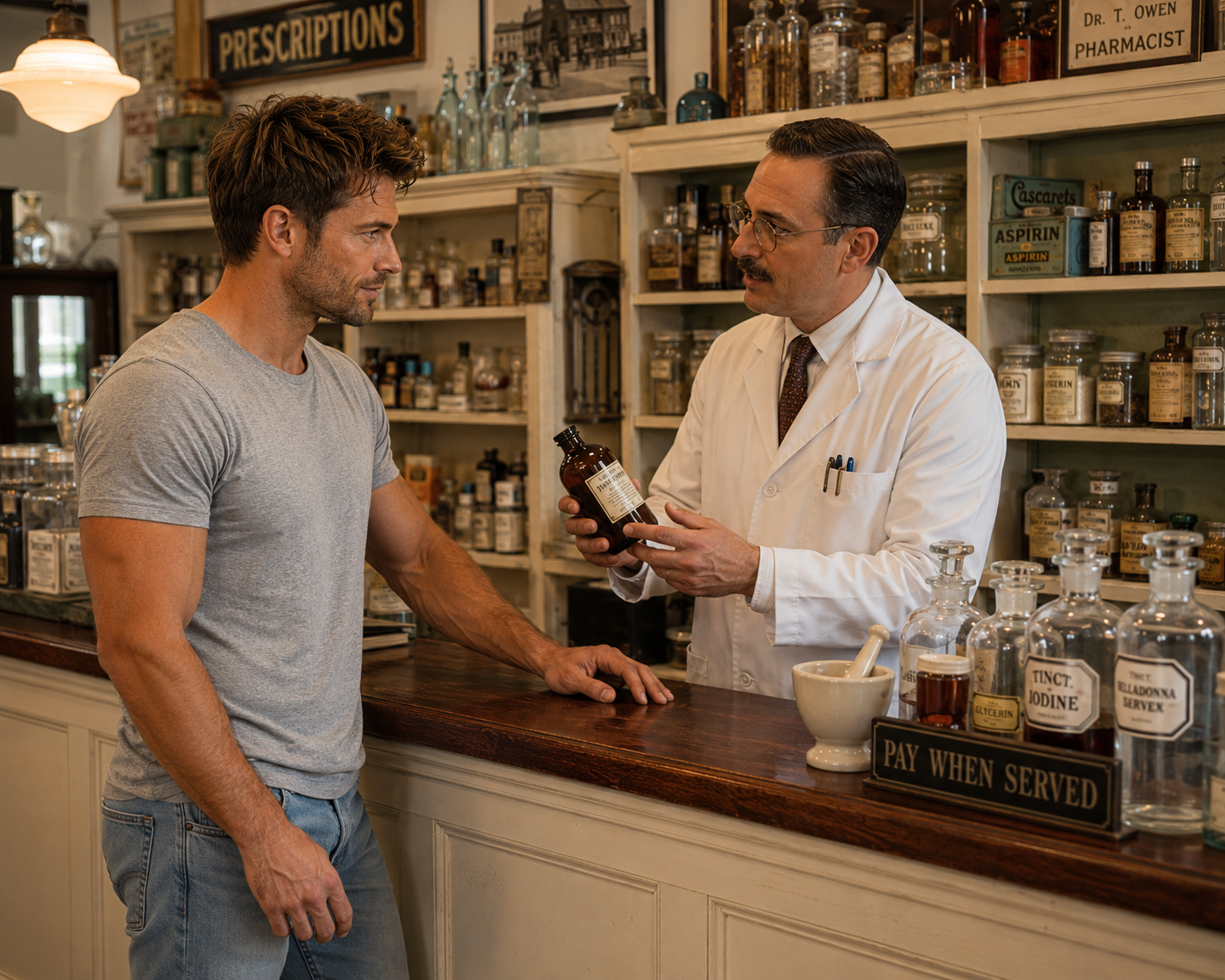
At the back of the shop, past the first shelf and the chrome-lettered tubs, a wooden counter runs the width of the wall. The bottles behind it are plain — white labels, small print, no lightning bolts. The old man steps behind the counter, and something in his manner changes. Slower. Heavier.
"Everything else in this store, you can pick up and put down as you please," he says. "Not back here. Back here is real pharmacology — compounds strong enough to change your blood, your brain, your hormones. Strong enough to heal you, and strong enough to own you. So let's get one thing straight before I say another word: I'm not a doctor, and neither is this program. Nothing starts, changes, or stops back here without your physician in the conversation — nothing. What I've got isn't a license. It's fifty years of standing at this counter listening — to the men these medicines saved, and the men who spent years getting free of them. That's what I'm going to give you: the stories, the history, and the questions worth asking. You take all three to your doctor. That's how this counter works."
That's the whole posture of this room. Not medical advice — investigation. Patterns, history, and testimony, offered so you can walk into a doctor's office as an informed man instead of a passive one. Correlation is not causation, a story is not a study, and this page will be honest with you about which is which.
The Word Behind the Window
Start with the history, because the word itself is trying to tell you something.
The pharmacy is old. Before the drive-through window there was the apothecary — jars of dried plants, a scale, a mortar, and a man who knew that the willow's bark quiets pain (we call it aspirin now), that the foxglove flower can steady a failing heart (we call it digitalis), that a certain mold kills the infections that used to kill us (we call it penicillin). Most of what's behind a modern pharmacy counter is descended from the garden and the field, refined and concentrated. The knowledge is ancient, and much of it is genuinely good.
But the Greeks, who gave us the word, built a warning into it. Pharmakon meant remedy — and it also meant poison. Same word, on purpose, because the ancients understood what the modern billboard doesn't say: the difference between the two is usually just the dose and the honesty of the man dispensing it. And the practice-word, pharmakeia, shows up in Scripture — Galatians 5, Revelation 18 — where your English Bible translates it sorcery. The word behind "pharmacy" is the word the apostles used for witchcraft.
Now be careful with that, because men swing to two errors here and the old man will let you make neither. The first error says the word history proves all medicine is sorcery — nonsense, and dangerous nonsense; insulin keeps diabetics alive, antibiotics have saved more children than any invention in history, and the man who throws away a needed medicine to prove his purity is not spiritual, he's foolish. The second error says the word history means nothing — also wrong. The ancients paired remedy and poison and enchantment in one word-family because compounds powerful enough to alter the body and mind have always attracted two kinds of men: healers, and merchants who profit from dependence and deception. The word isn't a verdict on medicine. It's a warning about markets. Keep that warning in your pocket; you're about to need it.
The Boom: When Medicine Became a Sales Force
Here's the investigative history every man should know before he fills another prescription — not to make him paranoid, but to make him awake.
Through the 1980s and into the '90s, American pharmaceutical companies transformed from research houses into some of the most sophisticated sales machines on earth. Armies of sales representatives — young, polished, carrying lunches and samples into doctors' offices by the tens of thousands. Sponsored conferences, sponsored studies, sponsored speakers. And then the move almost no other nation on earth allows: advertising prescription drugs directly to you. The United States is one of only two countries where the television tells you to "ask your doctor about" a chemical by name. Read that sentence again. The ad isn't for the doctor. It's for you — the same eye-level shelf game you learned at the grocery store, played with pharmaceuticals.
Then came the case study written in bodies. In 1980, a five-sentence letter to a medical journal noted that, among hospitalized patients, addiction to narcotics seemed rare. Five sentences, one narrow context. Over the next two decades that letter was cited hundreds of times as proof that opioid painkillers were rarely addictive — stretched from "monitored hospital patients" to "everyone, indefinitely, at home." In 1996, Purdue Pharma launched OxyContin and marketed it with exactly that claim — addiction risk "less than one percent" — alongside a twelve-hour relief promise the drug often didn't keep, which left patients swinging between relief and withdrawal in a cycle that teaches craving. The sales force was paid handsomely to push doses upward. Pain clinics in some towns wrote more prescriptions than the towns had people.
You know how it ended, because the country is still burying it. Pills led to dependence; when the pills got expensive or scarce, dependence led to heroin; heroin gave way to fentanyl; and the waves of that one epidemic have killed Americans by the hundreds of thousands — sons, fathers, men who started with a back injury and a legitimate prescription. Purdue pleaded guilty to federal criminal charges over its marketing — in 2007, and again in 2020. The family that owned it paid billions in settlements. The investigative verdict, held by courts and common sense alike, is that a manufactured lie about addiction risk lit the fire.
Hold both truths from that story, because both are the lesson of this counter. Opioids are real medicine — after surgery, in cancer wards, at the end of life, they are mercy itself. And the marketing of them was a lie that killed people at industrial scale. The medicine can be real while the marketing is poison. That is pharmakeia in a suit, and it's why no man should ever again confuse "prescribed" with "questioned and understood."
Stories at the Counter
Fifty years at this counter, and the old man has heard every kind of story. He'll tell you the two kinds you need, and he tells them in pairs on purpose.
He'll tell you about men these medicines saved. The friend whose blood pressure pills bought him thirty more years of grandchildren. The veteran whose depression medication, arrived at carefully with a good psychiatrist, gave him back the will to live — "that man is alive today, and I don't let anyone at this counter sneer at what saved him." The diabetic on his insulin, the man whose thyroid tablet is the reason he can think straight. Some medicines are for a season; some are for life; and taking a needed medicine faithfully is discipline, not weakness.
And he'll tell you the other stories, because you deserve to hear them before the prescription pad comes out, not after. The men who came off antidepressants and found the exit harder than anyone had warned them — the dizziness, the electric "brain zap" sensations, the months-long tapers, the emotional flatness they only recognized in hindsight. The men who discovered their medication carried a black box warning — the FDA's strongest caution, printed inside a black border on the label, reserved for risks of serious injury or death — and realized they'd never read it, never been walked through it, never asked. Antidepressants carry one about suicidal thinking in young people. Benzodiazepines carry them for dependence and for the genuine danger of stopping abruptly. Some of the most commonly dispensed drugs in America carry a black border, and most men taking them have never looked.
Now — the investigative discipline, and he's firm about it. One story is a story. A hundred stories with the same shape are a pattern worth taking seriously. Neither is a diagnosis, and your body is not the storyteller's body. What testimony gives you is not conclusions — it's questions with teeth: the ones you take into the appointment and ask out loud. What does the black box on this say? How long do people typically stay on it? What does coming off look like, and how would we do it? What's this medicine's history — and who studied it? A good physician welcomes those questions. If yours bristles at them, that tells you something too.
Coming Off — The Exit Is Part of the Prescription
The hardest stories at this counter share one detail: nobody talked about the exit until the man was already trying to find it.
So learn the rule here, once, forever: you never stop a serious medication cold, and you never do it alone. Abruptly quitting some drugs — benzodiazepines above all, and several classes besides — is not just miserable but medically dangerous. Antidepressant discontinuation can take careful months of stepping down, and the difference between a brutal exit and a manageable one is usually the slowness of the taper and a prescriber who's actually steering. If a medicine needs to go, it goes the same way it came: with the doctor, on a plan, on purpose. Any voice — internet, friend, or your own impatient pride — telling you to just throw the bottle away is not on your side.
The deeper discipline is asking about the exit at the start. When a prescription is offered, the informed man asks: is this for a season or for life? How will we know it's working? What's the plan for coming off, if that day comes? Medicine that manages a symptom while nothing underneath gets fixed becomes a permanent tenant by default — so while the prescription does its work, you do yours: the plate, the sleep, the training, the grief and the anger carried into the SPIRIT work where they belong. Sometimes the underneath gets fixed and the doctor agrees the season is over. Sometimes the honest answer is that the medicine stays for life — and then the man takes it like he keeps any other covenant: faithfully, with open eyes.
The Plant Behind the Counter
Last stop at the counter: the plant everyone wants to ask about, and the one the old man refuses to either worship or curse.
Cannabis is real medicine for some people — he'll say that flatly, because the evidence says it. A purified CBD preparation is FDA-approved for rare, devastating childhood seizure disorders. Cannabis compounds have earned their place against chemotherapy nausea, in certain chronic-pain and multiple-sclerosis cases, and a good number of men report genuine help with sleep and unwinding a nervous system that won't come down. Where the law of your state permits it and a physician is actually steering, medical cannabis is a legitimate line of inquiry, and Antidepressants & Anxiety Medications, CBD & THC, Depressants & Stimulants, Dissociatives & Empathogens, walks it honestly.
And — same breath — the costs are real, and "natural" doesn't waive them. The plant in the dispensary is bred to potencies the previous generation never smoked, and the young brain pays the steepest price for heavy early use, including a correlation with psychosis in that group that an honest man doesn't wave away. Daily leaning builds tolerance, dims motivation, and settles into the nervous system as a tenant with opinions — plenty of men at this counter came to talk about that dependence, gentler than the pill stories but dependence all the same. And the CBD boom brought grocery-store chaos: an under-regulated market where tested bottles have carried far less than labeled, more than labeled, or THC that was never on the label at all. The rule from the front shelves follows you back here — third-party tested or not at all — and the sober walkthrough lives at CBD.
His counsel on the plant is the same as for everything behind this counter: a named job, a doctor in the conversation, an exit plan, and no pretending that plant means free.
Four Rooms, In Order
⚠ One thing before the rooms, and it governs all four of them. Nothing behind this counter is medical advice, and no page in this program is a reason to stop, start, or change a medication. That decision is made with the prescriber who wrote it. And if you are somewhere dark right now — if the thought of not being here has started arriving — that is an emergency and not a discipline problem. Call your doctor, go to an emergency room, or call or text 988 in the United States.
Four rooms, walked from what a man is most likely to be handed to what he is least likely to encounter. The first room sets the rule the other three inherit.
Antidepressants & Anxiety Medications — the most-prescribed shelf in the building. What is actually in the four families, the black-box warnings stated straight, the questions to ask inside a nine-minute appointment, and what the medication genuinely cannot do on its own. It also handles pharmakeia honestly — aimed at the marketing machine and the prescription written with no exit discussed, ⚠ never at the man holding the bottle.
CBD & THC — the plant, weighed on both sides. Two compounds that are not interchangeable, what the evidence genuinely supports, what the word natural does not waive, and the mess that is the untested CBD market. Lands on the question that actually settles it — not is this natural, but what job is this doing, and could I stop for a month without an argument in my own head.
Depressants & Stimulants — the shelf you are already standing on. Caffeine, alcohol and nicotine handled without flinching, the prescribed stimulants and their real cautions, and the loop most men are running without ever having named it. ⚠ Almost every chemical loop is a sleep problem wearing a costume.
Dissociatives & Empathogens — where the research is real and the claims outrun it. Ketamine's genuine clinical role and its genuine costs; the accurate record on MDMA-assisted therapy, including the 2024 FDA decision; and how to stand in a wave of enthusiasm without being carried by it. ⚠ No doses, no methods, no protocols — several of these are Schedule I and this room teaches evaluation, not use.
Leaving the Shop
That's the third shelf — the one you don't browse, the one you investigate. Run it through the three questions the whole program runs on. Truth: do you actually know what you're taking, why, and what the black box says — or are you swallowing something you've never questioned? Love: an untreated condition steals a man from his family, and an unexamined dependence does the same thing slower — the men at your table deserve you treated and awake. Right: the body's design is fed from the plate, patched from the shelves, and repaired under real supervision when it breaks — in that order, without shame at any step taken honestly.
The deeper end of this counter — your labs, your hormones, your brain chemistry — lives ahead in Fitness, where the same rules apply: Blood Work before conclusions, Hormone Therapy under supervision, Brain Chemistry understood rather than guessed at. The old man walks you back through the shop, past the shelves, and holds the door — you already know his parting words: eat real food, move your body, sleep, pray. And now one more, from the back counter: question everything they hand you, friend — the good ones can take it.
That closes the third shelf, and with it the shop, and with it the whole of Nutrition. The plate is settled, the week is built, and the bottles have been cut down to the short honest list that actually belongs in your cabinet.
Which means the furnace is loaded — and a loaded furnace with nothing asked of it is not health. It is fuel sitting still, and fuel that never gets burned becomes precisely the thing you spent this entire ground trying not to build.
The old man walks you to the door and says the last part of it on the step, the way he says everything, as though it were obvious.