

Priorities & Prioritization
Information Overload
Urgency
Procrastination
A full week and an empty week look identical from the inside.
It is Sunday, near eleven, and there is a light on over a kitchen table.
He is nineteen. There is a job now, and something like a class, and a truck that needs a part he cannot afford yet, and a girl who has started to notice how long he takes to text back. Nobody sets his schedule anymore. That happened quietly a while ago and nobody marked it, and he has not yet worked out that it was the biggest change of his life so far.
There is a notebook open in front of him. He is trying to write down what he actually did this week.
Watch him work at it, because the page is thin. He was busy. He knows he was busy — he was tired every night, he never once sat around, there was not an hour of the week where he would have said he was doing nothing. And now he is trying to put it on paper and he has four lines, and two of them are things he had to do twice because he did them wrong the first time.
So he flips the page and starts a different list: everything he needs to get to. That one comes fast. Fourteen items in about ninety seconds, and they arrive in whatever order they occurred to him, and that is exactly how they will sit there for the rest of the week — as a flat list where the thing that decides the next five years of his life is sitting on line nine, under a phone call about a warranty.
His phone is face-up next to the notebook. It lights every couple of minutes and he picks it up every single time, and if you asked him he would tell you honestly that he did not decide to.
He falls asleep at that table with the list unranked.
That is the whole problem, and it is not a young man's problem. It is the problem. Not that he does not know what matters — ask him and he could tell you, roughly. It is that knowing what matters and having ranked it are two entirely different things, and only one of them changes a Tuesday.
The Bag with Holes
Start with the diagnosis, because most men have the symptom and have misnamed the disease.
The symptom is this: he is genuinely busy and cannot account for the output. He is not lazy. Ask his wife, ask his crew — the man works. He is tired in a way that feels earned. And then a year goes by, and then five, and if you sat him down and asked what got built in that time, he would have trouble filling the page, and the trouble would embarrass him because he knows how hard he ran.
Scripture describes that condition with an image nobody improves on:
"Ye have sown much, and bring in little; ye eat, but ye have not enough; ye drink, but ye are not filled with drink; ye clothe you, but there is none warm; and he that earneth wages earneth wages to put it into a bag with holes." — Haggai 1:6
Sown much. Bring in little. Not sown little — the effort is not in question and never was. The problem is downstream of effort entirely. He is earning real wages and putting them into a bag that does not hold, and the holes are not a character flaw. They are where the hours are going.
That is the correction this room exists to make, and it lands hard on hardworking men. The problem is almost never that a man is not doing enough. It is that his effort is not ranked, so it distributes itself across everything that asks for it, and everything asks. Effort spread evenly across fourteen items produces motion in fourteen directions and displacement in none. A man can run at full output for a decade that way and arrive precisely where he started, exhausted and confused about why.
Nothing in that is fixed by working harder. Working harder into a bag with holes just moves more money through the holes.
What’s Important Now
So here is the tool, and it is old — a general who had to sort a war down to what he could actually do this morning worked out the shape of it, and men have been rediscovering it ever since. Two questions, asked of anything competing for your hours.
Is it important? — meaning does it move something that will still matter in five years.
Is it urgent? — meaning does it demand to be handled now.
Those are different questions, and almost every man treats them as the same one. Cross them and you get four quadrants, and every hour you have ever spent sits in one of them.
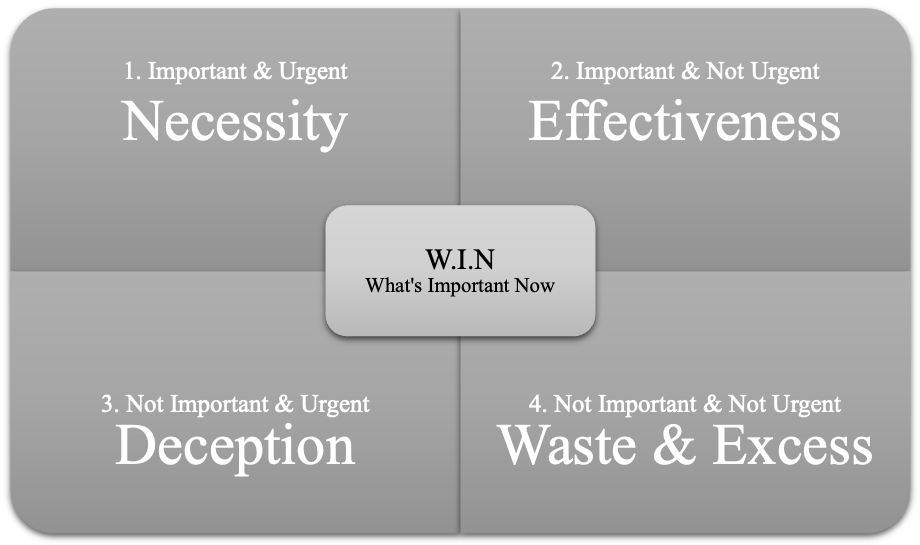
W.I.N. — What's Important Now. That is the question at the center, and it is deliberately not what's important. Everyone can answer what's important — that answer is cheap and abstract and changes nothing. What's important now is a ranking question about the next block of hours in front of you, and it has exactly one answer at a time. That is the discipline: not knowing your values. Naming the single next thing and doing that one.
Necessity — Important and Urgent. The real emergency. The deadline that actually matters. The child in the emergency room, the roof that is actually leaking, the conversation that cannot wait another day without doing damage. This quadrant is legitimate and it is not negotiable. It is also self-managing — nobody has to be taught to answer a genuine emergency. The only real danger here is a life that is only this: a man permanently in triage, handling one crisis after another, never asking why he is always in the emergency room. Chronic Necessity usually means quadrant two has been neglected for years, and the fires are the bill arriving.
Effectiveness — Important and Not Urgent. The training. The marriage before it is in trouble. The skill that takes three years. The savings. The reading. The maintenance done while the thing still works. This is where a life actually gets built, and this room's central claim is about this box: it is the only quadrant that never demands anything. It has no deadline, no ringing phone, no one waiting on you. It waits patiently and it waits forever, and a man can neglect it for twenty years without a single alarm going off — right up until it converts into quadrant one, all at once, as a heart attack or a divorce or a career that ended without notice.
Deception — Not Important and Urgent. This is the one that eats men, and the name is the sharpest thing on that chart. It is called deception because it does not feel like waste at the time — it feels like work. The phone lighting up. The email that could have been read Thursday. The meeting. The favor that had to be right now. Somebody else's emergency, arriving with all the urgency signals a genuine emergency has, and none of the weight. It feels identical to Necessity from the inside, and that is the entire trick: a man in this quadrant is busy, responsive, needed, and producing nothing. This is where the bag's biggest hole is, and it is the quadrant most men spend most of their working lives in while believing they are in quadrant one.
Waste & Excess — Not Important and Not Urgent. The honest hole. The scroll, the third hour of the game, the argument in the comments with a stranger about something neither man will remember. Nobody defends this quadrant, which is why it is not actually the dangerous one — a man knows when he is in it. It gets a warning anyway, because it is where a man goes to recover from the other three, and the recovery it provides is counterfeit. He does not come out rested. He comes out further behind and slightly worse about himself.
The Quadrant Nobody Visits
Stay on quadrant two, because everything else in this room is downstream of it.
Every genuinely consequential thing in a man's life is important and not urgent for a long time before it becomes anything else. His health is quadrant two for thirty years and then it is quadrant one for a weekend. His marriage is quadrant two through a decade of ordinary Tuesdays, and the day it becomes urgent it is frequently too late for the thing that would have worked. His competence, his savings, his standing with his kids, his walk with God — every one of them sits patiently in a box that never rings.
Which means quadrant two only ever gets entered on purpose. There is no other route in. Quadrants one, three, and four all recruit a man — they come to him, they make noise, they hand him a reason. Quadrant two never recruits anybody. A man arrives there because he decided to and defended the hours against three other quadrants that were all actively demanding them.
That is the entire discipline of this room, and it is why it is scheduled and protected rather than intended. A man does not get to quadrant two on leftover time. There is never leftover time — the other three consume every hour that is not defended in advance. So he puts it on the calendar first, before the week fills, and he treats that block the way he would treat a genuine emergency, because it is one. It is just an emergency that has not arrived yet.
Ranking Is the Whole Job
Now the part men skip, and the reason the notebook on that table never worked.
A list is not a priority. Fourteen items written down is fourteen items written down, and a man who works from that list will work from the top, or from whatever shouts, or from whichever one is easiest to start — and none of those is a ranking. Prioritization is not the act of writing what matters. It is the act of putting things in order, which necessarily means putting things last, which necessarily means some of them will not get done at all.
That is why men avoid it. Ranking is a small grief. Every genuine ranking is an admission that a man cannot have all of it — that something real and good and worth doing is going to sit at number nine and stay there, maybe for years, maybe permanently. The flat list is comfortable precisely because it never forces that admission. It lets a man keep believing he is going to get to all of it.
He is not. Nobody ever has.
"Prepare thy work without, and make it fit for thyself in the field; and afterwards build thine house." — Proverbs 24:27
Field first. House second. Both are good and neither is being condemned — the whole instruction is about order. Build the house first and you will have a fine house and nothing to put in it, because the field is what feeds the house. That is a sequencing rule, given plainly, and it is the oldest version of everything on that chart: not what matters, but what matters first.
And there is a second discipline riding alongside the first, which is the refusal. A ranking that only ever adds is not a ranking. The man who has genuinely prioritized has a short list of things he has decided he is not going to do — not this season, maybe not ever — and he has stopped feeling the need to justify it. Most men have never once said no to something good, and their calendars show it.
The Three Rooms Below
Three rooms sit under this one, and they run in this order because each removes what would defeat the next.
Information Overload — first, because a man cannot rank what he cannot hear over. He is taking in more input in a week than his grandfather took in a year, most of it engineered to feel urgent, and the volume does not produce comprehension — it produces a man who is aware of everything and clear about nothing. Ranking requires a quiet enough interior to think a single thought all the way through. This room is about getting that back.
Urgency — second, because once he can hear himself think, the next thing to sort is the counterfeit signal. Real urgency, manufactured urgency, and the internal urgency a man generates on his own out of anxiety. This is the room where quadrant three gets dismantled: the tyranny of the urgent, why manufactured pressure works on him, and what calm engagement with a genuine emergency actually looks like.
Procrastination — last, because it is the gap that remains after everything else is right. A man can have a clear head and an accurate ranking and still not start. This room is about the mechanism underneath the deferral — which is almost never laziness — and about the plain fact that tomorrow was never promised to anybody.
The Man Who Knows What Matters Now
What comes out of this work is not a man with a system. Systems are easy and most men who take up a system are using it to feel organized rather than to be effective.
"All things are lawful unto me, but all things are not expedient." — 1 Corinthians 6:12
Lawful and expedient are two different tests, and this is the sentence a serious man needs. Most of what fills his week is not wrong. It is permitted, reasonable, defensible, and in many cases genuinely good — and it is still not what he should be doing with that hour. He has stopped screening his life for is this bad and started screening it for is this what matters now, which is a far more demanding filter, and the only one that ever changed anybody's Tuesday.
He can name the one thing. Ask him what he is working on and he will not list six. He will tell you the one, and he will know where it sits on the chart, and he will know what he set down to make room for it.
He defends quadrant two in advance, on the calendar, before the week fills. And he is at peace with the number nine — the good thing he is not doing, which he has genuinely decided about rather than left hanging. That is the difference between a man with priorities and a man with a long list of guilt.
And when a real emergency arrives, he goes to it fully and without resentment, because he knows the difference between the fire and the phone.
Where Priorities & Prioritization Leads
Look at the table. The light is still on and the notebook is still open, and now you know what to do with the list.
That is the first thing in this walk you have been handed that works on Monday. The field was open. The ground was assigned. The people shaped you. Then you found out you get a vote, and then you found out the vote gets cast at stop signs — and now you have a way to rank what the vote is for.
Which means, for the first time, you are about to actually go do something.
And that is exactly when it starts.
Here is what nobody tells a man who has just gotten his priorities straight: nothing resists a man who is drifting. The world has no objection to him at all — it will let him spend forty years on quadrants three and four without a single complaint. Resistance does not show up in response to a man's confusion. It shows up in response to his direction.
So the day he ranks the list and starts on line one is the day the truck breaks. The day the good habit begins is the day the schedule changes. The man who finally commits to the marriage discovers the marriage has an argument waiting in it that was not there while he was absent. That is not bad luck and it is not God withholding. It is what terrain does to a man who has stopped wandering and started walking somewhere.
The next room is the terrain. It is the longest stretch of this walk and it has more ground in it than any other, because it is what the game is actually made of.