
Proof of God
He got up at two in the morning because he was not sleeping anyway.
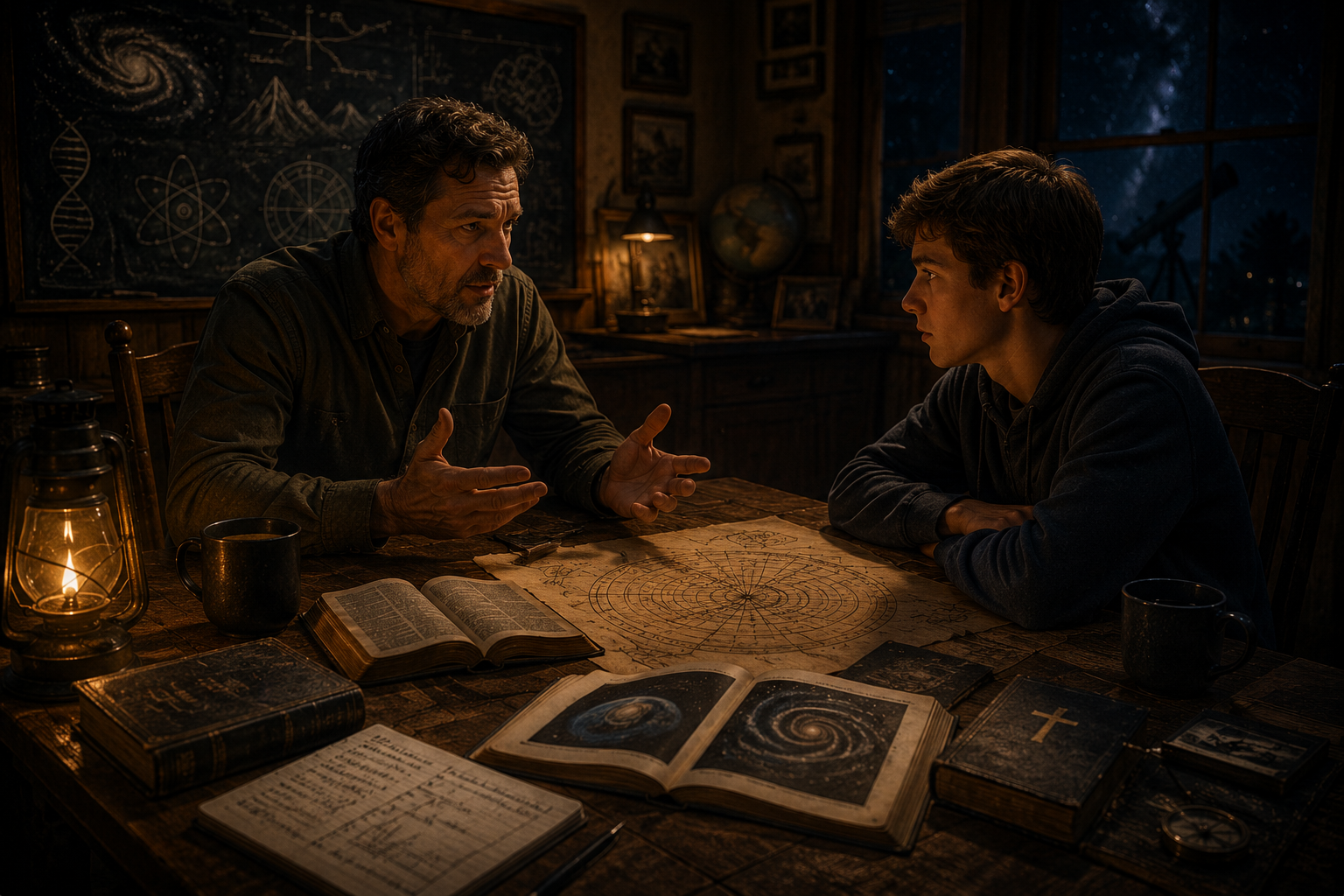
The house was quiet. His son had been in bed for four hours. He made coffee he did not want, opened a laptop at the kitchen table — the same table — and typed the question in almost exactly the words the boy had used.
Forty million results.
Four hours later he closed it and knew less than when he started, and not for the reason he expected. It was not that the answers were bad. Some of them were very good. It was that somewhere around the second hour he had realized he could not say what he was being asked to prove.
Prove God — which one? Prove him how? To what standard, exactly? And the standard he had been quietly accepting all night, the one where proof means the thing it means in a laboratory, repeatable on demand by anybody who shows up — where had he agreed to that? Nobody had put it to him. He had absorbed it, sometime in the last thirty years, and had been trying all night to meet a bar somebody else set without ever being asked whether the bar was the right one.
That is where the work actually starts, and it is not where most men start it.
Proof of God
"Come now, let us settle the matter," says the LORD. "Though your sins are like scarlet, they shall be as white as snow" — Isaiah 1:18
The older renderings put it come now, let us reason together, and men have quoted that half of it for two hundred years as though it were a motto about clear thinking.
Look at who is speaking and what the subject is.
God opens the argument. He is the one who says come. That alone should reorganize a man's expectations about this whole room — the invitation to reason is not something a skeptic wrings out of a defensive believer. It is issued from the other direction, first.
And then notice what he wants to reason about. Not the fine-tuning constants. Not the manuscripts. Scarlet. The reasoning God proposes is about guilt and what is going to be done with it, which means the question a man thinks he is asking in this room — is there a God — is not the question the room finally lands on. It is the question that has to be settled before the real one can be put to him.
Take the invitation seriously enough to do the work. Then stay in the room for the second half.
This room exists so that conversation goes differently the next time. So that when the question comes — and it will come from the son, the daughter, the coworker, the brother-in-law sitting on the porch at Christmas, the friend three weeks into a deconstruction — the believer has an answer that he himself has done the work to hold. The proof of God is not the believer's permission to believe. He already believes. The proof is what allows him to defend the faith when it is challenged, to engage the skeptic without flinching, to read the world as the kind of place that could only have been made, and to hand his children something more durable than just believe.
The proof is not a single argument. It is a convergence. Philosophical reasoning. Scientific implication. Historical record. Fulfilled prophecy. The testimony of conscience. The architecture of the gospel itself. No single line carries the whole weight. Together they produce a cumulative case no honest investigator can dismiss without choosing to. The atheist case against God is not stronger because of philosophy or science. It is stronger because the atheist has chosen what he wants to be true. The believer's case is not stronger because he wants it. It is stronger because what he holds lines up with reality at every level the question can be tested.
Distinctions Worth Drawing First
Proof of God is not proof that God will do what you want. The God who exists is not the genie of contemporary therapeutic spirituality. The case made here is that God is — not that he performs on demand.
Proof of God is not proof of every doctrinal detail. The case aims at a Creator who has revealed himself. The specific contours of that revelation — the Trinity, the atonement, the structure of the gospel — belong to the doctrinal clusters. The proof opens the door. Doctrine furnishes the house.
Proof of God is not winning every argument. The skeptic who refuses to be persuaded is not refuting the case. He is exercising the will to refuse. The job of the proof is to remove rational excuse, not to compel the will. Romans 1:20 names exactly this outcome — that they are without excuse. The will to refuse is the last move the skeptic owns; the believer cannot take it from him, and should not pretend his job is to.
Proof of God is not solved by appeals to feeling alone. The believer's interior witness is real and is part of the case. It cannot stand alone where the skeptic is operating from his own counter-feelings. Reasoned argument is required.
Three positions sit at the center of how project7 teaches this work. First, the proof is cumulative and convergent. No single argument carries the whole weight, and the man who waits for the one knockdown case will not find it. The case is built from many lines that all point the same direction. Second, the proof is specifically the proof of the God of scripture — not a generic deism. Christ's life, death, and resurrection are the center, and an apologetic that ends with a vague higher power has not arrived where the gospel begins. Third, the man who has done this work is equipped for the field. He can engage the skeptic without losing his footing, defend the faith without being shaken, and present the case to the searching man without flinching when the hard questions arrive.
Why the Believer Reasons About God
A man who cannot defend his faith does not fully hold it. Faith that has never been tested in the field collapses when the testing comes. Reasoning about God is not a sign of weak faith. It is the discipline of holding the faith with grounds, not just with sincere feeling.
The skeptic has built his arguments. Atheism, materialism, secular humanism, the various forms of contemporary irreligion — they have not been intellectually idle. Their arguments have been refined for decades. Their books are written. Their public advocates are practiced. The believer who walks into the field carrying only sincerity will lose the exchange. Arrive equipped.
Faith and reason are not enemies. The gospel's claim is that the God who is has revealed himself in ways that can be reasoned about, examined, and weighed. The historic church's tradition includes Augustine, Aquinas, Pascal, Lewis, Schaeffer, Plantinga, Craig, Lennox, Keller — men who demonstrated that faith and reason work together when both are properly held. The believer who has been told that faith requires the suspension of reason has been taught wrong by someone who needed him to think so.
The proof is for the watching world, not for God. God does not need the believer's defense. The case is for the man, his children, his household, the men he meets, the watching culture. The work gets done because the world is full of people who need to see the case made well by someone who is not afraid of their questions.
Scripture commands the work. Always be ready to give an answer to every man that asketh you a reason of the hope that is in you. The verse is not addressed only to professionals or scholars. It is addressed to every believer. The command stands.
The limits of the proof are honest. Proof of God is not mathematical proof. It is rational warrant — the same standard that operates in history, law, philosophy, and ordinary human reasoning. The man who demands a proof of God that exceeds the proof he accepts for everything else he believes is not asking honestly. He is asking strategically.
The Seven Attributes The Creator Must Carry
For a Creator-God to exist as the source of this universe, the attributes are not arbitrary. They are required by what he had to be in order to produce what is.
Transcendent. He existed apart from the creation. The Creator is not a part of the universe he made. He stands above it and outside it. Pantheism is ruled out — God is not the universe and the universe is not God.
Eternal. He existed before physical time came into being. The cause of time cannot be temporal. The Creator must be timeless in his own being, even if he acts within time after creation.
Spirit. He existed before the physical world was created. The Creator is not material. Matter is what he produced. Materialism cannot account for its own origin without smuggling in something material that existed before matter — which is incoherent on its own terms.
Powerful. The immensity of the creation event — every star, every galaxy, every law of physics, every biological system — requires power beyond any finite cause. The Creator is not powerful in a relative sense. He is the source of all power.
Intelligent. The precision of creation, the fine-tuning of the physical constants, the information density of biological systems, the order of mathematical reality — each requires intelligence at the source. Random unguided processes do not produce specified complexity of the kind the universe carries. The cell is not the result of a chemistry accident any more than a library is the result of an ink spill.
Caring. Creation is not a hostile environment for life. It is an ideal habitat in which life can flourish. The Earth's positioning, atmospheric composition, water cycle, agricultural fertility — each reflects a Creator who cared enough to make a place where his creatures could live. The contemporary framing of nature as indifferent is itself the indifference of the man looking at it, not a property of what he is looking at.
Personal. Creation is the result of decision. An impersonal force does not decide. Only a person decides to create. The Creator is not a force or a principle. He is a Person who chose.
These seven are not separable. The Creator who is one is also the others. The God of scripture matches every one of them, which is why the case lands at scripture's specific God rather than at a generic deism.
Genesis 1:1 — The Architecture Of Reality
The triadic compression. Modern physics has shown that for a universe to exist at all, three categories must come into being at once and inseparably — time, space, and matter. None of the three can exist without the other two. Matter without space has nowhere to be. Space without time admits no motion or change. Time without matter has nothing to act on and no events to mark. The three are a single architecture. The universe is the integration of them. Genesis 1:1 names all three in one sentence — In the beginning (time), God created the heavens (space), and the earth (matter). Ten English words compress a cosmological architecture that twentieth-century physics took centuries to articulate. The man who has read Genesis 1:1 as a decorative opening has been reading past what the verse is doing.
The Hebrew is doing more than the modern parsing names. The triadic reading is real and powerful as a teaching tool, but the original Hebrew is doing something even larger. The phrase hashamayim ve'et ha'aretz — the heavens and the earth — is a merism: a Hebrew totality construction in which two opposite or comprehensive terms are paired to mean everything in between and beyond. From Dan to Beersheba means all of Israel. From the rising of the sun to its going down means all the earth. The heavens and the earth means the totality of the created order. The merism is comprehensive in a way the triadic mapping is not. It covers physical reality, the spiritual realm, the angelic order, dimensions human instruments cannot measure, energy, information, law, mind, and the whole order of everything that is and is not God himself. The Hebrew is bigger than time-space-matter. Time-space-matter is what physics confirms is contained inside the merism. The merism asserts the rest as well.
Both readings reinforce each other. Neither cancels the other. The triadic reading lands at the level modern physics can verify — time, space, and matter are inseparable, came into being together, are accounted for in one verse. The merism reading lands at the level Hebrew grammar establishes — God created the totality of everything that is. The two are not in competition. The triadic is the partial physical confirmation of what the merism asserts comprehensively. Hold both — the Hebrew witness that establishes the doctrine and the modern physical witness that confirms the architecture inside it.
Verse two completes the architecture by introducing order from non-order. And the earth was without form, and void; and darkness was upon the face of the deep — the Hebrew tohu va'bohu — formless and void. The opening verse establishes the totality of created reality. The second verse introduces the state of that reality before God's structuring work begins. The Spirit moves over the waters. The speaking begins. The days unfold. The chaos is ordered into the cosmos. The cosmological argument is not just something rather than nothing. It is ordered something rather than chaotic something. The materialist must account for the existence of the universe and for the imposition of order onto it. The Christian account does both in two sentences.
The Christological echo runs back to verse one. In the beginning was the Word, and the Word was with God, and the Word was God. The same was in the beginning with God. All things were made by him; and without him was not any thing made that was made (John 1:1-3). John writes Genesis 1:1 in Greek with Christ named as the agent. For by him were all things created, that are in heaven, and that are in earth, visible and invisible, whether they be thrones, or dominions, or principalities, or powers: all things were created by him, and for him: And he is before all things, and by him all things consist (Colossians 1:16-17). Paul writes the merism explicitly — all things in heaven and in earth, visible and invisible — and names Christ as the Creator. Genesis 1:1 is not a deistic-Creator verse left to the reader to interpret. The New Testament opens both John and the central Christological passages of Paul by pointing back to it and naming Christ as the who. The case from Genesis 1:1 does not stop at generic theism. The verse's own scriptural context lands at the specific God of scripture acting through the eternal Son.
What the verse rules out. The opening sentence of scripture closes off, in one stroke, the major alternatives that have organized human thinking about origin. In the beginning rules out an eternal universe — the cosmos has a beginning. God created rules out atheism — there is a Creator. The singular God rules out polytheism — there is one Creator, not a council of gods producing reality together. Created the heavens and the earth rules out pantheism — the Creator is distinct from the creation. God is not the universe and the universe is not God. The verse also rules out dualism — there is no co-eternal counter-principle producing matter against a spiritual god; God alone is the source of both the heavens (the spiritual realm) and the earth (the material realm). Eternal universe, atheism, polytheism, pantheism, dualism. Five major worldview alternatives are excluded in the first sentence of the canon. The man who has not read Genesis 1:1 with this density has been reading it as a preface. It is not a preface. It is the floor every subsequent doctrine assumes.
Conscience, Natural Law, And Reason
The conscience is the witness inside every man. "Indeed, when Gentiles, who do not have the law, do by nature things required by the law, they are a law for themselves, even though they do not have the law" (Romans 2:14). The next line says the requirements are written on their hearts, with conscience bearing witness and their own thoughts taking turns accusing and defending them — which is a description of an argument a man has with himself when nobody is watching. Every man, regardless of cultural setting, knows there is a difference between right and wrong. The skeptic who denies objective morality cannot live consistently with the denial. He reaches for moral language the moment he is wronged. The conscience is the internal evidence of a lawgiver.
Natural law is the witness in the structure of reality. Things have a nature. The nature has purposes. The purposes are recognizable. Marriage has a structure that produces children. Food sustains life. Truth-telling builds society and lying destroys it. Courage protects, cowardice abandons. Natural law is not a religious imposition. It is the recognition that reality is ordered in ways that make some actions consonant with the order and others against it. The lawgiver shows in the law structure itself.
Reason is the witness in the mind. Logic operates. Mathematics is consistent across the universe. Cause and effect hold. Truth is non-contradictory. Reason itself is the kind of thing that requires an explanation — material processes do not produce truth-tracking minds unless something at the source intended truth-tracking minds to exist. The skeptic who uses reason to argue against God is borrowing reason that only makes sense if God is. C. S. Lewis named this clearly: if the brain is just chemistry, there is no reason to trust what the chemistry produces, including the conclusion that the brain is just chemistry. The argument eats itself.
Each witness points the same direction. The heavens declare the glory of God; and the firmament sheweth his handywork (Psalm 19:1). The convergence of conscience, natural law, and reason — together with scripture's specific revelation — is the cumulative case. No single witness is decisive. Together they are overwhelming.
The contemporary suppression of these witnesses. Who hold the truth in unrighteousness… So that they are without excuse (Romans 1:18-20). Scripture's diagnosis is that the natural witnesses are sufficient to leave men without excuse, and that men who refuse God do so by suppressing what they already know, not by lacking evidence. The case does not have to construct belief from nothing. It has to clear the suppression.
Proof that Jesus Is God
The Christian case does not stop at deism. A vague higher power leaves the man unable to know whether the Creator is for him or against him, willing to hear or indifferent. The gospel's specific claim is that the God who is has revealed himself in the person of Jesus Christ — fully God, fully man, who lived a perfect life, died a substitutionary death, and rose bodily from the grave. The proof ends here or it has not arrived where the gospel begins.
The just / merciful / loving resolution. God must be perfectly just — sin must be punished or he is not just. God must be perfectly merciful — he cannot leave sinners without remedy or he is not merciful. God must be perfectly loving — he cannot remain distant from the people he made or he is not love. The three are in tension at the surface. The gospel resolves them at the cross. He made him to be sin for us, who knew no sin; that we might be made the righteousness of God in him (2 Corinthians 5:21). Justice demanded the penalty. Mercy paid the penalty himself. Love is the reason he did. No other religion resolves the three. Only the gospel does. The cross is not just the mechanism of salvation. It is the geometric solution to a tension every other religion either denies or papers over.
The pre-incarnate witness in the Old Testament. Christ does not arrive in Bethlehem unannounced. The Old Testament carries the pre-incarnate Christ across multiple registers — the Angel of the LORD who speaks in the first person as God (Genesis 16, 22, Exodus 3, Judges 6, 13), the fourth man in the fire whose form is like the Son of God (Daniel 3:25), the figure in Proverbs 30:4 — what is his name, and the name of his son? Surely you know! — the chapter Jewish tradition has called the forbidden chapter — the Suffering Servant of Isaiah 53 and the betrayed friend of Psalm 41, the messianic figure threaded through the prophets. The pattern is sustained. Christ is not a New Testament invention. He is the Old Testament's expected fulfillment.
The fulfilled prophecies. "The virgin will conceive and give birth to a son, and will call him Immanuel" (Isaiah 7:14). "But you, Bethlehem Ephrathah, though you are small among the clans of Judah, out of you will come for me one who will be ruler over Israel" (Micah 5:2). He was wounded for our transgressions, he was bruised for our iniquities… and with his stripes we are healed (Isaiah 53:5). The probability calculations on the convergence of Old Testament prophecies fulfilled in one specific man are vanishingly small. Skeptics have tried to dismiss them as later editing or coincidence. Neither survives engagement with the Dead Sea Scrolls dating and the manuscript record. Peter Stoner's classical calculation of just eight prophecies' convergence put the odds at one in ten to the seventeenth power — Stoner's image was a state covered two feet deep in silver dollars with one marked, a blindfolded man picking the marked one on the first try. The actual count of prophecies is in the hundreds.
The eyewitness testimony. The New Testament documents are not mythological compositions written centuries later. They are first-century eyewitness accounts circulated within the lifetimes of those who could verify or refute the claims. The four Gospels, the Pauline epistles dating to the 50s AD, the early creedal formulations Paul cites (1 Corinthians 15:3-8, dating to within five years of the resurrection itself) — each sits inside the historical window where falsification was possible. The earliest Christians were martyred for refusing to recant claims they had personally witnessed. Men do not die for what they know to be a lie. Men sometimes die for what they sincerely but wrongly believe. Men do not knowingly invent something and then die for the invention. The eyewitness chain holds.
The blamelessness. Jesus' opponents could not produce a sin from his life. The Sanhedrin had to bribe false witnesses. Pilate found no fault. Herod had nothing to charge him with. Which of you convinceth me of sin? (John 8:46). Across the gospels' adversarial accounts, the consistent absence of any moral failure on Jesus' part is itself evidence — the only sinless man in recorded history is the only candidate for the role of substitutionary atonement the gospel requires.
The resurrection. The bodily resurrection of Jesus is the decisive event. And if Christ be not risen, then is our preaching vain, and your faith is also vain (1 Corinthians 15:14). The resurrection is the Father's vindication of the Son. The empty tomb is the historical event that requires explanation. The skeptic's alternatives — swoon theory, hallucination, theft, legend — have each been examined repeatedly across two thousand years and have not held up under serious investigation. The disciples did not have the medical means to revive a man crucified for hours and pierced through the chest cavity. Hallucinations are not shared by five hundred people at once. Theft does not explain the disciples' willingness to die for the theft. Legend does not develop inside a single generation while eyewitnesses are still alive to contradict it. The resurrection happened, or Christianity is false. The early church bet everything on the first horn of that alternative. The historical evidence supports their bet.
The Yom Kippur Sign
The crimson thread that stopped turning white. Jewish tradition records that for centuries, on Yom Kippur, the high priest tied a crimson thread to the horns of the scapegoat. The thread would miraculously turn white as the visible sign that God had accepted the sacrifice and the people were forgiven. According to the Talmud (Yoma 39b), this sign ceased forty years before the destruction of the Second Temple — that is, around 30 AD, the year of Jesus' crucifixion. Whatever the mechanism, the tradition itself records the change, and the dating is specific.
The westernmost lamp on the menorah began to fail. The same Talmudic source records that the perpetually-burning westernmost lamp on the menorah, which had remained miraculously lit for centuries, began going out at the same time. The Jewish authorities recorded these events as signs of doom and a diminishing of God's presence in the temple.
The temple doors that opened on their own. A third sign recorded in the same tradition — the heavy temple doors began opening on their own at night, which the rabbis interpreted as a warning that the temple was about to be destroyed. "Open your doors, Lebanon, so that fire may devour your cedars" (Zechariah 11:1) was read as the warning text.
The convergence is not coincidence. The signs Jewish tradition itself records as signs of God's withdrawing presence land precisely at the moment Christianity claims the sacrificial system was fulfilled and superseded. The crimson thread no longer turns white because the true sacrifice has been made. The perpetual lamp fails because the true light has come. The doors open because the temple is no longer the meeting place between God and man. The body of Christ is the new temple. Forty years later, in 70 AD, Roman armies under Titus destroyed the physical temple, and the sacrificial system has not operated since.
This is Jewish tradition, not Christian invention. The Talmud is not a Christian document. The signs are recorded by men who did not believe Jesus was the Messiah. Their own honest documentation of the signs lines up with the Christian account of what those forty years meant. This is one of the rare cases where the case for Christ is supported from inside the tradition that rejected him. The believer should know it. The skeptic should be asked to account for it.
When the Skeptic Pushes Back
On the problem of evil. The skeptic argues that the existence of evil disproves a good God. The Christian answer holds three claims together — God is sovereign, God is good, and evil is real. The cross is where these meet. God did not stand at a distance from evil. He entered it, suffered the worst of it, and overcame it. The problem of evil is real. The gospel does not dismiss it. The gospel resolves it at Calvary. The skeptic who refuses this resolution typically does not have a better one. The atheist position cannot ground evil as a category at all without smuggling in a moral standard the materialism cannot supply. That was evil is a sentence only Christians have a foundation for.
On the hiddenness of God. The skeptic argues that if God existed he would make himself obvious. But God has made himself obvious — in creation, in conscience, in scripture, in Christ. The hiddenness the skeptic complains of is not God's hiddenness. It is the skeptic's refusal of what God has shown. "What may be known about God is plain to them, because God has made it plain to them" (Romans 1:19). The man who closes the curtain and then complains it is dark has misdiagnosed the room.
On miracles. The skeptic argues that miracles are impossible because they violate natural law. But natural law is the regular pattern of how the Creator's universe ordinarily operates. The same Creator can act outside the regular pattern when he chooses. Miracles are not violations of nature. They are the Author of nature interrupting the regular pattern he authored. The skeptic's a priori rejection of miracles is not an argument. It is an assumption smuggled in before the evidence is examined. C. S. Lewis worked this carefully in his book Miracles — the question is not whether miracles are possible in the abstract, but whether God exists. If God exists, miracles are possible. The skeptic who rules them out in advance has decided the conclusion before he looked at the evidence.
On the multiplicity of religions. The skeptic argues that the existence of many religions suggests no religion is true. But the existence of many false answers does not preclude one true answer. The existence of multiple medical theories does not mean medicine is impossible. The Christian claim is that Christ stands distinct from every other religious figure. Every other religion is built on the believer doing something to reach God. Christianity is built on God reaching the man through Christ. The structural difference is not subtle. Salvation by works and salvation by grace are not two flavors of the same thing.
On the Bible's reliability. The skeptic argues that the Bible has been changed, mistranslated, or corrupted. The manuscript evidence is overwhelming — over 5,800 Greek New Testament manuscripts, over 25,000 manuscripts in all languages, with textual variations that affect no doctrine of the faith. The New Testament is the best-attested document of the ancient world by a margin of multiple orders of magnitude. The next-best ancient text is Homer's Iliad at roughly 1,800 surviving manuscripts. The Bible's textual reliability is not the weakness in the apologetic case. It is one of its strongest assets.
On consensus and academic prestige. The skeptic appeals to scientific consensus or academic majority. But consensus shifts. What was scientific orthodoxy in 1800 is laughed at by 1900. What was orthodoxy in 1950 is questioned by 2020. The Christian claim does not rest on academic consensus. It rests on the actual evidence and the actual historical events. Truth is not a vote.
On who designed the designer. The skeptic argues that if everything needs a cause, God needs a cause. But the argument has never been everything that exists needs a cause. The argument is everything that begins to exist needs a cause. God by definition does not begin to exist. He is the uncaused cause. The skeptic's version of the argument is a strawman of the actual claim.
The Men Who Carry This Work Into Rooms
These are the working apologists most worth studying. The believer who wants the case to land in his own mouth should sit under the actual material.
Wes Huff. Canadian biblical scholar specializing in manuscript evidence and the textual history of the New Testament. Huff's recent appearance on Joe Rogan's podcast brought him to a wider audience that had never heard the manuscript case presented carefully. His work is patient, evidence-driven, and unflinching when confronted with bad-faith claims about Bible reliability. He represents a generation of younger apologists who have done the academic work and can take it directly into hostile rooms.
Frank Turek. Author of I Don't Have Enough Faith To Be An Atheist (with Norman Geisler) and founder of Cross Examined. Turek's college campus engagement is some of the most consistent open-Q-and-A apologetic work in the country. He invites every objection, takes every question, and works the case in real time without prepared answers. His pattern is the public engagement that proves the work has been done.
Lee Strobel. Former legal journalist at the Chicago Tribune. Was an atheist when his wife converted; spent two years investigating the resurrection of Jesus as a journalist would investigate a homicide; converted as a result. The Case for Christ, The Case for Faith, The Case for a Creator form the trilogy that walked a generation of seekers through the historical case. Strobel's value is the investigator's posture — he did the work as a skeptic. The book is the record of what he found.
William Lane Craig. The leading philosophical apologist of the last half-century. Author of Reasonable Faith and the central modern developer of the Kalam Cosmological Argument — everything that begins to exist has a cause; the universe began to exist; therefore the universe has a cause. Craig's debates with Christopher Hitchens, Sam Harris, Lawrence Krauss, and Peter Atkins are master classes in how to engage the highest-level secular case without giving ground. The Atkins exchange in particular, where Craig produced five reasons God exists and Atkins responded with the proposal that the universe is the spontaneous combustion of nothing, is one of the cleanest captures on tape of what the materialist position actually reduces to.
John Lennox. Oxford mathematician, philosopher of science, debater with Dawkins, Hitchens, Singer, and Hawking's published positions. Lennox is gentle in delivery and devastating in substance. His move on Hawking — laws describe, they do not cause; calling gravity a law does not give it the power to create anything — is the cleanest correction of the modern physics-replaces-God argument on record. His books God's Undertaker and Gunning For God are the literate-skeptic case at its strongest.
Stephen Meyer. Cambridge-trained philosopher of science, founding figure of the Intelligent Design movement, author of Signature in the Cell and Return of the God Hypothesis. Meyer's central argument is information-theoretic — DNA carries specified information of the kind that, in every other context, requires a mind to produce. The materialist account of the origin of life has no working model for how the information got there. Meyer presents the case at the level the biochemistry actually operates.
J. Warner Wallace. Former cold-case homicide detective in Los Angeles. Came to the faith by applying forensic-investigative methods to the gospel accounts. His book Cold Case Christianity walks through the evidence using the same chain-of-custody, eyewitness-comparison, and circumstantial-evidence techniques he used to convict murderers on decades-old cases. The voice is the working detective's voice — facts laid out, conclusions drawn, no theatrics.
Cliffe and Stuart Knechtle. Father-and-son team running open-air dialogues on college campuses for over forty years. The format is bring your hardest question, no script, no edits. The recorded library is in the thousands of hours. The Knechtles model what conversational apologetics looks like when it is patient, kind, and uncompromising at the same time.
The historic foundation. Augustine's City of God and Confessions — the historic root. Aquinas's Five Ways — the classical theistic argument structure that every later philosophical theist has worked from. Pascal's Pensées — the wager argument and the human condition. C. S. Lewis's Mere Christianity, Miracles, and The Abolition of Man — the literary-philosophical case at the level the educated common reader can hold. Francis Schaeffer's The God Who Is There and He Is There and He Is Not Silent — the cultural-apologetic frame for the late twentieth century. Alvin Plantinga's Warranted Christian Belief — the modern epistemological case that Christian belief is properly basic. These are the shoulders all the contemporary apologists are standing on.
These men do not agree on every method. Craig and Lennox lean classical-evidential. Plantinga's epistemology runs differently. The Knechtles work dialogue rather than debate. The believer should read across them and learn what each is doing. The case has many lines. No single man carries all of them.
Where This Lands
The man who has done this work carries it into the rooms of his life.
In the household — the father whose children grow up watching him reason about God, defend the faith aloud, and hold it with intellectual seriousness transmits something his children will not have to reconstruct alone when they hit university. The boy at the kitchen table whose father had no answer carries that silence into adulthood. The boy whose father had an answer carries the answer. Both inheritances pass down. The father chooses which one.
In the brotherhood — brothers can engage hard apologetic questions with each other. Push the weak points. Hold one another to honest reasoning. The man who has only ever defended his faith to people who already agreed with him has not yet defended it. Iron sharpens iron applies to the mind as much as to the will.
In the local body — pastors and elders who teach apologetic content from the pulpit, churches whose adult education engages the actual questions the watching world is asking, congregations that welcome the searching man and his honest skepticism, all produce members who can live in the cultural moment without being steered by every loud voice.
In the public square — the believer with the case ready can hold a conversation with the searching coworker, the deconstructing friend, the hostile family member. He does not flinch when the hard question lands because he has already thought through the hard question. He does not perform offense at the skeptic's skepticism because he understands what the skeptic is actually asking. He represents the gospel honorably, and the watching world sees a believer who is not afraid of his own faith.
The destination is the man whose faith is held with both heart and mind. "Love the Lord your God with all your heart and with all your soul and with all your mind and with all your strength" (Mark 12:30). The mind is part of the loving of God. The man who has done the apologetic work has not separated heart from head. He has integrated them. His answer is ready when the question arrives. His faith stands when tested. His life is the visible witness to the God whose existence he has reasoned about and rested in.
Where the Work Continues
Each of these deserves its own deeper study.
Arguments & Evidence — the specific arguments and the evidence catalog in detail.
The Kalam Cosmological Argument — Craig's territory; the beginning-of-the-universe case.
The Fine-Tuning Argument — the cosmic constants and the design inference at the physical level.
The Information Argument — Meyer's territory; DNA as specified information requiring a mind.
The Moral Argument — the existence of objective moral law as evidence for a moral Lawgiver.
The Resurrection Case — the historical evidence for the bodily resurrection of Jesus, treated at full length.
Fulfilled Prophecy — the Old Testament prophecies fulfilled in Christ, with Stoner's calculations and the manuscript dating.
Manuscript Evidence — the textual reliability case for the New Testament documents.
The Yom Kippur Sign — the Talmudic record of the temple signs at 30 AD, with the source citations.
Apologetics To The Skeptic — the engagement track for honest unbelief.
Apologetics In The Household — answering a child's question without dodging it.
Take This Further
The work of the men named above is available in books, lectures, debates, podcasts, and live engagements. The believer serious about the case should sit under the actual material.
Wes Huff — manuscript-reliability lectures; the Joe Rogan appearance and follow-up interviews; Apologetics Canada programming.
Frank Turek — I Don't Have Enough Faith To Be An Atheist (with Norman Geisler); Stealing From God; Cross Examined college campus engagements and the Cross Examined podcast.
Lee Strobel — The Case for Christ; The Case for Faith; The Case for a Creator; The Case for Miracles. The film adaptation of The Case for Christ (2017) is the best-produced popular version of the conversion story on film.
William Lane Craig — Reasonable Faith (the book and the ministry); On Guard; the Reasonable Faith podcast and debate library. The Atkins, Hitchens, Krauss, and Carroll debates are each worth full study.
John Lennox — God's Undertaker: Has Science Buried God?; Gunning For God; God And Stephen Hawking; Cosmic Chemistry. The Dawkins and Singer debates.
Stephen Meyer — Signature in the Cell; Darwin's Doubt; Return of the God Hypothesis; the Discovery Institute lecture archive.
J. Warner Wallace — Cold Case Christianity; God's Crime Scene; Person of Interest; the Cold Case Christianity podcast and YouTube channel.
Cliffe and Stuart Knechtle — the Give Me An Answer YouTube archive; the campus dialogue recordings; Give Me An Answer book series.
The historic foundation — Augustine, Confessions and City of God; Aquinas, the Five Ways from the Summa Theologica (a short modern introduction will be more accessible than the full Summa); Pascal, Pensées; C. S. Lewis, Mere Christianity, Miracles, The Abolition of Man, The Problem of Pain; Francis Schaeffer, The God Who Is There and He Is There and He Is Not Silent; Alvin Plantinga, Warranted Christian Belief (academic-level); Tim Keller, The Reason for God (modern pastoral synthesis).
For the harder skeptical pushback — read the opposition slowly. Richard Dawkins, The God Delusion; Christopher Hitchens, God Is Not Great; Sam Harris, The End of Faith; Lawrence Krauss, A Universe From Nothing. Mark the moves. Notice what each book is actually doing. The popular atheist library is the working catalog of what the believer will be asked to answer. Studying it is studying the field.
The man who reads, watches, and trains under this material long enough begins to recognize the moves the moment they appear. The question at the kitchen table comes and he does not freeze. The deconstructing friend lays out his objection and the believer can name what the objection is built on. The professor's confident dismissal of Christianity gets met with the actual evidence rather than nervous silence. The case for God becomes audible in the believer's own mouth, and the watching world hears what a man sounds like when he has thought through what he believes.
Where This Room Stops
Go back to the man at the table at two in the morning, because he can finish the night now and he still cannot finish the conversation.
He has the distinctions. He knows what is actually being asked and what standard belongs to the question and which standard he was wrongly handed. He can name what a Creator must be — uncaused, outside time, immaterial, unimaginably powerful, personal, moral, intelligent — and he can say why each attribute is forced rather than chosen. He has conscience, natural law, the reasoning, the signs. That is not nothing. Most men who have believed their whole lives could not produce ten minutes of it.
And it gets him to something.
That is the honest limit of this room, and it needs saying before anybody walks out of it satisfied. Everything above establishes that the universe has the fingerprints of a mind on it and that the mind has certain properties. It does not get a man to a name. It gets him to an uncaused personal moral intelligence, which is a sentence, and a sentence has never once sat with anybody at a graveside.
His son did not ask whether an uncaused first cause exists. Nobody's son has ever asked that.
So the case has to narrow — from something made this down to a specific claim about a specific person, in a specific province, on a datable afternoon, with named witnesses who could be interviewed and were. That is a different kind of argument entirely. It runs on documents, chronology, testimony and probability rather than on metaphysics, and it can be checked in ways the argument from causation never can.
Whether it holds is the next room.
"Come now, let us settle the matter."