
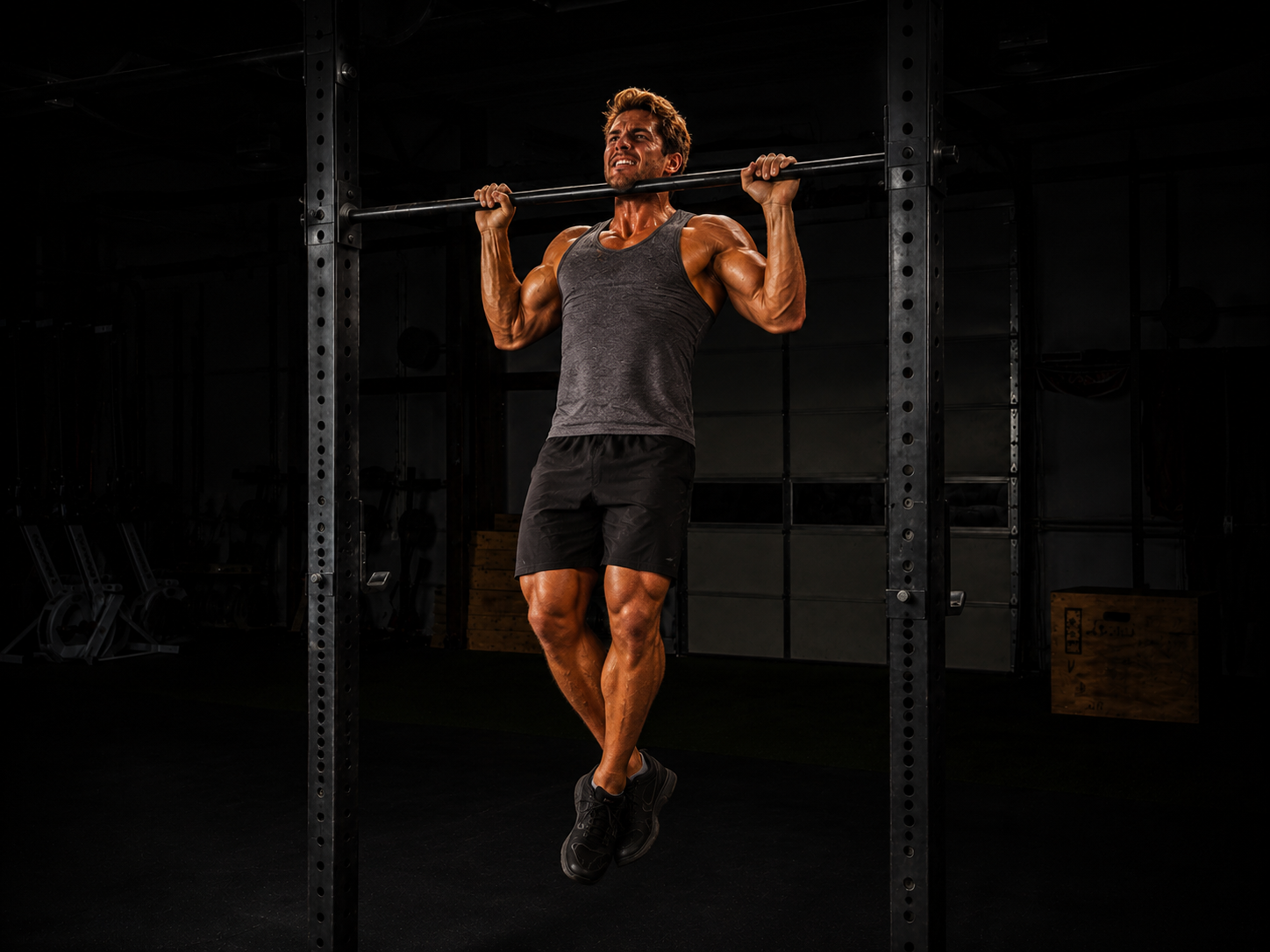
Pull-ups
Bodyweight Pull-ups
Weighted Pull-ups
Explosive Pull-ups
You either pull your own weight, or you don't.
If the squat is how a man stands up and the push-up is how he gets up, the pull-up is how he climbs. Over a wall. Onto a ledge. Out of a hole. The day a man's life depends on dragging his own body over an edge, this is the strength that answers or fails to.
The movement is one sentence long. Hang from a bar with the arms straight, pull until the chin clears it, lower back down under control. That is all of it, and it is the only movement in the building that cannot be negotiated with. There is no leaning into it. No bounce off the chest. No wall version, no knee version, no incline to hide on. You either move your bodyweight through the air or you do not, and the bar does not care what you tell it.
That is why the pull-up became the test. Firefighters, police, and the military lean on it because hauling your own body upward tracks with hauling a man out of a window or over a barricade — it measures something real and refuses to be talked out of the number. Bruce Lee, who weighed around 135 pounds, could pull his entire body up on one arm and hang from a bar by two fingers with the rest of him dead weight. At the far end, calisthenics men ride the same pull to the muscle-up and the one-arm, and a few have strung more than a thousand reps together without coming off the bar.
And most grown men, otherwise healthy, cannot do one.
That gap is the entire story of this room, and the reason for it is not weak arms. It is relative strength — the ratio between what a man can produce and what he is asking it to move. Every other lift in this gymnasium lets him choose the weight. Here the weight was chosen for him years ago, by everything he ate and everything he did not do, and it is standing on the scale in the morning telling him a number he thought was a separate conversation. The bar merges the two conversations. Two men can bench the same load and one of them owns the bar and the other one hangs there, and the difference between them is not strength. It is arithmetic they had been keeping in different columns.
So this room is not back-day tips. It is how one honest movement carries a man from a dead hang he cannot break up to feats most people will never touch. Three roads run off it, in order: the bodyweight ladder until a strict pull-up is easy, then load, then power.
The Strict Standard, and Why It Is Set There
A strict pull-up is: an overhand grip a touch wider than the shoulders, a dead hang with the elbows completely straight, a pull until the chin is clearly above the bar, and a controlled return all the way back to straight arms. No kick, no swing, no knee drive, no shrug at the top to buy an inch.
Every clause in that is doing work, and men shave every one of them.
The dead hang at the bottom is not optional. Stopping short of straight arms removes the hardest few inches of the movement and, worse, skips the part where the shoulder learns to hold the body's weight safely at end range. A man who never hangs fully never builds the tissue that keeps his shoulder healthy when something eventually forces him into that position without asking.
The chin over the bar is a floor, not a target. It is the minimum, chosen because it is unambiguous and a judge can see it. Nothing about clearing it by a millimeter is impressive; it is simply the line below which a repetition did not happen.
The kick is a loan. Driving the knees or throwing the hips generates momentum, and momentum is not strength — it is a substitute for it, borrowed at interest. It gets a man a number today and leaves the actual capability exactly where it was.
The way down is half the exercise. Dropping off the top and catching the next rep on the bounce trains one direction and skips the direction that builds the most. Lower under control or you have paid for a rep and collected half of one.
The reason for the strictness is not gatekeeping. It is that this is one of the few movements left where the standard cannot be quietly renegotiated with yourself, and a man who has one honest measurement of himself is holding something rare.
Bodyweight Pull-Ups
The main road, and the one that humbles every man who steps onto it honestly. Most men start below the first rung, unable to complete a single repetition, and that is where the build begins rather than where it stops.
The Dead Hang teaches the grip and the shoulders to carry the body's full weight and is the cheapest progress available to a man with nothing. Scapular Pull-ups ask you to pinch the shoulder blades down and lift the chest an inch without bending the arms, waking up the muscles that start every rep and that most men have never once consciously fired. Banded Pull-ups loop a band under a foot or knee to offset part of the load. Negative Pull-ups build the strength to go up by first owning the way down, and they are the most productive thing available to a man who cannot yet do one.
Then the standard laid out above: the Strict Pull-up, and nothing counted until it is clean.
From there it opens into dialects of grip — palms toward you, palms facing each other, palms away, hands wide — and each one changes something specific about which muscles carry the load and which joints stay comfortable while they do. Above all of them sits the chest-to-bar standard, which lengthens the range past the point the chin allows a man to stop.
At the top of the ladder wait the Archer Pull-up and the One-Arm Pull-up — relative strength taken to its conclusion, a man moving his entire body on a single hand. Bodyweight Pull-Ups walks the progression from a dead hang a man cannot yet hold to the one-arm, with the standard for clearing each rung.
Weighted Pull-Ups
The day arrives when a set of ten no longer costs a man anything, and the honest read on that is not that he has finished the movement. It is that the load stopped moving while he kept getting stronger, and the movement has quietly turned into a warm-up while he was still calling it training.
So you hang weight from yourself. A dip belt with plates, a loaded vest, a dumbbell pinched between the feet. It is the bridge between calisthenics and serious pulling strength, and it builds a back and a grip that repetitions alone stopped reaching some time ago. The ceiling is higher than most men picture: the strongest have hung well over two hundred pounds off the waist and still put the chin over the bar.
One order, and it is not negotiable here either: the strict repetition comes first, and the plate comes second. A man who adds weight to a pull-up that was already using a kick has just added weight to the kick, and the elbow or the shoulder will present the bill within the year. Weighted Pull-Ups covers what to load with, how much to add and how often, and the joints that need watching once the load is external.
Explosive Pull-Ups
Everything up to here has been about how much. This road is about how fast — the rate at which a man can deliver what he has, which is what lets him rip his chest to the bar or leave it entirely.
The road opens by simply pulling faster from a dead hang, climbs through the chest-to-bar and the high pull, and only then arrives at the Clapping or Release pull-up — pull hard enough to clear the bar, let go, catch it again. From there the road climbs to the Muscle-up, a pull explosive enough to carry a man up and over the bar into a dip on top of it. That is the movement that separates men who can do pull-ups from men who own the bar. It is also two things at once — a pull tall enough to get there, and a transition over the bar that is a skill in its own right — and the two are built in different rooms.
One warning belongs here and nowhere else on the page. The Kipping Pull-up — the swinging, hip-driven version made popular in competitive fitness — lets a man post large numbers quickly for conditioning, and it is a legitimate conditioning tool in a program that knows what it is doing. It is also a leading source of shoulder injury among people who adopted it as a shortcut to a number. It trades strict strength for momentum. Know exactly what it is and what it costs before you use it, and never mistake it for a measure of what you can pull.
Build the strict repetition first, always. Launching a body you cannot yet control is how men get hurt, and the bar is high enough off the ground to make that a real sentence rather than a figure of speech. Explosive Pull-Ups builds the half that cannot be finessed: the height.
Where This Goes Next
Those three roads are a branch. Take them in order when you are ready — the ladder, then the load, then the speed. The third one does not come back here; it is the deepest room in this building, and it lets out the far side.
And here is where the three movements end, because there is not a fourth. Stand up, press away, pull toward. Everything heavier in this building is one of those three carrying more, aimed differently, or done on one limb instead of two. The hundred exercises on the shelf outside stopped being a hundred exercises somewhere in the last three rooms and became variations you can now read on sight.
Which means the problem has changed shape on you.
You did not walk in here short of movements. You walked in short of the ability to perform them honestly, and that has been fixed. What you are short of now is a week — which of these, on what days, at what load, how often, and for how long before you are entitled to an opinion about whether it is working.
The floor cannot answer that one. It is a question for the shelf, and the shelf is where you came in.