
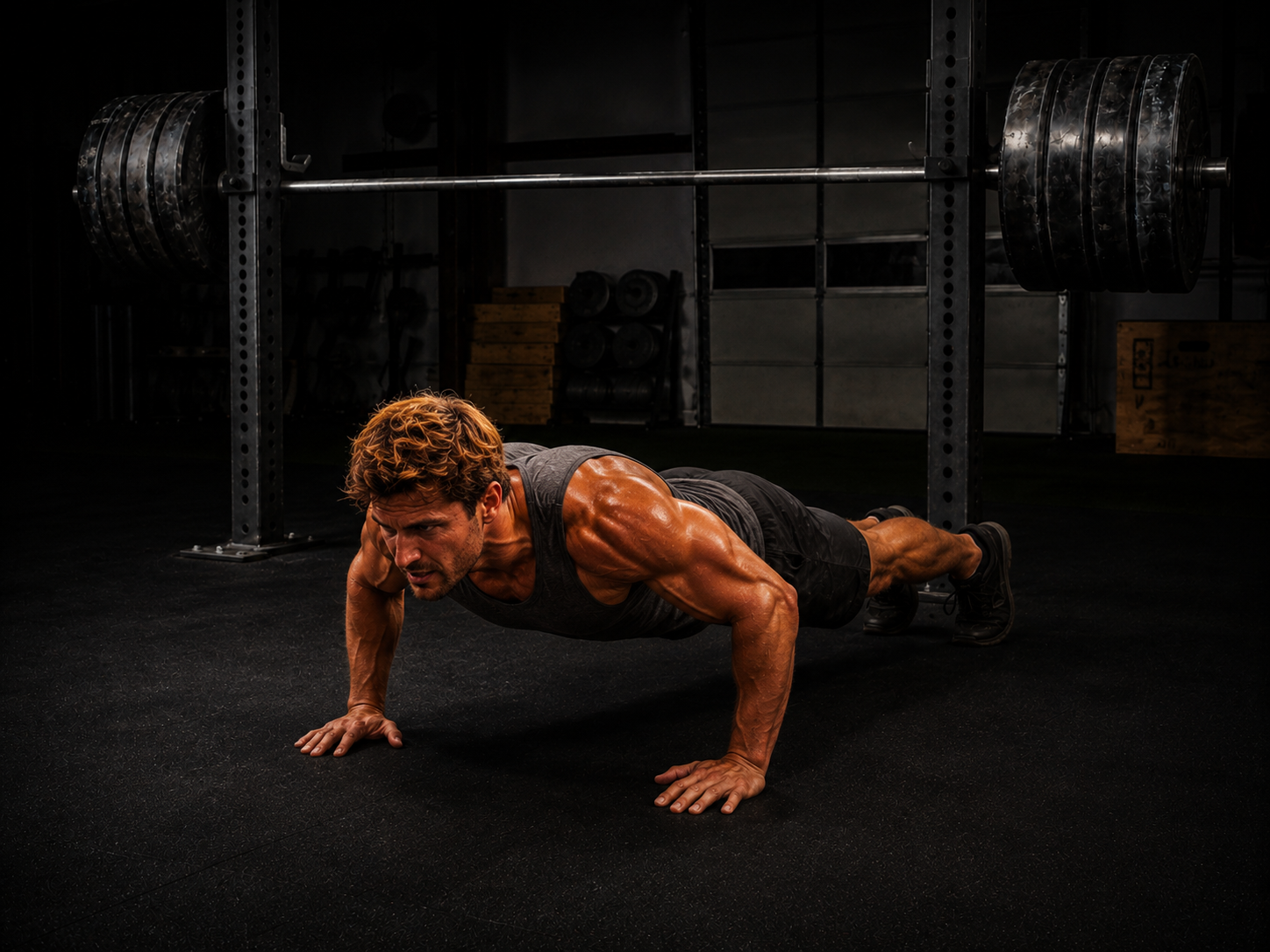
Push-ups
Bodyweight Push-ups
Weighted Push-ups
Explosive Push-ups
No gym. No bar. No excuse. Just the floor.
If the squat is how a man stands up, the push-up is how he gets up. Out of bed. Off the pavement. Up from wherever the day put him on his back. The pattern runs whether a number is attached to it or not, and it has never once required a man to own anything.
The floor has not changed since the last room. What changed is which way you are facing it. Down there you were pushing it away underneath you, and it was holding still and taking your weight and asking nothing. Now it is in front of your face, you weigh the same, and the only thing between you and it is two arms and a body that has to hold its own shape while they work.
That last part is the whole difficulty, and it is why the push-up is the most misunderstood movement in the building. Men treat it as an arm exercise and then wonder why forty of theirs are worth ten of somebody else's. It is not an arm exercise. It is a whole-body hold that happens to move — the trunk, the glutes, and the shoulders locking the body into one rigid line while the chest and triceps press that line away from the ground and lower it back down. Take the rigidity out and you are not doing an easier push-up. You are doing a different exercise, badly.
The men who proved what this movement can build never went looking for a barbell. Herschel Walker — Heisman winner, NFL running back, Olympic bobsledder, professional fighter into his forties — put it together on a living room floor, knocking out a set during every television commercial break until the reps stacked into hundreds and the hundreds stacked into a body that made grown men reconsider. Jack LaLanne built a career on the same floor work and once pressed out more than a thousand of them in a sitting. And at the far ceiling, gymnasts ride the identical pattern all the way to the planche — a push-up with the feet lifted clean off the ground and the whole body floating on the hands.
Same movement. Same floor. Sixty years of progress available and nothing to buy, which is the part most lifters miss. The push-up is not one exercise you master and retire. It is a ranked ladder that runs from something a recovering man can do standing against a wall up to feats a fraction of one percent of trainees will ever own, and the distance between the two ends is measured in years.
Three roads run off this floor, and you take them in order. First the bodyweight ladder, until the standard push-up stops being hard. Then load, because it will. Then speed, because strength you cannot deliver quickly is only half of what you built.
The Standard, and How Men Cheat It Without Meaning ToBodyweight Pushups
There is one push-up everything on the ladder is measured against, and it is worth stating exactly, because almost nobody was ever taught it and almost everybody thinks they know it.
Hands just outside the shoulders. Body in a single line from the heels through the hips to the back of the head — no sag, no pike. Elbows tracking back at somewhere near forty-five degrees from the ribs, not flared straight out to the sides. Down until the chest is at the floor. Up until the elbows are locked. Under control both directions. Breathe out on the press.
Now here is what actually goes wrong, and the reason it goes wrong is never laziness. It is fatigue finding the cheapest available shortcut, and the body is very good at that.
The hips sag. The trunk gives up before the arms do, the belly drops toward the floor, and the lower back takes a load it did not sign on for. The man feels his arms still working, so he assumes the set is still good. It is not. This is the single most common fault in the movement and it converts a whole-body exercise into a lower-back exercise, one rep at a time.
The hips pike. The mirror image, and the one men do deliberately without noticing. The rear goes up, the body folds, and the arms are suddenly pressing a shorter lever with less bodyweight on it. It looks like a push-up from the side. It is roughly two-thirds of one.
The head goes first. The chin dips toward the floor while the chest stays six inches above it, and the man counts the rep. Under fatigue this becomes the entire movement — a head bob with the arms bent slightly. Set the eyes on the floor a foot ahead of the hands and the neck stops volunteering.
The bottom half disappears. Range collapses from the bottom, because the bottom is where it is hardest. Half a repetition trains half a movement, and the half being skipped is the half that mattered.
The elbows flare wide. Straight out at ninety degrees to the body. It feels stronger for a few weeks and it is the standard way to hand yourself a shoulder problem in your thirties.
Every one of those is the same failure wearing different clothes: the body ran out and negotiated a discount. The fix is never to push through it. The fix is to stop the set at the last honest repetition, which for most men is a good deal earlier than the number they have been telling people.
Bodyweight Push-Ups
This is the main road and the one no man ever ages out of. Every man steps onto the ladder at whichever rung humbles him, and there is no shame anywhere on it.
At the bottom, wall, incline, and knee push-ups let a beginner — or a man coming back from an injury or a surgery — press a fraction of his weight by raising the hands or dropping to the knees, while scapular push-ups and slow negatives teach the shoulders to hold the line before any real load arrives. Then the standard push-up, the rung everything else is measured against.
From there the ladder splits by target — hands close, hands wide, feet raised, hips piked to tip the weight onto the shoulders and begin the press that eventually goes overhead. Each of those is a different job rather than a harder version of the same one.
Higher still it stops being an exercise and becomes a feat: one arm carrying most of it, then the shoulders leaned out past the hands, then the one-arm and the handstand and the plank — with rings available to make any rung on the whole ladder harder than it was.
You can climb this for the rest of your life and keep finding rungs. Bodyweight Push-Ups walks the whole progression, wall to plan, with the standard for clearing each rung before you reach for the next.
Weighted Push-Ups
There is a day when forty clean push-ups stop being strength training and start being conditioning. Both are worth having; they are not the same thing, and a man who wants the first has to notice when he has drifted into the second.
That is the day you add weight. A loaded vest, a plate or a sandbag laid across the upper back, a heavy band looped over the shoulders and pinned under the hands — real resistance returned to a movement your body has outgrown. It sits about a third of the way up the ladder: harder than a standard push-up, lighter than one-arm work, which makes it the honest next step for a man who has run out of repetitions but is nowhere near balancing on a single hand.
Done right it bridges calisthenics and the bench, building genuine pressing strength without ever leaving the floor. The rule is the one that governs everything on this page: own the form, then add the load, and never the reverse. Weighted Push-Ups covers what to load with, how to add it, and how to keep the line rigid once there is a plate sitting on it.
Explosive Push-Ups
Strength you cannot use fast is half-built. The explosive push-up trains the other half — the rate at which force arrives, which is the quality that throws a punch, breaks a tackle, and shoves a man off you at the one moment it counts.
You press out of the bottom hard enough to launch the hands off the floor. The Clap Push-up is the gateway, and the road climbs from there through Triple-claps, full-body "Superman" push-ups, and the 180-degree and plyometric variations that the athletic and fighting worlds are built on. These score among the hardest movements on the whole ladder, because launching a body is a harder problem than pressing one.
This road asks for a base underneath it first. A man who cannot control the descent has no business trying to leave the floor, because the landing is the part that hurts people and the landing is what he has not trained. Explosive Push-Ups lays out the progression from a first clap up, including the landings.
Where This Goes Next
Those three roads are a branch, not the walk. Take them in order when you are ready — the ladder, then the load, then the speed — and the third one puts you out at the next movement rather than back here.
Because there is still half a body unaccounted for.
Everything so far has been a press. You pushed the ground away beneath you and then you pushed it away in front of you, and in both cases the ground was there, solid, taking whatever you gave it. Push is one half of what the upper body does. The other half is pull, and it is the half a man cannot fake, cannot buy a machine to flatter, and cannot do at all until he can do it.
There is no wall version of the next movement. You hang, or you do not.