
Recipes & Ingredients
The Champion’s Plate
Herbs & Spices
Acids & Sweeteners
Condiments & Flavoring
Food Inventory Log
Recipe Box
A man doesn't need a hundred recipes. He needs ten he owns.
Ask the chef for his recipes and watch what he does. He doesn't walk you to the shelf of glossy cookbooks — every kitchen has that shelf, and it's mostly decoration. He reaches under the counter and pulls out a notebook. Stained, taped at the spine, handwriting only he can read. "Thirty years of cooking," he says, tapping it, "and it fits in one book. Not because I know few dishes — because I know which ones are mine. Every meal in here I've cooked a hundred times. I could make them in the dark. That's not a cookbook. That's a repertoire — and before you touch a shopping list, you're going to start one."
You just wrote a menu, and if you are honest about how that went, you got four dinners down and then stalled. That is not a discipline problem. A menu is drawn from somewhere, and nobody has ever asked you to write down what you can actually cook. So the page went blank, and you filled the rest with whatever came to mind, which is how most men end up eating the same handful of meals for twenty years without ever deciding to.
This room fixes that, and it comes before the shopping trip on purpose. Two things get built here: the short list of meals you own, and the shelf of ingredients that keeps them one decision away. Get both and the menu stops being a blank page, the shopping list writes itself, and every station after this one has something real to work on.
Your Vocabulary at the Stove
Think of cooking like a language. A recipe you've made once is a word you looked up in a dictionary — you saw it, you sounded it out, and by next week it's gone. A recipe you've cooked twenty times is a word you own. You don't think about it. It comes out right under pressure, on a tired Tuesday, with a kid pulling on your leg. The more meals you own, the more fluently you feed yourself and your family — and fluency, not fanciness, is what keeps a man cooking for decades instead of quitting by spring.
Here's why this matters so much. The man with no repertoire pays full price for every single meal: decide what to cook, hunt down a recipe, discover he's missing half the ingredients, fumble through unfamiliar steps. That bill comes due every night, and it's why most men's cooking dies — not for lack of skill, but from the grind of starting from scratch every time. The man with a repertoire paid that cost once per dish, years ago, and has eaten off the investment ever since. The ingredients are stocked. The steps are in his hands. Dinner is execution, not invention.
And be honest about where your current repertoire came from — because you have one, even if you never built it. It's whatever your mother happened to cook, plus whatever you stumbled into in your twenties, minus everything you've forgotten. That's not a repertoire; that's an inheritance you never audited. Most men eat off that accident for fifty years. You're going to build yours on purpose.
The Box with the Eagle on It
Here's a piece of history worth knowing — because fifty years ago, America already had this station figured out.
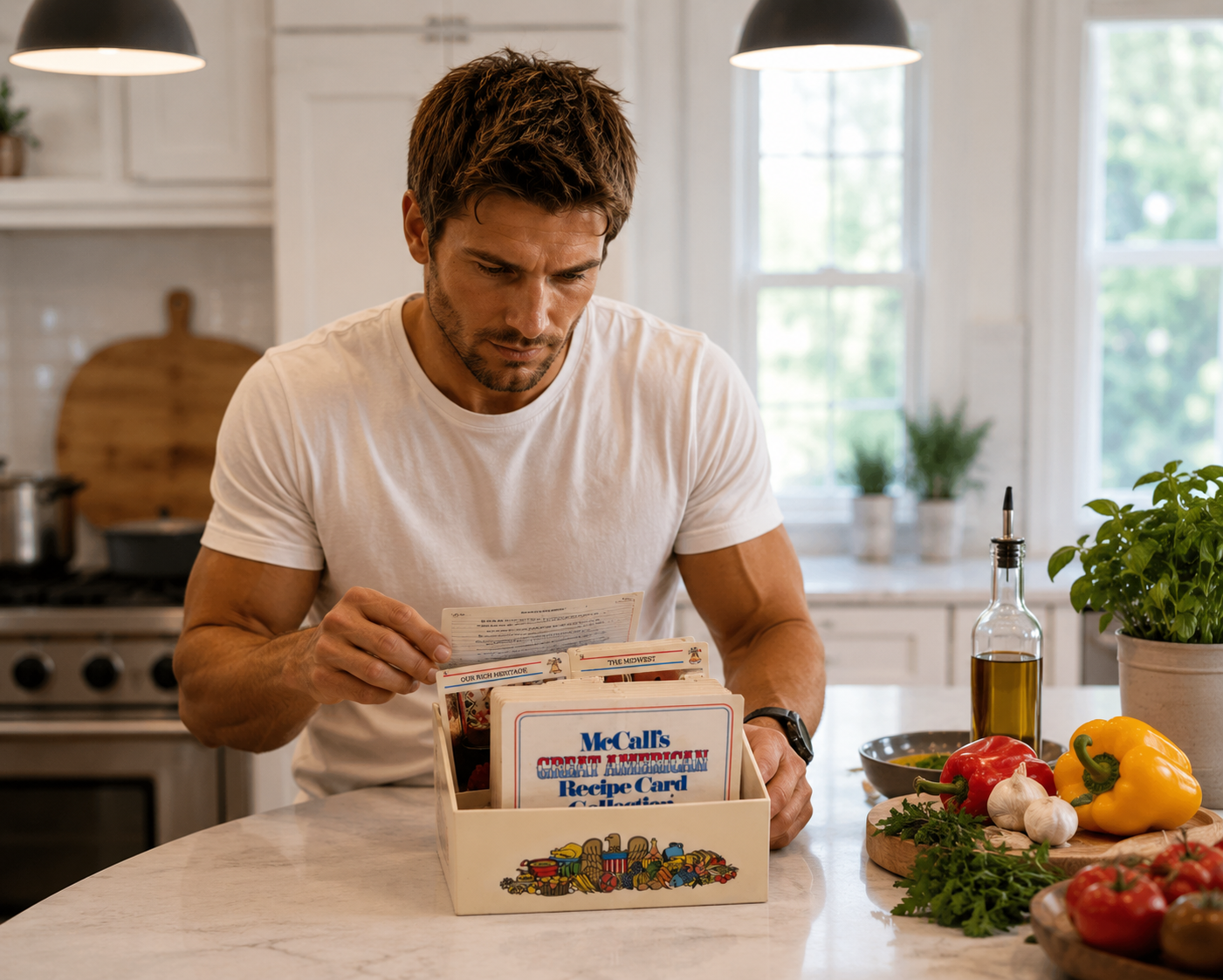
In 1973, McCall's magazine published the Great American Recipe Card Collection: six hundred oversized recipe cards, printed on both sides, sorted into twenty-four lettered categories, A through X, all of it packed in a red, white, and blue plastic box with a bald eagle on it. It landed on kitchen counters across the country, and the category names alone tell you what a home used to be organized around: Our Rich Heritage. Famous Restaurants. Sundays at Home. Saturday Night Parties. County Fairs. Even Low-Calorie Dishes — some worries never change.
The food on those cards was of its time — mashed potatoes and gravy, casseroles, heavy plates built for a crowded table — and this page isn't asking you to cook much of it. That was food from an era when the family table was the comfort of the week, and the plates were built accordingly. What you should take from the box isn't the menu. It's the idea.
Because look at what that eagle box actually was: a filing cabinet for dinner. A house that owned one could answer the seven o'clock question by flipping to a card. Sunday's big meal lived under one letter, the party food under another, the prize-winning pie under a third. And McCall's was only selling a polished version of something American kitchens already ran on — the plain wooden recipe box. Hand-copied index cards in your grandmother's handwriting, and her mother's before her. A card got stained because a dish got loved; the gravy spots were the rating system. When a daughter married, cards were copied for her box. When a grandmother passed, the recipe box was one of the first things the family asked about. That's not sentimentality. That's a repertoire — cataloged, indexed, and handed down like the treasure it was.
Then it vanished. The internet promised better: why keep six hundred cards when you can search ten million recipes? But watch what actually happened. Ten million recipes in every man's pocket, and still no answer at seven o'clock — infinite access, zero ownership. The card box knew something the search bar doesn't: a family isn't fed by access to recipes. It's fed by a short, organized, findable collection of the meals that house loves. We didn't outgrow the box. We lost it — and this station brings it back.
What an Ingredient Actually Is
Before the rotation, the chef wants a word about the other half of this station's name — because ingredient is a word that means two completely different things depending on who's saying it, and a man who can't tell the difference is about to walk into a supermarket and get robbed.
When a cook says ingredient, he means an edible thing you make a dish out of. Look at his shelf and you'll find only a handful of kinds:
Real food, cut up. Meat, fish, eggs, milk, vegetables, fruit, beans. Food that was recently alive or came straight off something that was. This is the bulk of every home-cooked meal on earth.
Food pressed out of food. Butter churned from milk. Oil pressed from olives. One real food, concentrated from another. Still food.
Gifts from the landscape. Honey. Maple syrup. Salt from the sea or the earth. Nobody eats them by the spoonful; everything tastes better with them in the right amount.
The kitchen's helpers. Baking powder, yeast, vinegar — the small workers that make dough rise and flavors brighten.
Herbs and spices. Leaves, barks, seeds, and roots that carry almost no nourishment and almost all of the pleasure — the cheapest upgrade in your whole kitchen.
That's the cook's entire world. Now flip over a package from the center store and read its ingredient list, and you're in a different world wearing the same word. Food taken apart into fractions — modified starches, hydrogenated oils, proteins isolated in a plant and shipped in drums. Substances no human would ever eat on their own — colorings, flavor enhancers, preservatives, fat replacers. Vitamins sprayed back in to replace what the processing stripped out, so the box can brag about what the factory first removed. And bottled "seasonings" — sauces and dressings that are themselves little factory products stacked inside a bigger one.
Same word. Two worlds. Your repertoire gets built from the first list — and carry that distinction into the aisles next week, because it is the single fastest label test there is. A short list of ingredients you'd find in a kitchen means food. A long list of ingredients you'd find in a laboratory means the word is being used against you.
Five Rooms, In Order
Five rooms off this one, walked in the order a plate is actually built — from what goes on it, through what goes in it, to what goes on top at the table, and finally to what is already in your house.
The Champion's Plate — what the food should be. Start here, because everything downstream decorates it. Eleven foods that could carry ninety percent of a man's eating, and the ten percent left deliberately free. Get this right and no recipe in the world can do you much harm; get it wrong and no recipe can save you.
Herbs & Spices — the flavor that goes in during the cooking. Leaves, seeds, barks and roots, layered in while the heat is on. The cheapest upgrade available to any kitchen, the reason the same chicken tastes like four different dinners, and the difference between eating your rotation gladly for years and abandoning it out of boredom by March.
Acids & Sweeteners — the two dials that fix a flat dish. Lemon, vinegar, wine, tomato on one side; honey, maple, sugar and the sweeteners that pretend to be them on the other. Almost every home-cooked meal that tastes dull rather than wrong is short one of these two, and a man who learns to reach for them stops needing anything from a bottle.
Condiments & Flavoring — what goes on at the table. Last in, because it is applied last: the sauces, dressings, spreads and shakers that arrive after the cooking is done. It is also where the most sugar and the worst oil in an otherwise disciplined kitchen quietly hide, which is exactly why it is walked at the end rather than assumed at the start.
Food Inventory Log — what you already have. The room that turns all of the above into a shopping list. Two minutes in the pantry, fridge and freezer before you write anything down, so you buy what is missing instead of a third bottle of mustard — and so the meals you own get cooked out of stock you already paid for.
The Recipe Box
Alongside those five rooms sits the thing this whole station is named for: Recipe Box — your own edition of the eagle box, already stocked to start you off.
It is not a walk and you are not meant to read it front to back. It is a box you open when you need a dish, sorted the way a kitchen actually thinks: Breakfast, Smoothies & Blends, Mains, Baked Goods, and No-Bake Treats. Every card in it lists real ingredients, honest macros, and a method short enough that a man with no cooking history can follow it tonight.
Use it the way the chef used his notebook. Raid it for candidates, cook one, cook it again, and if it survives four passes and the people at your table ask for it, it has earned a place in your rotation. What does not survive gets left in the box for somebody else. The box is the starting stock. The repertoire is what you take out of it and make yours.
The Stocked Shelf
A repertoire runs on staples — the short list of ingredients your meals draw on again and again, kept in the house at all times. When the staples are stocked, dinner is always possible; when they're not, the best repertoire in the world is theoretical. Yours will take shape around your own rotation, but every man's shelf starts about here:
Salt, pepper, and your working spices. Olive oil and butter. Onions and garlic — the starting point of half the world's cooking. Eggs, chicken, and ground beef — proteins that turn into a dozen different dinners. Rice, potatoes, and beans — the starches that stretch a protein into a meal. And vegetables that rotate with the seasons, because they're cheapest and best at their peak.
Notice what that list is: it's the perimeter of the grocery store, plus a raid on two aisles. Your shopping trip and your repertoire are the same system seen from two ends — which is exactly why this room comes before that one.
How a Recipe Earns Its Place
Not every recipe you cook joins the repertoire — and the ways men fail here are so predictable the chef can list them from memory.
The collector. Forty cookbooks, six dishes. Owning recipes is not cooking them, the same way owning a barbell is not training. The repertoire is what you execute, not what you shelve.
The one-and-done. He cooks a new dish, it goes fine, he never makes it again. One pass teaches you almost nothing. A recipe earns its place at around the fourth cooking — once to learn it, once to fix what went wrong, once to confirm the fix, once to make it yours. Below that, it was a cooking event, not a skill.
The one-song jukebox. Everything he cooks is from the same tradition — usually his mother's. Nothing wrong with the tradition; everything wrong with the ceiling. Borrow a few dishes from the Mediterranean, a few from Asia, a stir-fry, a curry, a proper taco — and the rotation stops feeling like reruns.
The recipe slave. He can follow instructions but can't cook — miss one ingredient and the whole dinner collapses. The cure is learning the why under the what, and that is what the craft rooms further down this section are for. A man who knows the principles can open the fridge and improvise; a man who only knows recipes is helpless without the page.
The weekend performer. His repertoire is all showpieces — the six-hour smoke, the special-occasion roast — and nothing he can land in thirty minutes on a Wednesday. The showpieces are worth having. But the repertoire that keeps a family fed is mostly fast, simple, and repeatable; the fireworks are the exception, not the plan.
The man who never asks the table. He tracks what he likes to cook and never notices what his household loves to eat. Watch the plates. The dishes that come back empty, that the kids request by name — those are your core rotation, because a repertoire the family celebrates gets cooked forever, and one that serves only the cook slowly starves at the table. Feeding people what makes them glad is half the reason a man learns this at all.
Build Your Own Box
Now the build — and it's slower and simpler than you want it to be. You're going to do what McCall's did for the whole country: catalog and index the meals of your house. One dish, one card. Ingredients on one side, steps on the other. Actual index cards in an actual box on the counter work beautifully — there's a reason the thing lasted a century — and a note app or a folder of pages works too, as long as it's yours, it's short, and you can flip to any dish in ten seconds. The tool doesn't matter. The catalog does.
Start with what you already own. Write a card for every meal you can cook reliably right now, without looking anything up. For most men that's four or five cards. No shame in the number; that's the starting line, and now it's honest — the box holds what you actually cook, not what you'd like to believe you cook.
Grow it one card at a time. Pick one new recipe — the Recipe Box upstairs is full of candidates. Cook it this week, again next week, again the week after, until it's yours. Then it earns its card; writing the card is the little ceremony that says this dish made the team. A man who adds one card a month has a box of ten inside a year and never felt like he was studying.
Aim for ten cards — then let the years take you to twenty. Eight or ten reliable meals is the working target, wide enough to rotate for weeks without boredom. Keep cooking and the box keeps filling on its own; the veterans of this station carry fifteen or twenty without trying.
Index it like McCall's did. Twenty-four categories is a nation's box; yours needs about four. Weeknight — thirty minutes or less, the bulk of the box. Sundays at home — the slower meals for the day there's time. Batch favorites — cook once, eat for days. And signatures — the one or two dishes you're known for, the cards you pull when there are guests at the table and you want to feed them something with your name on it.
Then let the box run the week. Your Weekly Menu stops being a blank page and becomes a simple draw from the cards you own. This is where the whole kitchen snaps together: the menu draws from the box, the list comes off the menu, the trip fills the shelf, Sunday preps it, and the week eats like it was planned — because it was.
And notice what you're really building, because it's bigger than dinner. A man who catalogs his meals is running his kitchen the way he's learning to run everything — organized instead of improvised, stocked instead of scrambling, ready before the need arrives. The box outlives the week, too. Twenty years from now, a stained card in your handwriting — the dish your kids ask for by name — is the kind of thing that gets copied when they leave home and kept when you're gone. Your grandmother knew that. It's time somebody in the family knew it again.
Where This Goes Next
The chef closes his battered notebook and slides something across the counter: a small stack of blank index cards.
"My book took thirty years. Yours starts with four cards and the meals you already own. Write them down, walk the five rooms, and stock the shelf. Then, and only then, do you get to go shopping — because a man who walks into that building without this" — he taps the cards — "is not shopping. He is browsing, and the store is very, very good at browsing."
That is the whole reason this room came second. You now have a menu drawn from meals you can genuinely cook, a shelf you know how to stock, and a two-minute count of what is already in the house. All three collapse into one page, and that page is the only defense you have against a building engineered from the floor up to sell you things you never came for.