
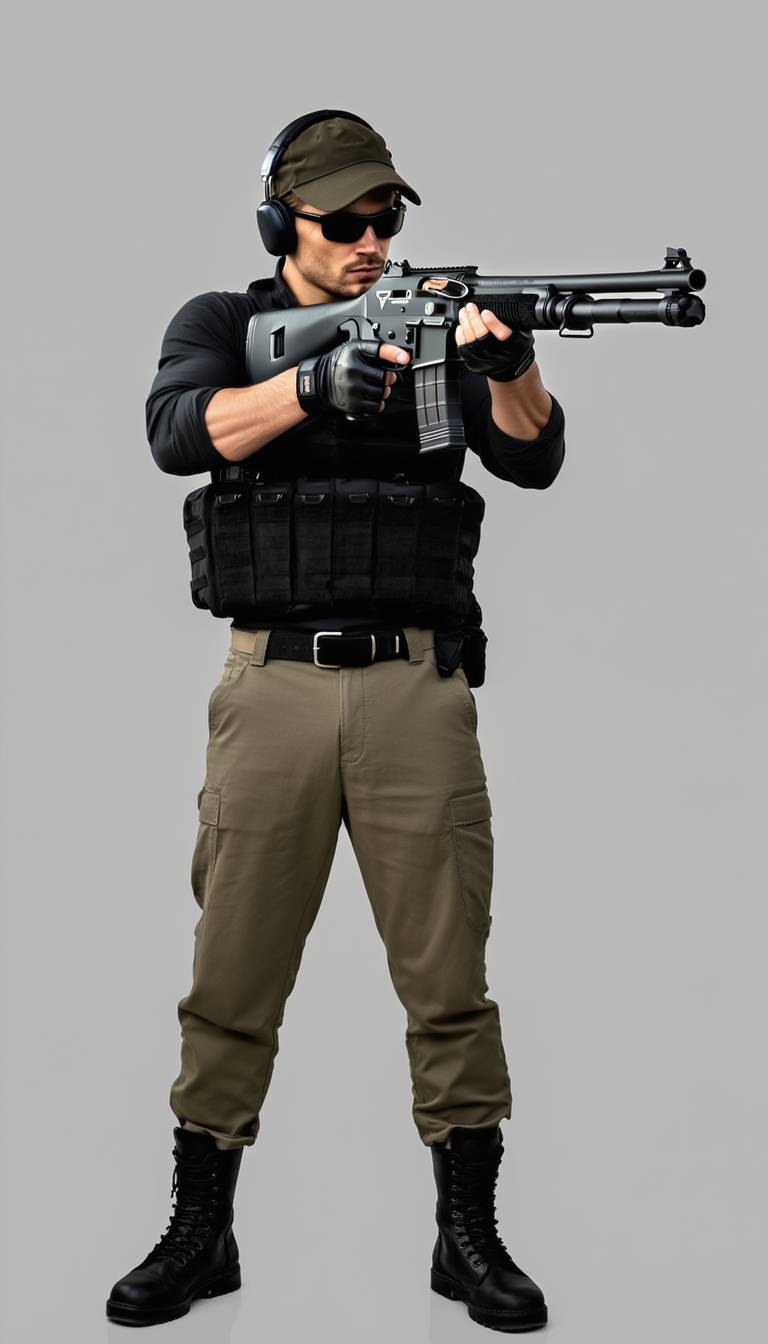
Shotguns
Break & Lever Action Shotguns
Pump-Action Shotguns
Semi-Automatic Shotguns
The Shotgun Rack
The Armorer does not start at the rack. He starts with a staple gun and a sheet of butcher paper, and he asks you how long the hallway is between your bedroom door and the top of your stairs.
You tell him. He paces it off across the shed floor, staples the paper to a frame at that distance, hands you a plain pump shotgun with one shell of buckshot in it, and says, "Middle of the paper." You fire, and the recoil surprises you more than the noise. He walks you to the paper. Nine holes, in a circle you could cover with a coffee mug. "That's your hallway," he says. "That's what the gun you were told you couldn't miss with does in the place you bought it for. Now watch." He moves the frame out to the far end of the shed, farther than your hallway by a good deal, hangs a fresh sheet, loads one shell of the same buckshot, and fires. Nine holes, spread across a circle the size of a door, and two of them off the paper. "Same gun. Same shell. That's forty yards. Both of those targets are true, and neither one is what you were told. The whole country owns this gun and the whole country believes the second target happens in the first place. The men who found out otherwise found out in their own hallway."
He hands the gun back with the action open. "Last gun on the wall. Everything about it is backwards from what you've heard, and by now you've spent two bays learning how much of hitting was ever yours, so you're ready to hear it."
This is the shotgun rack, the third of the three platforms and the last, the gun in more closets, farm trucks, and inheritances than anything else with a trigger, and the one running on more myth than the other two combined. The bench taught the four rules and the handgun and rifle bays taught a man what his hands are worth, and this floor assumes all of it. This page is the door: what a shotgun is and why it is two guns wearing one stock, the four rooms in the order they are walked and why, the five jobs the gun does, the myths killed in order, the strange corners, the mistakes that belong to this rack alone, and why the last gun on the wall hands the walk to something that is not a gun.
What a Shotgun Is, and Why It Is Two Guns
A shotgun is a long gun with a smooth bore, no rifling, fired from the shoulder, and built to launch a payload rather than a bullet. That last word is the whole rack.
The rifle and the pistol send one projectile, spun by the barrel, on a line. The shotgun sends whatever the shell holds: a few hundred tiny pellets for a bird on the wing, nine or so heavy ones for the gravest moment of a man's life, or one slug the weight of a roll of quarters that turns the smoothbore into a short, brutal rifle. One bore, many missions, and the mission is decided shell by shell before the gun ever comes up. That is the shotgun's genius and its discipline in one sentence. The shotgun is never one gun. It is whatever its owner loaded, and he had better have loaded it on purpose.
And it is two guns in a second sense, older than the first, which is why the bay walks it the way it does. The shotgun has a soul in the field and a soul at the door, and they are different souls that happen to share a stock. The field gun is pointed, not aimed. The eyes lock on a moving target, the gun comes to the face and swings along the bird's line and through it, and the shot breaks while the gun is still moving, the brain solving an interception problem the way a hand catches a thrown ball. That skill is the shotgun's native one, the oldest, and the hardest thing in the hall to do well, and it is a sport and a joy and a thing fathers hand to sons. The door gun is the same tool turned to its gravest use: nine pellets delivered as one decision at the length of a hallway, where the pattern is a fist and every pellet is aimed, and a miss is a miss with nine projectiles attached. A man who owns the shotgun for the door and has never shot the field has half a gun. A man who shoots the field and has never patterned the door has the other half. The bay is built to give him both.
The Bay, Walked in Order
Four rooms, and the order runs from the class through the three families of the gun, oldest and simplest first, most machinery last.
Shotguns 101 — the first class at the smoothbore. The Armorer's bench with the last gun: the mount that comes to the face and not the face to the gun, the eyes as the rear sight, the swing, the patterning board as the only honest witness, the gauge in one paragraph, the recoil and the fit, the four rules with the smoothbore's own addition, and the lines the law draws on the barrel. Beneath it, three rooms that are reference rather than walk: Gauges & Shotshells, where gauge is backwards arithmetic and the shell wall is read honestly; The Defensive Shotgun, the doorway duty done right, from the setup to the feeding drill; and the shelf of Shotgun Reviews, with the reading lesson pointed at from the handgun bay.
Break & Lever Action Shotguns — the gun that opens like a book. The oldest family and the most honored: the double gun of the field and the clay line, side by side and over and under, the single-shot that taught a century of boys, and the lever gun Browning built for the express companies. The room is held by the most titled shotgun shooter who has ever lived, a butcher from the south coast of England who claims no talent and thirty world championships, and who broke a clay at a hundred and thirty yards with the gun this room is about.
Pump-Action Shotguns — the gun America already owns. The closet gun, the farm-truck gun, the squad-car gun of three generations: cycled by hand, simple past breaking, cheap enough that no household that wants one lacks the money, and carrying the one weakness that lives in the owner rather than the gun. The room tells the pump's American century from the trench gun the enemy protested to the two rivals that have sold twenty-three million between them, and teaches the stroke that has to survive fear.
Semi-Automatic Shotguns — the gun that cycles itself. The newest family and the one the serious defensive and competition worlds have moved to: gas and inertia, softer recoil and faster follow-ups, the ammunition it is picky about, and the household shooter it exists for. The room closes the rack, and with it the gun, and hands the walk to the thing on the wall that is not a gun.
The order is the Armorer's. The class first, because the shotgun's fundamentals are not the rifle's and a man who mounts a shotgun like a rifle will miss every bird he ever swings at. The break-action second, because it is the oldest, the simplest, the safest first gun a household can own, and the gun the shotgun's master skill was built on. The pump third, because it is the gun most men actually have, and because its lesson, that the reliability is in the hands, lands on a man who has just learned what the hands do on a double. The self-loader last, because it is the most machinery, the most money, and the best answer to the question the pump raises. There is no fifth room. When the semi-automatic room closes, the rack is done, and the wall keeps going.
What the Shotgun Is For
Five jobs, and most men own the gun for one and never learn the other four.
The door. The gravest job and the one the country knows the gun for. Devastating at hallway distance, simple under terror, and unforgiving of the owner who never set it up or ran it. The class beneath the first room carries the whole doctrine.
The bird field. Where the gun began, and where it still lives most honestly. Dove in September, ducks at first light, a boy's first pheasant behind a dog. The shotgun is the great American teaching gun, sized for growing frames, with the patience of a Backcountry morning attached.
The clay line. Skeet, trap, sporting clays: the gun's native sport, cheap to enter, deeply social, and the finest wingshooting classroom ever built. A Saturday round with old men watching is the best coaching money barely has to buy, and the man in the break-action room rules this world.
The deer of the shotgun-only states. A slug turns the smoothbore into a hundred-yard rifle, and in the states and counties that forbid rifles for deer, the shotgun with a rifled barrel and a scope is the deer gun, and a serious one.
The games with a clock. Three-gun runs the shotgun beside the rifle and pistol on a timer, and its loading wizardry, born on the clock, is the best thing that ever happened to the door gun's feeding skills.
The Myths, Killed in Order
No gun on the wall carries more folklore, and the rack kills it in the order it gets men hurt.
The spread aims the gun for you. The Armorer's two sheets of paper answered that. At hallway distance the pattern is a fist, and every pellet is aimed or every pellet is wasted.
The sound of the pump ends the fight. It ends the fight with the kind of man who was going to leave anyway. The doorway room beneath the class buries this one properly; the rack only notes that a plan whose first step is a noise has no second step.
Birdshot for the house, because it will not go through walls. It does, and having done so it lacks the weight to end the man it was fired at. The shell room beneath the class does the arithmetic; the rack only says that a shell named for birds was named honestly.
The .410 for the wife, because it is small. The smallest bore is the hardest to hit with, throws the thinnest pattern, and gives up the most, and handing it to the household's smaller shooter as the easy gun is the same error the handgun bay named with the snub-nosed revolver. The honest answer for that shooter is a twenty-gauge with a stock that fits, and the shell room says why.
You cannot miss. Every experienced shotgunner has missed a bird at fifteen yards with a pattern the size of a bedsheet, because the eyes went to the barrel. The shotgun is the easiest gun on the wall to fire and the hardest to run well, and the honest instructors call it the expert's gun wearing the beginner's reputation.
Shorter is handier, so saw it off. Eighteen inches of barrel and twenty-six overall are federal floors, and below them the gun is a registered firearm that must be registered before the cut, not after. The paperwork is free as of this year. The felony is not.
The Strange Corners
The drum-fed monster. A fully automatic twelve-gauge with a twenty-round drum, built for a market that never existed, famous from films and from a decade of internet video, and owned by almost nobody. Dumb and awesome, in the words of the man who wrote it up, and the room agrees with both words.
The fourteen-inch "firearms." Guns built on the pump and semi-automatic actions with a bird's-head grip instead of a stock and a barrel four inches under the shotgun's legal floor, sold without a federal form, because a gun that never had a shoulder stock is, in law, not a shotgun, and so cannot be a short one, as long as it stays over twenty-six inches. The definition is real and the corner is lawful. The room's word for the guns is the same as for the derringer: fun, occasionally useful, and sold to more men than have learned the gun they were built from.
The breaching gun. A short pump with a toothed muzzle, built to be pressed against a door and fired at the hinges. A tool for men who enter buildings for a living, and the far end of this building tells what that work is.
The magazine-fed pump and the bullpup. Box magazines on a pump gun, and actions folded behind the trigger to shorten the whole. Real answers to real problems for a few men, and a heavy, fussy novelty for most.
The .410 revolvers. Handguns that fire the smallest shotshell and are sold as shotguns for the pocket. The handgun bay's last room already said what a .410 from a three-inch barrel is, and it is not a shotgun.
The punt gun and the market hunter. A shotgun with a two-inch bore mounted on a boat, fired into rafts of sleeping ducks by the hundred, and the reason the game laws exist. History, and a reminder that the field's rules were written in blood that was mostly birds'.
The pattern holds from two bays back. The center is a double, a pump, and a man who has patterned both and shot a round of clays with each.
What the Shotgun Owner Gets Wrong
The rack's parent named the owner who has never patterned, and that mistake is his. These are the smoothbore's own.
He bought a twelve for a shooter who needed a twenty. The gun kicks harder than the household's other shooter can manage, and so it is his gun and nobody else's, and the night the noise comes he may not be home.
The stock is too long. Cut for a large man in a field coat, and he is neither, and so the mount is slow, the recoil is worse, and the gun comes to the face crooked every time. The cheapest fix on the whole rack, and almost nobody makes it.
The door gun has no light. The four rules say know your target, and at three in the morning that rule has a hardware requirement, and he has not met it.
He has never run the pump hard. Every stroke of his life was a gentle range stroke, and the violent, complete stroke that survives fear is a different motion he has never made.
He has never shot a moving target. He owns the field gun and has only ever fired it at paper that holds still, and so the skill the gun was built for is one he has never once used.
He loaded it from the box on the shelf. Birdshot, because it was there. The shell room and the Armorer's two sheets of paper answer him.
He trusts the sound. The myth section already buried him.
He owns the hacksaw and has read nothing. The shortest room in the law is the one that says eighteen inches, and he is about to make a felony out of a Saturday.
The Three Pillars at the Shotgun Rack
TRUTH at this rack is the patterning board, and it is the most honest witness in the hall because it argues with nobody. Every barrel throws every shell differently, and no box, no counter, and no film will tell a man what his gun does at the length of his own hallway. Paper at measured distances will. The rifle bay wrote its truth in a notebook; this rack staples it to a frame.
LOVE at this rack is the household on both sides of the gun. It guards the door for the people asleep behind it, and every pellet it sends in a house is the owner's, through the wall and past the target and into the dark, which is why the shell choice and the pattern map of his own home are acts of care and not hobby trivia. And it is the gun that builds the family: the single-shot at the clay line, the first dove field, three generations in one duck blind. Few tools in the building hand down as well, and none of them hand down a skill as joyful.
LAW at this rack draws its lines on the barrel. Eighteen inches and twenty-six overall are the federal floors, the sawed-off below them is a felony without the registration, the fourteen-inch not-a-shotguns live in a definition the owner must actually understand, and the field carries its own code of seasons, plugged magazines, and shot that may not be lead. The reading runs through Legal Defense before the hacksaw, the build, or the hunt.
Walked as a System
The gun is two guns, and so the rack is four rooms and not three. The class puts the field mount and the door pattern into a man in the same hour. The break-action room gives him the oldest family and the master skill, and the man who owns more of that skill than anyone alive. The pump room gives him the gun he already has and the stroke that makes it reliable. The self-loader room gives him the answer to the pump's one weakness and closes the rack.
Three doors stand open when the rack is done. One leads down the wall, to a tool with no payload and no range at all. One leads to the Homestead, where the door gun takes its place in a plan that includes the pattern map of the house, the light, and the law. And one leads out of the building, to the clay line and the bird field, where the Farm's gravest gun becomes the Open Country's most social one without changing a fundamental.
After the Rack
A man leaves this rack with the whole wall behind him. Three guns, three jobs, and a hand that has been trained on all of them, and that is more than most men who own all three will ever have.
Then he stands at the gas pump on a Tuesday with none of them. The pistol is on his belt, and the handgun bay was honest about what that gun is. The rifle and the shotgun are at home, where the long guns live, and the shotgun most of all, because nobody carries the door gun through the door. And the man at the next pump has something in his pocket that every kitchen in the country also has, that no law in the country forbids, that has no payload to choose and no pattern to test and no range to speak of, and that does its work inside the distance where a shotgun is a stick. The rack has spent three bays teaching the reach of the gun. The next room on the wall teaches what happens inside it.