
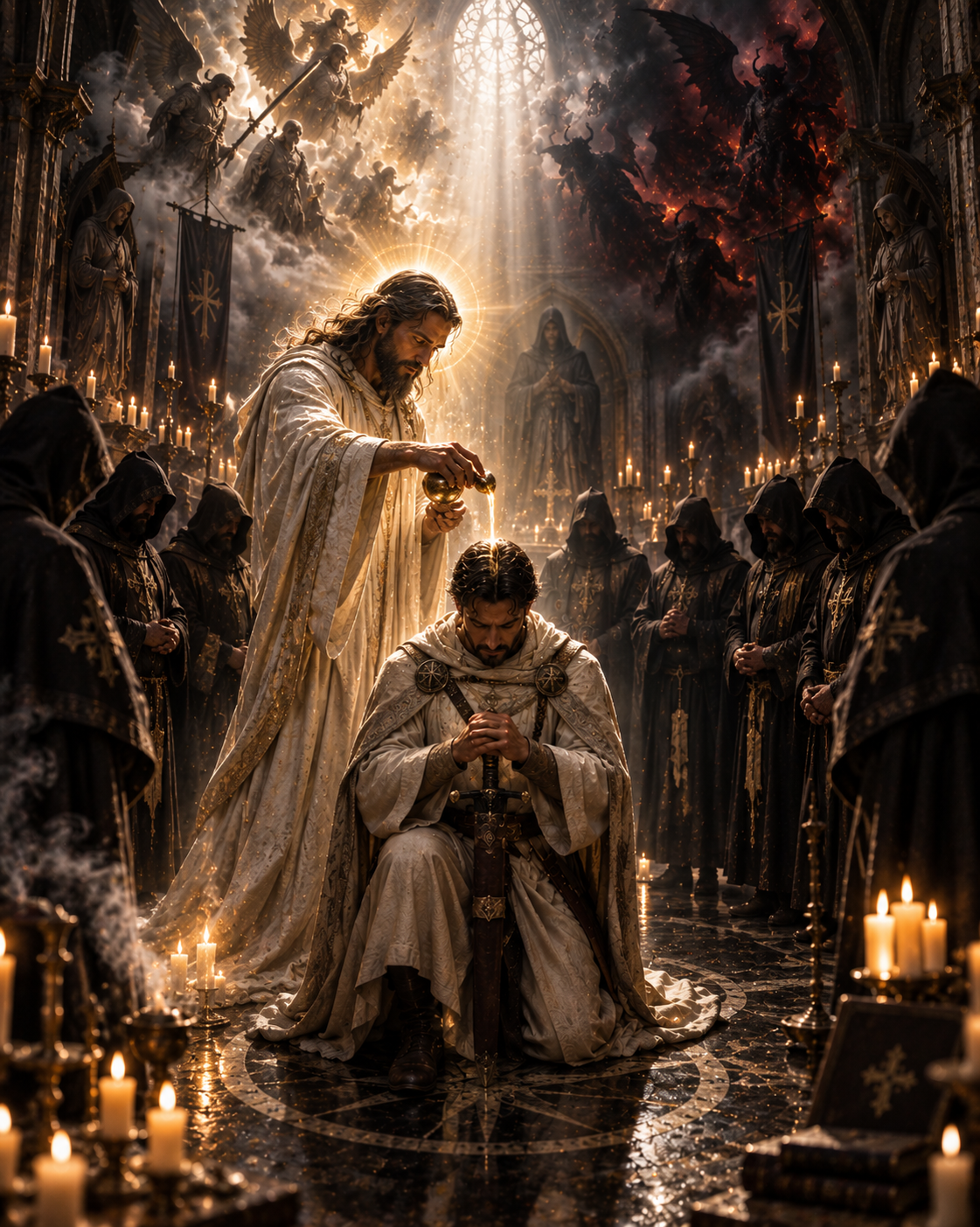
Spiritual Warfare II
For we do not wrestle against flesh and blood, but against the rulers, against the authorities, against the cosmic powers over this present darkness, against the spiritual forces of evil in the heavenly places — Ephesians 6:12
Spiritual Warfare (Part II)
Maybe it is the same night the keeper crowned you. More likely it is years later.
You went down the trail with the crown on, and you lived in it. The house got bigger and the calendar got fuller, and every one of the seven kingdoms paid out what it promised. Then one ordinary evening, standing on your own porch with everything you ever built laid out in front of you, you felt how little of it you could actually hold. An old king of Babylon once stood on his palace roof admiring the city he had built by his own power, and he lost his mind in a field before he found out what he had missed. He tells the end of it himself: At the end of the days I, Nebuchadnezzar, lifted my eyes to heaven, and my reason returned to me (Daniel 4:34). Nobody sent for you. You came to your senses, and you started walking.
You come back the only way the keeper said a man could. Not up the outside trail to the ledge, but to the fire at the foot of the mountain, where a few black belts you have never met hand you a new torch without asking where you have been. Forty more days. The rooms are the same rooms. The man walking them is not the same man, and the glass knows it.
At the top the keeper is on the ledge, exactly where he was. He does not set anything on your head this time. He looks at the crown already there, looks at you a long moment, and says nothing at all. You stand where he crowned you and look at the view one more time. Then you turn your back on it, and there in the rock, where you would have sworn there was nothing, is a curtain. The torch in your hand is still burning. It has not needed oil once, and you never noticed.
You step through. The last room in the mountain has no walls you can find. The torchlight goes out into the dark and doesn't hit anything. The floor is cold stone and the air is dead still.
You are empty. You have sat in the chair, read the record, watched the afternoons, heard the voice, stepped out of the rut, read the receipts, stood in the empty house, gone down into the cellar, closed the open door, taken down the bent glass, stood in front of the silhouette, left the ring on the stone, folded the letter, waited at the door, stepped out of the chalk circle, carried the chair off the compass, looked up from the board, taken the plain gold, sat by the fire, crawled into the seam, turned your back on the view, sat by the still water, opened your hand, and worn the crown. You are hungry in a way food would not fix.
The Other Side of the Curtain
Your eyes adjust slowly, the way they do in a field at night. And the first thing they adjust to is not this room. It is the world you just left.
From this side of the curtain, you can see what the porch could not show you. The house, the calendar, the name on the door, the accounts, the crown. All of it is real, and all of it is thinner than you thought, the way a morning fog is real until the sun gets high. A man is not a monument. He is a breath on a cold day. Behold, you have made my days a few handbreadths, and my lifetime is as nothing before you. Surely all mankind stands as a mere breath! — Psalm 39:5. You have heard that sentence at funerals. You have never before felt it about yourself while standing up.
And then you see the rest of it.
The world was never only what it looked like. Behind the traffic and the news and the arguments at the dinner table there has been a war the whole time, going on in places a man cannot walk into. An old prophet named Daniel fasted and prayed for three weeks and heard nothing. Then a messenger came and told him why. Fear not, Daniel, for from the first day that you set your heart to understand and humbled yourself before your God, your words have been heard, and I have come because of your words. The prince of the kingdom of Persia withstood me twenty-one days, but Michael, one of the chief princes, came to help me — Daniel 10:12-13.
Three weeks of silence, and none of it was silence. It was a fight.
Every unanswered night of your life looks different from here. So does every man you ever watched go under: the friend who drank himself out of his marriage, the brother who stopped calling, the kid down the street who was gone before anyone noticed he was going. You thought you were watching bad choices. You were watching bad choices and a battlefield.
The Weight
That is when it settles on your shoulders.
It is not the weight of what you did. You named all of that, room by room, and meant it. This is heavier. It is the weight of seeing: that the life you built is a breath, that the war is real, that it is going on right now over every person you love, and that you cannot win it. Your wife. Your children. The men you work beside. A city full of people asleep while something organized and patient works on them.
A man who sees that and feels nothing has not seen it. You feel it in your neck and down your back, the way you once felt a loaded ruck at the end of a long day. You go down on one knee under it without deciding to.
Then the air changes. It goes heavy, the way it does before a storm.
You hear them before you see anything. Not one voice. A great many, speaking together, low and in step, the way a crowd chants. And you recognize every word, because it is every confession you made, played back to you at once, with the ending changed. I name this. I own this. And I will always be ruled by it.
Then a single voice from the front of the dark, courteous and patient, says your name. Your full name. The one your mother used when you were in trouble. It quotes a psalm to you, beautifully, word for word. And it makes you an offer. It can take the weight off. You only have to stop looking. Go back down the trail, wear the crown, forget what you saw on this side of the curtain. And bow, once.
Every tunnel in this mountain was dug toward this room.
Forty Days
The Spirit led Jesus into the wilderness, and the devil did not come for Him on the first day. And after fasting forty days and forty nights, he was hungry — Matthew 4:2. The attack came at the end, when He was emptiest.
There were three offers, and you have now walked through all three. The first chamber of this mountain was the stone and the bread: your appetites, your need to be busy and right and comfortable. The second chamber was the pinnacle of the temple: the pride of knowing, and the urge to force God's hand. The third chamber was the high mountain: every kingdom in the world, for one bow.
Every time, Jesus answered the same way.
It is written, "Man shall not live by bread alone, but by every word that comes from the mouth of God" — Matthew 4:4.
Again it is written, "You shall not put the Lord your God to the test" — Matthew 4:7.
Be gone, Satan! For it is written, "You shall worship the Lord your God and him only shall you serve" — Matthew 4:10.
And notice what the devil did on the second offer. He quoted Scripture too. He took a real promise, that God will command his angels concerning you to guard you in all your ways — Psalm 91:11, and aimed it like a gun. Knowing verses is not enough. The enemy knows every one of them better than you do. The Word is a sword only in the hand of a man who is obeying it.
This room tests faith itself. Not what you know about God. Whether you will hold onto Him when you have nothing left, and when what you are being offered is relief.
The War Behind the Faces
Up until now, every enemy in this mountain has worn your face. That was true. It was not the whole truth.
The verse over this room says a man's real fight is not against flesh and blood. Not against his ex-wife, his boss, his father, the other political party, or the man who cut him off in traffic. It is against rulers, authorities, cosmic powers, and spiritual forces of evil. Those are not metaphors for bad moods. They are ranks. Scripture describes the unseen world as having real order to it, and the powers opposed to God are organized, ancient, and patient. Daniel's messenger was held up by one of them for three weeks.
When Jesus asked the thing tormenting a man in the tombs for its name, it answered, My name is Legion, for we are many — Mark 5:9. A legion was a Roman army unit of thousands. The spirits had arranged themselves the way an army does.
Here is what they do. They do not create lust in a man, or rage, or pride, or fear, or greed. Those grow out of his own heart, as you saw room by room. What the powers do is find those things and press on them. They give sin a strategy. They stir a crowd into anger it didn't know it had. They soak a whole culture in lust until it seems normal. They wait for the day a man is hungry and tired and alone, and then they make their offer in a reasonable voice.
What the Occult Calls Loosh
In some corners of the occult and the New Age there is a teaching that invisible beings feed on human emotion. Fear, rage, lust, and despair give off a kind of energy, the teaching says, and these beings farm humanity to harvest it. The name some of them use for that energy is loosh.
The men who came up with that teaching noticed something real. The same sins do seem to be stirred on purpose. Whole populations get whipped into fury or despair as if someone were profiting from it. A man who has watched that happen is right to suspect he is not just looking at human nature.
But Scripture never says the powers are feeding on you, and it matters that they are not. The loosh teaching makes a man livestock in someone else's field: a victim, harvested for fuel, with no one to answer to and no way out. The truth is worse and better at the same time.
The powers do not want your emotion. They want you: your worship, your obedience, and finally your ruin. Do you not know that if you present yourselves to anyone as obedient slaves, you are slaves of the one whom you obey, either of sin, which leads to death, or of obedience, which leads to righteousness? (Romans 6:16). The harvest is real. It is a harvest of men. Scripture describes people who need to come to their senses and escape from the snare of the devil, after being captured by him to do his will — 2 Timothy 2:26.
That is worse than the occult picture, because it means a man is responsible for what he gives himself to. And it is better, because it means he can be rescued, and there is One who has already done the rescuing.
The Names the Old Fight Gives Them
Christians who have fought this war for a long time have given names to the patterns they keep running into. Some of those names come straight out of Scripture. Revelation names a woman called Jezebel who led a church into sexual sin and false teaching, and her name has come to stand for the spirit of control and seduction. In Acts, a slave girl had a spirit of fortune-telling that the Greek text calls a python. The Law forbids consulting mediums and the spirits they call up, the ones older translations call familiar spirits. And the very first promise of the gospel is that the serpent's head will be crushed.
Other names, like monitoring spirits, are the church's later shorthand for things people believe they have seen. Hold the shorthand loosely and hold Scripture tightly. You do not need a complete catalog of the enemy to win this fight. You need the One who already beat him.
What You Brought That Won't Work Here
Everything. Every strength from every domain, and one more thing you didn't count on.
Room after room in this mountain you said, I will not be ruled by it. You meant it every time. Now listen to how many of them there are. A vow made in your own strength is a paper wall, and the Legion has walked through a great many paper walls.
And the weight on your shoulders will not come off by effort either. You cannot out-train it, out-earn it, out-think it, or out-fight it. You spent seven domains getting strong enough to carry anything, and you have finally met something no man was ever built to carry alone.
This is the bottom of the mountain, even though it is the top. This is where a man finally sees himself the way God has always seen him: broken, fallen, and not enough. Not on his worst day. On his best one. And this is the exact place where God begins to use him, because for the first time he has stopped trying to be the one doing the saving.
The Armor
Paul did not tell soldiers in this war to get stronger. He told them to put on armor they did not forge. In all circumstances take up the shield of faith, with which you can extinguish all the flaming darts of the evil one; and take the helmet of salvation, and the sword of the Spirit, which is the word of God — Ephesians 6:16-17.
Look at what is in that list. Faith that trusts Someone else. Salvation that was given, not earned. And one weapon, only one, that cuts: the Word of God. It is the same weapon Jesus used in the wilderness, three times, and He never once argued past it.
The Last Fight
The crowd presses in. The patient voice lists every sin you named, and a few you didn't, and every word of it is accurate. It is not trying to prove you guilty. You already are. It is trying to get you to answer on your own record, and to buy your relief with one bow.
Don't. Answer this way, out loud, into the dark.
II have walked through seven domains. I built what I was capable of building. I also carried what I was not willing to face.
I name the Shadow. All of it: the Pharisee's pride and the Vessel's vanity, the Sophist's performance and the Hollow Man's absence, the Brute's anger and the Ghost's fear, and the Drifter who was always running.
I am not destroyed by this. I am not excused by it either.
I own it. And I cannot rule it.
But it is written: He has delivered us from the domain of darkness and transferred us to the kingdom of his beloved Son — Colossians 1:13.
I am not my own. I will not bow. In the name of Jesus Christ, be gone.
Holding On Until Daybreak
On the night before he met the brother he had cheated, Jacob found himself wrestling a man in the dark until dawn. The man could not throw him, so he wrenched Jacob's hip out of its socket with a touch. Jacob kept hold anyway. Let me go, for the day has broken, the man said. But Jacob said, "I will not let you go unless you bless me" — Genesis 32:26.
That is what enduring in this room looks like. It is not landing the winning blow. It is refusing to let go of God with a ruined hip. Jacob limped for the rest of his life, and he walked away with a new name.
Enduring to the end is not a man holding out by his own strength. It is a man holding on to the only strength that was ever going to be enough. But the one who endures to the end will be saved — Matthew 24:13. And the crown at the end of it is not the one the keeper set on his head. That one was honest, and it fades. When the chief Shepherd appears, you will receive the unfading crown of glory — 1 Peter 5:4. Nobody places that crown on a man in this mountain. It is kept for him, and it is received, never taken.
After the Fortieth Day
The crowd goes silent. Not quiet: gone. The patient voice doesn't argue. It simply isn't there anymore.
Then the devil left him, and behold, angels came and were ministering to him
— Matthew 4:11.
You are still on your knees on the cold stone. Your hip hurts. Your hands are empty. And the weight has not moved. You won the fight and you are still pinned under what you saw. That is the part nobody warns a man about. Refusing the counterfeit relief does not hand you the real one.
Somewhere behind you in the dark, you realize, someone has been standing the whole time. More than one someone. You never heard them come in. You suspect they were here before you were.
But that is not where the light is coming from.
Come to Me
Someone is standing in front of you.
You don't see Him walk up, and you can't make out His face. The light is on Him more than from Him, the way sun sits on a man who has just come in from outside. He doesn't say your full name the way the other voice did. He doesn't quote anything at you. He crouches down in front of you on the stone, so that He is lower than you are, and you realize He came down into this room the way a man comes down into a ravine after something that fell.
Jesus once told a story about a shepherd with a hundred sheep who lost one and left the ninety-nine to go after it. And when he has found it, he lays it on his shoulders, rejoicing — Luke 15:5. You were told this mountain was a climb a man makes alone, and it was. Nobody told you the Shepherd comes into the last room after the one who made it.
Then He speaks, and the words are old, and you have heard them a hundred times, and you have never once heard them.
Come to me, all who labor and are heavy laden, and I will give you rest. Take my yoke upon you, and learn from me, for I am gentle and lowly in heart, and you will find rest for your souls. For my yoke is easy, and my burden is light — Matthew 11:28-30.
He puts His hands on the weight.
You expect Him to lift it off. He doesn't. A yoke is not a way to get rid of a load. It is a beam built for two, so that two can pull what one never could. He lays the beam across your shoulders and steps in beside you under it, and He takes the heavy side.
The weight is all still there. The war is still real. Your life is still a breath. Every man you love is still on a battlefield. None of that got smaller. But for the first time since the curtain, you can stand up under it.
Notice what He called Himself. Not strong, though He is the strongest thing in this mountain. Gentle and lowly. The hands on the beam could have ended the war in this room with a word, and they did not reach for anything but you. Hold on to that. You are about to see it again.
Until an Opportune Time
After the forty days, Scripture says one more thing about the enemy that every man leaving this room needs to hear. And when the devil had ended every temptation, he departed from him until an opportune time — Luke 4:13.
He will be back. Not tomorrow, maybe. But on some ordinary Tuesday years from now, when you are tired and successful and nobody is watching. The campaign never fully closes. A crowned man stands his post until the day he is called home. That is not a failure of this room. It is the last lesson in it. And on that Tuesday, you will not be standing it alone. The yoke does not come off at the door.
The Door
He stands, and you stand with Him, because the beam gives you no other choice and you would not want one.
Ahead of you, for the first time since you came through the curtain, there is light coming from somewhere other than your torch and other than Him. A door. It is not marked. He walks you toward it at a pace you can keep, which is slower than He could go, and you understand without being told that this is simply how He walks with men.
You are limping. You are carrying more than you have ever carried. And the walking is not heavy.
→ Continue on to GrandMastery