
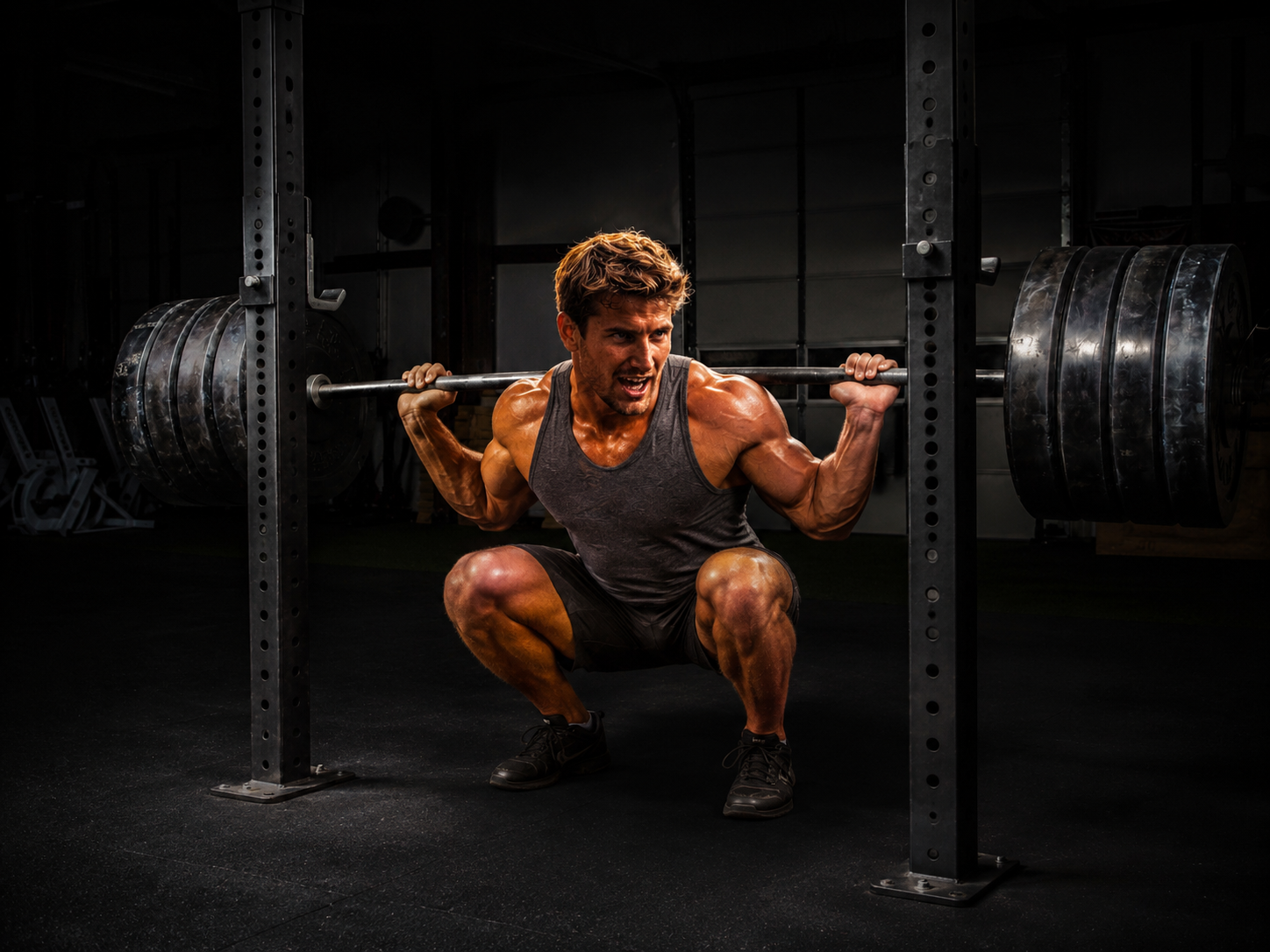
Squats
Hack Squats
Overhead Squats
Pistol Squats
Everything starts with the squat.
Nobody signs up for this movement. A man is already doing it — every time he rises off a couch, climbs out of a truck, lowers himself to the floor where a child is playing, or bends after a dropped key. He was doing it before he could talk and he has never once stopped. The version with a bar across the back is not a new exercise. It is the same pattern, asked to carry more.
Which makes the squat the one lift in this building where you cannot claim to be a beginner. You have run this pattern several times a day for your entire life. The only real question is what you have been grooving all that time, and most men find out the answer at forty-five, in a doctor's office, and do not like it.
Here is the thing about it that separates it from every other lift in the gymnasium: the squat is the only major movement where the hard part happens on the way down. A press, a pull, a carry — you lower the weight and then you do the work. Not here. The descent is where depth is won or given away, where the back either holds its shape or quietly rounds, where the knees either track or fold. By the time a man is standing back up, the rep was already good or already bad and nothing he does on the way up will change it. That is why coaching a squat is almost entirely coaching a descent, and why a man who has only ever thought about the standing-up half has been training the second half of a movement he never learned the first half of.
Dorian Yates won six Olympia titles and could have said anything at all about training. What he said was squats save lives, and he meant it about a body he had already pushed further than almost anyone alive. He trained them deliberately — controlled down, full depth, no bounce out of the bottom, no weight he had not earned. That is not caution. That is a man who understood that a squat you cannot control is a squat that is training you, and it is training you toward one specific afternoon several decades out.
So this room is not leg-day tips. It is the movement itself: the form that makes it honest, the errors that quietly wreck it, and the variations you reach for once the pattern is genuinely yours. Three doors open off it, and they come later.
Proper Form & Technique
Five things, in the order they happen. Learn the reason under each one and you stop reciting a checklist you will forget the moment you are tired — you start understanding the lift well enough to diagnose your own when it drifts.
Set the feet. Stand about shoulder-width, toes turned out a touch — somewhere between fifteen and thirty degrees, whatever lets your hips open without forcing it. Then screw the feet into the floor and grip it at three points: the heel, the base of the big toe, the base of the little toe. That tripod is the whole foundation of the rep. Lose it at any point and everything stacked above it moves.
Brace the middle. Before anything descends, take a big breath down into the belly — not up into the chest — and tighten the trunk the way you would if somebody were about to punch you in it. That is the brace. It turns the spine from a hinge into a pillar. A braced middle is the difference between your legs lifting the weight and your lower back finding out it volunteered.
Break hips and knees together. Send the hips back and bend the knees at the same time, as one motion rather than two. Chest proud, spine in its natural curve — not rounded, not cranked into an arch. Push the knees out so they track over the toes the entire way down. This is the moment the rep is decided, so it is also the moment to stop hurrying.
Hit honest depth. Sink until the crease of the hip drops below the top of the knee. That is full depth, and it is the range most men quietly skip. A deep squat under control builds more, protects the knee better rather than worse, and trains the body through the range it actually uses in life. A quarter-rep with double the weight builds nothing but a number and some wear.
Drive through the floor. Stand by pushing the whole foot down and shoving the floor away, hips and chest rising together at the same rate. The bar — or your bodyweight — travels a straight vertical line over the middle of the foot, bottom to top. Hold the brace until you are standing tall, then breathe. That is one repetition. Now do another one exactly like it.
Common Squat Mistakes
Almost every squat injury is one of a short list of errors, repeated for years. Not one of them feels like a problem on the day it happens. All of them send an invoice eventually, and the invoice arrives long after the man has forgotten what he bought. Hunt these out now, while the weight is still light enough that fixing them costs nothing.
Heels lifting. The weight rolls forward onto the toes, the heels come off the floor, the tripod is gone and the load transfers to the knees. Usually it is stiff ankles or a stance that does not fit the man standing in it. Fix the ankles, widen or turn out the feet, and stay rooted through the heel.
Knees caving in. They collapse inward on the way up — the fastest way there is to hurt a knee under a bar. It is weak glutes plus a forgotten cue. Push the knees out and make them track the toes, and they stop folding.
Rounding at the bottom. The lower back tucks under at the deepest point. It means you are diving past the depth your hips can honestly reach, or you lost the brace on the way down. Stop at the bottom of your clean range, not somebody else's, and keep the trunk tight the whole descent.
Hips shooting up first. The hips fire before the chest, the torso pitches forward, and the squat becomes a sloppy back-lift. The cause is nearly always a weight the legs cannot drive, so the back steps in to rescue it. Take weight off, lead with the chest, and make the legs do the job they were given.
Ego on the bar. Bouncing out of the bottom, cutting the depth, grinding out ugly reps to chase a number nobody else is tracking. This is the error underneath all the others, and it is the only one that is a decision rather than a fault. The men who built the strongest bodies of the last century loaded a movement that already worked. Take the ego off the bar early and the bar will still be paying you back in forty years.
Types of Squats
Once the pattern belongs to you, the variations stop looking like a hundred separate exercises and start looking like dialects of one movement you already speak. Each shifts the load somewhere — a different muscle, a different demand, a single leg — but the spine of it never changes. Reach for the one that fits the job in front of you.
Learning the pattern. The air squat is the bare movement at bodyweight, where clean form gets grooved before anything is added. The goblet squat has you hold one dumbbell or kettlebell at the chest; the front load forces an upright torso and is the fastest route a beginner has to real depth. The prisoner squat puts the hands behind the head, which kills the forward lean and teaches a tall spine.
The barbell trio. The Back Squat rests the bar across the upper back — the strength staple that loads the entire lower body and builds it like little else in the building. The Front Squat carries the bar across the front of the shoulders, hammering the quads and refusing to allow a torso that leans. The Zercher squat cradles the bar in the crook of the elbows: brutal on the trunk and upper back, easier on the lower spine than it has any right to be.
Shifting the target. The Sumo Squat widens the stance with the toes turned out, driving the inner thighs and glutes. The Suitcase Squat puts a dumbbell in each hand at the sides, building grip and a trunk that spends the whole set fighting to keep you level.
One leg at a time. The Bulgarian Split Squat rests the back foot on a bench and loads the front leg almost alone — the best correction there is for one side being stronger than the other, and the one most men discover they need only after they try it.
Power. The Jump Squat explodes out of the bottom and leaves the floor, training the fast end of the same pattern.
That is the survey. Three of the variations are not on this list, because three of them have rooms.
Three Rooms Off This One
Three doors open off this movement, and none of them is the next step in the walk. They are a branch. They run in one order, and the order is the argument: support the man first, then expose him, then take the support away entirely.
Hack Squats — the squat with the balance problem removed. First, because the machine holds the path for you. The back is against a pad, the bar runs on a fixed track, and every question about staying upright has been answered before you got there. What is left is the legs, working hard, with nowhere to hide and nothing to fall off. That makes it the honest starting point for a man rebuilding after an injury, a man whose lower back has been the limiting factor for years, and any man who wants to load quads hard on a day the rest of him is not up to steering. The room also names the cost, because a squat with the balance taken out is not the human pattern any more, and a man who trains only here will find that out the first time he stands under a free bar.
Overhead Squats — the one that tells the truth about you. Second, and there is nothing in this building that exposes a man faster. A locked-out bar held straight overhead for the entire repetition, usually with almost no weight on it, and suddenly the ankles, the hips, the upper back and the shoulders all have to be honest at the same moment. Men who back-squat serious weight fall over with an empty bar. That is not humiliation; that is information, and it is information nothing else in the gymnasium will give you. The room treats it as a diagnostic first and a lift second — light load, maximum honesty, and a short list of what each specific failure is telling you about the man doing it.
Pistol Squats — one leg, nothing to lean on. Third, and last, because it needs what the first two build. A full squat on a single leg with the other held out in front, no support, no counterweight but your own arms. It is the apex of the pattern and the one variation that matters latest in life, because life does not hand a man a barbell — it hands him a curb, a step, a slope, and one leg at a time. This is also the room where a man discovers that the strength he thought was symmetrical never was.
Walk the three in order and they do not send you back here. They chain — the machine, then the diagnostic, then the single leg — and the last one puts you out at the next movement with a squat that works in three situations where it did not before.
Where This Goes Next
You now have the movement everything else is stacked on. Not a leg exercise — the pattern the human body was arranged around, running from the floor up, held rigid through the middle, and owned well enough that adding load to it is a detail rather than a gamble.
Notice what you have been doing this entire time, though. You have been pushing the ground away. Every rep in this room was a press, and the thing you pressed against was the one surface that has never once moved, never wobbled, and never had an opinion about it.
The floor is about to stop being underneath you and start being in front of you.
Guiding Quote
"Squats save lives." — Dorian Yates
Two words and a verb, from a man who had every reason to say something more complicated. He was not talking about legs. He was talking about the fact that the ability to lower your own body and bring it back up is the single capability underneath living on your own terms, and that it is the one most men surrender quietly, decades before they had to, because nobody told them it was optional to surrender it.
So you do not train the squat to be looked at. You train it so that a long way from here you can still get down onto a floor where a grandchild is sitting, and get back up off it, under your own power, and have it be unremarkable.
Train for that. And then read this, which was written about the same afternoon by a man who had already had everything:
when the keepers of the house tremble, and the strong men stoop, when the grinders cease because they are few, and those looking through the windows grow dim — Ecclesiastes 12:3
The strong men stoop. Not the weak ones — those had already stooped. The strong ones. The passage is a description of a house going quiet, told from the inside, and every man in it trained or did not train and arrives anyway.
None of that is an excuse to train less. Everything in this room still holds, and the man who trains it well will get years the man who did not will never see.
But notice who wrote it. A man with every resource a king could command, who had already built and tried and owned everything there was, sat down to describe to a much younger man exactly what the end of a body looks like from close up. He was not doing it to frighten him. He was doing it to get him to spend his strength on the right thing while the strength was still in his hands — which means that somewhere in that passage there is a right thing, and the passage does not appear to think it is the squat.