
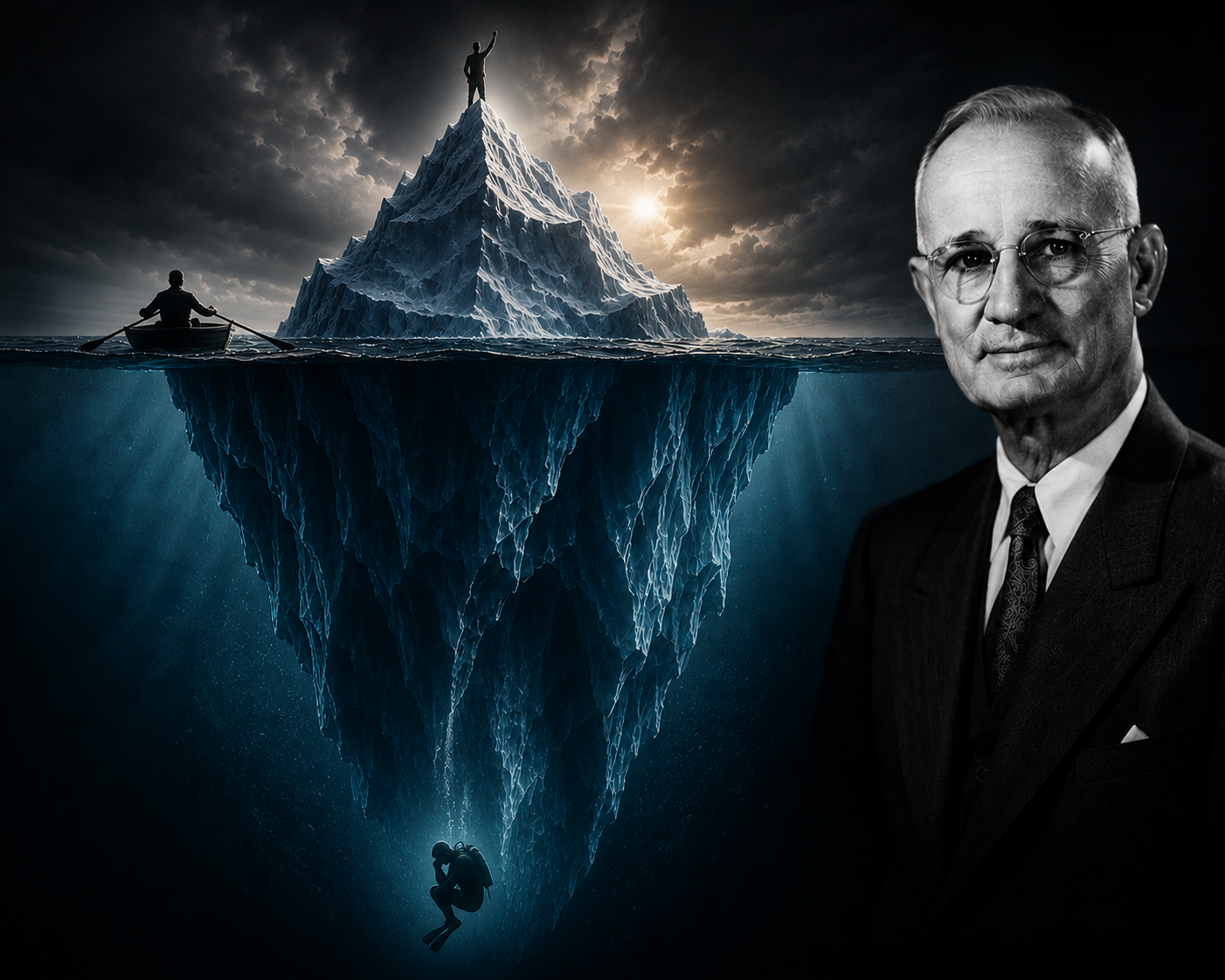
Success Principles
Consistency
Volume
Compounding
Organization
Collaboration & Cooperation
"Whatever the mind can conceive and believe, it can achieve." — Napoleon Hill
Some things are simply true about how effort turns into results, and a man who knows them gets more out of the same week than a man who does not. That is what a principle is. Not advice, not a technique, not a trick that worked once for somebody with a podcast — a regularity that holds whether or not you approve of it, whether or not you have heard of it, and whether or not you are having a good year.
This is the second room of Success Prep, and it exists because the last one handed you capacity and capacity is not the same thing as leverage. You can now put your hands on your time. Every hour is anchored, scheduled, and defended. What no calendar can tell you is that two identical blocks — same length, same discipline required to show up for both — can be worth wildly different amounts, and that the difference between them is usually knowable in advance.
"If the ax is dull and its edge unsharpened, more strength is needed, but skill will bring success." — Ecclesiastes 10:10
That is the whole room in one sentence. Two men, same tree, same arms, same hours. One of them stops and works on the edge. Notice what the proverb does not say — it does not say the second man works less, and it does not say he is stronger. It says he needed less strength for the same result, and the difference was something he knew.
That is what the rest of this is: the edge.
The Man Who Wrote It Down
You have already met him.
He was the old man in the lamplight before the sun came up, in the first room of this whole ground, with a question he had been carrying most of a century and five hundred interviews behind him. He asked you what you were building, he handed you a sheet of paper, and he went back to work without being introduced.
His name is Napoleon Hill, and this is his room.
He is here rather than back there for a reason. Back there he was doing the thing he was best at — getting a man to say out loud what he actually wants, which is harder than it sounds and which almost nobody does unprompted. But the work he spent his life on was not the wanting. It was the mechanism: sitting with men who had built things and hunting for what they had in common, then writing it down in a form an ordinary man could use. He published it in 1928 and again, more famously, in 1937, and then a century of men repeated it back to each other, usually without knowing where they got it. There is a real sense in which most of what you will ever hear about success in your life is a paraphrase of one man's notes.
He earns the credit. He also gets an honest ledger, because a man who is being honored is not a man who gets to skip the audit.
The origin story is disputed. Hill said Andrew Carnegie commissioned him in 1908 and gave him a letter of introduction to the most accomplished men in America. Historians have never found the commission, and several of the interviews Hill described cannot be corroborated. The most defensible position is that he did real work with real men and dressed the origin in something grander than it was.
Some of the metaphysics does not survive. Parts of his writing on faith and thought drift into New Thought territory — the mind as a transmitting station, thoughts as a force that reorganizes the material world. That is not what Scripture teaches and it is not what the evidence supports, and it is the seam where a century of manifestation doctrine came out of a book that mostly is not about that.
And the observations have earned their keep anyway. This is the part men get wrong in both directions. The biography being shakier than advertised does not retroactively make the findings false, and the findings being sound does not launder the biography. A law is not validated by the character of the man who noticed it. Gravity did not need Newton to be pleasant.
"Do not wear yourself out to get rich; do not trust your own cleverness. Cast but a glance at riches, and they are gone, for they will surely sprout wings and fly off like an eagle." — Proverbs 23:4-5
Hold that beside the whole genre he founded, this room included. Do not trust your own cleverness is not an argument against being clever. It is an argument against the specific thing clever men do, which is to mistake a working method for a guarantee — and the more the method works, the harder that is to see.
What follows: the four he found, what a law can and cannot do, the five rooms that reorganize all of it, the instruments his students never had, and the only comparison worth making.
The Four He Found
He named more than four. Four of them do most of the work.
Definiteness of purpose. A clear, specific, written, time-bound objective. I want to be successful is not one; I will build a five-million-dollar roofing business in Phoenix and exit within ten years is. He put it first because it was the one trait present in every man he studied without exception — none of them held vague ambitions. A century later, Locke and Latham's research came to the same conclusion from the opposite direction, in controlled settings, hundreds of times. You did this work two rooms back. It is his.
The mastermind. A deliberately assembled group of trusted men whose combined judgment and genuine mutual investment produce what none of them reaches alone. He emphasized the second half — the harmony — far more than the men who quote him do, and it is the half the modern imitations drop.
Faith and visualization. Clear sight of the goal, sustained mental rehearsal of the execution, and the confidence that comes from real conviction. This is the one carrying the metaphysical drift, and the disciplined version underneath it is sound enough that every serious athlete and performer in the world now uses it.
Persistence. Continuing after the setback. His story of the prospector who quit three feet short of the vein has been retold for a hundred years because the thing underneath it is real: most men stop during the flat stretch that turns out to have been the last one.
Four laws, from one man, still earning. The five rooms below take those and everything found since, and sort them a different way — not by who catalogued them, but by what each one acts on.
What a Law Can and Cannot Do
Two corrections, and they keep the whole room from turning into something it was never able to be.
A law tells you how, never whether. Every principle here describes a mechanism — this is how leverage works, this is how repetition accumulates, this is how combined judgment beats solitary judgment. Not one of them can tell a man whether the thing he is applying them to deserves a decade of his life. They are perfectly obedient to a man building a household and a man building a monument to himself, and they will serve the second one just as faithfully, right up until he arrives.
"Woe to him who builds a city with bloodshed and establishes a town by injustice! Has not the Lord Almighty determined that the people's labor is only fuel for the fire, that the nations exhaust themselves for nothing?" — Habakkuk 2:12-13
The city gets built. That is what makes the passage frightening rather than comforting. The methods worked, the walls went up, the labor was real, and the verdict is passed on the whole enterprise anyway — exhausted themselves for nothing. No principle on this page is equipped to raise that objection. A man has to bring it in with him.
A law is not a lever on the outcome. This is where the entire success trade slides, and it slides the same direction every time: from this is how effort converts to therefore effort commands the result. It does not. Markets move, health fails, the years that were supposed to compound get eaten by a crisis nobody scheduled. And the man who has run the laws well for twenty years is in the single best position to forget it, because for twenty years the arithmetic held.
"You may say to yourself, 'My power and the strength of my hands have produced this wealth for me.' But remember the Lord your God, for it is he who gives you the ability to produce wealth." — Deuteronomy 8:17-18
Read what that concedes and what it does not. It never denies the power or the strength of his hands. Those were real, they were his, and he used them. It relocates where they came from.
Run the laws hard. Keep every bit of the leverage. Refuse the arithmetic that turns leverage into a promise.
Five Rooms Off This One, In Order
Sorted by what each law acts on, and walked in this sequence, because each one is only worth anything once the one before it is true.
Consistency — will you be there at all. The floor, and the only one that is binary. Every law below this is a multiplier, and a multiplier applied to zero is zero. This room holds the least glamorous and most decisive thing in the whole section: just show up, on the days it is dull, on the days it is not working, and on the days nobody would notice if you did not.
Volume — how much, and on what. Two laws that correct each other. The Law of 10,000 says the hours are not optional and mastery does not accept a smaller payment. Pareto Principle says not all hours are worth the same, and a man who spreads himself evenly across everything gets the average return on all of it. Take the first without the second and you get a decade poured into the wrong thing. Take the second without the first and you get a man citing an Italian economist to justify doing less.
Compounding — what happens to it over time. What consistency and volume actually produce, which is not a sum. Capability accrues interest as long as it is not withdrawn, and the curve is flat for years before it is steep, which is exactly why most men get off it. Compound Learning sits inside, on how knowledge and skill in particular behave this way.
Organization — can you find and deploy what you already have. The largest room here by a distance, and the one men skip because it looks like housekeeping. It is not. A man cannot execute a good plan out of a life he cannot find anything in, and most of what he needs he already owns, somewhere. The mind, the space, the time, and the resources — Organizing Your Mind for Success, Organizing your Living Space, Organizing your Life for Success, Coral the Chaos, with Workspace Management and Livingspace Management beneath them.
Collaboration & Cooperation — who else is in it. Last, because it is the only one that is not about the man alone, and because it is the ceiling on all four above it. There is a level of result that a man cannot reach by himself no matter how consistent, how high-volume, how compounded or how organized he is, and the only way through it is other men. The Mastermind Principle sits inside.
Walk them in that order and the fifth one puts you back on the main road.
The Instruments He Did Not Have
His world lacked tools you have in your pocket. The principles are unchanged; the leverage on them has multiplied.
Counsel on demand. An AI assistant will help a man clarify an objective, pressure-test a plan, work a decision from three angles, and find the hole in his own reasoning, at two in the morning, for nothing. Used well it sharpens definiteness of purpose faster than a legal pad ever did. It does not replace the mastermind and it does not replace his judgment; it serves both. The man who has it write his goals has not done the goal work.
Brotherhood without geography. His groups had to meet in a room, so the candidate pool ended at the county line. Yours does not. The character and the harmony still have to be earned across years — that part has no shortcut and never will — but the map no longer decides who is eligible.
Accountability on rails. Calendars, trackers, reminders, standing check-ins. Persistence no longer has to ride on willpower alone. A man can build supports that catch him in the weeks his drive lapses, which is the difference between a bad month and a lost year.
Knowledge without gatekeepers. He spent years earning interviews because what high achievers knew was locked behind their office doors. Most of it is now free and searchable. The bottleneck moved from access to judgment — from can I find out to what is worth absorbing and what should I walk straight past.
Every one of these amplifies the work when it serves it and erodes the work when it substitutes for it. The tool count is not the measure.
The Only Comparison
I am in competition with no one. I have no desire to play the game of being better than anyone. I am simply trying to be better than the person I was yesterday.
That belongs here specifically because the world Hill studied was soaked in rivalry. The richest men of his era measured themselves against each other by the yard, and a great deal of the literature descended from them still runs on beating the other man. project7 cuts that root.
The other man is not the standard. He has a different assignment, different gifts, a different field, a different set of years, and a different Judge. Measuring against him produces pride or despair, and both are equally useless for the work in front of you.
"Let not the wise boast of their wisdom or the strong boast of their strength or the rich boast of their riches, but let the one who boasts boast about this: that they have the understanding to know me." — Jeremiah 9:23-24
Look at the three things named there and then look at what this room produces: wisdom, strength, and riches. It is not a coincidence and it is not an accident. Those are precisely the three yields of a well-run set of principles, and they are the three the passage identifies as the most likely to be misfiled.
The only honest comparison is the man of yesterday against the man of today — the same measure the tracking discipline runs weekly. Better than yesterday, walked out across ten thousand yesterdays, is what every law on this page is actually for. A man who internalizes that competes ferociously and envies nobody, which makes him the most dangerous kind of competitor there is: the one who cannot be discouraged by another man's scoreboard.
Where the Principles Are Not Enough
The four laws, the five rooms, and every instrument listed above produce real leverage. They guarantee nothing.
"But God said to him, 'You fool! This very night your life will be demanded from you. Then who will get what you have prepared for yourself?'" — Luke 12:20
Read what that man in the parable actually did, because it is uncomfortable. He had a genuinely good year. He recognized his capacity constraint, made a capital decision to expand it, planned for the long term, and secured his position for years ahead. Every move is textbook. Not one of them is criticized. The verdict falls on a question none of his planning had any way to raise, and the word used on him is not lazy or foolish about money. It is just fool — and the thing he was foolish about was the one variable he had left entirely out of the model.
That is the honest ceiling of this room. A man can run definiteness of purpose, brotherhood, rehearsal, persistence, concentration, volume, compounding and organization — flawlessly — and still not arrive where he aimed. And there is a second, quieter problem, which is that he might arrive.
So settle one thing before the pressure arrives rather than during it: which prices you will pay and which you will not. Some are right — the years, the deferred comforts, the lesser offers refused, the discomfort of growth. Some are corrupting — the integrity, the household, the witness, the soul. The man who has not decided in advance will find out at the moment of testing that he already paid a corrupting price and did not notice it was the price.
And the last reframe, which is harder to receive than any law on this page: some of the best work done in a man happens because the thing did not arrive on his schedule. The delay forms something the arrival could not have. Hold the goal seriously and the timing loosely, and these laws will serve you well for forty years.
A law tells a man how effort converts. It cannot tell him which effort, in his situation, this year, with the hand he was actually dealt. That is a different discipline, and it is the last room.