
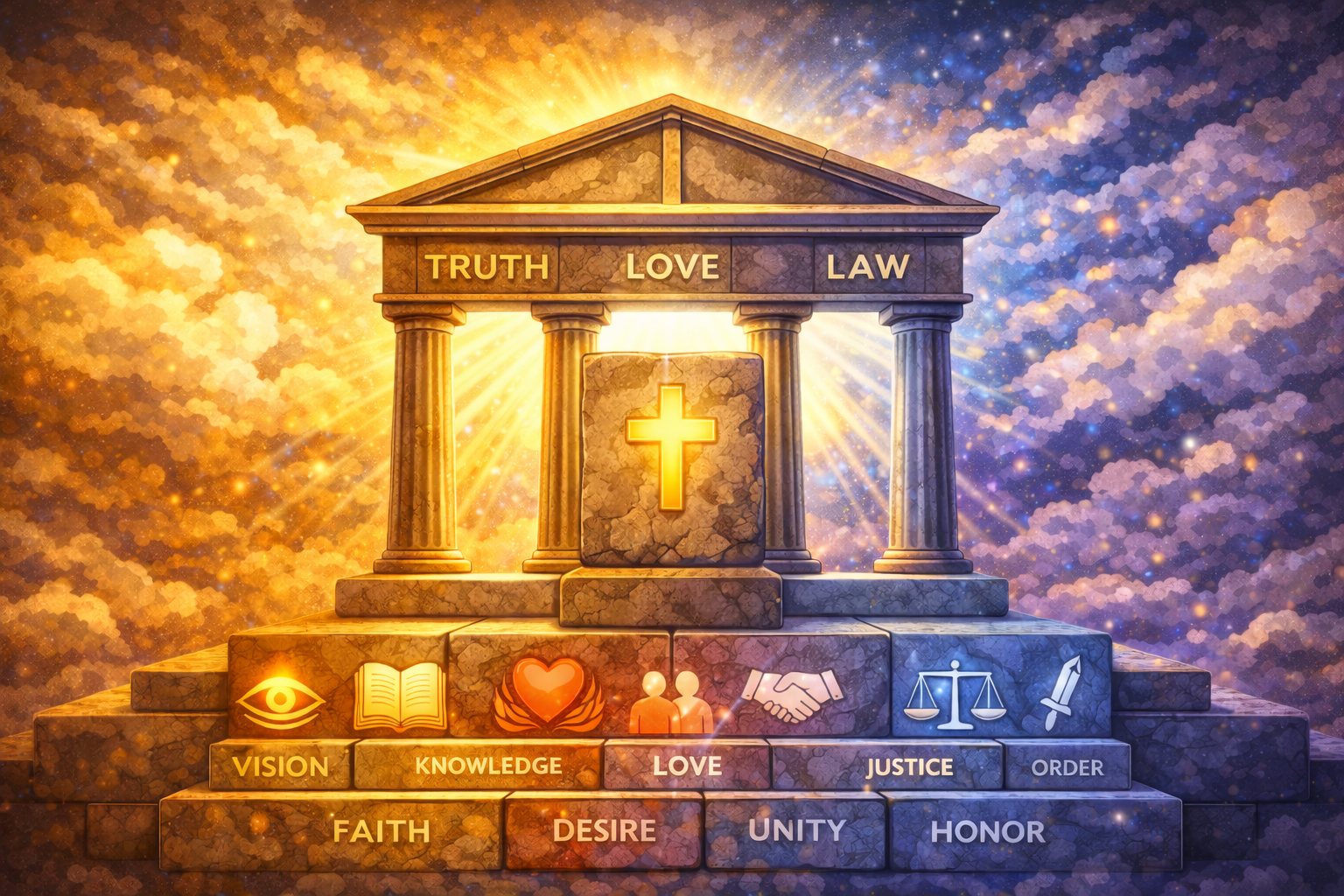
Truth & Lies
You have walked the whole road. The bedrock, where you climbed from the ground of your own existence to the summit and met the God truth is grounded in. The signature layer, where you learned to read His hand at every scale of creation. The current, where you learned to stand in moving water without being swept. And you were told, as you left the current, that this walk ends in front of something you will not see coming. It does. But the room has work to do first.
This is not a fourth layer of truth. Truth and lies are not two more vantage points to be weighed against each other. They are opposed at the root — two forces that cannot occupy the same ground, that cannot coexist in the same statement, that pull in fundamentally different directions about what reality is and how a man should relate to it. The distinction between them is not a matter of perspective. It is a matter of alignment with what is actually the case versus deliberate or willful departure from it.
So this room does not treat truth and lies as academic categories. It treats them as forces — one that builds and one that destroys, one that produces integrity and one that produces fracture, one that holds and one that collapses under the weight of what is real. A man who has not settled this distinction at the level of character will spend his life negotiating it at the level of circumstance — and losing ground he cannot recover.
The Nature of the Opposition
Polar opposites do not simply differ in degree — they differ in kind. Hot and cold are not points on a spectrum where either might be right depending on the context. Truth and lies are the same: one corresponds to reality, one departs from it. There is no middle position where they meet as equals.
You learned this in the signature layer, in the architecture itself: the binary is not symmetrical where it matters most. Good is the positive substance and evil is its corruption — and a lie is the bending of a truth that had to exist first. Truth is what is actually the case, independent of whether anyone acknowledges it. A fact does not wait for consensus. A lie is a statement that misrepresents what is actually the case — and while deception can be sophisticated, partial, strategically timed, and delivered with complete sincerity, none of that changes what it is. The gap between what is said and what is real remains, regardless of how the gap is framed.
The opposition matters because reality is not neutral. A man operating with accurate information navigates the world as it actually is. A man operating on false information navigates a world that does not exist — and reality does not accommodate him because of his sincerity. The building falls whether or not the architect believed the foundation was sound. Truth does not become false because it is inconvenient, and a lie does not become true because it is believed. The opposition is not philosophical. It is built into how reality runs — and departures from truth produce consequences that follow that same logic whether the man who chose them understood what he was doing or not.
Truthfulness
Truthfulness is not simply the absence of lying. It is a character commitment — the sustained orientation of a man's words, representations, and actions toward what is actually true, even when the truth is costly, awkward, or unwelcome.
A truthful man is not always tactful. He is not always received well. What he is, is reliable — because what he says corresponds to what he knows, and what he knows he pursues honestly. Other men can build on what he tells them. They do not have to account for the possibility that he shaded the truth to manage their reaction or protect his own interests. That reliability is not a small thing. It is the foundation of every functioning relationship, institution, and society.
A culture of truthfulness produces trust. A culture of managed truth — where what is said is calibrated to what the audience can tolerate, what the institution can afford, what the relationship can absorb — produces the slow erosion of the ground that trust is built on. Men stop believing what they are told. Institutions lose legitimacy. Relationships develop fault lines that eventually fracture under pressure. The erosion is not dramatic. It compounds. Small departures from truth normalize slightly larger ones, which normalize larger ones still, until the gap between what is said and what is real has become the operating condition rather than the exception.
The project7 man is a man of his word. Not because it is required of him. Because he has settled it as a matter of character.
The Father of Lies
You do not need to be persuaded that evil is real. You went to the bottom of the well. You saw what it does, you learned what Scripture calls it — the mystery of iniquity — and you know the leash it strains against is held by a hand. What this room adds is the piece the well could not: evil's native language.
"He was a murderer from the beginning, and does not stand in the truth, because there is no truth in him. When he lies, he speaks out of his own character, for he is a liar and the father of lies." (John 8:44) Notice the order of operations in Scripture's account. The first weapon recorded in the Bible is not a sword. It is a question: "Did God actually say...?" (Genesis 3:1) Before any blood was shed, a truth was bent. Deception is not one tool among many in evil's kit — it is the mother tongue, the thing the adversary speaks when he is speaking out of his own character. Every lie a man tells, believes, or builds on is grammar borrowed from that language, whether he knows whose language it is or not.
This is why the man who refuses to account for malice is not more sophisticated — he is less prepared. He misreads predation as confusion. He gives repeated second chances to people and systems that are not confused — they are operating exactly as intended. His charitable interpretation is not generosity. It is a liability. "Be sober-minded; be watchful. Your adversary the devil prowls around like a roaring lion, seeking someone to devour." (1 Peter 5:8) The man who receives that warning is more awake in his own life. The man who dismisses it is the one being looked for.
Holy & Unholy
God is not indifferent to what is true and what is false. He is not the tolerant moderator of a discussion between competing perspectives. He is the Author of reality — and what departs from reality, what departs from what is true and right and aligned with his nature, is not simply different. It is profane. It is an abomination to a God who is perfect.
The word holy means set apart — distinct, consecrated, belonging to a different order than what is common or corrupt. You met the name in the summit's side chamber: Qedosh Yisrael, the Holy One of Israel — the name that forbids a man from shrinking God down to a manageable size. The word profane means the opposite: common, outside the sacred, belonging to what has not been set apart. What is profane is not neutral. In the presence of what is holy, it is an offense.
This is not a comfortable framework for a culture that prefers to describe everything as valid expressions of personal truth. It is, however, an honest one. A man who has internalized it understands that there are choices that are not simply suboptimal — they are in violation of something that does not negotiate. The Law does not bend because a culture has decided it is outdated. The moral order does not shift because a generation has voted to redefine it. What is holy remains holy. What is profane does not become acceptable by majority agreement.
The practical implication is not guilt — it is orientation. A man who knows the difference between holy and profane is not confused about which direction he is moving in when he makes a choice. He may still choose wrong. But he is not deceived about what he chose.
Deception & Manipulation
Lies are not always outright statements of what is false. The most effective deception rarely is. The most dangerous forms of untruth are the ones that are almost true — that carry enough real information to be believed, enough false information to misdirect, and are delivered in a form that makes questioning them feel like the unreasonable response. You were warned about this in the current: lies swim best dressed as somebody's honest perspective.
Distorted truth — presenting accurate information in a frame that produces a false conclusion. Statistics are the most common vehicle. A fact stated in isolation, without context, without the surrounding data that would change what it implies, becomes a lie without containing a single false statement.
Right and almost right — the gap between the two is larger than it appears. A wrong answer and an almost-right answer produce the same outcome: misalignment with reality. The almost-right answer is more dangerous because it is harder to identify and easier to defend. The man who is almost right feels more justified in his position than the man who is clearly wrong — and is correspondingly more resistant to correction.
Manipulation is deception deployed strategically for the purpose of controlling behavior. It exploits the gap between what a person believes and what is actually true in order to produce an action the manipulator wants. Manipulation does not require lying outright — it requires managing perception. It is present in marketing, in politics, in relationships, and in the interior conversation a man has with himself when he is rationalizing a choice he already knows is wrong.
A man who cannot recognize these forms is not equipped to navigate the world honestly. He will be deceived. He will deceive himself. He needs to know what he is looking at.
The Gray Area
The gray area is where the Game of Life is actually played.
Pure truth and outright lies are the edges of the field. Most decisions a man faces in a day do not happen at the edges. They happen in the middle — where the right answer is not obvious, where competing truths are in tension, where what is technically accurate is not the same as what is honest, where loyalty to one person creates a debt to another. This is the gray area. A man who has not thought through how to navigate it will make decisions there by instinct, by default, by whatever impulse is loudest in the moment.
This is where character is actually built — not in the dramatic moments of obvious choice, but in the accumulation of small decisions in conditions of ambiguity. The man who tells a comfortable half-truth to avoid a difficult conversation does not make a single bad decision. He trains himself to manage truth rather than speak it. Over time, that training becomes character — and the character that results is one that cannot be trusted under pressure, because under pressure it defaults to what it has practiced.
The gray area rewards the man who has already settled the questions. When the situation is ambiguous, the man with a clear internal standard navigates it. The man without one negotiates with himself — and the negotiation rarely ends in his favor.
The Mirror
Now stand still, because this is the moment the room turns.
Everything so far has pointed outward. You can name the opposition. You can spot the distorted statistic, the almost-right answer, the managed perception. You know the father of lies and the language he speaks. You walked in here to learn to catch liars, and you are now better armed for it than most men alive. And that is exactly when the walk ends in front of the thing you were not going to see coming — because the liar you are most practiced at believing is not out there. He has been walking the whole road with you.
There is a test that cuts through every rationalization, every gray area, every carefully constructed narrative about why what a man does is acceptable.
It is the 10 Commandments. Not as a legal checklist. As a mirror.
Paul's argument in Romans is precise: "Through the law comes knowledge of sin." (Romans 3:20) The Law was not given to make men righteous. It was given to show men that they are not. It functions as a diagnostic — not a performance standard that a man might plausibly meet, but a revelation of what a man actually is when the measurement is taken against an absolute standard rather than against the people around him.
You shall have no other gods before me. Most men have several. You shall not covet. Most men measure their lives against what others have. Honor your father and mother. Honor your neighbor's marriage. Do not bear false witness.
The 10 Commandments Test does one thing: it removes the basis for self-congratulation. "You are not that great" — not as an insult, but as an honest assessment delivered by an honest standard. The man who has stood in front of this mirror and seen what is actually there is not destroyed by it — but he is no longer operating under the illusion that he is good enough on his own terms. The walk through Truth does not end with you catching the world in its lies. It ends with the mirror catching you in yours.
This is where the Truth pillar's walk ends — but not where the story does. A man who honestly confronts what the mirror shows him immediately faces a question: if this is what I am, what is there to do about it? The measurement came from the Law, and the full reckoning with it — Justice, Redemption, Reconciliation — waits two columns down the road. But that is not the next door. The next Pillar is Love — where the man the mirror just stripped of self-congratulation finds out what is given to him rather than demanded of him. Truth, then Love, then Law. The order is not casual here either.