
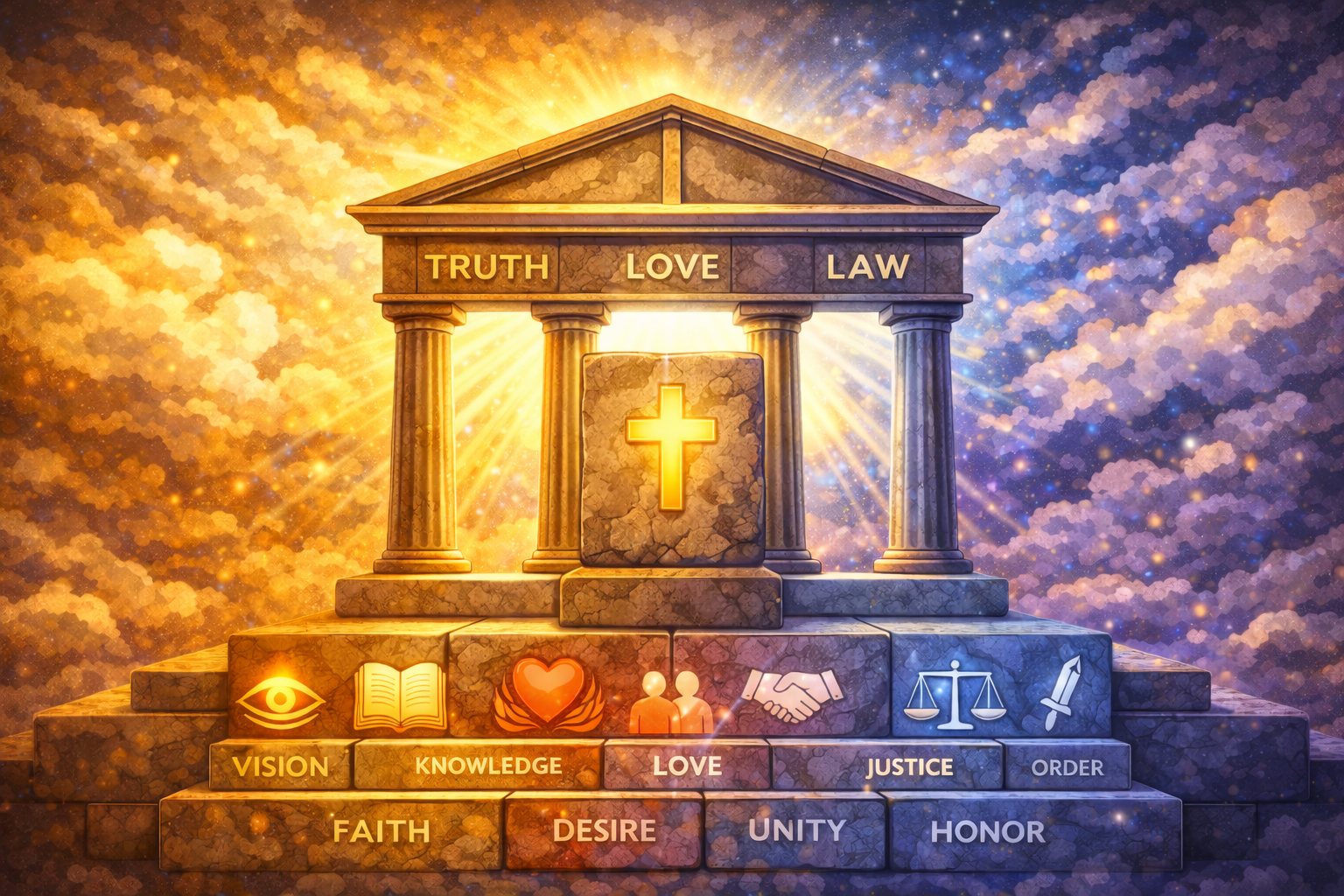
Truth Classification
Follow the subject of truth far enough out and you reach the frontier — the place where the philosophers live. Not arguing about what is true, but about something stranger and deeper underneath it: what makes anything true at all. They have been at it for centuries, and they have produced five major answers. This is the far edge of the map, well past the shore, and it is worth the trip out for one reason. Out here, a single degree off course does not land a man a few feet from the dock. It lands him on a different continent.
The 5 Theories of Truth Classification
The five theories of truth are not five rival answers a man is asked to pick between, the way the philosophers frame them. They are five tests a real truth has to pass — five principles by which truth is formed, checked, and made able to stand against any scrutiny that comes for it. Each one caught hold of something genuinely real. Not one of them, by itself, holds the whole thing. And that is the danger this page is built to expose: almost right is the most dangerous place a man can stand, because almost right feels exactly like right the entire way down.
A boat one degree off course leaving the harbor lands a few feet from where it meant to. The same boat, one degree off, crossing an ocean, makes landfall on the wrong continent. Error does not stay small — it compounds with distance. A theory of truth that is almost right, that captures a true piece and mistakes the piece for the whole, does not produce a small mistake. It produces a man who is confidently, systematically wrong and has no way left to tell.
Correspondence — Truth Matches Reality
A statement is true if it corresponds to the way things actually are. "The sky is blue" is true if the sky is, in fact, blue. This is the principle closest to bedrock, the one project7 builds on, because it is the one theory that flatly refuses to let truth become a matter of preference: truth is what matches reality, whether a man likes the match or not, whether it is convenient or not, whether anyone is watching or not.
Its only incompleteness is the question it cannot answer on its own — corresponds to what? A statement needs a fixed reality to correspond to, and a fixed reality needs a Source that does not shift. Correspondence is right. It simply cannot stand without the Absolute underneath it, holding the reality still long enough to be matched.
Coherence — Truth Fits Without Contradiction
A statement is true if it coheres with the larger body of what is already held to be true — if it fits the system without contradiction. This is a real test and a necessary one. Contradiction is a reliable alarm: when two things a man believes cannot both be so, one of them is false, and the alarm has done its job.
But here is where almost-right turns lethal. A lie can be perfectly coherent. A cult is coherent. A conspiracy is coherent. An entire false ideology can be built without a single internal contradiction — airtight, consistent, and wrong from its first premise forward. Coherence catches the careless lie. It cannot certify the truth, because it only checks the parts against each other and never against reality. A coherent system floating free of the world is not truth. It is a well-built cage, and men live their whole lives inside ones that were never once checked against what is actually out there.
Pragmatic — Truth Is What Works
A statement is true if it works — if it is useful, produces results, pays off in practice. This catches something real too: reality rewards alignment with it, and over a long enough run, truth works better than falsehood because it is built on what is actually there.
But the pragmatic theory is the most seductive counterfeit on the bench, because "what works" and "what is" sit only one degree apart — and that one degree is the entire distance between truth and manipulation. A useful lie works. For a while. The con works until it is discovered. The flattering story a man tells himself works until reality sends the bill. The moment a man lets it works for me quietly replace it is so, he has stopped seeking truth and started managing outcomes — and that exact doorway is the one every propagandist, every manipulator, and every self-deceiving heart walks through. Usefulness is a fruit of truth. It was never the test of it.
Semantic — Truth Stated Precisely
The semantic theory, sharpened by Tarski and Davidson, gives a formal, logical account of the conditions under which a statement counts as true. At its core it is a refinement of correspondence, fitted with the rigor of formal logic. The principle it guards is precision: a truth stated carelessly — vague at the edges, blurred in its terms — is easy prey for distortion, and most lies do their work in exactly that blur.
But formal precision is a scalpel, not a foundation. It can hone a statement to a fine point and still tell a man nothing about whether reality stands behind it. A perfectly precise statement about something that does not exist is still false — precisely, rigorously, formally false. Precision sharpens truth. It cannot supply it.
Deflationary — The Theory That Tries to Dissolve Truth
The deflationary, or redundancy, theory says that "true" is not a real property of anything — that calling a statement true adds nothing at all, that "it is true that the sky is blue" says no more than "the sky is blue." As a remark about grammar it is almost clever. Followed where it actually leads, it arrives at a destination worth naming plainly: if "true" means nothing, then there is no truth — only assertion, only what people say, with no standard standing above the saying to judge it by.
This is the cliff at the edge of the far country. It is the one-degree error carried all the way out to the wrong continent — beginning as a tidy observation about language and ending by emptying the single most important word a man owns. A man who reaches this edge and keeps walking does not become more sophisticated. He becomes someone who can no longer tell a truth from a lie, because he has talked himself out of believing there is a difference between them. The frontier has a guardrail, and this is the theory that climbs over it.
The Same Error Wears Religious Clothes
This is not only a philosopher's problem. Walk the same frontier in religion and the pattern is identical — which is exactly why a page about classifying truth borders a page like the Four Noble Truths of Buddhism.
Those four truths are almost right, and strikingly so. They name suffering honestly while most of the world stays anesthetized to it. They trace it inward — to craving, to attachment — while most men spend their lives blaming their circumstances. That is a real piece of the puzzle, and project7 does not pretend it isn't. But almost right is off course by the degree that decides everything: the diagnosis stops at craving and never reaches sin, and the cure becomes the extinguishing of desire by a man's own disciplined effort — one more path to walk, one more work to perform, one more attempt to save the self by the self. It misses the mark precisely where every system built on human effort misses it: there is no sufficient sacrifice a man can make to close the gap, because the gap was never his to close. The piece it caught is real. The whole it missed is everything. The 4 Noble Truths walks the full comparison.
The lesson is the one this page keeps repeating: a teaching can be true in its parts and false in its trajectory — and the true parts are exactly what make the false trajectory so hard to question. Other religions and schools of thought are not simply wrong and dismissed. They are men who found a corner of the picture and built a whole house on it, missing the mark through works, through legalism, through a sacrifice that was never going to be enough. project7 does not burn the corner they found. It shows where the one degree turned, and where the road they were on actually goes.
The Authenticity Test
Put the legitimate principles back together and you have the test that genuine truth passes — the one that lets a man's truth stand up under any scrutiny that comes for it. It corresponds: it matches reality. It coheres: it holds together without contradiction. It bears fruit: over the long run, not the short con, it works, because it is aligned with what actually is. It is stated with precision: it does not hide in the blur. And beneath all four it is anchored to the Absolute — to a fixed reality, and finally to the One who said "I am the way, and the truth, and the life." (John 14:6) — because a test without a fixed standard has nothing to test against, and truth that is not grounded in the unchanging cannot stay still long enough to be trusted.
A claim that passes one of these and fails the rest is not a smaller truth. It is a counterfeit. The test exists to catch it.
The Counterfeits
This is how lies survive in the open: they borrow the look of truth from one principle while failing the test as a whole. The half-truth corresponds — partly — and omits the part that would have changed everything; it passes one test by quietly failing another. Manipulation is pragmatic: it works, it produces the outcome it was built for, and it never once corresponds to what is actually so. Propaganda coheres: airtight, internally consistent, and false at the root. Deception, corruption, omission, the blind eye turned on purpose — each one appears as truth and fails the authenticity test, which is the entire reason the test has to exist. These are not the opposite of truth wearing its own face. They are the opposite of truth wearing truth's face, and only a man with the full test in hand can tell the difference under pressure. Truth & Lies walks the anatomy of how they form and how a man trains his eye to read them.
Where to Go From Here
This is the frontier, and the point of coming this far out was never to stay. It was to gather the tools and carry them home. A man who holds the authenticity test can lift any claim — a philosopher's, a preacher's, a marketer's, his own — up to the light and see whether it stands.
So take the test home and put it to work on the walk. The Pillar is walked in order — bedrock, then pattern, then current, then a last room — and the instrument you built out here serves at every step. If you have not planted yet, start where the ground does not move: Absolute Truth. From there the path reads the pattern the bedrock prints in Universal Truth, then wades the current in Relative Truth — the water where almost-right swims thickest, and where the roads on the Rival Roads shelf are walked with exactly this test in hand. Its companion, Types of Truth, travels alongside it — naming what kind of claim you are holding while this page tells you whether the claim is sound. And the room where the test earns its keep is the last one: Truth & Lies — where the counterfeits you met out here in theory stand up in the flesh, wearing truth's face, and where the walk ends in front of an instrument that tests the man instead of the claim. "We destroy arguments and every lofty opinion raised against the knowledge of God." (2 Corinthians 10:5) That is what these tools are for — not to win debates at the edge of the map, but to keep a man from being carried off by what is almost, but not quite, true.