
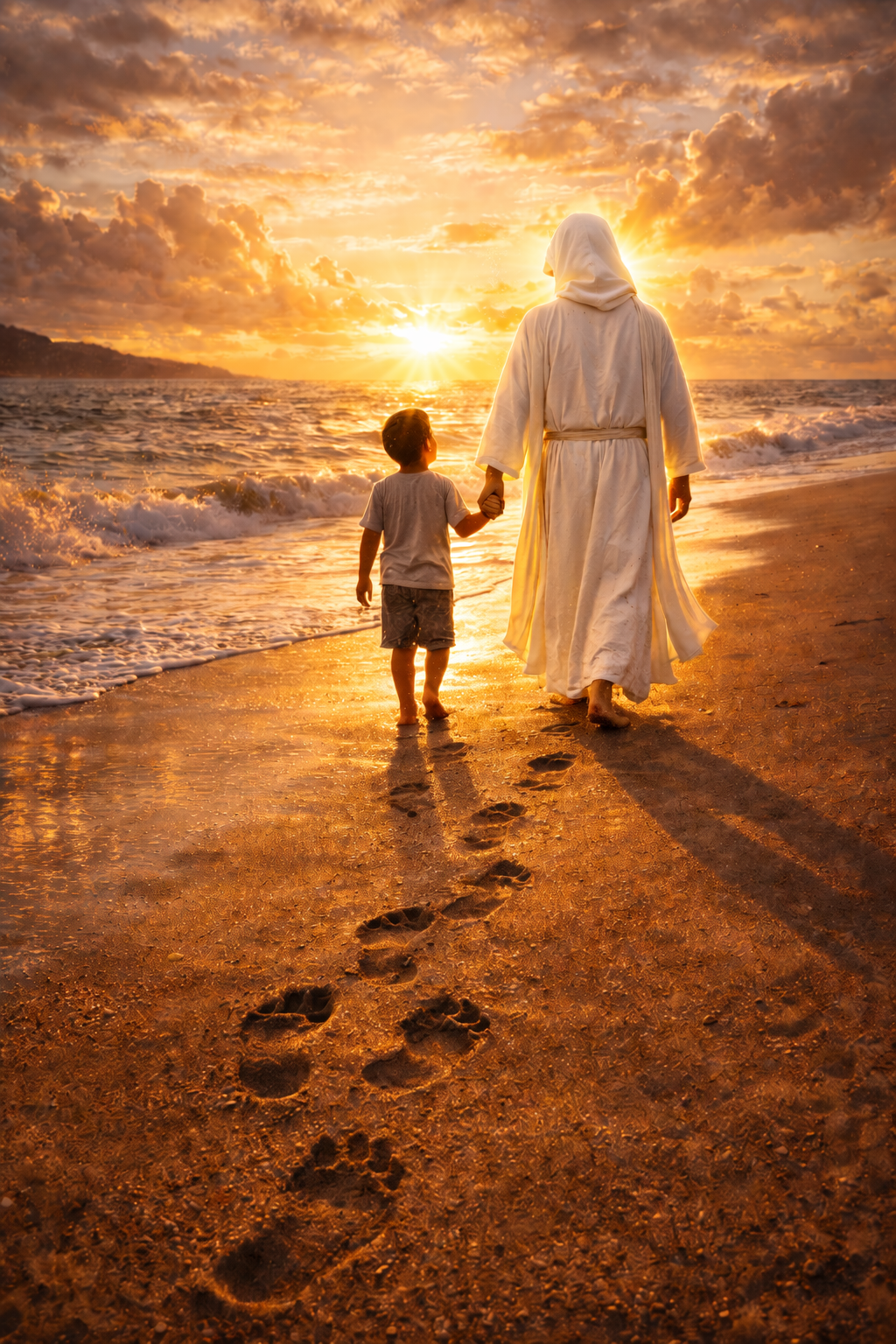
Walking with God
Everybody who has ever walked beside somebody they love knows the adjustment. One man's stride is longer. So he shortens it, and the other lengthens his, and neither one announces it or thinks about it again. After a mile you are simply in step. After a few years you can walk together for an hour without saying anything and come home closer than when you left.
That is the word Scripture chose, and it chose it on purpose. Not believe in. Not attend services about. Not hold correct positions concerning. Walk — which means movement, direction, staying close enough to talk, and a thousand small adjustments nobody keeps count of.
You cannot walk with a doctrine. You walk with a Person, or you are not walking.
"Thus saith the LORD, Stand ye in the ways, and see, and ask for the old paths, where is the good way, and walk therein, and ye shall find rest for your souls" (Jeremiah 6:16).
Notice how much of that verse happens before anybody moves. Stand. See. Ask. Then walk. There is a way to do this that men have been doing for four thousand years, and a man does not have to invent it from scratch or figure it out alone. It has been mapped. The map is what this room is.
So here is the plain promise of this section, stated once and without decoration: there is a way to get closer to God, it works, and it can be laid out in order. Not a formula. Not a technique. An order — the way a relationship actually deepens when two parties keep showing up.
Seven rooms, in sequence. Each one opens because the one before it did its work.
"Then shall we know, if we follow on to know the LORD" (Hosea 6:3).
Follow on to know. That is the whole thing in four words. Not know, then follow. Follow on — keep going — and the knowing comes as you go. Nobody gets handed the destination at the trailhead.
Walking with God
Before the first step, the same thing that was said at the door of this whole section has to be said again here, because this room is where men are most likely to forget it.
None of these seven steps make God love you more.
He is not further away when you start and closer when you finish. Your standing was settled by Christ, at the cross, before you were born, and it does not move with your performance. If you walk all seven of these rooms in order and come out thinking you have climbed something, you have climbed the wrong thing.
What changes is not His position. It is yours — your nearness, your capacity, your ability to hear Him, the amount of yourself that is actually available to Him. A father loves the infant and the grown son exactly the same. But he can talk to the grown son. He can hand him things. He can walk beside him for miles and be understood. The love did not increase. The relationship deepened, and depth is the thing these seven rooms are for.
Here is the road:
Communion — you make contact.
Obedience — you start doing what He says.
Killing Sin — you clear what is in the way.
Fear of the Lord — the fight teaches you who you are dealing with.
Mirroring Christ — the work turns from subtraction to becoming.
Righteousness & Holiness — it settles into character.
Perseverance of the Saints — and you find out who has been holding this together the whole time.
One honest word before you start. You will not walk this cleanly. Nobody has. You will be in three of these rooms at once, you will be thrown back to the first one by a bad month, and you will discover at fifty that a room you thought you finished at thirty has more floors under it. That is not the process failing. That is the process.
"And thine ears shall hear a word behind thee, saying, This is the way, walk ye in it, when ye turn to the right hand, and when ye turn to the left" — Isaiah 30:21
Read where the voice is coming from. Behind thee — spoken to a man who has already wandered off the path. The correction assumes the drift. Come back and keep going.
Step 1: Communion
"Behold, I stand at the door, and knock: if any man hear my voice, and open the door, I will come in to him, and will sup with him, and he with me"
— Revelation 3:20
Everything starts here, because you cannot have a relationship with somebody you never speak to.
That is not a spiritual insight. It is just true of people. A man can admire someone from across a room for twenty years and know nothing about him. He can read a biography of a man and never once have a conversation with him. Most of what passes for Christian life in this country is exactly that — sincere admiration of a Person nobody talks to.
Communion is the talking. And it runs in both directions, which is the part men miss.
You speak. That is prayer, and the only skill it requires is honesty. Bring the actual contents of your head, not the version you would read aloud in a church basement. He is not deceived by the polished one and He was not asking for it. The prayers that change things are almost never the eloquent ones. They are the desperate ones, the angry ones, the ones where a man does not know what to say and says that.
He speaks. That is Scripture, chiefly — which is why the room you just came from stands ahead of this one. A man who never opens the Book has cut off the only reliable line coming back. He also speaks through the Spirit's nudge, through a brother who says the exact thing on the exact day, through the way circumstances line up. None of those outrank the Book. All of them get checked against it.
And there is a table. The Lord's Supper is communion with your hands in it — bread and cup, the same meal He handed His friends the night before He died, taken with the body He put you in. It is not a ceremony to sit through politely. It is the anchor a man comes back to when he needs to remember what all of this actually cost.
Downstairs: Prayer & Meditation develops the practice — Morning Prayer and Morning Meditations for the men who have learned that the first thirty minutes of a day decide the rest of it, Prayer & Supplication for how to ask, The Power of Prayer for what it actually does.
Start here. Ten minutes, most mornings. That is the entire assignment, and it is enough to change a life if you do not quit.
Step 2: Obedience
"Ye are my friends, if ye do whatsoever I command you" (John 15:14).
Sit with the strangeness of that sentence. He did not say ye are my servants. He said friends — and then attached doing what He says to it, as though the two were the same thing.
They are, in every relationship worth having. You find out what a man's word is worth the first time keeping it costs him something. Obedience is not the fee for the friendship. It is how the friendship becomes real instead of sentimental.
So step two follows step one immediately: once you are actually talking to Him, He says things. And then there is a decision.
Understand what this is not. It is not legalism — a man racking up compliance to earn a favor he already has. It is not perfectionism; obedient men fail constantly, and the difference between them and everybody else is not the falling but the coming back. And it is not behavior with the heart left out. This people honoureth me with their lips, but their heart is far from me. A man can build an impressive-looking life and be in full rebellion underneath it.
The test is almost never dramatic. It is the word kept when breaking it would cost nothing. The second look refused. The honest answer when the dishonest one was easier and nobody would have known. The call returned. The temper held in the kitchen at ten at night. Character gets built in those, and the big moments only reveal what the small ones already made.
And then, eventually, obedience costs something real — a relationship that has to end, income that has to be refused, a friendship that has to be confronted, a habit that has to die even though killing it takes more than a man wants to pay. That is the door where faith stops being theoretical. Before it, a man has mostly coincided with God — obeying in the places where God's will happened to match his own.
Step 3: Killing Sin
"If thou doest well, shalt thou not be accepted? and if thou doest not well, sin lieth at the door. And unto thee shall be his desire, and thou shalt rule over him"* (Genesis 4:7).
That is God, speaking to Cain, before the murder. Sin is described as something crouched outside a door, wanting in — and the man is told plainly that he is capable of ruling it. Cain heard that and went out to the field anyway.
Step three arrives because step two runs into a wall. A man starts obeying and finds out fast that something in him does not want to. There is cargo he has been dragging, and he cannot get closer while he refuses to put it down.
So the fight starts. And the word is kill, not manage — because managed sin is sin kept on a leash in the yard, fed just enough to stay quiet, and every man who has tried it knows how that ends. There is no neutral setting. The thing you tolerate is not dormant; it is working.
The toolkit is in this room, and every tool is a mercy rather than a punishment.
Repentance — not a one-time event at conversion but a practice: the honest turn, made immediately, without the self-protective delay of waiting until you feel worthy. Forgiveness — both directions, including the one most men never finish, which is releasing the man who wronged them. Spiritual Fasting — voluntarily going without, which is how a man discovers what has actually been driving him. Submission & Surrender — the posture underneath all of it, the daily release of self-rule. And Taking Thoughts Captive — the front line, because nearly every failure a man will ever have began as a thought he let run.
Two hard truths this room insists on. You will not win this alone; the brothers are not optional equipment. And brokenness is where it starts — a man does not put a sin to death until he has stopped defending it.
Step 4: Fear of the Lord
"The fear of the LORD is to hate evil" — Proverbs 8:13
Now, why is this fourth?
Every book on the shelf will tell you the fear of the Lord is the beginning of wisdom, and it is. But there is a difference between a man who can quote that and a man who has it, and the second one almost never got there from a lecture. He got there the way it is written above — by hating evil. And a man learns to hate evil by fighting it and getting beaten by it a few times.
That is the honest sequence, and it is why this room sits where it does. Step three puts a man on the floor. He finds out that the thing he thought was a habit has roots he cannot reach, that he is weaker than he presented, and that the God he has been casually chatting with is holy in a way he had not reckoned with. Both facts arrive together. And what comes out of that is not terror — it is the calibrated, wide-awake reverence of a man who has finally understood who he is dealing with.
Get the word right, because it wrecks men who get it wrong. This is not the flinch of a boy waiting to be hit. God tells His people do not be afraid constantly, in the same breath He tells them to fear Him, and both are true because they are different things. The fear He forbids is the panic of an orphan who does not know whose he is. The fear He commands is the awake awareness that He is God and you are not. If your picture of God was built out of a father who was cold or absent or unsafe, that repair is part of the work here — and this room is the end of cowering, not a return to it.
What it produces is the best internal governor a man can own. A man ruled by what others see performs when watched and rots when alone. A man who fears God knows there is no unwatched room, and something restful happens when the performing finally stops being worth anything.
And it kills the fear of man, which is the quiet disease of nearly every male alive — the constant tuning of speech and posture toward the approval of a boss, a woman, a peer group, an audience of strangers on a screen. It does not stop by trying harder. It stops when the verdict that controls you moves. Then every other opinion becomes information instead of a sentence.
Step 5: Mirroring Christ
"He that saith he abideth in him ought himself also so to walk, even as he walked” — 1 John 2:6
Everything so far has mostly been subtraction — stop that, put this down, kill the other thing. Necessary work, and not enough. A cleared field is not a crop.
Step five is where it turns positive, and where the target finally gets named out loud. The goal was never a man who has quit doing bad things. The goal is a man who looks like Jesus.
The word is mirror, not imitate, and the difference matters. Imitation is a man studying a technique and copying it from the outside — which produces exactly what you have seen it produce: Christian mannerisms with nothing behind them. A mirror does not work at it. A mirror reflects what it is turned toward. Which means the work here is mostly about where a man keeps his face pointed, day after day, for years.
The rooms make it concrete. Beatitudes — Christ's own description of the formed man, which reads like a list of everything the world calls losing, and which is not poster material but a portrait. Christ-likeness — the specific traits, in a real week: meekness, which is power under control and not weakness; mercy toward the man who does not deserve it; purity in the interior where no one checks. Christ-Centered Life — what happens to a man's calendar, money, and ambitions when the center actually moves. And Discipleship — the handing-on, because the man who has walked twenty years and is investing in nobody younger has misunderstood what he was given it for. It was never only about him.
Do not expect this fast. This is the decade work — the reason a man is recognizably different at fifty than at thirty in ways he cannot take credit for.
Step 6: Righteousness & Holiness
"Follow peace with all men, and holiness, without which no man shall see the Lord" — Hebrews 12:14
Step six is where it stops being a set of practices and becomes a character. And it turns on a distinction that has freed more men than almost anything else in Scripture.
Righteousness is given. It is a standing, handed to you, credited to your account on the basis of what Christ did and not one thing you contributed. You did not build it, you cannot improve it, and you cannot lose it by having a bad Tuesday. That is settled ground and it is meant to be stood on.
Holiness is grown. That is the slow reshaping of an actual man — his desires, his reflexes, his instincts under pressure — into something that matches the standing he was already given. Sanctification is the name for that work, and the Spirit does it, over decades, usually without asking permission and rarely on the schedule the man would have picked.
Hold both. A man who has the first without the second has a certificate and no life. A man chasing the second without the first is trying to earn what he was already handed, and he will either burn out or turn into a Pharisee — and both of those men are exhausted.
And understand what holiness is not. It is not a list of things a man avoids, though it will change some of that. It is what he is becoming. It is also not perfection — the target is not a man who never fails but a man who is moving, who sins and repents rather than sins and rationalizes. Direction is the whole measure. A man walking slowly toward Christ is a different creature from a man standing still, and both of them know which one they are.
One more thing this room handles: your body is not a neutral container. Scripture calls it a temple, and what a man does with it is not separable from his walk.
Step 7: Perseverance of the Saints
"Now unto him that is able to keep you from falling, and to present you faultless before the presence of his glory with exceeding joy" — Jude 1:24
Read who the subject of that sentence is. Him that is able to keep you. Not you, keeping yourself.
That is the last step, and it is a relief rather than a demand — which is exactly backwards from how most men expect a section like this to end. Six rooms of work, and then the seventh tells you that the One who started this is the One finishing it, and He does not lose people.
This is not the world's perseverance. It is not grit, and it is not the leadership trait — those exist and are covered elsewhere. This is the promise that a man genuinely brought into this relationship will be held in it, through every season built to make him quit. Not because he is strong. Because God is faithful.
Which does not remove the work. It makes the work survivable. A man who believes his standing finally rests on his own performance lives between pride and despair, flipping between them depending on the week. A man who knows he is being kept fights from a settled position rather than for one — not to be saved, but because he is.
And in practice it looks unremarkable. He keeps reading in the season when the Book is dry. He keeps praying when the ceiling feels like brass. He keeps showing up to the brothers when hiding would be easier. He keeps obeying in a small thing today that he cannot see the point of. He continues — and the continuing itself turns out to be the evidence that something real was done in him.
The wilderness years do not disprove the calling. They are usually how a man gets built to carry it.
How to Actually Use This Room
Do not try to do seven things.
Do the first one. Ten minutes in the morning — say something honest to Him, read something from the Book, and go to work. Do that for a month before you worry about anything below it. Almost every man who has ever walked this well started with something that small, and almost every man who quit started by attempting all seven at once and failing at all seven by Thursday.
Then let the next room open when it opens. It will. You will be praying regularly and He will bring something up. Then you will obey it and find the thing in the way. Then the fight will show you His holiness. The order in this section is not administrative — it is what happens to men.
And come back. This is a room to return to, not a course to complete. Some men will be in step three for two years. Some will get to step five and be sent back to step one by a hard season, which is not a demotion. There is nothing here you can use up.
Where Walking with God Leads
Something happens to a man who walks this for a while, and he usually cannot name it at first.
He starts wanting to be near God for no reason — not to get anything, not to fix anything, not because he is in trouble. The relationship stops being primarily useful and starts being the thing he wants. Ask him what he is after and he will have trouble answering, because the honest answer sounds strange out loud: I just want to see Him.
David got there in a desert, on the run, with nothing.
"O God, thou art my God; early will I seek thee: my soul thirsteth for thee, my flesh longeth for thee in a dry and thirsty land, where no water is; to see thy power and thy glory, so as I have seen thee in the sanctuary" (Psalm 63:1-2).
He is thirsty in a place with no water, and what he asks for is not water. He wants what he saw in the sanctuary.
That is the seam. When the walking has gone on long enough, it starts bending toward the sanctuary on its own — and the man finds himself doing something he did not plan to do. He bows. Not because a service told him to. Because of what he has been walking beside.
The next room is what that bowing is, where it goes when it goes wrong, and what a life looks like when it is aimed right.