
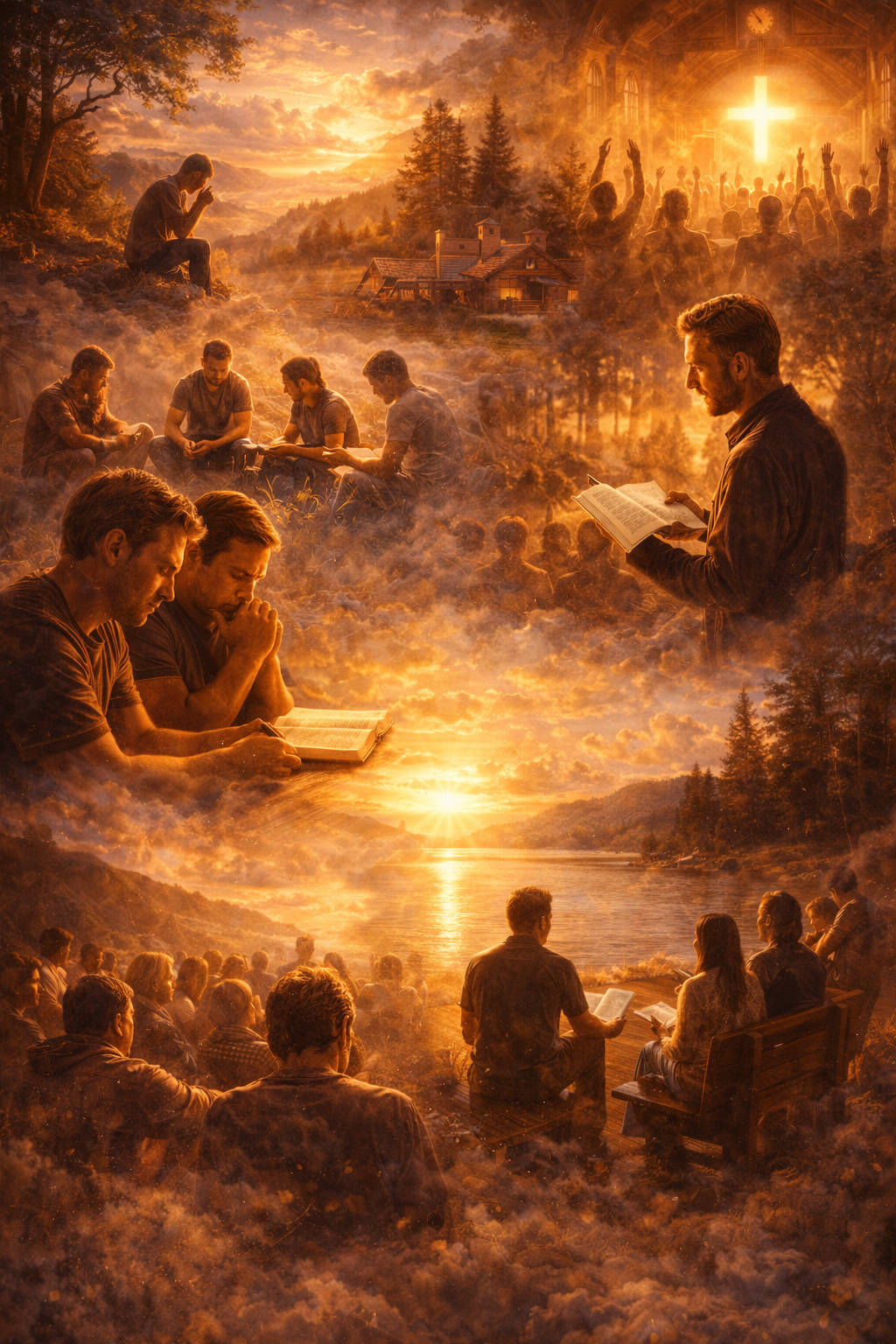
Churches & Pastors
Brotherhood
Preaching Styles
Understanding Other Christians
Finding & Choosing a Church
Top Pastors & Preachers
"Now you are the body of Christ and individually members of it." — 1 Corinthians 12:27
When choosing a church you're gonna want to… yeah no. The Lord is going to put you where He wants you. But here is a list of resources since you don't listen. (Don't worry — I was the same way too. Hope is coming.)
The Fellowship parent named the institutional architecture as one of the three faces of the horizontal walk. This sub-cluster develops it. It addresses what a church actually is, the pastor and the pulpit, the brotherhood within the church, the diversity across the denominations, the contemporary preachers worth listening to, the historical Hall of Fame of saints whose voices still teach the church across centuries, and the specific churches that exemplify what to look for. The architecture below maps the children of this folder.
The man who has not yet found a church is the man whose horizontal walk is incomplete. The man who has found one and is engaging it is in the structure scripture commends. This page is the entry point.
Whose Church Is It Anyway
The first move in thinking about church is the move that the man's instinct resists.
The instinct is consumer. The man approaches church-finding the way he approaches gym-shopping or restaurant-choosing — assessing the product, comparing the options, optimizing for his preferences, willing to leave when something better presents itself. This frame is so natural to the modern Western man that he often does not notice he is using it. He notices only the symptom — the inability to commit, the dissatisfaction with every option, the slow drift across multiple congregations without ever putting down roots in any of them.
Scripture's frame is different. The church is Christ's, not the man's. The man does not select a church the way he selects a service provider. He is brought into a body that the Lord is building, and his task is to find the local expression of that body where the Lord has placed him, and to become a faithful member of it. The shift is from what works for me to where has the Lord planted me.
This does not mean every church is equally suitable. Some churches teach false doctrine. Some have abusive leadership. Some have decayed into something that cannot be called a church anymore. The believer is not commanded to ignore these problems. He is commanded to find a faithful church and stay in it. "Not neglecting to meet together, as is the habit of some, but encouraging one another." — Hebrews 10:25. The Finding and Choosing a Church page in this folder develops the practical diagnostics. The point here is the underlying posture — the man comes to the church as a member of a body that is not his to design, looking for the place the Lord has prepared him to serve.
What a Church Actually Is
The Greek word ekklesia, translated church throughout the New Testament, means a called-out assembly. It does not mean a building. It does not mean an institution. It means the gathered people of God.
This is foundational. The man can attend a Christian building, in a Christian denomination, with Christian programming, and not actually be part of a church in scripture's sense — because he has not been incorporated into the gathered, called-out people whose lives are being shaped together by Christ. Conversely, the small house gathering of believers meeting in a home, with no building and minimal institutional structure, can be a church in the fullest scripture sense. The substance is the gathered people, not the apparatus around them.
What the gathered church does is also specific. "They devoted themselves to the apostles' teaching and the fellowship, to the breaking of bread and the prayers." — Acts 2:42. Four marks. The teaching of the apostles — preserved in the New Testament, preached in the local church through faithful exposition. The fellowship — the koinonia of brothers and sisters sharing life in Christ. The breaking of bread — the Lord's Supper, kept regularly, with appropriate gravity. The prayers — corporate prayer as a normal part of the church's life, not an afterthought.
A gathering claiming to be a church and missing one or more of these marks is incomplete. The church without faithful teaching is not feeding its people. The church without fellowship is performing services to passive consumers. The church without the table is missing the sacrament Christ instituted. The church without prayer is operating in its own strength rather than dependence. The believer evaluating a church is checking for these marks. Their presence indicates a church operating as scripture describes. Their absence indicates a building hosting religious activity without the substance.
The Pastor and the Pulpit
The pastor is not the church. He is one office within it. But his work is consequential, and the man should understand it.
The pastor's primary work scripture names is the feeding and shepherding of the flock. "Shepherd the flock of God that is among you, exercising oversight." — 1 Peter 5:2. The shepherding includes the pulpit ministry — preaching the word week by week — and the pastoral ministry — caring for the people through visitation, counsel, the rhythms of life and death the congregation passes through. A pastor who does only the pulpit and never the pastoral has half the office. A pastor who does only the pastoral and never the substantial pulpit is also incomplete.
The pulpit work is consequential because what the people are taught week by week shapes them. A faithful pastor preaching the actual scripture, in context, applying it to actual lives, across years — produces a congregation that is being formed by the word. An unfaithful pastor preaching topical sermons that drift away from the text, that flatter the audience, that avoid hard doctrines, that substitute cultural commentary for biblical exposition — produces a congregation that thinks it is being fed but is actually starving. The Preaching Styles page develops the distinctions in detail. The Test the Spirit page in the Spiritual Warfare cluster develops the diagnostic for evaluating teachers.
The man's relationship to his pastor is one of respect for the office, honest engagement with the substance, willingness to be taught, and willingness to confront when confronting is required. The pastor is a man, with weaknesses and failures. He is not infallible. He is also not to be despised, undermined, gossiped about, or abandoned at the first failure. The proper relationship is honored — neither cult-of-personality submission nor consumer-class entitlement, but the respectful brotherhood of a man under shepherding by a faithful undershepherd of Christ.
Brotherhood Within the Church
The local church is the natural environment for brotherhood. The men a man worships with on Sunday are the men he should be in the foxhole with through the rest of the week.
This is often not how it works in the modern church. The Sunday gathering is large, anonymous, structured for performance rather than relationship. The men leave without having known each other. Across years, the man has attended with hundreds of brothers and known none of them. The structural failure has been allowed to persist because the institutional church is more efficient when relationships are shallow — fewer demands on staff, fewer conflicts to manage, more attendance numbers per square foot.
The remedy at the institutional level is the recovery of small group structures and meaningful pastoral care. The remedy at the man's level is the deliberate building of brotherhood within whatever church he finds himself in. He identifies the men who could be brothers. He invites them to the breakfast, the small group, the early-morning prayer, the workout. He cultivates the relationships intentionally. The church is the pool of candidates. The brotherhood is what he builds with the men who are willing.
The Brotherhood & Fellowship cluster in this folder develops the forms — Men's Groups, Men's Breakfast, Spiritual Retreats, Fitness & Fellowship. The principle here is that brotherhood inside the church is not optional add-on. It is the relational substance without which church attendance becomes spectatorship.
Across the Denominations
The visible church is fragmented across denominations. The believer needs a working frame for engaging this reality without being either tribal or indifferent.
The historical creeds — the Apostles' Creed, the Nicene Creed, the Athanasian Creed — name the doctrinal floor that all genuinely Christian traditions share. Trinity. Incarnation. Atonement. Resurrection. The bodily return of Christ. The authority of scripture. Salvation by grace through faith. The traditions that hold these doctrines are within the broader Christian family, regardless of their differences on secondary issues. The traditions that have abandoned these doctrines are not within the family, regardless of their continued use of Christian vocabulary.
Within the Christian family, the man has the freedom — and the responsibility — to find the tradition where he can faithfully serve and be served. The Finding and Choosing a Church page develops the project7-aligned preferences (Reformed/Protestant, Baptist, Calvinist within the New Calvinism stream). These are not the only faithful traditions. They are the ones that have shown the deepest theological substance and the most consistent integration of doctrine and practice in recent generations. The man may end up elsewhere — Presbyterian, Anglican, congregational evangelical, even a faithful expression of older traditions — and the choice is his within the Christian family.
What scripture does not authorize is theological indifferentism — the posture that doctrine does not matter as long as everyone is sincere. Doctrine matters. The traditions that have held doctrine faithfully across centuries have produced different fruit than the traditions that have not. The Understanding Other Christians page in this folder develops a typology of believers at different levels of maturity. The diagnostic is the same one that runs throughout this cluster — the substance, not the surface.
The Architecture
This folder contains the cluster's children, each developing a face of the institutional and pastoral architecture.
Finding and Choosing a Church. The practical diagnostics for evaluating a local church. What to look for, what to flag, when to leave. Roger's project7-aligned preferences locked in.
Preaching Styles. The major styles of preaching and the project7 preference for expository. Distinguishing biblical preaching from motivational speaking with religious vocabulary.
Understanding Other Christians. Roger's typology — Base Camp Christians, Christ Warriors, Doubting Thomas, Curmudgeons, Overcomers, Intellectuals, Bereans. How to engage charitably across maturity differences within the body.
Brotherhood & Fellowship The brotherhood cluster within the church. Men's Breakfast, Spiritual Retreats, Fitness & Fellowship, Men's Groups. The relational substance without which church attendance is spectatorship.
Churches Specific churches that exemplify what a faithful church looks like in practice. Apologia Church as the seed example.
Top Pastors & Preachers Contemporary preachers worth listening to, plus the Hall of Fame of historical saints whose voices still teach across centuries.
The cluster also contains parked references — Church Denominations, Teachers, Preachers, and Automobiles, Understanding Your Pastor — that Roger has flagged but not yet built into pages of their own. Cross-link from those pages back to this parent when they are built.
Cross References
Walking with God
Fellowship
Finding and Choosing a Church
Preaching Styles
Understanding Other Christians
Brotherhood & Fellowship
Churches
Top Pastors & Preachers
Hall of Fame
Test the Spirit
Bible Study
Liturgy