
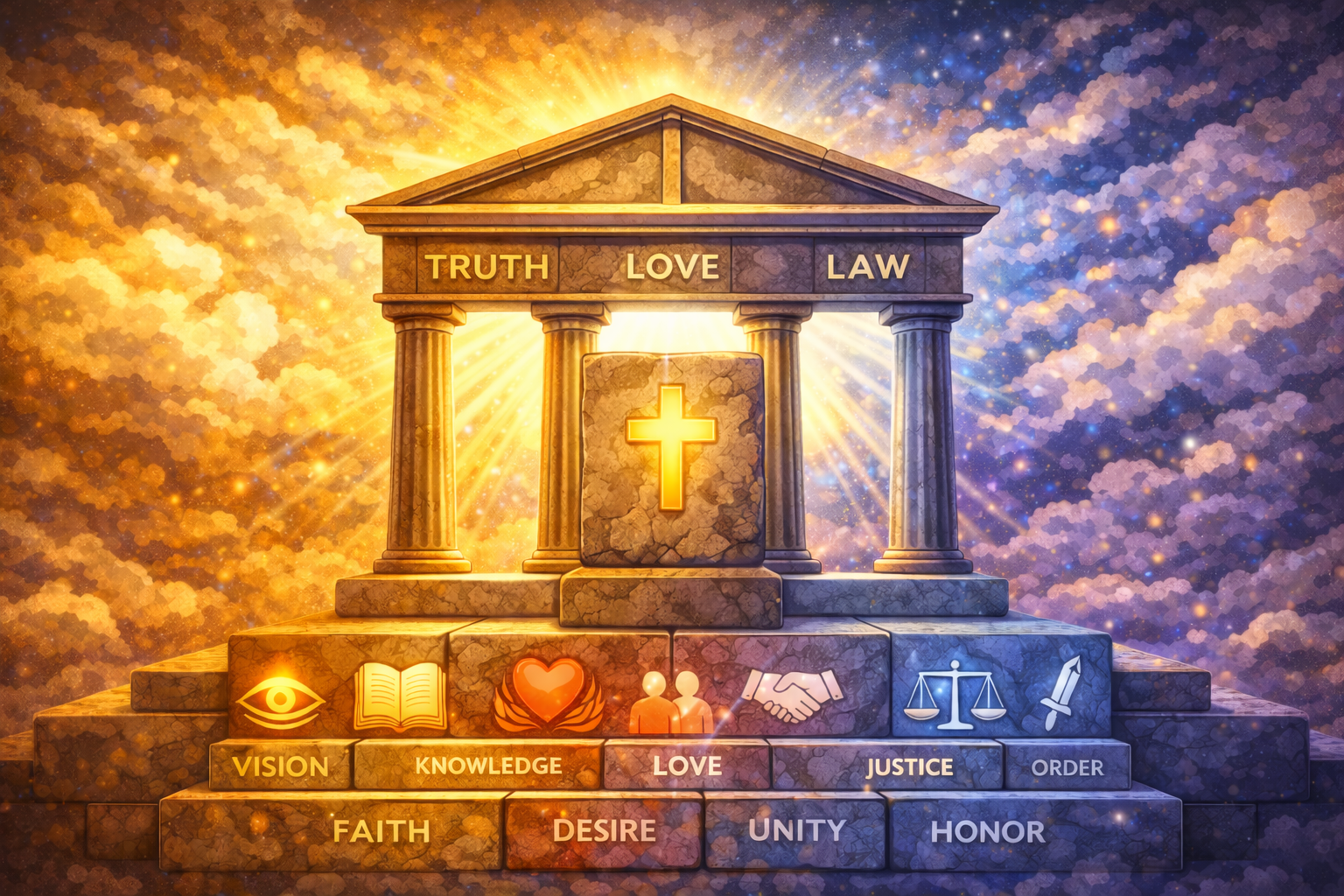
Dualism & Duality
Every line that was ever ruled has two sides, and the two sides have never once been equal.
The league would have folded without a referee, so the man took the shirt. Under-twelves, Saturday mornings, a whistle on a lanyard and a shirt with two colors on it and no third. His son played for the blue side. In the second half the boy went through another kid's legs for the ball and took the legs instead, and the man blew it before he had decided to, and pointed the other way, and heard the blue parents go quiet behind him.
In the truck the boy asked whose side he was on. The man said, "The line's." He had not planned the answer; it was only what was true. The boy was quiet for most of the drive and then asked the better question: what the game would be if there were only one bench. The man said there would be no game. Nobody to run against, nothing to get past, no score, no reason to lace a boot. The other side was not the enemy of the game. The other side was the game.
His wife found the shirt that night on the back of a chair. Two colors, and the stripes did not blend where they met. She asked why they made it like that. He said so nobody could say which one he was.
A man came in off the ink. He read the numbers and the code and the spiral in the room before this one and was told, on the way out, that under the ink the page is ruled. This is the room for the ruling. Everything that exists stands on one side of a line, set against what it is not: light and the lack of it, the holy and the common, the good and the corruption of the good, two parties before one bench, two sexes, and a force and the thing it pushes against. That is duality, and it is the architecture of the world, not a philosopher's game. Dualism, as the philosophers use the word, is something else, and it is the error this room exists to keep a man from making: the claim that the two sides are equals, two powers splitting the world between them, light and dark as rival gods. The title holds both words so that a man can tell them apart, because the line between them is where most of the damage gets done.
The room covers six things and hands off one. It covers the pair under everything, the line God draws between what is his and what is common, why the two sides were never the same size, the one pair that makes more of itself, the court with its two parties, and resistance, which is the form the second side takes when a man is trying to build something. What it hands off is the tool. There is a room among the Components further down this foundation that teaches a man to read the two poles in his own wiring, and that is a different job. This room is not about his wiring. It is about the world's, and about reading the same hand in it that he read in the numbers.
Dualism & Duality
"And God saw that the light was good. And God separated the light from the darkness." — Genesis 1:4
Read the order of the two sentences. The first thing God did with the first thing he made was to look at it and pass a verdict, and the verdict was on the light. Not on the pair. Not on the balance between them. On the light. Then he separated it from what it was not, and the separating is the second act of creation in the Bible, before a star, before a blade of grass. A line, drawn on purpose, with a judgment already sitting on one side of it. That is the whole of this room in two sentences, and the page only walks what they contain: that the line is real, that God draws it, that the two sides are not equals, and that a man meets the line again in his sex, in every court he stands in, and in every wind he leans into.
Every Line Has Two Sides
The deepest sentence a man can say about anything is that it is, or it is not. Present or absent. There is no third state, and every attempt to find one turns out, on inspection, to be one of the two wearing a hat. A heart is beating or it is stopped. The code that runs every machine a man owns is built from one distinction, a one and a zero, and the men who built it did not invent the distinction; they found that the world would answer to nothing else.
Genesis names both sides and makes a point of it. "God called the light Day, and the darkness he called Night" — Genesis 1:5. Both sides get a name. Only one got the verdict. That is the shape a man should carry through every pair on this page: both halves are real enough to be named, and they are not the same kind of real. When God answered Job out of the storm he asked him, among sixty other questions, whether he knew the addresses. "Where is the way to the dwelling of light, and where is the place of darkness, that you may take it to its territory and that you may discern the paths to its home?" — Job 38:19-20. Light has a dwelling. Darkness has a place. Each has a territory, and a man can no more blend them than he can blend the two stripes on the shirt. The Preacher's famous list of pairs, a time for this and a time for its opposite, fourteen in a row, is not a poem about balance. It is an inventory of the lines, and the psalmist drew the one that matters most in a single verse: "for the LORD knows the way of the righteous, but the way of the wicked will perish" — Psalm 1:6. Two ways. One known. The other does not get a verdict; it gets an ending.
Holy and Common
The line a man meets first in Scripture is not good and evil. It is holy and common, and he should learn it first because it is the one God draws with his own hand and the one men are most eager to erase. Holy is what belongs to God. Common is everything else, and common is not an insult; a man's dinner table is common and so is his truck. The point of the line is not that the common is bad. It is that the two are not to be confused, and that the confusing of them is the beginning of every other confusion.
God put the line in stone and in masonry. To Israel: "You shall be holy to me, for I the LORD am holy and have separated you from the peoples, that you should be mine" — Leviticus 20:26. Separated. The same verb as the light. And when Ezekiel was shown the temple, the last thing he was shown was the wall, measured on four sides, and told what the wall was for: "to make a separation between the holy and the common" — Ezekiel 42:20. A wall. Not a gradient, not a suggestion, a thing a man could walk up to and put his hand on. The priests' whole job was to keep that wall legible, and a prophet in the exile charged them with the one failure that undid the nation: they had stopped teaching the difference, and the people could no longer tell.
Here is where the adversary works, and a man should see the method, because it is the only method he has. He does not build a third side. He cannot; there is none to build. What he does is swap the signs. Job's friends described men who "make night into day: 'The light,' they say, 'is near to the darkness'" — Job 17:12, and Malachi heard the finished version from God's own people: "Everyone who does evil is good in the sight of the LORD, and he delights in them" — Malachi 2:17. The line was not erased. It was relabeled, the holy called common and the common called holy, and a people who had lost the wall could not tell the difference. That is the first thing the man in the striped shirt has to be able to do: read a line that somebody has been repainting.
The Side Without a Floor
Now the claim that makes this room different from the one in the Components, and the claim the last room of this column will lean its whole weight on. The two sides are not equals. One of them has a floor and the other does not. Good is a thing. Evil is not a second thing standing across from it; it is the first thing bent, or hollowed, or turned against its purpose. A lie cannot exist until there is a truth for it to depart from. Cruelty is strength with the protection taken out of it. Theft requires that something belong to someone. The dark side of every pair on this page is the bright side with something missing, and nothing missing has ever built anything.
Scripture says it from both ends. From the top: "God is light, and in him is no darkness at all" — 1 John 1:5. At the source, one of the two sides is not present even as a trace. From the bottom, Jude described the men who had crept into the church with four pictures and every one is an absence: "waterless clouds, swept along by winds; fruitless trees in late autumn, twice dead, uprooted" — Jude 12. Clouds with no rain. Trees with no fruit. Dead, and then dead again. That is what the second side is made of, and a man who has been to the bottom of the well in the hall behind this one already knows there is someone down there who wants things. This room does not go back down. It only shows him the architecture the well is dug in: the thing at the bottom has no floor of its own. It stands on what it corrupts.
There is a detail in the prophets that a man would not guess and should not forget. Holiness does not spread by touch. Defilement does. Haggai put the question to the priests as a ruling: if a man carries holy meat in his garment and the garment touches bread, is the bread holy? No. If a man unclean by a dead body touches the bread, is it unclean? Yes — Haggai 2:12-13. The corruption travels on contact; the holy has to be given. That is the asymmetry a man lives inside every day, and it runs the opposite way from what he would prefer. The wicked "do not know over what they stumble" — Proverbs 4:19, because the thing they stumble over was never a thing. This is why the philosophers' dualism is not merely wrong but backwards. Two equal gods would mean two floors. There is one floor, one side standing on it, and the other side standing on that side.
The Pair That Makes More
Most of the pairs on this page produce clarity. One of them produces people. "Male and female he created them, and he blessed them and named them Man when they were created" — Genesis 5:2. Two, and one name. Not two rungs on a ladder with one above the other, and not two settings with a comfortable middle. Two poles, each whole as a person and each incomplete in exactly the way that makes the union generative, so that the line between them is the only line on this page that, when the two sides meet, makes a third thing that did not exist before. A son. A household. The next hundred years.
A man should notice that the move against this pair is the same move he just watched in the temple: not the building of a third side, which cannot be done, but the repainting of the line until nobody can read it. What the pair is in practice, how a man carries his side of it and what his side is for, belongs to the rooms on manhood farther down this foundation and to the household rooms far along the road. Here the room says only what the architecture says: two, named with one name, and the line between them is not an accident of biology that a wiser age will tidy away. It is the ruling on the page.
The Court With Two Parties
Every structure men have built to settle a dispute without blood has the same floor plan, and a man who has seen it once will see it everywhere: two parties, one line, and a third person who is not a party and whose only job is the line. "If there is a dispute between men and they come into court and the judges decide between them, acquitting the innocent and condemning the guilty" — Deuteronomy 25:1. Between them. Two sides, and the verdict falls on one. Moses charged the first judges to "hear the cases between your brothers, and judge righteously between a man and his brother or the alien who is with him" — Deuteronomy 1:16, and then fenced the judge from both benches at once, which is the part men forget: "nor shall you be partial to a poor man in his lawsuit" — Exodus 23:3, and three verses later, "You shall not pervert the justice due to your poor in his lawsuit" — Exodus 23:6. Not for the rich. Not for the poor either. The line's.
That is what the shirt is for. The stripes do not blend where they meet so that nobody can say which side the man wearing them is on, and a court, a ring, a field, a chessboard, a pair of scales, every one of them is the same device: two forces placed in formal opposition under rules both accepted before the first move, with a third party holding the rules, so that the thing which would otherwise be a brawl becomes a result. A man who resents the structure has not understood what it replaced. God promised Israel the day the structure would be fully legible again: "Then once more you shall see the distinction between the righteous and the wicked, between one who serves God and one who does not serve him" — Malachi 3:18. The distinction. The line, read plainly, with the verdict on one side of it.
There is one man the court cannot accommodate, and Elijah named him on a mountain with two altars. "How long will you go limping between two different opinions? If the LORD is God, follow him; but if Baal, then follow him" — 1 Kings 18:21. He is the man who wants a seat on both benches, who thinks the line is a place to stand. It is not. Moses found that out with his arms. "Whenever Moses held up his hand, Israel prevailed, and whenever he lowered his hand, Amalek prevailed" — Exodus 17:11. Up or down. A battle in two states and no third, and the men on either side of him holding his arms up were not neutral. They had read the line.
Built Against
The last pair on the page is the one a man meets whenever he tries to make anything: a force, and the thing it pushes against. He will be tempted to call the second half the problem. It is the design. A kite does not rise on a still day; it rises because the wind is against it and the string is pulling the other way, and the two oppositions, held, are what the lift is made of. A keel works by resisting the water. A wing is held up by air that refuses to get out of the way. Pull the resistance out of any of those and a man does not get a freer kite or a faster boat. He gets something lying on the ground.
The body is the plainest case and the training yards own it entire, so it is only named here. The rest of a man works by the same law. A conviction that has never been pushed on is a guess. A skill that was never tested against someone trying to beat it is a hobby. David, who was tested against everything, thanked God not for the absence of enemies but for the training: "Blessed be the LORD, my rock, who trains my hands for war, and my fingers for battle" — Psalm 144:1. Trains. The war was the resistance and the hands were the result. And Isaiah, in the strangest parable in the prophets, described a farmer who threshes each grain with the right tool for the right length of time, and no longer: "Does one crush grain for bread? No, he does not thresh it forever... This also comes from the LORD of hosts; he is wonderful in counsel and excellent in wisdom" — Isaiah 28:28-29. Resistance measured to the grain. Not endless, not random, and sent. The man who refuses it is the one case Solomon gave no second chance: "He who is often reproved, yet stiffens his neck, will suddenly be broken beyond healing" — Proverbs 29:1. He treated the second side of the line as his enemy, and the second side was the only thing that could have made him strong.
How Men Mishandle the Line
The man who says it is a spectrum. He has decided there are no lines, only gradients, and he says it about everything until the day someone takes what is his. Then he discovers a line in about a second, and discovers that he had always believed in it, and had only wanted it to run somewhere more convenient.
The man who repaints the signs. He does not deny the pair; he swaps the labels, and calls the common holy and the holy a phobia. He is doing the only thing the adversary has ever done, and he thinks he invented it.
The man with two gods. He has read enough to know the dark is real and has concluded it is the equal of the light, a second power with its own floor. He is frightened of the wrong thing. The dark has no floor. It is standing on his.
The man who resents the wind. Every force pushing back on what he is building is, to him, evidence that the world is against him. He has never flown a kite. He is trying to get lift from a still day and calling the stillness peace.
The man in the striped shirt. He called the foul on his own son and did not plan to. He had worn the line long enough that it blew the whistle before he could decide, and the boy in the truck, who had lost the call, trusted him more by the end of the drive than at the start of it. That is the man this room is built to make.
Three Questions at the Whistle
TRUTH: Which lines has a man been calling spectrums? Not the ones he is willing to defend. The ones he has let somebody repaint because reading them would have cost him something. He can name one before the end of this sentence.
LOVE: Who in a man's life is standing on a side he believes has a floor? A friend, a brother, a son, building a life on the hollow half of a pair and calling it the other kind of good. Loving him is not agreeing that the dark has a generator. It is being the wall he can put his hand on.
LAW: If the line is drawn by the one who stands on neither bench, who drew it? A man who has agreed that courts need a judge who is not a party has agreed that the court above all courts has one. The third column of this foundation is where that judge is met.
A Witness on High
All of this a man can do. Read the pair under everything. Learn the wall between holy and common and notice when somebody has been repainting it. Hold the asymmetry, so that he is never frightened of the side without a floor. Keep the pair that makes more. Wear the shirt. Lean into the wind. He should. The next room will not open to a man who has not.
And he should notice the one court where he is not the man in the stripes. In every court on this page he was reading the line from the middle. There is one where he is a party, with a case against him, and no amount of reading the line will move him to the other bench. Job found himself in that court with nothing to say for himself and said the thing a man says there anyway. "Even now, behold, my witness is in heaven, and he who testifies for me is on high... that he would argue the case of a man with God, as a son of man does with his neighbor" — Job 16:19-21. A witness for him. On high. Someone to argue a man's case at the bench, and Job did not know the name and asked for him anyway. Isaiah's servant stood in the same court and did not ask; he reported. "He who vindicates me is near. Who will contend with me? Let us stand up together... Behold, the Lord GOD helps me; who will declare me guilty?" — Isaiah 50:8-9. Stand up together. In a court with two benches, somebody crossed the floor. That is as far as this room will say it, and a man who has worn the striped shirt should carry the sentence with him, because the line was never going to move for him. Somebody came to his side of it.
Where the Stripes Lead
A man who has stood in this room can read the ruling on the page. He knows every pair has two named sides and one verdict. He knows the wall between holy and common is God's and that the adversary's whole craft is to repaint it. He knows the dark has no floor and so he is not afraid of it in the way he was. He knows what a court is for, which bench the shirt belongs to, and why the wind is not his enemy. He can tell duality from dualism, and he knows which one is the lie.
Everything he has read in two rooms sits where it was put. The light does not consider the dark. The constant does not weigh being different. The gallium was in its row before anyone looked, and the wind pushes on the kite because that is what wind does, and none of it chose a side, because none of it could. Then the road reaches one thing in all of creation that reads the line with a foot on each side and has to be asked which one it is standing on, and the whole layer turns on that one. Everything before this was the page. What comes next is the hand holding the pen.