
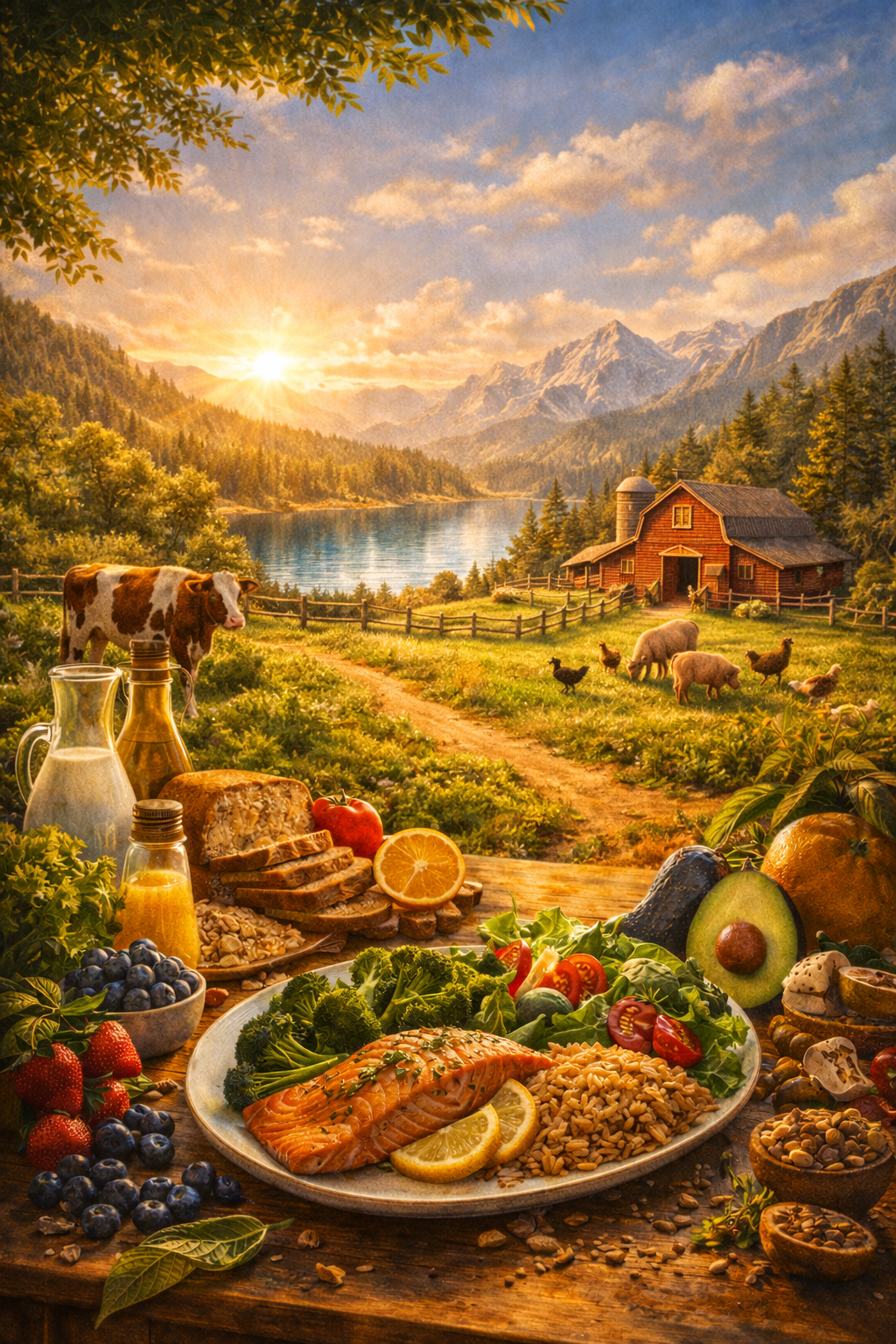
Food & Diet
Eating Behavior
Types of Food
Food & the Body
Diets & Protocols
Nutrition Guidelines
"Please test your servants for ten days: Give us nothing but vegetables to eat and water to drink." — Daniel 1:12
The Foundations of Nourishment
The mentor walks you out of the mind and into the kitchen. The smell of real food. A market down the street where the produce still has dirt on it. And waiting for you is not a chef — it is a doctor. A heart surgeon, in fact, who spent decades opening men's chests and putting in stents, until he could no longer ignore what he was seeing: that almost every disease on his table had been built, slowly, three times a day, out of what these men had been eating their whole lives.
He picks up a tomato. He picks up a brightly coloured box off the shelf next to it. "One of these," he says, "your body has known how to use for ten thousand years. The other one was invented in a laboratory to keep you eating it. Today I am going to teach you the difference — and once you see it, you will never un-see it."
Welcome to Food and Diet, the groundwork of healthy eating. This is where you learn what food is actually for: how the things on your plate either fuel you, sharpen you and repair you, or quietly take you apart. Whether you are new to this or trying to undo habits you have carried for twenty years, this is the foundation. Let the doctor talk.
You Are Being Sold Sickness Three Times a Day
Let me be honest with you, the way I would be with a patient sitting across from me. The modern food supply is not neutral. Most of what fills the middle aisles of your grocery store was engineered — by smart, well-paid people — to override the signals your body uses to tell you it has had enough. It is cheap, it lasts forever, and it makes you want more of it. That is not food. That is a product.
And the body pays. I have seen it ten thousand times: the slow rise of insulin resistance, the spare tire that will not leave, the blood pressure creeping up, the crash every afternoon, the fog, the joints that ache, the labs that get a little worse every year until one day a man my age is on five medications and cannot understand how he got there.
He got there with his fork. Most of the disease I treated for a living was not bad luck. It was a diet doing exactly what that diet does.
The good news — the great news — is that the reverse is also true. The body wants to repair itself. Give it the right inputs, stop giving it the wrong ones, and it will do things that will surprise you. That is what this room is for.
Stop Memorizing Rules. Understand Your Body.
Most men come to me reciting rules. No carbs. No fat. Nothing after eight. No seed oils. No sugar. They can list a dozen things to avoid and cannot tell me one thing about what their body actually needs to run. That is backwards, and it is why they fail. A man living on rules is helpless the moment a new rule contradicts the old one — and the marketplace will sell him a new one every quarter, forever, because a man who understands nothing has to keep buying.
I do not want you following rules. I want you to understand. When you know what protein does in your body, what carbohydrate does in different situations, which fats are essential and why, what the vitamins and minerals are quietly running behind the scenes, what fibre accomplishes, and why water governs nearly every system you have — then you do not need anybody's diet. You can look at any plan, any trend, any program with a documentary behind it, and judge it yourself: what is real here, what is exaggerated, what is simply wrong.
Knowledge makes you free. Rules keep you a customer.
What the Food Is Actually For
Before any of the detail, get the purpose straight, because a man who is unclear about what he is eating for will be sold something.
"Blessed are you, land whose king is of noble birth and whose princes eat at a proper time — for strength and not for drunkenness." — Ecclesiastes 10:17
Two things in that and both are worth having. At a proper time — the eating is structured, not continuous, which turns out to be a modern problem the ancient world did not have to name. And then the purpose, stated in five words: for strength and not for drunkenness.
Not for comfort. Not for entertainment. Not to manage a mood, fill an evening, or reward a hard week. For strength — the capacity to do work, carry weight, stay standing, and be of use. That is the standard, and almost every bad pattern a man falls into at the table is a case of food being asked to do a job it was never given.
The Dose Is the Thing
Now the correction that keeps everything I just said from turning into fear.
"'I have the right to do anything,' you say — but not everything is beneficial. 'I have the right to do anything' — but I will not be mastered by anything." — 1 Corinthians 6:12
He concedes the point twice before he answers it, which is unusual and deliberate. The freedom is real. He does not withdraw it, qualify it, or replace it with a rule. What he introduces instead are two different tests, and neither one is is this allowed.
Is it beneficial — does this actually do anything for me, which a surprising amount of what a man eats does not. And will I be mastered by it — which is the question almost nobody asks about food, and the only one that explains why a man can know everything in this room and still not be able to walk past a particular shelf.
Most trouble at the table is dose and mastery, not category. The man hunting for the one villain food will always find a candidate, because there is always a study and always somebody selling the answer.
He will eliminate it, feel better for a month from the general tightening-up that came with it, credit the elimination, and start the search again when the effect fades.
"For everything God created is good, and nothing is to be rejected if it is received with thanksgiving." — 1 Timothy 4:4
Hold that against everything I have told you about the food supply, because both are true and men can only ever seem to hold one. Yes — a great deal of what is sold to you is engineered against you, and you should learn to see it. And no — food is not the enemy, eating is not a moral hazard, and a man who has arrived at a place where he cannot eat a meal his mother cooked without auditing it has not achieved discipline. He has acquired a different disorder with better manners.
The Body Is Beautifully Designed
Here is what years of medicine taught me to stand in awe of: your body is magnificently made. It is not a machine you fight — it is a design you can work with or against, built to run on specific inputs in specific ranges. Honour the design and it rewards you. Violate it — starve it of what it needs, flood it with what it cannot handle, feed it on a schedule it was never built for — and it fails in ways so predictable I could set my watch by them.
And this is where the program adds what I, as a physician, can only point toward. The body was not only designed. It was given. It is on loan. You did not build it, you cannot keep it, and you will hand it back.
To feed it well, then, is not vanity and it is not even mainly for you. It is stewardship of something entrusted — so that you are still standing, clear and strong, for the people who are counting on you to be here in twenty years.
Eat like a man who intends to be of use for a long time.
The Kitchen Is the Cure
Now the most powerful prescription I have ever written, and it costs less than the medications it replaces: learn to cook your own food.
The man who has handed the making of his food to restaurants, drive-throughs and packages has handed over his health with it. He does not know what is in what he eats. He cannot adjust it to what his body needs. He cannot teach his children to feed themselves, because he never learned. And he cannot lead a household that eats well, because the skill is missing at the head of the table.
Get into the kitchen. Go to where food actually comes from — the butcher, the market, the garden if you can manage one — and buy things that were recently alive and will soon go bad. Food that never rots was built to sit on a shelf, not to nourish you. Cook simply. Cook often. A man who can feed himself and his family real food has taken back something most men gave away without ever noticing it was gone.
Six Rooms, In Order
This is the largest part of Nutrition and you will come back to it for the rest of your life. The order below is not arbitrary and it is not mine — it is the order this whole ground established before you got here: behavior before planning, whole food before protocols, digestion before macros, and the named systems last.
Eating Behavior — how you eat, before what. First, because a man can know exactly what belongs on the plate and undo all of it three times a day in the manner of eating: too fast to notice fullness, finishing what is in front of him because it is in front of him, grazing continuously so the body never gets a break. Food & Mood sits here too — the connection most men never make between what they ate at noon and who they were at six.
Types of Food — telling real food from a product. Whole foods, processed foods, the labels, the marketing, and the vocabulary that lets you see what is actually in front of you. Fruits & Vegetables, Grains, Dairy, Nuts and Oils live here, with Processed Foods and its Additives.
Food & the Body — what it does once it is inside you. Five windows into one system: Digestive & Gut Health upstream of everything, Metabolic Health where fuel handling and body fat and inflammation sit together, Heart Health which kills the most men, Immune Health, and Joint Health which has to carry you another forty years.
Nutrients — what food is actually made of. Protein, carbohydrate, fat, and the vitamins and minerals running your chemistry behind the scenes. This is the level at which every claim in this section is finally settled, which is why it comes after the body and not before — a man who learns macros first tends to spend years optimising numbers on a system he never examined. Fluids & Hydration is here, and it is the most overlooked lever there is.
Diets & Protocols — the named systems. Keto, paleo, carnivore, plant-based, fasting, and whatever is next. You will not adopt these like religions. You will evaluate them: what real thing each one noticed, what it overstated, what it costs, and whether you could still be doing it in five years.
Nutrition Guidelines — all of it, on one plate. The last room, and the one that turns everything above into something you could actually build tonight.
Walk them in that order and the sixth one hands you across.
Three Questions at the Table
Run everything in this room through the three the program never sets down.
Truth — Is it true? Do you actually understand what you are eating and why — or are you running on half-remembered marketing? Be able to explain your own plate without naming a brand or an influencer.
Love — Is it loving? Does the way you eat serve the people you are responsible for? A father who eats badly is teaching his children to eat badly regardless of what he says at the table, and a man who breaks his body down with his fork becomes a burden to the very people he meant to carry. And the other edge: a man whose eating has become so rigid that nobody can share a meal with him has also failed this question, from the opposite direction.
Law — Is it right? Are you honoring the way the body was built, or fighting it? Chronic deficiency, chronic excess, and patterns the body was never designed for all send their bill eventually, and the bill arrives long after the pattern felt normal.
Where the Plate Stops
One last thing from me, and it is the thing I most wish somebody had told me at forty.
"Man shall not live on bread alone." — Deuteronomy 8:3
I spent a long career on the bread alone half of that sentence and I do not regret a day of it. What food does to a man is real, most of what I treated was built at a table, and everything I have told you in this room will still be true in fifty years.
And it is not the whole of him. I have watched men eat impeccably and die anyway, on schedule, of something nobody saw coming. I have watched men do everything I told them and remain hollow, because their problem was never metabolic. The best-fed man in the world is still a man who needs something food has never once been able to give him, and a room like this one — full of protocols and mechanisms and things you can control — is exactly where a man is most likely to forget that.
Eat like your life depends on it. Some of it does.
Now — knowing what to eat is one thing. Having it in front of you at seven o'clock on a Tuesday when you are tired and starving and the drive-through is on the way home is a completely different problem, and it is not solved by knowledge. It is solved by a system, built on a Sunday, by a man who knew Tuesday was coming.