
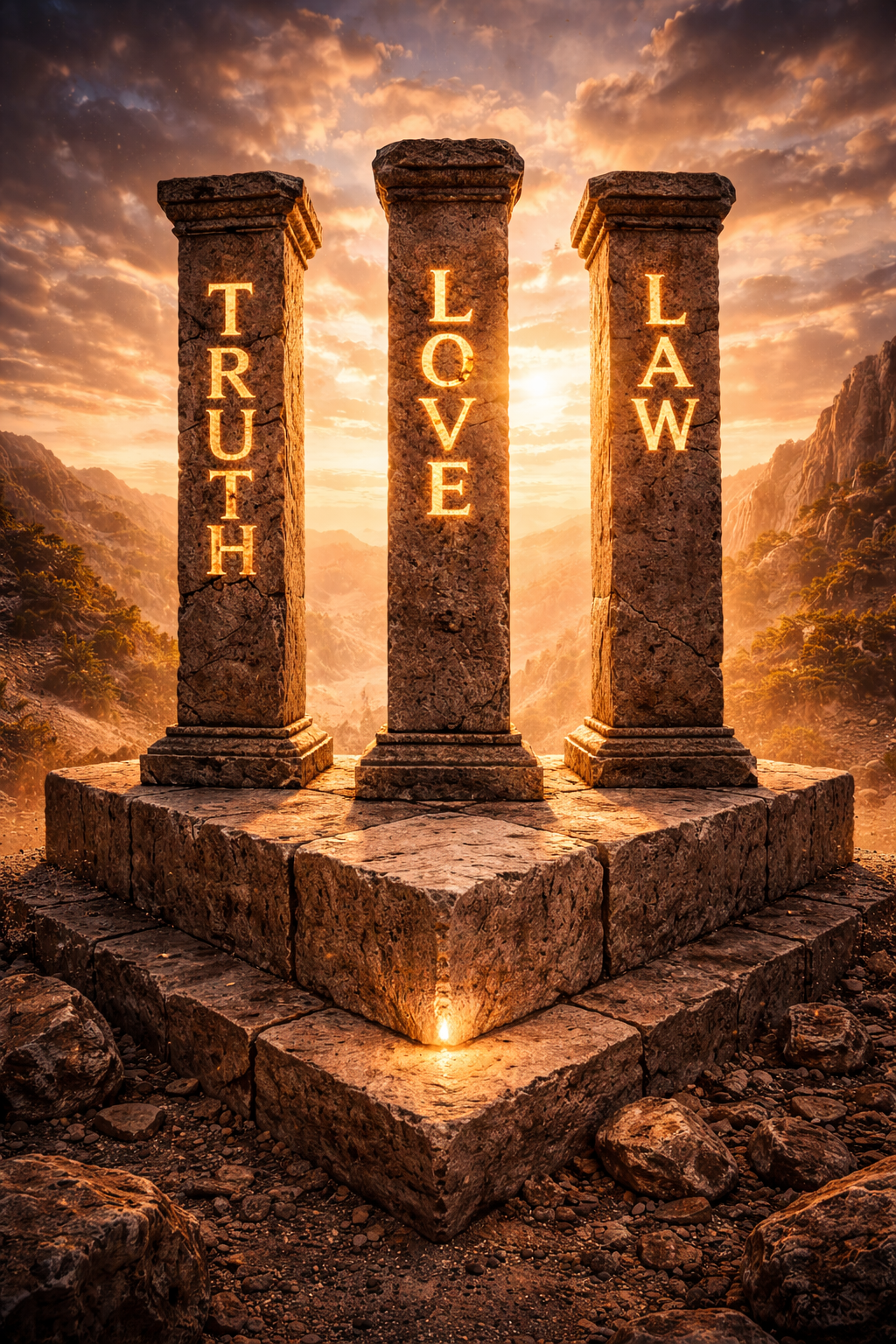
The 3 Pillars
Set the stone right, and three columns rise from it.
The Cornerstone is laid. The reference point is fixed, and every angle in the structure is measured against it. Now the vertical supports go up — the columns that take the weight of everything a man will build on this foundation and carry it down into the stone that does not move.
There are three of them: Truth, Love, and Law. The raw material was named in the Elements. The mixture was weighed in the Compositions. The ground was cured and the Cornerstone was set. The Pillars are what rise out of all of it — the three supports that turn a settled foundation into a structure that can actually bear a life. They are not independent. Each is aligned to the Cornerstone and to the other two, and each carries a portion of the total load. Pull one out and the remaining two do not redistribute the weight evenly — they carry it wrong, and the stress gathers at the seam until the whole thing fails along the line of the missing column. All three stand, or none of them holds.
These are not abstract philosophical categories. They are the three forces that govern reality as it actually runs — beneath every system, every relationship, every household, every civilization that has ever been built or buried. Truth establishes what is real and unmoving, independent of opinion, emotion, or convenience. Love gives what is true its worth and its direction, turning a man's strength outward toward others instead of inward toward himself. Law makes Truth and Love actionable, setting the order, boundaries, and consequences that keep what is built from collapsing under its own accumulated exceptions. Order, meaning, and accountability — one Pillar for each, holding up both the inner man and the world he has to move through.
And there is a way to carry them every day, not just understand them. The formed man runs three questions through every decision before he commits to it. Is this true? Is this loving? Is this right? Truth, then Love, then Law — always that sequence, never reordered. Most men run one of the three and call it discernment. The man with Truth alone is correct and cold. The man with Love alone is warm and useless. The man with Law alone is orderly and cruel. The man who runs all three, in order, is the one whose judgment can be trusted with weight.
The Three Pillars
Truth — Is this true?
Love — Is this loving?
Law— Is this right?
Truth is what reality rests on, whether a man acknowledges it or not.
It is the first Pillar and the most load-bearing, because without it the other two have no ground to stand on. Love without Truth is sentiment — agreeable and unstable. Law without Truth is tyranny — orderly and unjust. A man who does not have an honest relationship with reality cannot love accurately or rule rightly, because neither love nor law can function when aimed at a false picture of the world. Set this column wrong and the other two lean for the rest of the build.
Truth is not consensus. It is not what the majority agrees on, what is culturally safe to say, or what a man needs to be true so his current life makes sense. It is what is actually the case — independent of preference, independent of comfort, independent of whether anyone admits it. The building does not care what the architect believes about gravity. A man in right relationship with Truth is not comfortable; he is oriented. He has built the discipline to see accurately — to resist his own brain's loyalty to its existing framework, to question the narratives that are convenient, to follow the evidence where it goes instead of where he wishes it went. That man is harder to deceive and harder to manipulate, not because he is suspicious but because he is watching what is real instead of what is being staged for him.
Truth also has dimensions, and a man who wants to stand on it has to know which kind he is standing on. There is Absolute Truth — the fixed reality that does not bend, negotiate, or evolve with opinion. There is Universal Truth — what holds across all people, places, and times, the patterns that show up wherever human beings build and seek meaning. There is Relative Truth — what genuinely shifts with context, and the discipline of telling the difference between what only seems to change and what actually does. And there is Truth & Lies, where truth is sharpened by its opposite — how deception forms, why lies persist, and how a man learns to read the line between what corresponds to reality and what distorts it. Wherever the reader needs to go deeper, the column opens into each.
The child of Truth is Integrity — the man whose inner reality and outer expression are the same thing. He is the same man in every room, under every pressure, at every level of success and failure. He is not performing consistency. He is consistent, because what he shows is what is actually there.
Love is the force that gives Truth its purpose.
Without it, Truth becomes a weapon. The man who has only Truth owns a perfectly calibrated instrument for finding what is wrong with everything around him. He can see clearly, diagnose accurately, and be entirely correct and entirely useless — because Truth deployed without Love damages instead of builds. Where Truth defines what is, Love decides what is valued. It reveals not only what a man believes but what he is willing to bleed for.
Love, rightly understood, is not a feeling. It is a disposition toward action — the sustained orientation toward the genuine good of another, held even at cost to the self. This is the definition the Cornerstone set, not the version that requires good weather and collapses under pressure. It is tested by endurance, not intention: it stays after scrutiny, after failure, after the applause fades and the outcome turns inconvenient. And it is not weakness. The father who disciplines his child in love is not being unloving — he is loving in a form mature enough to prize the child's formation over the child's momentary comfort. The leader who holds a man accountable has not failed to love him; he has refused the lazy version of love that lets harm continue rather than endure the discomfort of confrontation.
Love is also a spectrum, and every man has lived at several points on it — from its absence to its summit. There is the formative wound of love withheld: unappreciation, neglect, emotional distance, indifference, the ground where fear rules because love never arrived. There are its lower and distorted forms — conditional and transactional love, self-consuming Philautia, uncommitted Ludus, possessive Mania. There is love that reaches outward in the bonds of Brotherly Love and Familial Love. There is love tested by Romantic Love, by confession and repair, by covenant, by heartbreak and loss. And there is the summit — Sacrificial Love, Grace, and the unconditional Agape that gives everything toward people who have not earned it. The full traversal lives in Types of Love; a man can walk into it wherever his own history sits.
The child of Love is Honor — the man who treats others according to their genuine worth, regardless of what they can offer him in return. He can give honor without needing it back, love without requiring it to be received, and lead the people in his life toward what they actually need rather than toward what keeps them comfortable with him.
Law is Truth and Love made actionable.
Without it, Truth stays theoretical and Love stays sentimental. Law is what converts the other two columns into a system that functions — the order, the boundaries, the consequences that protect what is being built and keep it from collapsing under the weight of its own exceptions, conveniences, and quiet compromises. Law is not punishment. Law is structure: the recognition that certain things produce certain outcomes, that certain behaviors undermine certain goods, and that a world without order produces not freedom but chaos — and chaos always destroys the weakest first. Rules are not the enemy of freedom. They are the architecture of it: the established order that lets human beings build, love, and create without being permanently at war with each other over everything.
And Law operates at more than one tier, which is why a man has to know which one he is dealing with. Moral Law is the deepest — the structure of right and wrong embedded in the nature of reality itself, not invented by consensus, not revocable by cultural vote, carrying mercy and consequence in their proper proportions. Natural Law is the law written into how the world and human nature actually behave — the laws of nature and the laws of human nature, which assert themselves whether a man studies them or not. Universal Law is the order that governs the cosmos itself — physics, metaphysics, the principles that hold everywhere at once. Violate any of these and the damage is real whether or not the man believes in the law he broke. The man who betrays someone who trusted him does not escape the fracture by deciding the moral order is subjective. The Law does not stop working because he stopped believing in it.
The child of Law is Justice — the man who renders to each person what is actually due, who does not bend the rules in his own favor, who administers both accountability and mercy in their right measure. This is also where Law meets Love: the righteous judge who hears the plea of the innocent and the loving father who corrects the son he will not abandon are running the same Pillar from two directions.
How the Three Pillars Work Together
Each column requires the other two to stand straight.
Truth without Love produces the man who is right about everything and connected to nothing — accurate, cold, and alone in his correctness. Truth without Law produces the man who sees what is real but has no structure to act on it consistently — insightful and inert.
Love without Truth produces the man who wants the best for everyone and cannot see what the best actually is — kind, enabling, ultimately unhelpful. Love without Law produces the man whose compassion has no architecture — who forgives everything, enables everything, and leaves the people he loves stuck in their damage rather than walking them out of it.
Law without Truth produces the man who enforces rules without knowing whether the rules serve anything real — rigid, bureaucratic, and perfectly capable of being precisely wrong. Law without Love produces the man who is correct and cruel — technically justified and genuinely harmful.
The three in correct proportion — aligned to the Cornerstone, standing together, distributing the weight — produce a man who is accurate without being cold, compassionate without being complicit, and principled without being weaponized. This is not a common man. He is a man who has done uncommon work to build what most men leave unbuilt.
The Order Is Not Casual
Truth, then Love, then Law. Always that sequence.
The order is not stylistic — it is structural, and reversing it breaks the logic. Truth comes first because a man cannot love accurately or rule rightly while standing on a false picture of the world; the real has to be established before anything can be aimed at it. Love comes second because once a man sees what is true, the question is what he will do with it — and Truth without the outward turn of Love curdles into a weapon. Law comes last because it is the enforcement of the first two; rules built before Truth and Love are in place will enforce the wrong things with perfect discipline. Run them in any other order and the structure lists toward whichever column got priority it had not earned. Whenever the Pillars are named, listed, or built into anything — a decision, a sentence, a constraint on a man's own conduct — it is Truth, Love, Law, in that order, and never Truth, Law, Love.
Where the Pillars Lead
The Pillars support the structure. They do not constitute it.
A man who has set the Cornerstone and raised all three columns has a foundation able to hold something that matters. But the foundation is not the building. What he raises on it — the Framework through which he reads and processes reality, the Life he constructs inside it, the legacy he hands forward — is the next territory. And the foundation decides what that building can be. A man cannot carry others toward Truth he has not settled in himself. He cannot demonstrate Love he has not first received. He cannot govern by Law he has not first let govern him.
The Foundation is not the destination. It is the prerequisite for reaching one. Beneath these columns run the unseen Components that move power through everything built above them — and on top of them, the Framework begins.