
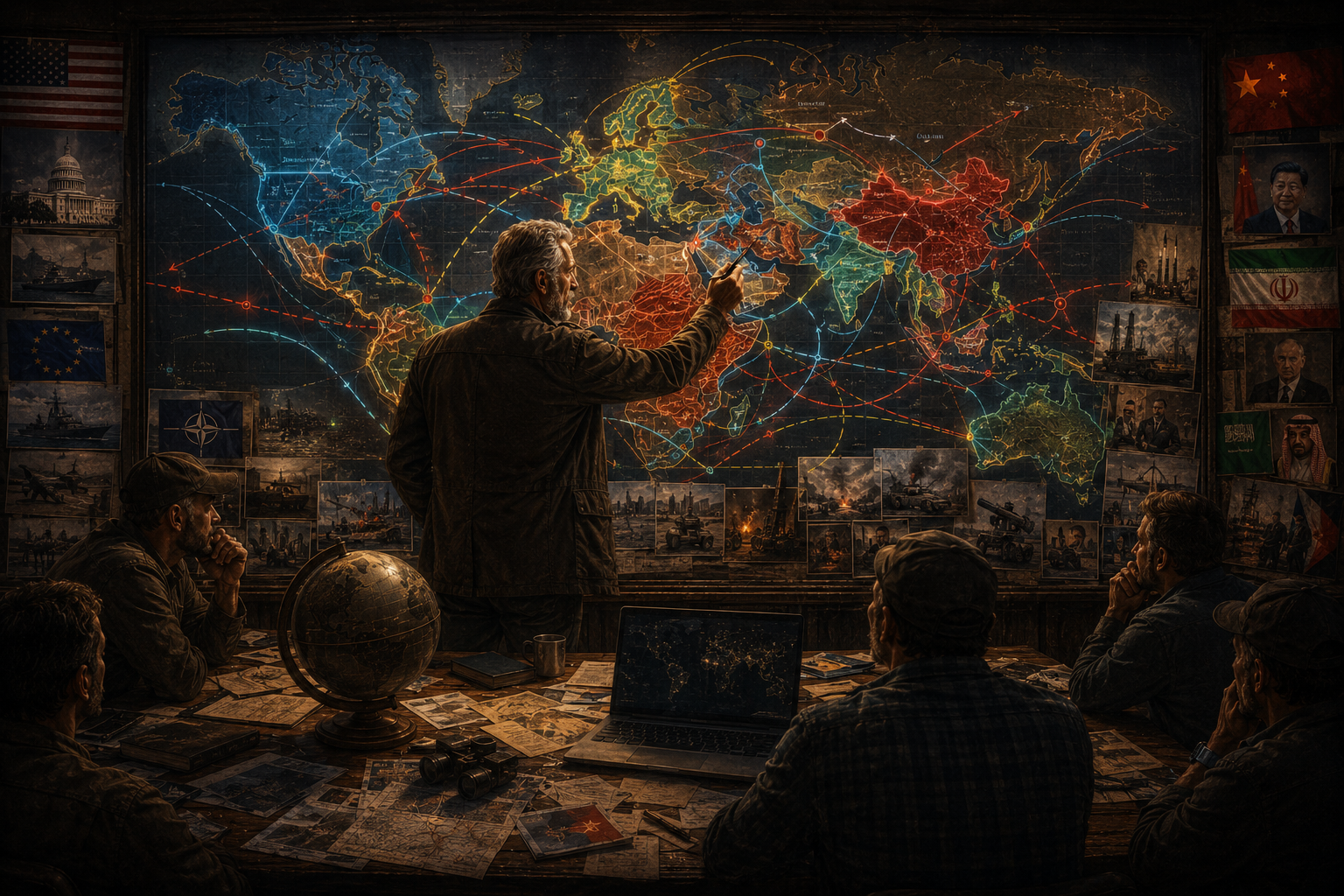
Geopolitics
Economic & Trade Wars
GWOT
Iran Conflict
Russo-Ukrainian War
Sanctions & Embargos
U.S. Hegemony
The Captain files his notes from airports, and the note he sent that November was four lines long.
He had spent the week in three countries he will not name in writing, doing the ordinary work he does, and somewhere in the middle of it he had ended up in a schoolroom. There was a map on the wall. Standard issue, laminated, the borders in confident colour, the kind that has hung in every classroom on earth since before any of the five of them were born.
He stood and looked at it for a while, and then he wrote this down:
Every country on that wall is the right shape and the wrong size. None of the lines that actually decide anything are on it. Nobody teaches the other map. There is no other map printed anywhere. Men who run countries carry it in their heads and everyone else is looking at the wall.
Then the fourth line, which is the one the file runs on.
So what am I actually looking at when I watch the news?
Nobody on the thread had an answer.
Geopolitics
"He makes nations great, and he destroys them; he enlarges nations, and leads them away" — Job 12:23
That is one of the strangest sentences in the wisdom literature, and it belongs at the front of this file for a reason that has nothing to do with comfort.
It is spoken by a man in the worst season of his life, in the middle of an argument he is losing, about a subject nobody asked him to address. And it does not distinguish. Makes great and destroys sit in the same clause, in the same hand, with no note about which nations deserved which. Enlarges and leads away — the second phrase is the language of deportation, of a people walked off their own ground.
The verse is not telling a man which side to be on. It is telling him what class of object he is looking at when he looks at an empire: something with a beginning and an end, currently in the middle.
Hold that, and the rest of this file becomes readable rather than frightening.
Two Maps
The map on the schoolroom wall shows the recognized borders. It is not the map the powers actually use.
The map they use shows spheres of influence, resource corridors, sea-lane chokepoints, sanction perimeters, currency and trade blocs, basing networks, technology-transfer controls, and the proxy regimes each major capital will underwrite to keep its zone shaped the way its planners want it. Those are the lines that decide where wars get fought and whose money stays the world's money.
A man reading modern politics off the wall map is reliably surprised by the news. A man who learns the other one understands the news about a year before it happens. This file trains the second reading.
⚠ And it holds two citizenships in order while it does. A man owes the country he was born in real loyalty, of the kind Romans 13 names, and he owes it honestly rather than sentimentally. He owes the other one a loyalty that relativizes every arrangement on either map and refuses to call any configuration of them the kingdom of God. He reads this material to see the actual ground his children will live on — not to enlist in somebody's empire, and not to perform the reflexive anti-Western posture that has become the lazy way of pretending he has thought about it.
The Classical Frame
The man should know the names that built the discipline before he reads the contemporary file.
Alfred Thayer Mahan — American naval officer, The Influence of Sea Power upon History (1890). The thesis: control of the seas, secured by a blue-water navy and a chain of coaling stations, is the foundation of imperial reach. Mahan's book shaped American, British, German, and Japanese naval doctrine simultaneously. The contemporary US Pacific posture is still recognizably Mahanian.
Halford Mackinder — British geographer, The Geographical Pivot of History (1904) and Democratic Ideals and Reality (1919). The thesis: the Eurasian heartland — the great inland mass from the Volga to the Yangtze — is the world-island; whoever controls the heartland commands the world-island; whoever commands the world-island commands the world. The maritime powers ringing the heartland must therefore prevent any single land power from organizing it. Read every Cold War containment doctrine through Mackinder. Read the post-2014 Russia-China consolidation through him too.
Nicholas Spykman — Dutch-American strategist, The Geography of the Peace (1944). The Rimland thesis revised Mackinder: the decisive zone is not the heartland but the coastal periphery — Western Europe, the Middle East, South and Southeast Asia, the Far East — and the maritime-versus-continental contest runs through that arc. NATO and the East Asian alliance structure are the Spykman blueprint in policy form.
Graham Allison — Destined for War: Can America and China Escape Thucydides's Trap? (2017). The thesis, drawn from Thucydides's reading of Athens and Sparta: when a rising power threatens to displace a reigning one, the structural pressure toward war intensifies, and historical escapes are rare. Allison studied sixteen historical cases. Twelve ended in war. The contemporary US-China relationship is the test case the entire policy class is now watching.
The classical frame does not predict outcomes. It tells the reader what the players believe they are reading. That is enough to make the news interpretable.
The Macro Shift
The international system the man was born into is not the one he is currently living in.
From 1945 to 1991, the order was bipolar — two superpowers, two alliance systems, a frozen line through Berlin, and proxy wars on every continent that was neither. The Soviet Union collapsed in December 1991. The decade that followed was the unipolar moment — one global hegemon, no peer competitor, an American century the policy class assumed would extend indefinitely. Francis Fukuyama wrote The End of History. The Pentagon's 1992 Defense Planning Guidance named the goal as preventing any rival from ever rising to match American capability. Both texts got read as prediction. Neither survived the next two decades.
The transition has had three accelerating moments. The September 2001 attacks pulled the United States into two decade-long wars that depleted its treasury and exposed the limits of military supremacy against asymmetric opponents. The September 2008 financial crisis shattered the assumption that the American financial system was the unquestionable backbone of the global order. The post-2014 confrontation with Russia over Ukraine and the post-2018 trade-and-technology war with China hardened the realignment.
The system the man is now living in is multipolar. The United States is still the largest single power. It is no longer the only one whose decisions set the agenda. China has built itself into the second-largest economy in nominal terms, the largest in purchasing-power terms, the global manufacturing center, and a peer technological competitor. Russia, smaller economically but still the second nuclear power and the largest territorial state, has reasserted regional dominance from Syria to the post-Soviet space. The European Union, India, the Gulf monarchies, Turkey, Brazil, Indonesia, and a handful of regional middle powers each shape outcomes inside their spheres in ways the unipolar-era policy class did not have to plan for.
The policy class has not yet named what the new system is. The reader does not have to wait for the naming to read what is in front of him.
The Postwar Architecture and Its Erosion
The Bretton Woods conference of July 1944 set the financial architecture the world has lived inside ever since — the International Monetary Fund (emergency liquidity for member states), the International Bank for Reconstruction and Development that became the World Bank (development lending), the General Agreement on Tariffs and Trade that became the World Trade Organization in 1995 (the open-trading regime), and the dollar-gold convertibility arrangement that pinned every other currency to the American dollar at a fixed rate.
The military architecture followed — the United Nations Charter (June 1945), the North Atlantic Treaty Organization (April 1949), the parallel bilateral and multilateral Asian alliance structure, and the network of American overseas bases that has stood since.
The architecture has eroded in stages.
1971. Nixon ended dollar-gold convertibility. The fixed-rate system collapsed. The world entered the floating-exchange-rate era and the dollar became a pure fiat reserve currency backed by political and economic prestige rather than metal.
1974. The petrodollar arrangement — Treasury Secretary William Simon's agreement with Saudi Arabia to price oil exclusively in dollars in exchange for security guarantees and Treasury-bond absorption — created a synthetic demand for dollars that replaced the gold anchor. Every nation that needed oil needed dollars to buy it. The Saudi-led OPEC pricing convention became the load underneath the reserve-currency status.
Post-2014. The petrodollar arrangement has visibly weakened. Saudi Arabia has accepted yuan settlement for crude sales to China. Russia, Iran, and Venezuela have priced significant fractions of their exports outside the dollar system. The arrangement is not dead. It is no longer the unconditional structure it was.
2022. The freeze of three hundred billion in Russian central-bank reserves following the Ukraine invasion was the most consequential single decision of the post-Cold-War financial period. The decision demonstrated that dollar-denominated reserves are not the unconditionally-neutral asset every non-aligned central bank had assumed they were. Every non-Western central bank watched. Gold purchases by non-Western central banks have accelerated every quarter since.
The Bretton Woods architecture has not collapsed. It has been put on notice.
The BRICS Counter-Architecture
The most consequential institutional development of the post-2008 period has been the rise of BRICS — originally Brazil, Russia, India, China, and South Africa, with substantial expansion across 2023 and after (Saudi Arabia, the UAE, Iran, Egypt, Ethiopia, and additional invitees through the formal accession process).
BRICS is not a military alliance. It is a slow-build parallel architecture for the non-Western economies, designed to reduce their dependence on dollar-denominated finance, Western-controlled clearing systems, and the political conditionality the Bretton Woods institutions attach to their lending. The New Development Bank (founded 2014, headquartered in Shanghai) provides infrastructure lending without IMF-style conditions. The Contingent Reserve Arrangement provides a parallel to IMF emergency liquidity. Bilateral local-currency trade settlement has been expanded across the bloc, routing dollars out of a growing share of intra-bloc commerce. China's CIPS settlement system, India's UPI, and Russia's SPFS provide alternatives to SWIFT for member-to-member transactions.
The de-dollarization conversation is real and worth reading carefully. The dollar is unlikely to be displaced quickly. The bloc's live alternative is not a single rival reserve currency; it is a fragmented multi-currency settlement system that lets member economies route around the dollar where they prefer to, while still using it where it remains efficient. The mechanism is gradualist. The direction is the direction.
The Instruments of Modern Statecraft
Most great-power competition in the twenty-first century runs through instruments that do not appear in the war-movie vocabulary.
Sanctions. Unilateral and multilateral measures one bloc deploys against another to deny it access to finance, technology, energy markets, and the broader benefits of the integrated system. The historical record (Cuba 1960-present, Iran post-1979 and intensified post-2018, North Korea, Venezuela post-2017, Russia post-2014 and dramatically expanded post-2022) is mixed on whether sanctions achieve their declared aims. The record is clearer on whether they impose costs on the targeted population, which they do, and on whether they accelerate the targeted state's pursuit of parallel arrangements, which they also do. The Sanctions & Embargos child page develops the case files.
Trade and tariff war. The post-2018 US-China tariff escalation marked the formal end of the open-trading-regime consensus that had governed since the 1995 WTO accession framework. Both capitals have since used tariffs, export controls, and inward-investment screening as routine tools of strategic competition. The Economic & Trade Wars child page carries the mechanics.
Currency war. Competitive devaluation, capital controls, reserve diversification, and the slow-motion contest for which currencies clear which transactions. The conversation that used to live in central-banker conferences now lives on the front page.
Technology controls. Export controls on advanced semiconductors, on extreme-ultraviolet lithography equipment, on dual-use AI components, and on the broader stack of capabilities that determine who can manufacture the next generation of weapons and infrastructure. The most consequential frontier of the current rivalry is the chip and the chip-making machine, and the man who follows that file knows more about the future than the man who follows the public political theater.
Supply-chain weaponization. The pandemic exposed how thin the global manufacturing redundancy had become. The realignment since has been the rebuilding of friend-shored, near-shored, and re-shored production for inputs each major capital cannot afford to source from a rival — semiconductors, rare earths, pharmaceutical precursors, battery cells, fertilizer.
Proxy conflict. The classic Cold War instrument has not been retired. It has been updated. The current proxy theaters include Ukraine (where NATO support to Kyiv is the post-2022 Western counter to Russian movement), the broader Middle East (where Iran and the Sunni Gulf states fight through Hezbollah, Hamas, the Houthis, and competing armed factions across Syria, Iraq, Yemen, and Lebanon), parts of sub-Saharan Africa (where the Wagner / Africa Corps presence has shaped post-coup governments across the Sahel), and the South China Sea perimeter (where the freedom-of-navigation contest and the Taiwan question are the live items).
Information and influence campaign. State broadcasting, troll-farm content production, narrative-shaping through diaspora networks and commercial media, and the cyber dimension of the same fight. The Conspiracy Theories and Government Operations files work the same material from inside the machinery.
Privatized statecraft. The rise of private military companies (Wagner, Blackwater / Academi successors, a dozen national imitators), of intelligence-contracting firms, and of NGO-and-foundation networks that conduct what used to be state functions outside the formal accountability of any state. The line between government and contractor has thinned across every major capital.
The Flashpoints
The contemporary flashpoints worth keeping on the map.
Ukraine and Russia. The 2022 invasion is the defining hot conflict of the European theater since 1945. The Ukraine vs. Russia Conflict child page carries the case. The war is simultaneously a Russian war of territorial revisionism, a NATO proxy fight over the eastern boundary of the Western alliance system, a sanctions experiment of unprecedented scale, and a stress test of European energy independence after the Nord Stream sabotage. None of those readings is complete by itself. All four are real.
The Middle East — Israel, Iran, the Gulf. The post-October-2023 conflict broke the prior decade's quiet realignment (the Abraham Accords had been knitting Israel into the Sunni Gulf security architecture against Iran). The current war reopened every closed file. The Iran question, the Saudi-Israel question, the Hezbollah and Houthi questions, the Red Sea shipping question, and the broader regional balance are all moving at once. The Biblical Prophecy file carries the long view that runs alongside the map here, and the two readings should be held together rather than merged.
Taiwan and the South China Sea. The single highest-stakes file on the board. PLA capability to take Taiwan by force has been building for two decades. The semiconductor dependency runs through TSMC fabs on the island. The American security commitment is deliberately ambiguous. A miscalculation here would reorganize the world more dramatically than any other live scenario. Follow the file closely without panicking about it weekly.
Africa and the Sahel. The competition between Western, Chinese, and Russian presence across the continent has accelerated. China is the largest single trading partner of most African states. Russia has filled the security vacuum across the Sahel coup belt (Mali, Burkina Faso, Niger, Guinea, Sudan in different forms). The minerals — cobalt, rare earths, uranium, lithium — that the next generation of technology and defense industries require sit substantially under African soil. The continent is no longer the periphery the postwar planners assumed it would remain.
Latin America. The post-2018 leftward turn of several major capitals (Mexico, Brazil, Colombia, Chile) combined with the ongoing crises in Venezuela, Cuba, and Nicaragua, and the rising Chinese presence (especially in lithium-triangle Bolivia / Chile / Argentina and in Panama-Canal-adjacent logistics) keep the hemisphere live on the board.
The Forces Underneath
Four slower currents the headlines do not lead with, and that the man reading the long file should keep in view.
Demography. Japan, South Korea, China, Italy, Germany, and Russia are aging faster than they are reproducing. China's population began its absolute decline in 2022. South Korea's fertility rate has fallen below 0.75. The economic, fiscal, and military assumptions every government planner has worked under for fifty years are about to break against the demographic wall. The United States is in better shape than most peers only because of immigration; that political file is itself contested.
Sovereign debt. Total global debt has crossed three hundred trillion dollars. American federal debt has crossed thirty-five trillion and interest service has crossed the defense budget. European fiscal capacity is exhausted. Japanese debt-to-GDP is past two hundred and fifty percent. The bond market is the constituency neither party in any major capital wants to alienate, and yet every major capital is running deficits the bond market is increasingly skeptical of. Something gives at the end of this decade or the next. The man should not predict the timing. He should know the pressure is building.
Energy and the metals transition. Whatever the West's stated climate trajectory, the actual transition runs through copper, lithium, nickel, cobalt, and rare earths — and the mining and refining of those metals sits disproportionately in countries that are not under Western alignment. The energy security file has reopened the natural-gas, nuclear, and coal conversations in capitals that thought they had closed them.
The AI and chip race. The most concentrated technology competition in human history is happening between roughly eight companies and three governments in real time. Whoever achieves and sustains the lead at the frontier of artificial intelligence and the semiconductor manufacturing that feeds it will likely set the terms of the next forty years of economic and military power. The reader should treat the headlines on this file as more consequential than most of the wars he is being asked to pay attention to.
The Christian Reading
The canon places the geopolitical question inside a long view the policy class does not share.
Daniel 2 reads world history as a succession of empires — gold, silver, bronze, iron, iron-and-clay — each rising, each falling, each replaced by the next.
"And in the days of those kings the God of heaven will set up a kingdom that shall never be destroyed, nor shall the kingdom be left to another people. It shall break in pieces all these kingdoms and bring them to an end, and it shall stand forever" — Daniel 2:44
⚠ Read what that does to the reader's own moment. The empires in the vision are not evaluated. They are counted. Each one was, in its hour, the obvious permanent arrangement of the world, and each one is a metal in a list. The image comes down to a stone cut without hands — which is not American hegemony, Chinese ascendancy, BRICS multipolarity or any other configuration a man could pick a side in. The stone is Christ, and it does not enter the story as one more contender.
Romans 13 instructs the believer to honor the governing authorities under which he lives. The text does not specify a regime type. It does not promise that the authorities will be just. It instructs honor and lawful obedience as the default disposition of the Christian under the magistrate of his time and place.
Revelation 18 describes the eschatological fall of Babylon the Great — the trading empire whose merchants grew rich by her, whose kings committed fornication with her, whose ships made the seas roar with her commerce — and the kings of the earth weep and lament her in one hour. The text is prophetic, not partisan. It does not name the empire. It does set the long pattern. Every great trading empire has eventually heard the dirge.
The man holding these texts together holds the long view. He honors his earthly citizenship without idolizing it. He recognizes the empire he was born under as a real thing he will be held to account inside, not as the kingdom of God. He prays for those in authority (1 Timothy 2:1-2). He pays the tax (Matthew 22:21). He does not weep when the configuration shifts, because he was not living for the configuration.
Two Failure Modes
Imperial cheerleading. The man whose home empire becomes the church. Every foreign policy decision is defended. Every casualty on his side is a hero and every casualty on the other side is necessary. The cross on the wall is decorative; the flag is the actual altar. This failure mode produces Christians who cannot read the prophets honestly because the prophets condemned exactly this in the believer's national ancestors.
Reflexive anti-Westernism. The man who, having seen through the imperial-cheerleading failure mode, reverses polarity. Now every American action is malevolent, every adversary's narrative is correct by virtue of being adversarial, every Western institution is a CIA front. This failure mode is imperial cheerleading inverted — the same partisan posture pointed in the opposite direction, the same emotional architecture, the same theological hollow. The reader who has lived inside both knows that the cure for one is not the other.
The disciplined position is neither. It is honest literacy combined with theological calibration. Read the file straight. See the empire straight. Refuse to enlist as either booster or partisan opposition. Keep the citizenship you were given by blood and the citizenship you were given by the cross in their proper order, with the second governing the first.
Closing the Transmission
Go back to the schoolroom wall, because the Captain's note has one more thing in it that he did not write down and worked out later.
The wall map is not a lie. Every border on it is real. Treaties were signed over those lines, men died on them, and a passport works or does not work because of them. The problem with the wall map is not that it is false. It is that it is finished — printed, laminated, hung, and no longer moving, in a room full of children who will spend their whole lives being governed by a map that is still being drawn.
The other map has no printing. It is held in the heads of a few thousand people across a few dozen capitals, it is redrawn continuously, and none of them agree on it. That is why nobody can hand it to you and why every version of it a man reads — including this one — is somebody's sketch.
Which is the correct posture to leave this file with, and it is neither of the two on offer.
The empire a man was born under is not the kingdom of God. The empire that replaces it will not be either. Both of them are on the list in Daniel 2, somewhere between the metals, and both of them will be counted rather than evaluated.
So learn the map. Watch the flashpoints without becoming a doomscroller of them. Keep the slower currents in view, because that is where the next forty years are being decided while the headlines argue about the last forty. Pray for the men in authority in your particular hour, including the ones you would not vote for. Pay the tax.
And do not grieve the configuration. You were never living for it. The stone cut without hands keeps its own timing and is not waiting on the policy class for permission to land.