
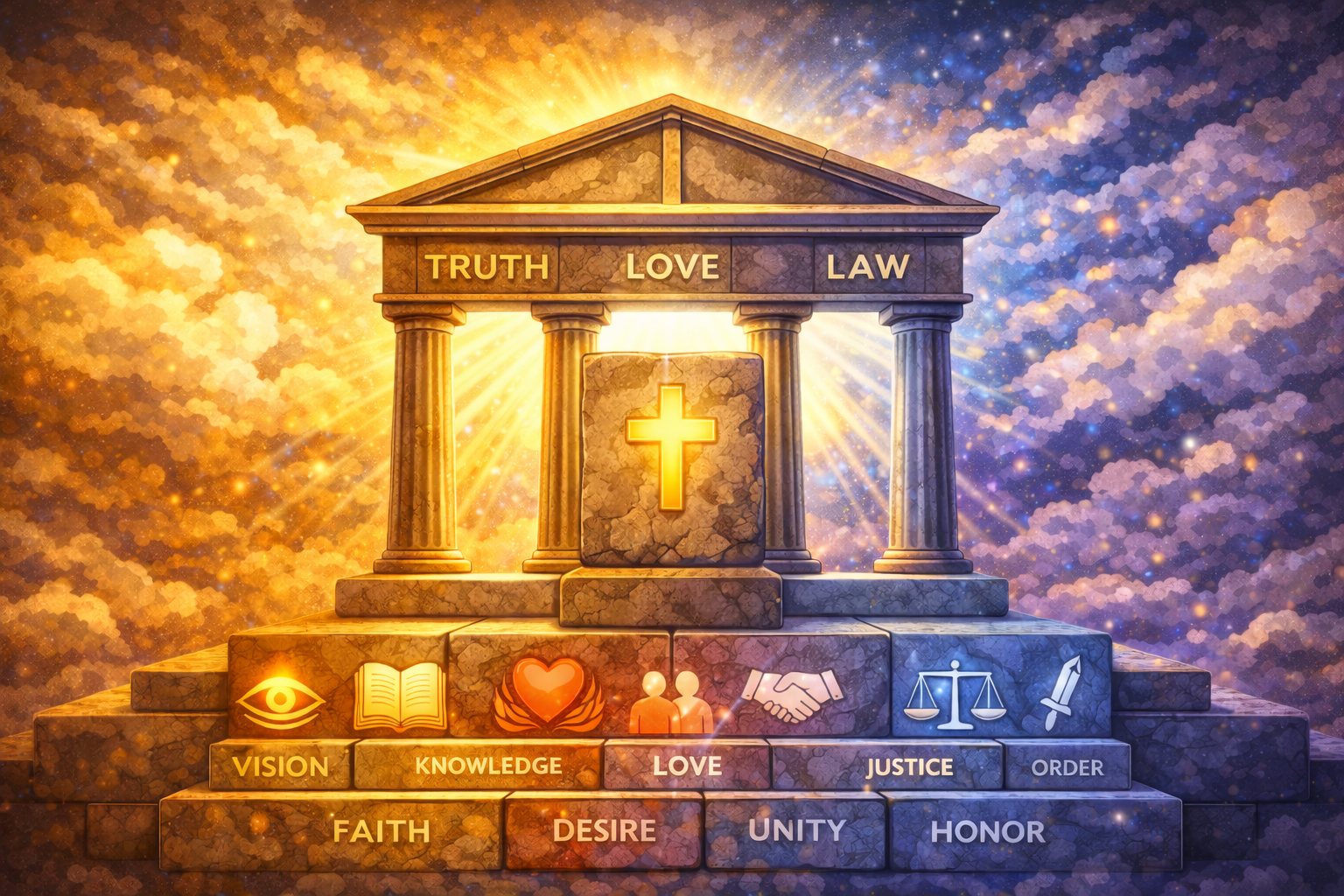
God
You have been to the bottom of the well, and you have climbed. Existence & Reality established that you are real and that reality is not negotiable. The Nature of Reality handed you the receipt, and Reality of Evil took you down to the darkest thing in it — the place where the worst that can happen is done to the most innocent that exists. Then Spirit & Soul showed you that you are not only a body — that part of you belongs to the same unseen order the war is fought in. Every one of those pages was walking upward, and all of them were pointing at the same door.
This is the door. And one thing should be said before it opens. You walked up to this room — from existence, through the immaterial, past the bottom of the well. That is the order of discovery. It is not the order of reality. Reality runs the other way: everything you have walked through hangs from what lives here. You climbed the building floor by floor, and you are now standing in the room the whole building hangs from.
Who is this God? Not the vague sense of a higher power. Not a personal interpretation. Not a culturally constructed deity shaped around what men find comfortable. The specific, named, revealed God of Scripture. This is not a page for comfortable religion. It is a page for honest reckoning with who the God of the Bible actually claims to be — so that the man who builds on this foundation is building on what is actually there.
The Lamb at the Bottom of the Well
At the bottom of the well you learned evil's signature: it seeks out the most innocent thing it can find and does the worst that can be done. You were told the road would not descend there again, and it will not. But before you meet God in His attributes, you need to see the one place where that signature and the love of God occupy the same ground.
The worst possible thing, happening to the most innocent one who ever lived. That is a description of the darkness at its deepest. It is also, word for word, a description of the cross.
Jesus of Nazareth was the only innocent man in history — no sin, no guilt, nothing owed. Scripture calls him the spotless Lamb: "a lamb without blemish or defect." (1 Peter 1:19) At the cross, everything you saw at the bottom of the well converged on him. Betrayal by a friend. A rigged trial. Torture conducted as public spectacle. Mockery while he died. And beneath the visible brutality, something heavier than all of it: "the LORD has laid on him the iniquity of us all." (Isaiah 53:6) He did not merely suffer what evil does. He carried what evil is — the accumulated sin of the world — as the innocent sacrifice that settles the account.
Here is the difference between the cross and every atrocity in the well: he chose it. The innocents at the bottom of the well had no say. The innocent one at the cross had every say — "No one takes it from me, but I lay it down of my own accord" (John 10:18) — and laid it down anyway. Evil did its worst to the most innocent, and the most innocent turned that worst into the rescue. "God demonstrates his own love for us in this: While we were still sinners, Christ died for us." (Romans 5:8)
Which means something that needs to be said plainly to any man reading this from a low place: there is no depth from which redemption is impossible. The well has a bottom. Grace goes under it — because the rescue was worked at the bottom, by one who went there deliberately. No man is too far down. That is not sentiment. It is the direct consequence of what happened at the cross, and it is the first thing to know about God: before He is a concept to be defined, He is a rescuer who has already acted. And the motive was not obligation. "For God so loved the world that he gave his one and only Son." (John 3:16)
What God Would Have to Be
Now step back and ask the question every man should ask before he takes anyone's word about God: for anything to rightly be called God, what would it have to be?
Not derived. If something caused God, that something outranks him — and the cause, not the effect, would be God. Whatever is truly God must be self-existent: uncaused, unmade, depending on nothing outside himself for his own being.
Not changing. A god who improves was imperfect yesterday. A god who declines is dying. Either way he is being measured against a standard above himself — and the standard would be God. Whatever is truly God must be unchanging: the same before the universe as after it, the fixed point every moving thing is measured from.
Not limited. If there is a fact he does not know, the fact escapes him. If there is a power he cannot exercise, the power exceeds him. If there is a place he is absent from, the place sits outside his rule. Anything that exceeds, escapes, or excludes him outranks him. Whatever is truly God must be omniscient — all-knowing; omnipotent — all-powerful; omnipresent — present everywhere, with no outside.
Not plural. Two ultimate beings is a contradiction — whatever decides between them would be the actual ultimate. And a god who can be overruled is not God; he is simply the strongest being currently in play.
Run the logic honestly and it produces a short, hard list: self-existent, eternal, unchanging, singular, unlimited in knowledge, in power, and in presence. Reason can build the shape of the throne. What reason cannot do is tell you the name of the One who sits on it. For that, He would have to speak.
He has.
There Is One God
The first claim of the biblical worldview is not complex: there is one God. Not the best god among many. Not the god of this culture or that tradition. One God — the God of Abraham, Isaac, and Jacob. The God of the Bible.
"Hear, O Israel: The Lord our God, the Lord is one." (Deuteronomy 6:4)
This is not pluralism. It is not the claim that all spiritual paths point toward the same ultimate reality and it does not matter which one a man takes. It is the claim that there is one God, that he has revealed himself with specificity, and that other frameworks are evaluated against that revelation rather than given equal standing. I believe in one God, eternally existent in three persons — Father, Son, and Holy Spirit (Genesis 1:1, Matthew 28:19, John 10:30).
This matters for the man building on Truth. A God who is one means that truth is unified — not fragmented across contradicting systems that are each partially valid. There is a source, and it is singular. What comes from that source is consistent. What contradicts it is wrong, not merely different.
The Name — YHWH
When Moses asked God who he was — who should he tell Pharaoh had sent him — God did not give a name in the sense of a label. He gave a declaration of nature.
"God said to Moses, 'I AM WHO I AM.' And he said, 'Say this to the people of Israel: I AM has sent me to you.'" (Exodus 3:14)
YHWH — the personal name of God — means the self-existent one. The one who does not derive existence from anything else. The one who simply is, has always been, and always will be. Eternal. Uncreated. Not contingent on anything outside himself. The Alpha and the Omega. The Beginning and the End. Never changing, always the same. Notice what just happened: the list reason built in the previous section — self-existent, eternal, unchanging — is the list God declared about himself from a burning bush, roughly three thousand years before the philosophers formalized the argument.
He is known by many names across Scripture, and none of them are labels. Each is a revelation — a doctrine compressed into a word, a facet of who He is disclosed at the moment His people needed it. Adonai — Lord and Master, the one who holds final authority. Elohim — the Creator God of Genesis 1. El Shaddai — God Almighty, sufficient for the impossible. El Roi — the God Who Sees, named by a slave woman alone in a wilderness who discovered she had never been unwatched.
The full catalog deserves its own room, walked slowly — and it gets one: The Names of God, just off this page. Step in before you leave the summit. Finish this page first, though — the names will mean more once you know the One they belong to, and the room will return you here.
The Triune Nature - One Being. Three Persons
The most distinctive and most contested claim about the God of the Bible is that he exists as one being in three persons. Not three gods. Not a single person who appears in three different forms. A Trinity: Father, Son, and Holy Spirit — equal in deity, equal in attributes, distinct in persons and in roles.
The Father — Yahweh, Yahuah, I AM. Pure substance of love, light, and truth. The one no man has seen in his full nature and lived to fully describe. The Creator. The one from whom all things originate. The one Jesus addressed as Father in prayer and commanded his disciples to address the same way.
The Son — Jesus Christ. Yeshua Ha Mashiach. God incarnate. Fully God and fully man — not fifty percent of each, but the complete nature of both in one person. He entered history at a specific time, in a specific location, born of a woman, and lived a perfect life — the only human being who has ever done so. He did not come to teach a better way to live. He came to do what no man could do for himself. He is the Lamb this page opened with. He is Lord.
The Holy Spirit — the Third Person of the Triune God. Poured out upon the apostles at Pentecost. The Spirit of truth and conviction. He dwells within those who belong to Christ, guides and convicts, advocates as an intercessor, and empowers the believer to live according to God's will. He is not a force or an energy — he is a person. The more mature the believer, the more wisdom is given; the more knowledge and awareness, the higher the accountability that comes with it. He helps combat depravity through conscience and awareness — which is why the man who grows in faith grows in the uncomfortable clarity of what is actually wrong in his life.
The three persons are not a mathematical problem. They are a relational reality within the nature of God himself — which is why God can be Love without requiring an object outside himself to love. He has been love, in relationship, eternally.
The Attributes — What God Is
Reason said God would have to be unlimited in knowledge, power, and presence. Revelation confirms it — and shows what each one means for the man standing in this room.
Omniscient — God is all-knowing. He knows every fact about every situation, every motive behind every action, every consequence of every choice before it is made. There is no information gap in God. A man can act in secret. He cannot act outside of what God already knows — and neither can the men you read about at the bottom of the well. The networks that operate in darkness are not dark to Him. The implications are both sobering and liberating: sobering because nothing is hidden, liberating because nothing is unknown to the one who governs.
Omnipotent — God is all-powerful. There is no limit to what he can do that is consistent with his nature. He is not the most powerful being — he is the being relative to whom power itself is defined. His power is not in question. The only question is his will.
Omnipresent — God is everywhere simultaneously. He is not localized. There is no place a man can go that is outside of God's presence — not for hiding, not for escape, not to conduct his private life without witness. David grasped this in Psalm 139: "Where shall I flee from your presence? ... If I make my bed in the depths, you are there." Even the bottom of the well is not outside His presence. For the man walking rightly, that is comfort. For the man who is not, it is the one fact he cannot outlast.
All-Loving — Not sentimental or permissive. The love that willingly gives what the beloved genuinely needs, at cost to itself. The love that went to a cross while the beloved was still hostile. This is the standard against which every human expression of love is a reflection — and the standard the project7 man is being shaped toward.
The Character — How God Moves
Attributes describe what God is. Character describes how he moves in relation to what he has made.
God is Just and Fair. He does not play favorites. He does not bend the standards for those he prefers or relax them for those he loves. He is the God of Justice and Mercy — and both at full strength simultaneously. Justice without mercy is cruelty. Mercy without justice is complicity. The fact that God operates both at full capacity without contradiction is precisely what makes the cross necessary, and what makes it sufficient.
God is Close to the Broken-Hearted. (Psalm 34:18) The God who holds the universe in existence draws near to the man whose world has come apart. He is not distant in the moments that matter most. He is not watching from a safe elevation. He is present in the lowest place — and the man who hits the lowest point of his life is not abandoned there. He is found there.
The Fruit of the Spirit — love, joy, peace, patience, kindness, goodness, faithfulness, gentleness, self-control — is the character of God expressed through the life of a man being formed by the Holy Spirit. These are not virtues a man performs on his own effort. They are the natural output of a man connected to the Source. A man who wants to know what God's character looks like in daily life looks at this list — and then looks at himself honestly.
Sovereignty — What God Does
God is sovereign. He holds absolute dominion over all things. He directs all things freely and exercises his will as he pleases. This is not the doctrine that makes God arbitrary — it is the doctrine that makes reality coherent.
A universe without a sovereign is a universe where nothing is ultimately governed — where the most powerful temporary force determines outcomes, where what is good and what prevails have no guaranteed relationship. Without sovereignty, history is noise. Suffering is meaningless. Justice is optional. The wicked get away with it permanently.
You have already met sovereignty in action, though it was not named when you saw it. At the bottom of the well you learned that the mystery of iniquity is at work and it is being restrained — that for all its intelligence and appetite, evil never reaches the totality it thirsts for, and that the restraint is not luck but governance. This is the room where the governance gets its name. The leash on the darkness is held by a hand.
Sovereignty does not eliminate human agency. It encompasses it. A man makes real choices with real consequences, and those choices matter. At the same time, God is not surprised by them, not defeated by them, and not ultimately thwarted by them. He directs all things freely — which means nothing escapes his governance, even the things that most appear to operate outside of it.
By definition, he would not be God if he were not sovereign. A god who can be overruled is not God — he is simply the most powerful being currently in play. YHWH is not currently in play. He is the ground on which everything in play exists.
Made in His Image
"So God created man in his own image, in the image of God he created him."
— Genesis 1:27
This is the statement with the most direct practical implication for everything project7 is building. A man is not an advanced animal. He is not a biological process that developed self-awareness through sufficient complexity. He is an image-bearer of the living God — which means he carries within him the imprint of the being this entire page has described.
This is also the final piece of the well's explanation. You saw that evil's hatred lands on human beings with a ferocity no survival logic accounts for, and lands hardest on the most defenseless of them. Now you know why. The enemy cannot touch God, so it defaces His image — and nothing carries that image more openly than the innocent. The war you have been reading about since the bottom of the well is, at its root, a war over what you are.
The dignity this confers is intrinsic, not earned. It does not depend on what a man has accomplished, what he looks like, where he was born, or what has been done to him. It is what he is. And it is the ground of every accountability this program holds him to — because a man who carries the image of God is not free to be less than what that image represents.
He is also a co-creator. The authority given to man in Genesis — to name, to cultivate, to have dominion — is not a license for exploitation. It is a delegation of creative authority from a Creator God to beings made in his likeness. The man who builds something, who shapes what is raw into what serves and endures, who leaves his corner of the world better than he found it — he is doing something that reflects what he was made from.
We are created in the image of God. Co-creators. Heirs. That is the starting point for everything built from here.
The Summit — Where Absolute Truth Ends
This is the end of Absolute Truth. Look back down the road for a moment, because you have climbed the whole of it.
You entered at ground level — you exist, and reality is real. You took the receipt of what reality actually contains, and you went down to the darkest room in it, the bottom of the well. You learned what you are made of — body, soul, and a spirit breathed in from outside. And the climb ended here, in the summit room: what God would have to be in order to be God at all, and who He declares Himself to be — one God, triune, unlimited in knowledge and power and presence, just and merciful at full strength together, near to the broken, sovereign over the leash on the darkness, and the One whose image you carry.
Understand what you were actually given in this room. This section was never a doctrine to master. It was an introduction to a Person — the Person the whole climb was toward, the One every floor of the building hangs from. And if you stepped into The Names of God on the way through, you left with more than a description. You know what to call Him.
That is the bedrock: Absolute Truth, grounded in the unchanging nature of God.
But bedrock does not stay buried. A God who is what this page describes leaves His pattern on everything He has made — the same signature pressed into every scale of creation, from the physical constants to the structure of a cell to the conscience of a man. Men who never met, who shared no language and no scripture, keep discovering the same things true — because they are all standing on the same ground. The next layer of the walk is learning to read that fingerprint, in plain sight, everywhere.