
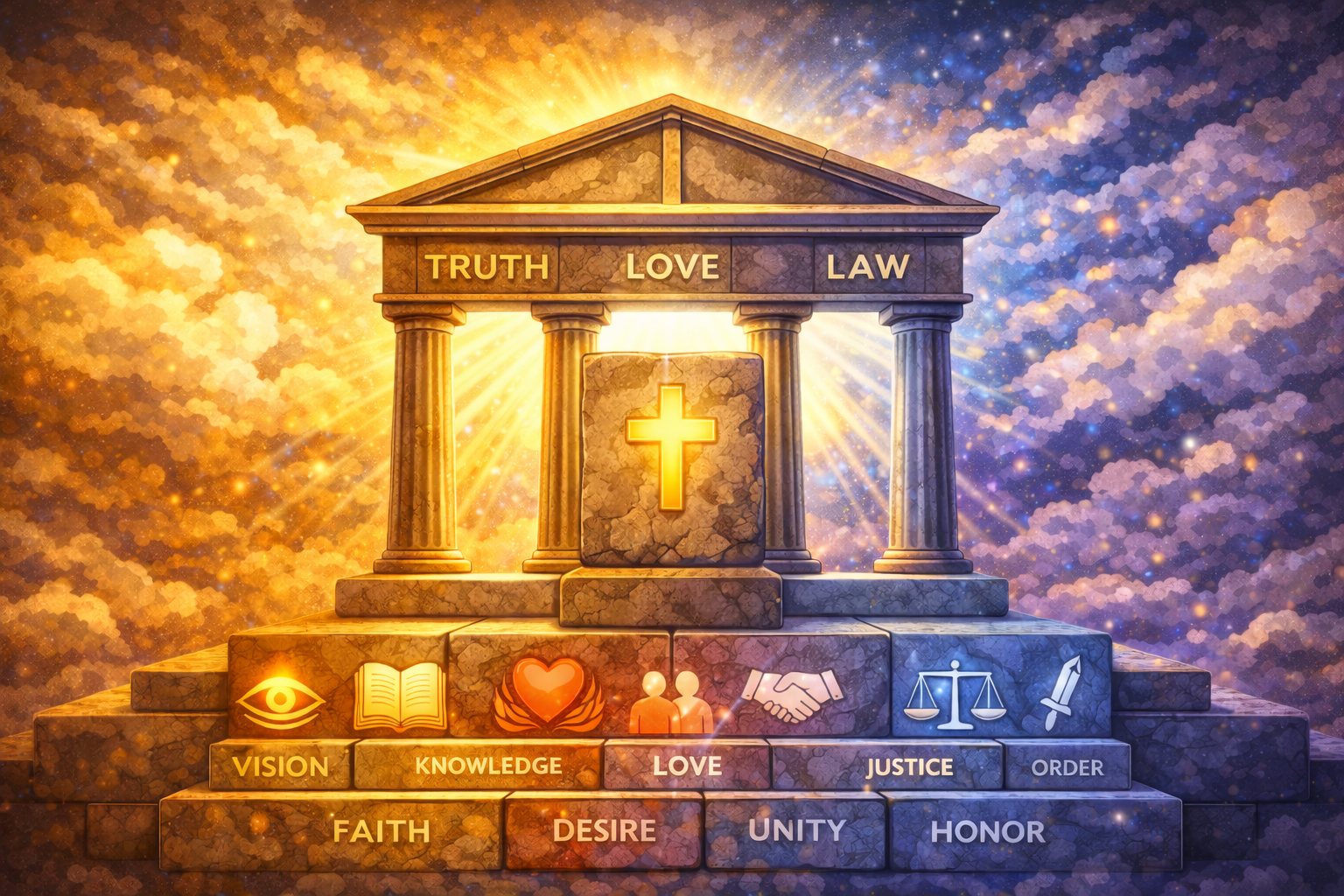
Universal Truth
You have come from the summit. In Absolute Truth you climbed the whole road — from the ground of your own existence, down through the darkest room in this program, up through what you are made of, to the One everything hangs from. You stood in the summit room, you know what God would have to be, and you know what to call Him. But no man is left on a summit. He is sent back down — into the world where men argue, build, trade, marry, and bury each other — and the road down the mountain is where this layer begins.
Universal truth is the middle layer of that road — between the bedrock of Absolute Truth behind you and the moving current of Relative Truth below. It is not grounded only in the nature of God the way the bedrock is, and it does not shift with a man's vantage point the way the current does. It is what shows up everywhere, in every culture, every era, every corner of creation — whether anyone acknowledges it or not, whether anyone was ever taught it or not. It exists beyond opinion and beyond consensus. It does not spread easily, and not because it is hidden: it is in plain sight at every scale, and most men walk past it because seeing it takes effort, honesty, and the willingness to look at reality without first deciding what they are allowed to find.
This is the layer you were promised as you left the summit: a God who is what the bedrock describes leaves His pattern on everything He has made. This page is not built to persuade. It is built to hand the instrument to the man who is ready to stop asking comfortable questions and start asking better ones — and to teach him to read the pattern he now knows the name behind.
Universal Truth
Universal truth holds across all people, places, and times — not because humanity took a vote, but because it reflects how reality runs beneath the surface of cultural variation.
Two men on opposite ends of the earth, raised in entirely different traditions, with no shared history or language, both recognize that betrayal damages trust, that protecting a child is an obligation, that death is not nothing, that beauty is worth pursuing. These are not cultural products that somehow spread to every population on earth independently. They are recognitions of the same underlying reality — a reality that does not change based on who is looking at it. Where Absolute Truth is the foundation, grounded in the unchanging nature of God and true whether or not any man ever confirms it, Universal Truth is the pattern that foundation prints at the surface of human experience — the observable fingerprint of a fixed ground. And where Relative Truth genuinely varies with context and perspective, Universal Truth transcends context. The language, the cultural dress, and the degree of access may differ from place to place. The thing underneath does not.
One Signature, Written at Every Scale
Here is the thread that ties this whole layer together: it is the same signature, written over and over, at every scale of reality — and a man who learns to read it once begins to see it everywhere.
The signature is written in two great movements, and the walk below follows them in order. The first movement is the world no man made: the structure of the cosmos — the fine-tuning of the physical constants, the information packed into a single cell — and beneath the matter, the architecture of reality itself, the binary that runs from physics to morality. Then the walk crosses a hinge: the one creature who can stand outside the chain of cause and effect long enough to choose. Everything before that hinge is creation. Everything after it is the creature — and what he makes and carries. The second movement descends through him: the agreements men build their whole societies on, knowingly; the awareness all of humanity shares in the open, without ever having agreed to it; and the archetypal depths every mind carries beneath what it will say out loud, without knowing they are there. Six dimensions — from the design of the universe to the unconscious depths of a man. Walk them in that order, from the heavens to the human heart, and watch the same hand show up in each.
You met the hand on the summit. This is where you learn the handwriting.
Intelligent Design — The Fingerprint in the Structure
The universe did not have to work. It did not have to be ordered, predictable, or hospitable to conscious life. And yet it is — with a precision that strains the credibility of accident the moment a man examines it honestly.
The fundamental constants — the strength of gravity, the electromagnetic force, the cosmological constant — are calibrated so finely that small deviations in any direction would produce a universe of nothing but hydrogen, or one that collapsed in on itself in an instant, or one that flew apart too fast for matter to gather into anything at all. Fred Hoyle, the atheist physicist who coined the term "Big Bang" as an insult, ran the numbers on the carbon resonance that makes life possible and concluded that "a super-intellect has monkeyed with physics." He did not want that conclusion. The evidence pushed him to it — and that is the mark of a real signature: it does not need the reader's permission. The same order appears at every level: DNA is literal digital information, three billion base pairs in a single cell, and complex specified information does not arise from random processes — it arises from intelligence. The periodic table is so ordered that Mendeleev predicted undiscovered elements from the gaps before anyone found them. The Fibonacci sequence runs through sunflower seeds, nautilus shells, and spiral galaxies alike. Order implies an orderer — the same inference that makes an archaeologist see a maker in an arrowhead rather than the work of erosion.
Design requires a designer, not as a matter of religious preference but as a matter of logical inference from the evidence. Intelligent Design lays it out in full — including quantum entanglement, the "spooky action at a distance" Einstein spent his last decades trying to disprove, where physics keeps arriving from its own direction at a reality more deeply connected than pure materialism can account for. And the design is not only in the matter. It is in the very way reality is built.
Dualism and Duality — The Binary Architecture
Reality is structured as binary opposition — not as a philosophical preference, but as the deepest unit of how existence is put together. There is only "is" and "the absence of." On and off. The switch open or closed, the code 1 or 0. Cold is not a substance; it is the absence of heat. Dark is not a thing; it is the absence of light. The same binary runs up through every level: light and dark, male and female, giving and receiving, good and evil.
This is not a flaw in the design — it is the design, because contrast is what makes meaning possible. Dark does not diminish light; it is what makes light visible. And the binary is not symmetrical where it matters most: good is the positive substance, and evil is its corruption or absence, which means evil is parasitic. It cannot create, only distort what was already made — a lie is the bending of a truth that had to exist first. You were told this at the bottom of the well: the darkness makes nothing, it can only take what was already made and twist it. Here you see where that truth is anchored — not a comfort spoken over the war, but the architecture of existence itself. You cannot corrupt a nothing, which is why the very existence of evil is evidence that something real and good exists to be corrupted, not evidence against God. The pattern shows up wherever men build something to resolve a conflict: the court of law with its two parties and a referee in black and white, the chess board, every structured field where opposing forces are held in tension until a verdict is reached. Dualism & Duality goes deep into all of it — the holy and the profane, the adversary who inverts the binary by calling evil good, and resistance as the mechanism by which strength is actually built. This binary runs through the cosmos and the moral order both — but the sharpest place it appears is inside the one creature who gets to choose which side of it he will stand on.
Free Will — The Universal Experience of Agency
Every human being experiences what feels like genuine freedom to choose, and every serious tradition has had to decide what to make of it. Something in a man deliberates, weighs the options, and commits — and that something is not merely the sum of the forces acting on him. It is agency, and it is real.
The capacity to choose, to hold oneself and others responsible for the choosing, is the assumption every legal system, every moral framework, and every real relationship runs on. Remove free will and responsibility goes with it; remove responsibility and accountability collapses; remove accountability and human community comes apart. This is why determinism cannot actually be practiced — even the man convinced his choices are fully determined still acts as though the next one is his to make, because he cannot live any other way. The biblical frame is specific: God built a creation governed through creatures free to choose rather than machines that cannot, which is exactly what the Garden establishes — a real command, and the real capacity to break it. Every man is still standing in that garden, facing the same two directions: agency aligned with God, or agency in rebellion — Eden or Babylon, the city built under God or the tower built for a man's own name. Free Will walks agency, autonomy, and sovereignty, the red pill that cannot be un-chosen, and the weight of "everyone to whom much was given, of him much will be required" (Luke 12:48); the operational discipline of owning the choice is carried further in Extreme Ownership. A man exercises his agency alone — but he is never only alone. He is woven into structures that other men built, by agreement, long before he arrived.
Collective Agreements — How Shared Belief Builds Social Reality
Take money in your hand. It is paper and ink, or numbers flickering on a server — and it dictates where a man lives, who he marries, how long he survives. It has no inherent value. Its power comes entirely from collective agreement: billions of people acting as though it is real, billions of times a day, until it feels as solid as granite. That is what a collective agreement is — not a signed contract or a passed law, but an unspoken, constantly-reinforced consensus that something is valid and binding, held together by nothing but the ongoing participation of everyone who treats it as true.
And when enough people stop treating it as true, it dissolves — fast. Weimar Germany paid workers twice a day so they could spend before the currency lost value; Zimbabwe printed hundred-trillion-dollar notes that could not buy bread. The paper did not change. The agreement collapsed. The same mechanism runs language (control the definitions and you control what can even be thought — Orwell understood that Newspeak's goal was to delete words, not add them), law, institutional authority, and social norms, all of which keep their force only as long as people keep participating in them. Understanding this does not make a man cynical about his society; it makes him accurate about it. He knows which of his constructions rest on shared belief — currency, stocks, institutional standing — and which rest on something more durable: land, skills, relationships, character. Collective Agreements walks how they form, how to read the signs of one breaking, and how a man builds toward what would remain true even if the agreement around it evaporated. These are the things men build together knowingly. But beneath everything they agree to is something they share without ever having agreed to it at all.
Collective Conscious — What Humanity Shares in the Open
There is only one race. The human race. That is not a sentiment — it is a genetic finding (human beings are among the least diverse species on earth, all tracing to a common origin) and a biblical claim: "From one man he made all the nations." (Acts 17:26) The differences between people groups are real and surface-level; the shared substance beneath them runs deeper. Scratch any human being anywhere and you find the same needs, the same fears, the same capacity for love and cruelty, the same awareness that death is coming.
Émile Durkheim named the collective conscious at the turn of the twentieth century — the shared beliefs and moral attitudes that hold a society together as more than a pile of individuals. At the broadest scale, the collective conscious of humanity itself is the moral convergence every tradition has landed on: that human life has value, that some things are wrong regardless of where you stand, that something is owed between people simply because they are people. C.S. Lewis catalogued this in The Abolition of Man as the Tao — the same moral law surfacing in cultures that never touched, which is exactly what you would expect if the intuition is picking up a real signal rather than inventing one. Scripture says it plainly: "The work of the law is written on their hearts." (Romans 2:15) This shared mind also moves: happiness, loneliness, and habit spread through human networks like contagion, which is why guarding a man's associations is not social conservatism but an accurate reading of how the mind actually operates in a crowd. Collective Conscious develops what humanity holds in common and the responsibility it lays on the man who sees it — that every man either lifts the collective or drags it, and the neutrality of non-participation is not on the menu. This is what humanity shares in the open, stated and known. Beneath even this runs a deeper layer, one no culture states out loud because it operates below speech entirely.
Collective Unconscious — The Depths Beneath
Something runs beneath every man's thinking that he did not put there. Not personal memory, not cultural programming — older than any living tradition and deeper than any individual life. Carl Jung called it the collective unconscious: the layer of the psyche shared by all human beings, carrying the patterns and character types that surface across the whole span of history with no transmission between the cultures that hold them.
The same hero appears in Greek myth, Norse saga, African oral tradition, and a modern man's recurring dream. The same shadow, the same wise old man, the same trickster, the same great mother — not borrowed from one another but recognized, because they were already there. These archetypes are the inherited structures of the psyche, as built-in as two eyes and the capacity for language, and the project7 archetypes are drawn from this same well: not invented, but discovered — universal patterns of masculine character that a man recognizes the moment he meets them, because he meets them first in himself. The collective unconscious is reached most directly through the dream state — REM sleep, lucid dreaming, the long tradition of dream interpretation from Joseph in Genesis to Jung's clinic — and it has a shadow expression in social life: the hive mind, where individual judgment dissolves into the group's emotional state. That mechanism is neutral; it produces the esprit de corps of a unit in worship and the frenzy of a mob alike, and social media has made it faster than at any point in history. Its most chilling demonstration was the Third Reich — a cultured, educated, scientifically advanced nation whose collective unconscious was deliberately activated through symbol, rally, and archetype and steered toward atrocity at industrial scale. The lesson is not that the depths are evil. It is that they can be manipulated, and that education alone does not protect a man — only honest self-knowledge does. Collective Unconscious goes all the way down: the archetypes, the dream state, the hive mind, and the unspoken currents every man carries — the sense of being measured, the fear of being found inadequate, the longing to matter.
Where to Go From Here
"For his invisible attributes, namely, his eternal power and divine nature, have been clearly perceived, ever since the creation of the world, in the things that have been made. So they are without excuse." (Romans 1:20) That is the claim under this entire layer. The signature is not hidden — it has been in plain sight since the beginning, written into the things that were made, and the man who refuses to see it is not lacking evidence. He is refusing to look.
So learn to read the one signature at every scale, in order, from the heavens to the human heart. See it in the structure of the cosmos in Intelligent Design, in the architecture of reality in Dualism & Duality, in the agency of the man in Free Will, in the societies men build in Collective Agreements, in the mind humanity shares in Collective Conscious, and in the depths beneath all of it in Collective Unconscious. The man who can read the same hand in the galaxy and the genome and his own dreams is not seeing things. He is finally seeing what was always there.
The walk through the six begins at the far edge of creation and ends in your own depths. And when you come up out of those depths, the last leg of the road down the mountain will be waiting — Relative Truth, the moving current every man lives his daily life in. That handoff comes where it should: at the bottom of the sixth room, not here. Begin where the signature is written largest.