
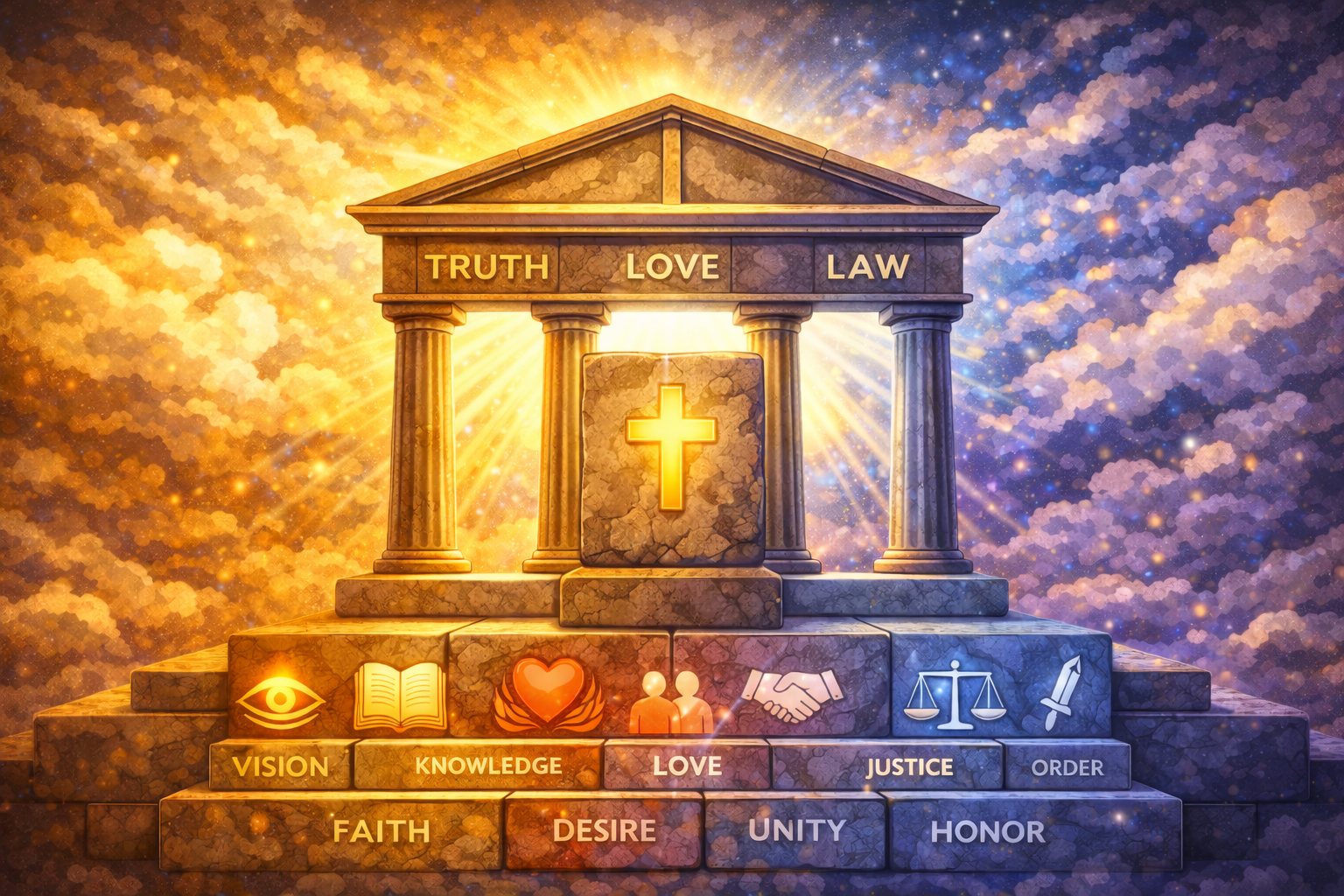
Intelligent Design
The universe did not have to work. It did not have to be ordered, predictable, or hospitable to conscious life. The laws of physics did not have to be what they are. The constants that govern everything from the behavior of atoms to the expansion of galaxies did not have to be calibrated the way they are. And yet they are — with a precision that, when examined honestly, strains the credibility of accident as an explanation.
Intelligent design is the inference that the order, complexity, and fine-tuning observable across the natural world are more adequately explained by intentional design than by undirected process. It is not a claim that evolution did not occur. It is a claim about what produced the framework within which any process — evolutionary or otherwise — could operate at all. The question is not only how life developed from prior life. It is why there is something rather than nothing, and why that something is structured the way it is.
This section does not argue for a specific theological position from a position of faith. It presents what the evidence actually shows — across physics, chemistry, biology, and quantum mechanics — and asks what explanation is most adequate to account for it.
Order & Design
Order implies an orderer. This is not a religious premise — it is a logical one.
An arrangement that is not the result of random accumulation — that displays consistent structure, internal coherence, and functional precision — is an arrangement that inference attributes to design rather than chance. When archaeologists find an arrowhead in a dig site, they do not conclude it formed by geological pressure on rock. They infer a maker — not because they saw the maker, but because the object's design requires one. The inference is from the evidence of the object to the existence of a cause adequate to produce it.
The same inference applied to the natural world produces a significantly more demanding conclusion. The laws of nature operate with mathematical consistency across every corner of the observable universe. The same physics that governs the orbit of a planet governs the behavior of a subatomic particle. The regularity is not local — it is universal. And a universe governed by consistent mathematical laws is a universe that is, at its deepest structural level, ordered rather than random.
Order at that scale — the scale of the fundamental laws of physics — does not arise from within the system. It is a feature of the system as found. The question an honest man asks is: what produced a system with this degree of structural consistency?
The Fine-Tuned Universe
The fundamental physical constants that govern the universe are not arbitrary values. They are precisely calibrated — and the calibration is so tight that small deviations in any direction would produce a universe incapable of supporting complexity, chemistry, or life.
The gravitational constant, the electromagnetic force, the strong nuclear force, the cosmological constant — each operates at a specific value. Physicists have calculated what would happen if these values were different by even small margins. The results are consistent: a universe with slightly different constants would be either all hydrogen (no chemistry), or would have collapsed in on itself within fractions of a second, or would have expanded too fast for matter to coalesce into anything at all.
The physicist Fred Hoyle — who coined the term "Big Bang" as a term of derision, and who was not a theist — calculated the carbon resonance that makes carbon-based life possible and concluded: "A common sense interpretation of the facts suggests that a super-intellect has monkeyed with physics, as well as with chemistry and biology, and that there are no blind forces worth speaking about in nature." He did not want to reach that conclusion. The evidence pushed him there.
The fine-tuning of the universe is not a gap in scientific knowledge being filled by God. It is a feature of the universe as observed, requiring an explanation that the universe itself cannot provide.
The Periodic Table
The periodic table is one of the clearest visible examples of embedded order in the structure of matter.
Elements do not arrange themselves arbitrarily. They display consistent patterns of behavior based on their atomic structure — patterns so regular that Dmitri Mendeleev could predict the existence, mass, and properties of undiscovered elements based on the gaps in the table before those elements were found. He predicted gallium in 1871. It was discovered four years later. He predicted germanium. It was discovered seventeen years later. The pattern was real before the elements that filled it were found.
What the periodic table reveals is that the structure of matter is ordered — not in a way that was imposed on it by scientists who observed it, but in a way that existed before the observation and was discovered through it. The order is in the thing, not in the description of the thing. That embedded order at the atomic level — the same level at which all physical reality is constructed — is not something a random universe is expected to produce.
Quantum Entanglement
Quantum entanglement is the phenomenon in which two particles become correlated in such a way that the state of one instantaneously influences the state of the other — regardless of the distance between them. Measure one particle and the other, wherever it is in the universe, responds immediately. Not after the time it would take for a signal to travel between them. Immediately.
Einstein called this "spooky action at a distance" and spent the last decades of his life attempting to demonstrate that it could not be real. He was wrong. The experiments have confirmed it repeatedly. Entanglement is real.
What entanglement reveals is that the universe is more deeply connected at its foundations than a purely material, locally-acting, cause-and-effect model can account for. The connection is non-local — it transcends space. It is instantaneous — it transcends time as we understand it. The implications for what reality actually is are significant and still being worked through by physicists who do not have a theological agenda.
The biblical framework has a name for a reality that transcends space and time, within which everything is connected and nothing operates in genuine isolation: God's active governance of creation. The physics is arriving, from a completely different direction, at structural features of reality that the theological framework already accounts for.
Biological Information
DNA is information. Not metaphorically — literally. It is a four-letter digital code that specifies, with precise sequencing, the construction of every protein in a living organism. A single human cell contains approximately three billion base pairs of DNA — more information than a library of thousands of books, compressed into a structure invisible to the naked eye.
The question intelligent design presses on is not whether natural selection can modify existing biological information. It is whether undirected processes can originate complex, specified information in the first place. Information science has a consistent finding: complex, specified information — the kind that performs a function — does not arise from random processes. It arises from intelligence.
The origin of the first self-replicating molecule capable of producing biological information has not been explained by any undirected process. The gaps in the naturalistic account are not at the edges — they are at the center. The beginning of life, the origin of the genetic code, the Cambrian explosion of complex animal body plans — these are the points where the evidence is most resistant to the purely undirected account.
A man does not need a biology degree to recognize the argument. He needs honest engagement with the question: where does complex, specified information come from?
Pattern Recognition Across Nature
The same mathematical patterns appear independently across the natural world — in living systems, in geological formations, in astronomy — without any mechanism that would produce them from within those systems individually.
The Fibonacci sequence (0, 1, 1, 2, 3, 5, 8, 13...) appears in the spiral arrangement of sunflower seeds, the branching of trees, the arrangement of leaves around a stem, the spiral of a nautilus shell, the structure of hurricanes, and the shape of spiral galaxies. The Golden Ratio (approximately 1.618) — the ratio of successive Fibonacci numbers — appears in the proportions of living bodies, classical architecture, and human perception of beauty.
These patterns are not placed there by humans who noticed them. They are structural features of the systems in which they appear. The question is why the same abstract mathematical relationship appears across systems as different as a sunflower, a spiral galaxy, and the human face. One answer is that it is a remarkable coincidence. Another is that the same mind that ordered the laws of physics also ordered the proportional relationships that produce beauty and efficiency across scales of creation.
Intelligent Design and the project7 Man
A man who has honestly engaged with the evidence of intelligent design does not move through the world the same way.
He understands that he was not an accident. The universe that produced him was not a random event. The order that sustains his existence — from the physical constants that make atoms stable to the biological information that assembles his body from a single cell — reflects intentional design operating at every level of reality. That is not a small claim. It is the foundational claim about the nature of the world a man is operating in.
If the world is designed, then what a man builds in it matters. If the universe has a designer, then the man made in that designer's image is accountable to something beyond his own preferences. If the patterns embedded in creation reflect an intentional mind, then a man who trains himself to see those patterns is getting closer to seeing how the world actually works — which makes him more effective in every domain he operates in.
Intelligent design is not the end of inquiry. It is the frame that makes inquiry coherent — that makes it worth asking what is true, because the universe was built by a being for whom truth is not an accident.
And the design does not stop at the matter. The constants, the code in the cell, the spiral in the galaxy — those are the ink. Beneath them sits something deeper: the way reality itself is put together, the architecture under the materials. Look closely enough at anything — physics, computation, biology, morality — and the same structure keeps repeating: two poles, held in tension, defining each other. That architecture is the next dimension of the signature, and it runs from the switch on your wall to the war you already know about.