
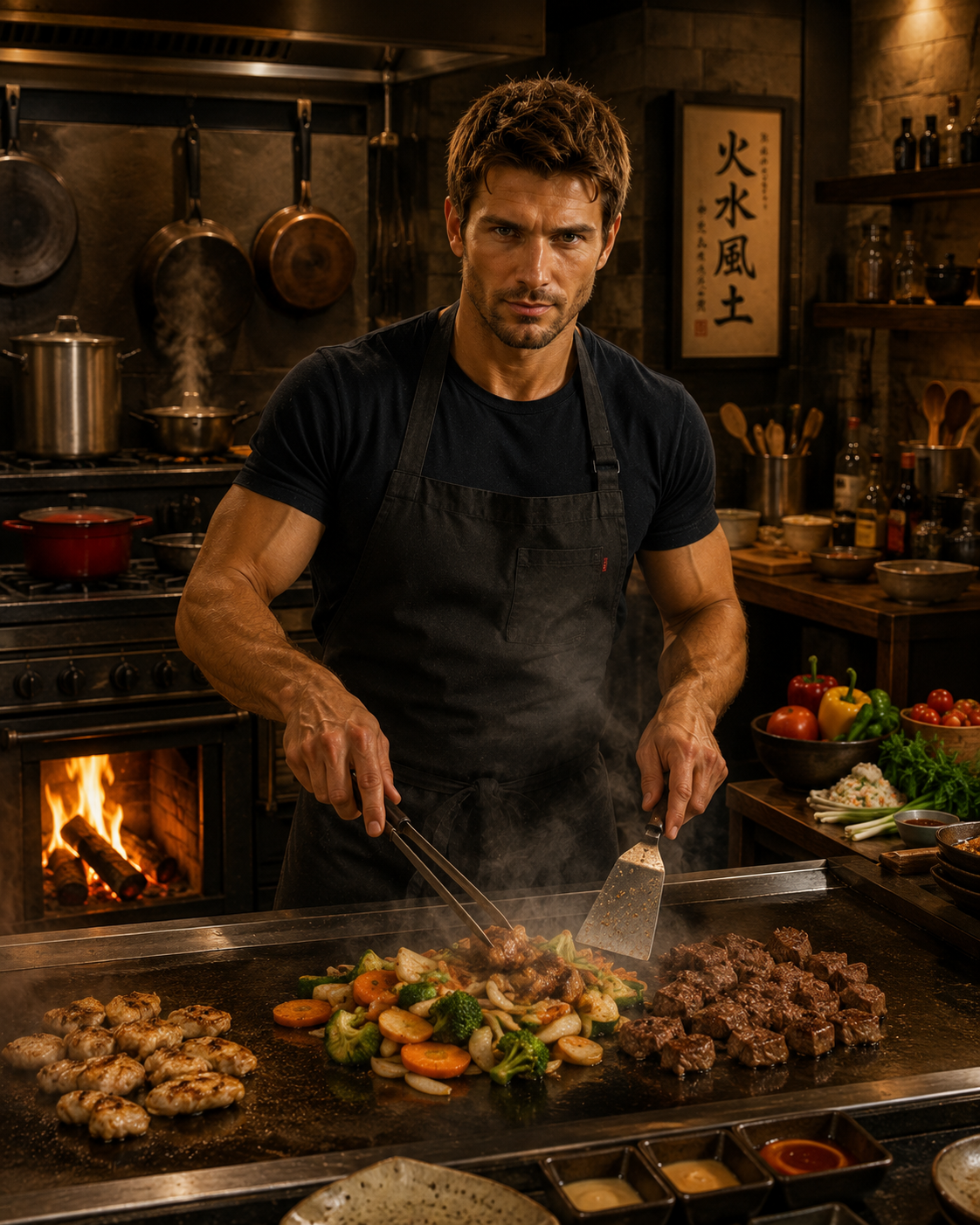
Grilling & Cooking
Baking & Roasting
Frying & Sautéing
Smoking & Steaming
Learn to cook for yourself, and you will end up cooking for everybody.
Somewhere in the tour of this kitchen the chef stops talking. He takes the clipboard out of your hands, sets it down on the steel, and puts a knife in them instead.
"Enough planning. You can build menus and stock a fridge and fill a hundred containers, and none of it feeds anybody until a man stands at a stove and cooks. That is the only part of this I cannot do for you." He slides a board across and sets an onion on it. "Board. Knife. Watch my hands, then show me yours. And understand what I am actually handing you here — this is not a chore I am teaching you. It is the reason people will come to your house for the next forty years."
This is the craft, and it is the station everything else was built to serve. The menu decided. The list bought. The block staged. Now comes the part that turns groceries into dinner — knife work, heat, seasoning, tasting as you go — and then the part almost nobody teaches: putting three or four things on a table at the same time, hot, for people you love. That skill is quietly vanishing from modern men, and it is a real loss, because the man who can cook is the man who can feed people. Everything downstream of it — the table he keeps, the friends who end up in his backyard, the kids who learn it by watching — starts here.
This room holds the fundamentals and the fire. The other ways heat meets food get three rooms of their own.
Men Have Always Cooked
Get one lie off the table before you pick up the pan: the idea that cooking is women's work and a man in an apron is out of his lane.
History laughs at that. Men hunted the animal, butchered it, salted it, smoked it, and stood over the fire while it cooked. The pit tradition is men. The chef tradition is men — walk into the back of any serious restaurant on earth and look around. For most of human history, in most places, the most demanding cooking was male territory. The notion that a man does not belong at the stove is a recent invention, and it has cost two generations of men a skill their grandfathers took for granted.
Look at what the loss actually bought. The man who cannot cook is dependent — on restaurants, on delivery apps, on packaged food, on whoever else in his life is willing to feed him. He pays triple for every meal. He eats whatever industrial kitchens decide to sell him, in oils and salt he would never choose. His kids grow up never once watching their father make dinner, so the dependence gets inherited. And socially he is always the guest and never the host, receiving hospitality his whole life and never once returning it. None of that is convenience. It is a quiet surrender of ground men used to hold.
There is a practical edge to it too. Cooking is where your whole eating system finally touches food. Every principle from the rooms before this one depends on somebody actually producing the meal. The man who can cook can run any eating plan he ever chooses. The man who cannot is limited to whatever comes in a package — and you have read those labels by now.
Why Most Men's Cooking Fails
The men who do try mostly get stopped by the same handful of walls. Every one of them is learnable, and every one of them shows up again in all three rooms below this one.
One trick, no repertoire. He can grill a burger, and that is the entire act — one method, a few dishes, and the family is politely tired of all of them by June. That is what the three rooms below are for.
Recipes without understanding. He follows steps like assembly instructions, but take away the recipe — or one ingredient — and he is stranded. Learn why instead: why you sear, why meat rests, why the pan has to be hot before the food goes in. A man who understands the why can open a fridge and improvise dinner out of what is in it. That is the actual skill.
Slow, scared knife work. Bad grip, dull blade, uneven cuts, twenty minutes to chop what should take three. Poor knife skills make every meal feel like labor, and labor is what makes men quit. Learn the grip, the rocking motion, and the claw hand that keeps your fingertips attached. It is one afternoon of practice and it makes cooking pleasant for the rest of your life. Keep the blade sharp, too — the dull knife, not the sharp one, is the one that slips and cuts you.
Everything on high. The most common sin men commit at a stove: crank every burner to maximum and hope. The outside burns, the inside stays raw, and he concludes he cannot cook. Heat control is cooking, and every room below teaches its own version of it.
Fear of seasoning. His food is bland because he salts like it is rationed — and bland home cooking is exactly what drives men back to the drive-through. Four things make food taste good: salt, fat, acid, heat. Season in layers as you cook, and taste as you go. Tasting is the single habit that separates a cook from a man who merely heats food. Nobody ever fixed a dish they never tasted.
One menu forever. He cooks the six things he grew up on, on rotation, until everyone at the table can predict Tuesday. That is real skill, just a narrow one. Steal one dish at a time from other tables of the world and the boredom that kills long-term home cooking never gets a foothold.
Be Skilled on the Grill
Fire comes first, and it stays in this room, because grilling is the one kind of cooking men never needed convincing to love and the one they are most likely to have been doing wrong for twenty years.
Most men who own a grill have never actually learned to use one. They light the whole thing, put everything on at once, and stand there flipping. Four things separate that man from one who can cook anything over fire.
Build two zones, never one. Set your grill up with a hot side directly over the flame and a cooler side with no flame under it. That is the entire secret of the backyard, and almost nobody does it. The hot side is for searing. The cool side is where you move food to finish cooking through without burning, and where you put it when something flares up. One screaming-hot surface with nowhere to retreat to is why so much backyard food comes off black outside and raw inside.
Temperature, not time. If you can control the temperature of your grill, you are already ahead of most men who own one. Time is a guess — it depends on thickness, on how cold the meat was, on the wind, on the grill itself. Temperature is a fact. Recipes lie about minutes; a thermometer does not, and a good instant-read thermometer is the cheapest skill upgrade available to a man who cooks meat.
Know your three heats. Nearly everything you grill lives at one of them.
Low and slow, around 250°F. Gentle, patient heat for tough, fatty cuts — pork shoulder, ribs, the cuts full of connective tissue that need hours to surrender. Never put a lean cut here; long low heat pulls the moisture out of lean meat and hands you leather. This heat has a whole discipline built on top of it, and it gets its own room further down.
Medium, around 350°F. The everyday working heat. Burgers, chicken, sausages, vegetables. Most of what you will grill in a year belongs right here.
As hot as it goes. Steak. Short, violent heat, a hard crust built fast, and off the fire before the middle overcooks.
4. Understand the crust. That dark brown seared exterior has a name — the Maillard reaction — and it is not burning. It is what happens when real heat hits the surface of food and the amino acids and sugars already in it react together, building hundreds of new compounds that were not there sixty seconds earlier. That reaction is the color, the smell that carries down the street, and most of what people mean when they say something tastes grilled. It needs two things: a dry surface and serious heat. Wet meat on a lukewarm grate steams itself gray. So pat the surface dry, get the grate properly hot, lay the food down — and then leave it alone long enough for the crust to form. The man turning his steak every thirty seconds is robbing himself of the best part of it.
Two habits finish the job. Keep the lid down — the lid is what makes a grill an oven instead of a campfire, and every time you lift it to look, you dump the heat you were building. And let meat rest before you cut it, five or ten minutes off the fire. Cut it straight off the grate and the juice runs out onto the board. Wait, and it stays in the meat where you wanted it.
Three Rooms, In Order
Fire is one way to cook and there are only a handful of others. They are laid out in three rooms, walked in this order, and the order runs from the method that asks least of you to the ones that ask most.
Baking & Roasting — the method that works while you don't. Dry heat surrounding the food, no pan to babysit, and the only cooking in this section that continues after you have left the kitchen. The sheet pan dinner that feeds your family on a weeknight, the roast that feeds the table Sunday and feeds you again on Wednesday, and the four rules men break every time they crowd a tray. Then baking proper, which is the one corner of the kitchen where a confident man cannot improvise his way out.
Frying & Sautéing — ten-minute dinners, and the pan that punishes you for looking away. Direct heat, fast, and it will not forgive a wandering mind. Hot pan, dry food, room to move. The order aromatics go in and why burnt garlic ruins a dish nothing downstream can save. And the single most valuable move in this whole section: the brown stuff stuck to the bottom of the pan is not a mess to be scrubbed — it is the sauce, and it takes ninety seconds to prove it.
Smoking & Steaming — the longest way to cook and the shortest. They share a room on purpose: neither one touches the food, neither one browns anything, and both ask a man for restraint rather than effort. Smoke turns cuts nothing else can rescue into the best meal on your street, and the whole skill is not opening the lid. Steam is the six-minute method most men have written off because they confused it with boiling, and it is the fastest way to get a real vegetable onto a plate.
Putting a Whole Meal on the Table
One thing before you go, because it is what all four methods are ultimately for. This is the gap that separates a man who can cook a thing from a man who can cook dinner. Plenty of men can produce one good item. Far fewer can put three or four things on a table at the same time, all hot, that taste like they belong together. That is what feeding people actually means.
Every meal you will ever serve has the same shape. A protein. A vegetable, two if you can manage it. Something starchy — rice, potatoes, bread, pasta. And something bright to keep the whole plate from being flat: acid, fresh herbs, a sauce, something sharp or crunchy. Learn that shape and you never need a recipe to plan a dinner again. You are not memorizing meals. You are filling in four slots.
Cook backwards from the plate. This is the part nobody teaches, and it is the difference between a hot dinner and three lukewarm dishes served twenty minutes apart. Do not start at the top of the recipe. Start at the clock. Decide what time you are eating. Find the item that takes longest and start that first, then work backwards — the roast that needs an hour goes in first, the potatoes that need thirty minutes go in half an hour later, the vegetables that need eight minutes go on near the end, and the sauce gets made while the meat is resting. Amateurs cook in the order things are written down. Cooks cook in the order the clock demands.
Use more than one method at once. This is the practical reason to learn all four rather than one. A tray in the oven, a pan on the stove and a basket of vegetables steaming beside it is three cooking methods running in parallel with one man managing them, and it produces a full dinner in about half an hour. A man with only one method has to run everything through it in sequence and eats late.
Taste at every stage, not at the end. By the time it is plated, your options are salt and regret. Taste the sauce while it reduces. Taste the vegetables before they leave the pan. Adjust while adjusting is still possible.
The cooking is not finished when the food is done. It is finished when people are eating it. Hot food, real plates, everyone sitting down at once. A man who cooks well and then lets it go cold on the counter while everyone drifts in has done ninety percent of the work and collected none of the payoff.
Knowing Is Not Cooking
Be honest about one thing before you walk the three rooms: none of what you read in them will count for anything on its own.
The methods go in your head. The tools sit in the drawer. That is worth exactly nothing until dinner comes out of your kitchen, most nights, made by your hands. This station keeps one measure and that is it. A man who has read about cooking for two years and cooked eleven times has learned to talk about cooking, which feeds nobody and impresses no one worth impressing.
So cook something out of each room within a week of reading it. Pick three dishes total — genuinely three, not thirty — and repeat each until you can do it without looking anything up. That is your foundation, and everything else in your life as a cook gets built on top of those three.
The Man People Come To
Now the part that surprises men who take this seriously.
You learn to cook for yourself. It does not stay there. A man who can genuinely cook becomes, without ever planning it, the man people gather around — because food is the oldest reason human beings have ever had to be in the same room, and it still works. Nobody organizes their Saturday around a man who orders pizza. They absolutely organize it around a man with something on the smoker since six that morning.
"So Abraham hurried into the tent to Sarah. 'Quick,' he said, 'get three seahs of the finest flour and knead it and bake some bread.' Then he ran to the herd and selected a choice, tender calf and gave it to a servant, who hurried to prepare it."
— Genesis 18:6-7
Read how much of that passage is a wealthy old man hurrying. Three strangers show up at his tent in the heat of the day and Abraham does not send someone out for something. He runs into the tent. He runs to the herd. He picks the animal himself, personally, because the quality of what these men are about to eat is his own responsibility and he is not delegating it. The hospitality is not the invitation. The hospitality is the labor, and the labor is cooking.
That is what this skill unlocks, and it reaches into every other part of a man's life. You bring a real dish to the church potluck instead of a plastic tray from the store. You feed a family that just had a baby, or one that just had a funeral, and you show up with something you made rather than something you bought. The men's group meets at your house because you will cook for it. A friend going through the worst year of his life gets fed at your table instead of talked at across one. Cooking is how a man serves people without ever having to make a speech about it, and it is one of the few forms of generosity that nobody can mistake for anything other than what it is.
It also gets its own room much further down the road. In the FUN domain, hosting becomes a whole discipline of its own — the backyard everybody ends up in, the annual cookout the neighborhood plans around, the man who can honestly boast the most roast. That is Parties & BBQ’s, and it is a long way from here on purpose. You cannot host what you cannot cook. The skill gets built at this station, in an ordinary kitchen on an ordinary Tuesday, years before anybody shows up to eat it.
And it starts closer to home than the backyard. Your kids watch you sharpen a knife and stir a pot and learn — without a single lecture — that feeding people is what a man does. Your wife gets a real partner in the one room of the house that never closes. The table fills with food you chose, cooked the way you chose, eaten together. In a world eating alone out of paper bags in front of screens, a man who can put a real meal in front of his people is holding something quietly powerful. Cooking is not beneath you. It is provision in its oldest form: the strong feeding the people they love, from their own hands.
One thing worth knowing before you start, because it changes how you cook from the first day.
A man who learns these four methods properly is not going to end up making single portions. Every one of them rewards scale — the oven has room for a second tray, the smoker was never worth lighting for one piece of meat, and the pot of sauce that took forty minutes takes the same forty minutes at four times the volume. Cook like a man feeding people and you will produce more than one night's dinner nearly every time. That is the point of it. It is also a problem, and there is a cold room at the end of this section built specifically to solve it.