
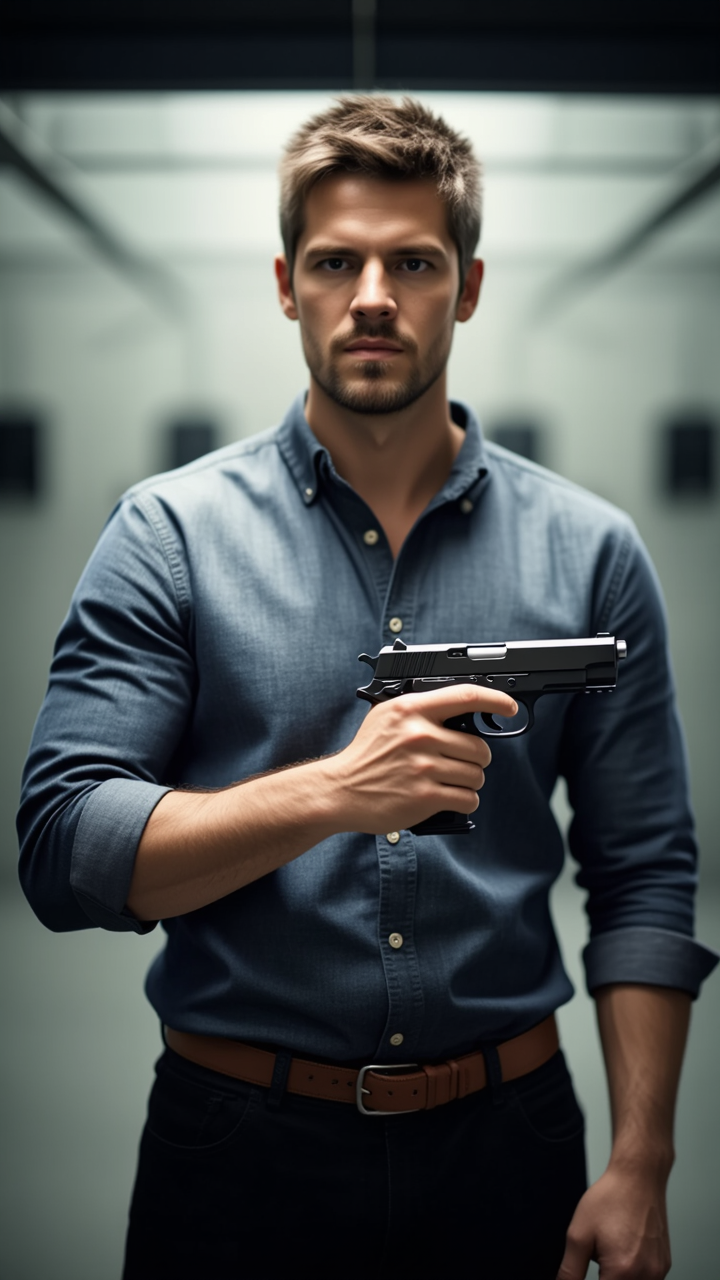
Handguns
Pistols
Revolvers & Wheelguns
Single Shot & Derringers
"Fast is fine, but accuracy is final." — attributed to Wyatt Earp
The Handgun Bay
The Armorer walks you past the long guns without looking at them and stops at a counter with four things on it.
A black polymer pistol, the kind half the men in this state have in a nightstand. A blued revolver with the finish worn silver at the muzzle where somebody's holster rubbed it for thirty years. A two-shot derringer no bigger than a wallet. And a folded gun magazine, open to a review with a five-star headline. "Same job," he says. "Three answers. And the fourth thing on this counter is how you find out which of the three is lying to you." He hands you the pistol, empty, and has you hold it out at arm's length. Then he waits. Ten seconds. Twenty. "Feel that? The rifle gives your body four places to hold it still. This gives you your hands. And your hands are the problem. Every gun in this bay is a machine for finding out what your hands are worth, and they're worth less than you think. Everybody's are. That's not an insult. It's the price of admission."
He takes it back. "Here's what I'll tell you about this bay that I won't tell you about the other two. The rifle and the shotgun are guns a man goes and gets. This is the gun a man is wearing. That changes everything about it. It changes what it can weigh, what it can hold, how far it reaches, how hard it kicks, and how much of the job falls on you instead of the steel. A man who doesn't understand that buys the wrong handgun, and a man who does understand it and still buys the wrong one bought it for the wrong reason. This bay is for both of them."
This is the handgun bay, the first of the three platforms on the rack and the one the whole hall was ordered around. The bench behind you already taught the four rules, the grip, the press, the draw, and the cleaning that is really inspection, and nothing on this floor teaches them again. This page is the door to the bay: what a handgun is and what it costs to be one, the four rooms in the order they are walked and why in that order, the questions that decide the gun before the gun is chosen, the strange corners of the family and what they are for, the mistakes that belong to this bay alone, and why the walk leaves here for the long gun.
What a Handgun Is, and What It Costs to Be One
A handgun is a firearm made to be fired from the hands alone, with nothing against the shoulder. That is the entire definition and everything else in this bay follows from it.
Because it has no stock, it has no third and fourth point of contact, and so the whole business of holding the gun still while the trigger moves falls on the grip and the wrists. Because it has to be worn, it has to be small, and small means a short barrel, a short distance between the sights, less powder behind the bullet, and fewer bullets. Because it is small and light and the cartridge is not, it moves in the hand when it fires, and it moves more the smaller it gets, so the guns that are easiest to carry are the hardest to shoot. Every handgun ever built is a negotiation between those facts, and the negotiation never comes out clean. The gun on your belt is the weakest firearm in the building, the shortest-ranged, and the one that shows every fault in your hands on the target at seven yards. It is carried anyway, by more men than carry anything else, because it is the only one that is there.
The family has produced three mechanical answers to that negotiation, and the bay is built around them. The single chamber, one barrel, one round, the oldest answer, older than the cylinder by three centuries and still made. The cylinder, a drum of chambers turned by the trigger, which put repeating fire into a man's hand in 1836 and held the field for seventy years. And the self-loader, a magazine in the grip and a slide that uses the shot's own recoil to feed the next round, which took over in the first decade of the twentieth century and has never given the ground back. A fourth answer, the machine pistol, exists and is not a civilian's tool, and this bay does not pretend otherwise.
The history that matters fits in a paragraph. Wheellock and flintlock pistols armed horsemen and duelists for three hundred years, one shot at a time. Samuel Colt's revolver made the pistol a fighting weapon rather than a last resort. John Browning's self-loaders, and above all the one the Army adopted in 1911, gave the world the mechanism nearly every modern pistol still uses. A curtain-rod maker in Austria who had never built a gun put that mechanism in a plastic frame in 1982 and by the end of the century his design was the default on every police belt in the country. And in 2018 a pistol the size of the old six-shot pocket guns showed up holding eleven, and the market has been chasing it since. Each of those turns is told in the room where it belongs. What the bay wants you to hold is the shape: the handgun keeps getting smaller and holding more, and the one thing it has never done is get easier to shoot.
The Bay, Walked in Order
Four rooms. The order is the Armorer's, and it runs from the gun a man will almost certainly buy first to the shelf that tells him whether he should have.
Pistols — the self-loader. The magazine-fed semi-automatic, the gun most men mean when they say pistol and the one the whole modern market is built on. The room walks the machine itself, the slide and the magazine and the way it feeds; the families it comes in, from the polymer striker gun to the hundred-year-old Browning line and its five-thousand-dollar descendants to the micro-compacts that changed carry; the caliber argument and why it ended; the sight that has done to the pistol what the scope did to the rifle; and the standard, set in 1982 by one of Cooper's men, that tells a man the actual size of the mountain between range comfort and competence.
Revolvers & Wheel Guns — the cylinder. The older answer, given its full and fair hearing. The room tells how the cylinder came to be and how it was overtaken, where it still wins outright, where it loses and by how much, and what its trigger asks of a man that the self-loader never does. It is held by the fastest hands that ever held one, a machinist from Louisiana who took the platform every counter calls obsolete and set records on it that no self-loader has beaten, the latest of them past the age of sixty-nine, and who handed the whole trade down through his own household.
Single Shot & Derringers — the oldest answer, and the smallest. The corner where the family started and the remainder it left behind: the one-shot pistol that armed three centuries of horsemen, the pocket gun that killed a president, the two-shot over-and-under that rode in gamblers' vests for seventy years and is still made in Texas, and the break-action single shot that turned the handgun into a hunter's rifle. The room is history and plain information, and it carries the honest ledger of what these guns are for and what they are not, because more of them are sold to men who have not walked the first two rooms than to men who have.
Handgun Reviews — the shelf. The running shelf of platform write-ups, kept current as the market moves, with the reading lesson in front of it: how to tell a test from an advertisement, what a round count means, what a reviewer's silence about the price is telling you, and the state of the market as of the date on the page. The bay ends here, and the room closes the bay and hands the walk to the long gun.
The order is a teaching order. The self-loader first because it is the gun a man will buy, and because everything the counter tells him is about it. The revolver second because it answers exactly the questions the self-loader raises, the hands that cannot run a slide, the pocket that will not take a slide, the woods, and because its trigger is the hardest press in the bay and a man should meet it after he knows what a good press feels like. The single shot and the derringer third because they are where the whole family came from and where the worst purchases in the family get made, and a man who has walked two rooms will recognize both. And the shelf last, because a review is only readable by a man who already knows the three answers and can tell which one the gun on the page is giving.
The Role Decides the Gun
Men buy backwards. They fall for a handgun and then invent a job for it. The Armorer's rule is the reverse: name the job, and the job names the gun. There are five jobs, and one man rarely needs more than two of them filled.
Carry. The gun that has to disappear into your actual clothes and your actual life, every day, or it stays home and protects a drawer. This is the compromise job, and it is the reason the micro-compacts exist. The man who buys a full-size duty pistol for carry and finds it in the nightstand six weeks later did not fail at carrying. He bought a gun for a job it was never going to do.
The house. Concealment is irrelevant at two in the morning. A full-size gun with a light mounted on it and every round it will hold costs nothing in a hallway, and the handgun holds one advantage there that no long gun can match: it leaves a hand free. A phone. A flashlight. A doorknob. A child carried down the stairs. The rifle and the shotgun answer the same night differently, and the bays after this one weigh them.
The game. Competition builds its own machines, compensators and magazine wells and triggers tuned by the ounce, and they teach speed honestly and lie about carry. A man should know which game a gun was built for before he trusts it with a different one. What the game does for a shooter is not small, and the pistol room says so.
The woods. Bear country, the backcountry, the trapline, the deer stand. This job belongs mostly to the magnum revolver and the long-slide ten-millimeter, and the trail into it runs through the revolver room and the single-shot room both.
The pocket. Deep concealment, the gun for the clothes that will not hide a holster, the second gun on the ankle. The small revolver owns most of this, the smallest self-loaders share it, and the derringer claims it and mostly should not.
Name the job first. Then walk into the room that answers it.
Four Questions Before the Gun
Whatever the job, four questions get asked before a handgun is chosen, and they are the same in every room of this bay.
Does it fit the hand? Not the hand of the man at the counter. Yours. The trigger reach, the width of the grip, whether the controls can be run without shifting the hand, whether the recoil of that cartridge in that weight of gun can be managed by these wrists. A handgun that does not fit is a handgun that will be shot badly and then not shot at all. Rent it. Shoot it. Then buy it.
What does it hold, and what does that cost? Capacity is bought with size, and size is paid for in carry. The man who wants seventeen rounds and a gun that hides under a t-shirt wants two different guns, and the bay will not pretend otherwise.
What does it fire? The caliber argument is mostly over and the pistol room tells why. What the question still decides is the cost of practice, which decides how much practice happens, which decides everything.
What sights does it wear? Iron, or a dot, or iron with the slide cut to take a dot later. The direction of the platform is not in doubt, and the workshop's rooms on Sights & Optics and Red Dots cover the choice. What the bay adds is a warning: the dot does not fix a bad press. It shows it to you in a red circle that will not hold still.
The workshop's buying room, Handguns, Pistols, and Revolvers, carries the working table and the shopping discipline, from research to the rental range to the five hundred rounds a gun runs before it rides. The bay does not repeat it. The bay tells you which gun to put on the table.
The Strange Corners
Every family has its edges, and the honest guide walks a man through them instead of pretending they are not there.
The AR pistol. A rifle-pattern gun with a barrel under sixteen inches and a brace on the back instead of a stock. It is legally a pistol, and practically it is something in between, and it exists because of a line in federal law: put a shoulder stock on that same short barrel and it becomes a short-barreled rifle, which requires a federal form, a background check, and registration. The brace question has moved more in five years than most gun law moves in fifty. A federal rule in 2023 declared most braced pistols to be short-barreled rifles; a federal court vacated that rule in 2024; the appeal was dropped in 2025; and as this is written no federal brace rule is in force, with a proposal on the table to strike the rule from the books for good, while several states have written their own. The standing order in this corner does not change with the rule: know the law where you stand, today, before you build or buy, and read it through Legal Defense and not through a forum. The true short-barrel room is Tactical Rifle (SBR).
The race gun. Compensated, optic-mounted, tuned to the gram. Formula cars, marvels of the gunsmith's art, that teach real lessons about speed and prove nothing about the street.
The hunting handgun. Long-slide ten-millimeters, scoped magnum revolvers, the break-action single shot with a rifle cartridge in it. A small fraternity of men take deer and elk and defend against bears with a handgun, and it is a real fraternity with real skill in it.
The collector's shelf. The heirloom revolver, the war bring-back, the derringer in the sock drawer that belonged to a great-grandmother. History a man can hold. Nothing wrong with any of it, as long as he is honest about which gun on his shelf is a tool and which is a treasure, and does not load the treasure.
The pattern across every corner is the same: the edges are for men who have mastered the center. Fringe first is backwards, and the counter sells fringe.
What the Handgun Owner Gets Wrong
The rack's parent named the mistakes of the untrained gun owner. These are the handgun bay's own, and the workshop has a room for every one of them.
He bought it before he named the job. The gun is the wrong size for the life he actually lives, and so it lives in the drawer, and the drawer is not on his belt.
He has never fired the ammunition it is loaded with. Practice with the cheap load, carry the expensive one, and never once confirm that the expensive one feeds. The workshop's rule is a round count, not a hope.
He carries it in his pocket without a holster. The trigger is covered by nothing but denim and keys, and the four rules are being broken by his trousers.
He has one gun doing five jobs. The full-size gun he cannot carry is also the carry gun he does not carry, and so the house has a gun and the man has none.
He believes in stopping power. A handgun cartridge stops a man by where it lands, and the caliber on the box does not put it there. The argument he is having at the counter was settled by the people who study wounds, and the pistol room reports the verdict.
He has never fired with the other hand. The standard at the far end of the pistol room repeats every stage with either hand alone, and the man who has never tried it will find out on the day which hand the day gives him.
He thinks the revolver is the beginner's gun. He handed his wife a snub-nosed revolver because it was simple, and its trigger is the heaviest, longest press in the bay, and the gun kicks harder than his, and she will not shoot it twice. The revolver room has a word for him.
He reads the review and not the round count. Five stars, a sponsored headline, and no price. The shelf at the end of the bay teaches him to read.
The Three Pillars at the Handgun Bay
TRUTH at this bay is what the target says about the hands, at arm's length, with nothing to help. The rifle can flatter a man for years. The handgun cannot flatter him for one magazine. The group is where the group is, the draw took what it took, and the man who will not put his handgun on a clock and his group on paper is keeping a story about his hands safe from the only witness that matters.
LOVE at this bay is the reason a man wears the worst gun in the building every day of his life. He does not carry it because it is the best tool. He carries it because the people beside him at nine o'clock on a Tuesday do not get to choose where the day happens, and the handgun is the only gun that comes. And it is trained with the other person on the end of it in mind, the one who may be a threat and may not be, because the handgun's short reach means the identification and the decision happen close, and fast, and the round that lands wrong at seven yards lands in someone.
LAW at this bay is heavier than at any other in the hall, because the handgun is the most regulated object a man will own and the one he will carry through the most doors. Where it can go, how it must be carried, what the magazine may hold, what the state says about the brace and the barrel and the permit, and what follows the first shot he ever fires at a man, are all read before they are needed, at Legal Defense, and the trained man knows them better than the men who would test him on them.
Walked as a System
One counter, four rooms, and each does a job the others do not. The self-loader room teaches the machine the whole market is built on and the standard that measures a man on it. The revolver room teaches the answer to everything the self-loader cannot do, and the trigger that finds out whether a man's press is real. The single-shot room teaches where the family came from and which of its remainders are tools and which are toys. The shelf teaches him to read what is written about all three, and ends the bay.
What the bay builds leaves it by three doors. Down the hall, to the long guns, which do everything the handgun does badly and cannot be worn. Down the building, to the blade and the close range, where the handgun's short reach becomes no reach, the draw gets fouled by another man's weight, and the gun becomes the thing being fought over, which is why the workshop teaches the transition drill and the far end of the building teaches Weapons Retention. And out to the Homestead, where the handgun is one piece of what a man carries every day, the piece the law watches closest, and the piece he prays stays holstered for the rest of his life.
After the Bay
A man leaves this bay knowing the gun he wears and what it cannot do. That second part is the point of the next room.
The handgun is short, weak, and hard, and it is carried in spite of all three because it is there. But there is a day a man sees coming. A noise downstairs that is not the cat. A season in the backcountry. A threat that gave warning, which they sometimes do. On that day nobody who owns both reaches for the gun on his belt, and the reason is the four points of contact the Armorer had you feel the absence of at the counter. The next bay holds the gun a man chooses when he can choose, the one that puts the stock in his shoulder and his cheek on the comb and gives his hands, for the first time in this hall, some help. Having learned on the handgun how hard hitting is, he is ready to learn what it feels like when the gun wants to.