
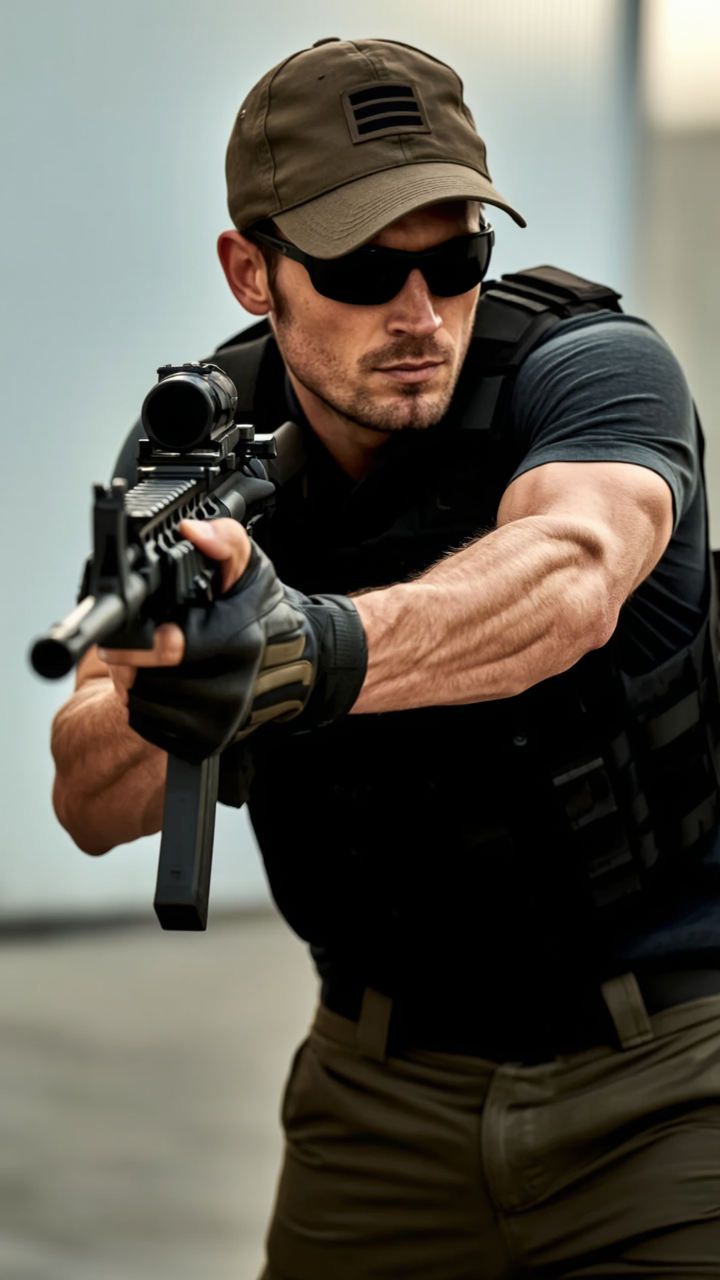
Rifles
Rifles 101
Tactical Shooting
Precision Shooting
"The rifle itself has no moral stature, since it has no will of its own. Naturally, it may be used by evil men for evil purposes, but there are more good men than evil, and while the latter cannot be persuaded to the path of righteousness by propaganda, they can certainly be corrected by good men with rifles." — Jeff Cooper
The Rifle Rack
The Armorer does not hand you the rifle. He hands you the pistol again, empty, and has you hold it out at arm's length one more time, until your hands remember what the handgun bay taught them. Then he takes it, lifts a plain bolt-action off the pegs, and sets it in your hands the way a man sets a sleeping child in another man's arms: the butt into the pocket of your shoulder, your cheek down on the stock, your support hand out under the forend, the whole length of the thing lying along your body. "Now hold that still," he says. And you find that you can. Not perfectly. But the shake that made a fool of you at the counter is mostly gone, and it went nowhere; the gun just gave your body more to do the work with.
"That's the whole bay," he says. "Everything after this is detail. The handgun asked your hands to do a job they were never built for. This one helps. That's why a boy can learn it at ten and why a man can shoot it at eighty, and it's why nobody who owns one reaches for anything else when he knows trouble is coming." He takes the rifle back. "It's also why this gun will make a liar out of you longer than any gun on the wall. It hits so easy at fifty yards that most men never find out they can't hit at two hundred. This bay is about finding out."
This is the rifle rack, the second of the three platforms and the one that holds the deepest skill a civilian shooter can build. The four rules and the press are the bench's and the humility about your hands is the handgun bay's, and this floor assumes both and repeats neither. This page is the door: what the rifle is and why it carries the weight it does in this country, the three rooms in the order they are walked and why in that order, what a rifle is for and the five jobs it does, the gap the gun hides from its owner, the strange corners of the family, the mistakes that belong to this bay alone, and why the walk leaves here for the last gun on the wall.
What a Rifle Is, and Why It Carries the Weight
A rifle is a long gun with a rifled barrel, spiral grooves cut inside the bore that spin the bullet and keep it true, fired from the shoulder with both hands and the cheek on the stock. Dry as that sounds, the whole bay is inside it.
The rifled bore gives the gun reach and precision that a smooth one cannot; the shoulder stock and the long barrel give the shooter a platform that holds still while the trigger moves. Put the two together and the rifle becomes the only firearm a man can own that outperforms him for years. A three-hundred-dollar bolt gun from a chain store, with a two-hundred-dollar scope on it, will put five rounds inside an inch and a half at a hundred yards out of the box. Almost no owner can. That gap, between what the rifle can do and what the man behind it can, is the subject of the whole bay, and the reason the bay is walked in the order it is.
And the rifle carries a weight in this country that no other tool does. The American story opens with riflemen: farmers who shot to feed a family and shot the same way when the militia mustered, whose long guns outranged the musket by a factor the King's officers found out about the hard way. The rifle over the door was never decoration. It was the household's reach, its meat, and its answer. A man who takes up the rifle today steps into that line whether he means to or not, and it is better to know it, because the line asks something of him. Not the costume of a rifleman. The competence of one. There is a Navy photograph, posted by the Navy itself, of a commanding officer firing a service rifle with the scope mounted backward, the lens cap on, and his elbow in the air, and the internet had its fun with him. The Armorer's reading is kinder and worse: a man in a uniform was handed the national gun and had never been taught it. Most owners are that man with a better hat.
The Bay, Walked in Order
Three rooms, and the order runs from the class every rifle owner owes himself, through the gun most of them actually bought, to the discipline that has no ceiling.
Rifles 101 — the first class at the long gun. The Armorer's bench, walked again with the explaining put back in: the mount and the four points of contact, the natural point of aim, the breath and the press and the follow-through that the handgun never taught; the little rimfire that is the finest teacher in the building; recoil and the six ways a man manages it; the vocabulary of glass and the hour of honest work that is a zero; the families of actions and why the argument between them is boring; and what actually makes a rifle accurate, which is mostly not the rifle. Beneath it, Rifle Cartridges & Calibers, the map of the cartridges themselves, because a rifle is its cartridge before it is anything else.
Tactical Shooting — the carbine, run. The rifle most Americans bought, and the room that teaches what to do with it besides own it: the gun run from the sling under time and movement, the ready positions, the fifty-yard zero, the reload and the stoppage, the light, the transition to the pistol, and the shot not taken. The room is held by a man who wore a Ranger's uniform through four deployments before he wore a hat for a living, and who teaches the rifle as his grandfather taught him lumber. Beneath it, three rooms in order: the AR-15 itself, what it is and why it won; Assault Rifles, where the word came from and what it does and does not describe, told straight; and the Short-Barreled Rifle (SBR), the specialist bought with federal paperwork, and the one cartridge that will chamber in the wrong barrel and destroy it.
Precision Shooting — the discipline with no ceiling. The rifle's summit: fundamentals compounded with ballistics, wind, and honest records until a round lands where it was promised at distances most shooters cannot estimate. Held by a man who was a Ranger sniper before he was a lawyer, and who wrote the book that has taught more civilians to shoot far than any other. Beneath it, Sniper Rifles, the history of the men nobody saw and the rifles they carried, from the Civil War to a shot in Ukraine last year that nobody certifies.
The order is a teaching order. The class first because every rifleman, whatever he bought, owes his body the mount and his rifle a zero, and because most men skip it and find out on a deer. The carbine second because it is the rifle most men own and the one the household actually depends on, and because running a rifle under time and movement is a skill separate from hitting with it, and a man should have both before he starts chasing distance. Precision last because it is the hardest thing in the hall and the only one that never ends, and because a man who has learned to run the carbine cold and fast arrives at the long-range bench already knowing what a fundamental is and how badly a small error scales. There is no fourth room. The precision room closes the rifle, and one gun is left on the wall.
What the Rifle Is For
The handgun bay taught you to name the job before the gun. The rifle's jobs are different from the handgun's, and there are five.
The house. A carbine with a light on it, a dot on it, and a full magazine is the easiest gun on the wall to shoot well at two in the morning, and the least likely of the three to send a round through the neighbor's drywall if it is loaded with the right ammunition, which is the opposite of its reputation and the kind of thing a man verifies. Its cost is that it takes two hands, and the tactical room and the shotgun bay both weigh that honestly.
The field. The rifle is the provision gun. Deer, elk, antelope, hogs, the freezer filled by a man's own hand from country he knows. This job is where the rifle's reach becomes a moral matter, because a shot a man cannot make cleanly is a shot he owes the animal not to take, and the precision room and The Backcountry both hold him to it.
The distance. The rifle is the only gun on the wall that reaches past three hundred yards, and the only one whose skill compounds without limit. Some men walk this road for the hunt, some for the game, and some because a thing that cannot be finished is the only kind of thing worth doing.
The game. Rifle competition runs from a fifty-dollar club match with a .22 to national series with targets past a thousand yards, and it is the honest audit of every claim a rifleman makes about himself. Nobody's zero survives its first match unrevised.
The inheritance. The rifle is the great teaching gun. A .22 at a quiet range is where fathers have handed patience, discipline, and respect for consequence to sons and daughters for a hundred years, and it is the one job on this list every man with children should fill whether or not he fills the other four.
Name the job. Then walk into the room that answers it.
The Gap the Gun Hides
The handgun exposes its owner in one magazine. The rifle flatters him for years, and the bay owes him the list of what it is hiding.
It hides that he has never fired past a hundred yards, because at a hundred yards the rifle does most of the work and the man does not know which part was his. It hides that his zero is a stranger's, set by the store or the last owner or himself three years and two hunting seasons ago, and that the rifle hits where it shot, once, and not where it shoots. It hides that he does not know what his cartridge does at three hundred yards, in inches, and that the difference between two hundred and three hundred on a deer is the difference between a freezer and a wounded animal in the timber. It hides that he has only ever fired from a bench, with the rifle on bags, and that from his knees in a wind with his pulse up the gun he could not miss with will not hold on a paper plate. And it hides that the scope he paid for was bought by its magnification number, mounted with a screwdriver by feel, and has been walking a click a week ever since.
None of this is a fault in the rifle. It is a description of an owner who let the gun's willingness stand in for his own competence, and the three rooms of this bay are the cure, in order. The class fixes the mount and the zero. The tactical room fixes the bench habit and the clock. The precision room fixes everything that is left, and takes a lifetime doing it.
The Strange Corners
Every family has its edges, and this one has more than most.
The lever gun's second life. The saddle rifle that won the West, outdated on paper for a century, is quietly back in fashion as a handy, unthreatening, deeply effective working rifle, and the model that put a military cartridge in a lever action in 1895 still has men who call it the finest of the line. The corner is real and the rifles in it are honest tools. A man should know that a lever gun in .30-30 has probably taken more American deer than any other rifle and cartridge, and that it is legal in states where the carbine is not.
The fifty. The rifle that fires the machine gun's cartridge, thirty pounds, five feet long, ten thousand dollars with glass, and a mile of reach. A small fraternity owns them, one state bans them by name, and the precision room's sub-room tells what they have done in the right hands. For nearly every man reading this it is a machine to know about and not to buy.
The other rifle. The Russian one, the rifle more of the world's armies carry than any other, cheap, crude, and reliable past all reason. Its civilian version is sold here in the hundreds of thousands and its cartridge is in the cartridge room. The tactical room's second sub-room tells its story alongside the American rifle's, because the two were built to answer each other.
The pistol-caliber carbine and the rimfire toy. Long guns firing handgun cartridges, and the plinkers with drum magazines and threaded barrels. Fun, cheap to feed, real rifles for training a child on and honest tools for a few narrow jobs, and the counter sells them as more.
The muzzleloader. The rifle that loads from the front with powder and patch and ball, the frontier's own gun, kept alive by a hunting season most states set aside for it. A different discipline, a slower one, and a corner where a man meets the rifle the way the men who made the tradition met it.
The handgun bay's rule about corners applies without change, and the rifle's center is easy to name: a bolt gun and a carbine, zeroed, and a man who can hit with both from his knees.
What the Rifle Owner Gets Wrong
The rack's parent named the untrained owner's mistakes, and the zero he never set is on that list. These are the rifle bay's own.
He bought the scope by its biggest number. Twenty-five power on a deer rifle, a field of view the width of a fence post, and glass so dim at dusk that the deer he can see at noon is a shadow at the hour deer move.
He mounted it by feel. No torque wrench, no level, rings tightened until they felt right, and a reticle that is canted three degrees and a zero that walks. The class has a number for every screw on the mount.
He has fired from a bench and nowhere else. The rifle has never left the sandbags, and the only shot the field will ever give him is from his knees, in a wind, breathing hard.
He has never fired it past a hundred yards. He owns a rifle that hits at six hundred and has not learned what his own bullet does at two.
He keeps two calibers in the same magazines. The short-barrel room tells what happens when the specialist's cartridge finds its way into the standard barrel, and it has happened to careful men.
He thinks the sixteen-inch line is a suggestion. It is a felony, and the barrel he cut on a Saturday is a registered firearm he did not register.
He bought the rifle for the argument. He can tell you what the news gets wrong about his rifle and cannot tell you where it hits at two hundred yards. The second sub-room of the tactical room sorts the argument so he can get back to the range.
The house gun is in the safe, and the ammunition is in the closet. He bought the carbine for the night the noise comes, and on that night the safe is on a dial and the magazines are empty. The tactical room's storage discipline and the Homestead's are the same discipline.
The Three Pillars at the Rifle Rack
TRUTH at this rack is the zero and the notebook. A rifle hits where it hits, and at distance the target is arithmetic rather than opinion: drop in inches, drift in inches, a group with a size. The rifle is the only gun in the hall that will let a man believe a comfortable lie about himself for years, and the whole bay is the discipline of not letting it. The man who verifies his zero, records his shooting, and knows his cartridge has replaced belief with knowledge, which is the only ground a marksman can stand on.
LOVE at this rack is reach used rightly. The rifle is the household's long arm, the tool that meets trouble at the distance it starts rather than the distance it ends, and it is the provision gun, the one that fills a freezer with meat a man harvested himself and killed cleanly because he had done the work. And it is the inheritance. A .22 handed to a child at a quiet range, with the four rules said aloud, is a stronger gift than the rifle itself will ever be, and it is the reason the family's story includes a rifle at all.
LAW at this rack runs heavier than at any other in the hall except the short-barrel room inside it. Barrel lengths, overall lengths, features, magazines, the cartridge the state allows on game, the rifle the state allows at all, the registered configuration and the form and the notice before it crosses a state line. Some of the lines are felony lines. The trained man reads them at Legal Defense before he buys, builds, or cuts, not after.
Walked as a System
Three rooms, and the rack needs all three because the gun is willing and the man is not. The class puts the rifle into a man's body and a zero into his rifle. The tactical room takes the rifle most men own and teaches it under time, movement, and decision, and beneath it sorts the platform, the argument, and the paperwork. The precision room takes everything the first two built and compounds it until distance stops being a stunt.
The rifleman the rack makes walks out through three doors. Down the hall to the last gun, which trades the rifle's reach for a doorway's decisiveness. Out to the Homestead, where the carbine is one layer of a perimeter with a plan around it and the law is read before the night. And out of the building altogether, to the Backcountry, where the rifle stops being practice and starts being provision, and where the Farm's work becomes The Open Country's joy without changing a single fundamental.
After the Rack
A man leaves this rack with the gun he would choose, zeroed, run, and reaching. What he does not yet have is the gun the whole country already owns.
The rifle owns distance, and most of what a man defends is not distant. It is a doorway, and the few feet of hallway between it and the people asleep down the hall, where reach means nothing, a rifle round's virtues become its dangers, and the question is no longer how far but how decisive, right now, at the length of a room. The last gun on the wall was built for exactly that, and the whole country thinks it knows how the gun works, and the whole country is wrong about it in the same way. A man who has just spent three rooms discovering how much a willing gun was hiding from him is the right man to meet a gun that hides more.