
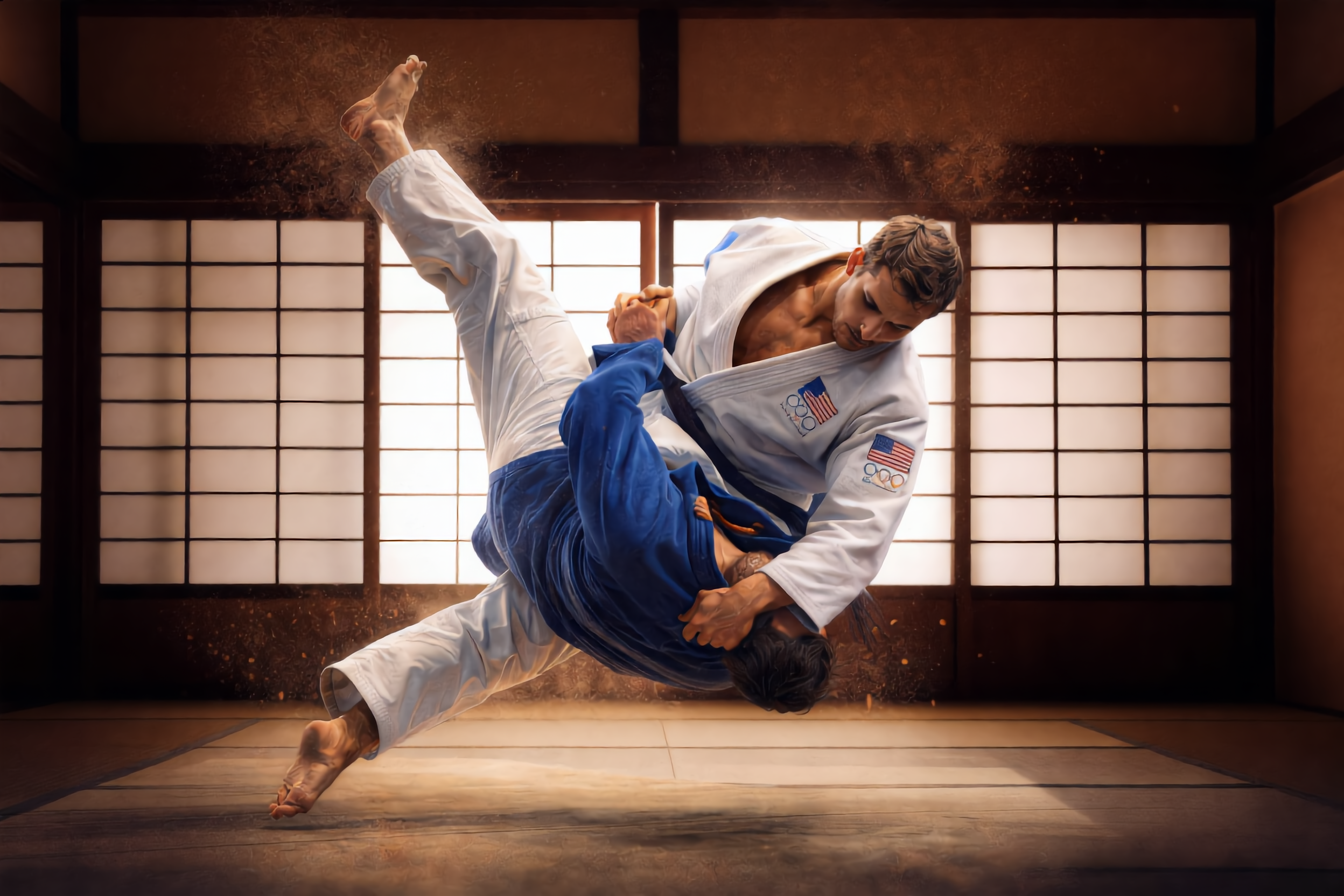
Judo 101
Judo Fundamentals
Ne Waza
Judo Philosophy
The First Class
The Warrior does not come in. He stops at the edge of the mat, in his shoes, and nods at the man in the middle of it, and then he is gone, and you understand that the room you have just entered has a different kind of authority in it than the last three.
You bow at the edge of the mat before you step on it, because a boy of nine bows in front of you and you are not going to be the one who did not. The jacket is stiff and the belt is white and you tie it wrong twice. The sensei is not a large man. He is in his sixties, and there is a quality in the way he stands that you will not be able to name for a year, and he does not raise his voice once in the hour. The class bows to him, kneeling, and he bows back, lower than you expected, and then everyone is on their feet and the first thing you do in judo is fall down.
Twenty minutes of it. Backward, slapping the mat with both arms so the sound cracks off the walls, chin tucked so the head never touches. To the side, one arm slapping, the body landing on its length. Forward rolls over a shoulder that end with the same slap. Then the same falls from a crouch, then standing, then off a partner's hip while he holds you and lowers you and you learn what it feels like to be put on the floor by a man who is being careful. Then the grip, sleeve and lapel, and ten minutes of two men moving each other around the mat with it. Then one throw, taught slowly, done a hundred times without anyone landing. Then five minutes of the sensei throwing every man in the room in turn, so gently that you get up smiling and then realize you never felt yourself leave the ground. Then kneeling, and the bow, and the mat wiped down by the students before anyone leaves.
That is Judo 101. Three things are asked of you in it, to bow, to fall, and to hold a sleeve, and the rooms beyond it take for granted that you did all three until they stopped being things you do.
The Bow and the Jacket
Nobody explains the bow the first night, and you should understand it anyway, because it is the whole difference between this room and the last one.
The wrestling room had a whistle. This room has a bow, and the bow does what the whistle did and more. It marks the moment the practice starts and the moment it ends, so that what happens inside it is governed and what happens outside it is not. It is offered to the mat, to the teacher, and to the partner, in that order, and it says the same thing each time: I am about to be given something, and I know it. The man who bows to his partner before he throws him has told him he is trusted with a body. The man who bows after being thrown has told him the debt was paid. And the bow to the teacher is the oldest lesson on this Farm, taught without a word: there is an authority in this room, it was here before you, and it will outlast you.
The jacket is called a gi, and you will hate it for a month. It is heavy cotton woven to be grabbed, with a collar like rope and sleeves that give a man a handle on your arms, and the first time a stranger takes hold of it you will understand that you are wearing the thing every attacker on earth is counting on. Coats, hoodies, collars, a belt. The art was built on the assumption that a man is dressed, and it is the only room on this mat where the clothes are part of the curriculum. Learn to fight in the jacket and every shirt you ever wear is a weapon you know how to use and a handle you know how to strip.
The Month of Falling
The first month is falling, and the men who quit in the first month quit because nobody told them that.
Ukemi is the word, and it means receiving. Not falling, receiving: taking the ground the way a catcher takes a pitch, meeting it with the whole body at once so that no single part of it pays. The arm slaps the mat a fraction before the body lands, spreading the impact across a surface instead of a point. The chin stays tucked so the head never touches. The body lands on its length, never on a hand, never on an elbow, never on the point of a shoulder. Backward, sideways, forward, rolling, from standing, from a partner's throw, a hundred times a night until the body does it without being asked.
Understand what is being built, because it is more than safety. A man who cannot fall will not let himself be thrown, and a man who will not be thrown cannot train, and neither can the man he is training with. The fall is the first gift the room asks of you, and it is the gift that makes the whole school possible. The letter on the wall of the last room said that and it is true. But hear the second thing. The ground you will actually meet in this life is not a mat. It is a stairwell, a wet parking lot, a curb, a bar floor, and the man who has fallen ten thousand times on purpose meets it as a place he knows. If either of them falls down, one can help the other up (Ecclesiastes 4:10). The room is built on that verse without knowing it. Every fall you take here, another man lowered you into, and every fall he takes, you did.
Around week five you will be thrown hard by accident, by a partner who got the timing wrong, and your body will slap the mat and tuck the chin and land on its length before your mind knows what happened, and you will get up unhurt and understand what the month was for.
The Grip and the Unbalancing
Now the two things that make this art the opposite of the last room.
The grip is the fight before the fight. The standard hold is one hand on the sleeve, below the elbow, and one hand on the lapel, at the collarbone, and the whole art of the grip is which hand lands first and what it takes away from the other man. The sleeve hand takes his arm out of the fight. The collar hand takes his posture. The sensei will spend whole classes on nothing but two men gripping and stripping grips and gripping again, and it will feel like nothing is happening, and it is where the match is decided. The man who wins the grips has decided what the next five seconds may contain. The man who lost them is about to be shown.
The unbalancing is the thing the wrestler never learned, because the wrestler drove and did not need it. Kuzushi. A man standing in balance cannot be thrown by anyone smaller than himself, and the room does not try. It moves him. Pull the sleeve and he leans forward to keep his feet. Push the collar and he leans back. Step to his corner and his weight is on one foot. At the instant his weight is committed, he can be sent the direction he is already leaning by a child, and the throw is not an act of strength. It is the last thing that happens to a man who was already falling and did not know it. Every throw in the art has three parts, and the sensei names them in order: break the balance, fit the body, and finish. Beginners try to do the third one first. The room spends a year teaching them to do the first one at all.
Together those two things are the entire reversal of the wrestling room. There, the fight was forward, through the man, by the road of pressure. Here it is through the man's own push, by the road of yielding, and the first time a partner sixty pounds lighter than you puts you on your back using nothing but your own weight, you will understand a sentence the letter wrote in 1886 and you nodded at without believing.
The First Throws
The sensei teaches four throws in the first year, and the fourth is not taught until the first three are yours.
The hip throw. O-goshi, the big hip. Pull the sleeve, step in, turn so that your hip is across the front of his, lower than his, with your arm around his back, and straighten your legs. He goes over the hip because there is nowhere else for him to go. It is the first throw taught everywhere on earth because it teaches the turn, the entry, and the fact that a throw is a lift from the legs, never the arms.
The major outer reap. O-soto-gari. Step to the outside of his lead leg, drive your collar hand into his shoulder so that his weight goes onto that leg, and sweep the leg out from under him with yours, from behind, the way you would kick a door shut. He lands flat. It is the throw most likely to work on a man in a parking lot, and the throw most likely to hurt him there, and the sensei says both things when he teaches it.
The shoulder throw. Seoi-nage. Turn under his arm so that your back is against his chest and his arm is over your shoulder, drop your hips below his, and bend forward. He goes over your back. It is the throw of the small man, the fast man, the man who is underneath everyone he fights, and every nation in the hall ahead has a version of it that the others cannot stop.
The foot sweep. De-ashi-barai. Not a throw at all, and the hardest thing in the room. As his foot moves forward to take a step, before it lands, you sweep it sideways with the sole of your own, and a man who was walking is a man on the floor with no idea how. It requires no strength and cannot be forced, and the sensei can do it to any man in the room whenever he chooses, and it will take you three years to do it once.
The technique is drilled the way the last room drilled the shot: entries without the throw, uchi-komi, a hundred at a time, the fit and the turn and the pull repeated until the body finds them without the mind. Then the throw completed, nage-komi, with a partner who takes the fall. Then, at the end of the class, randori, free practice, two men trying to throw each other with everything they own and both of them still standing when it is over. That is the audit. Everything before it was rehearsal, and the room is honest enough to keep the two apart.
After the Throw
The throw lands and the sensei does not stand up. He follows the man down.
The sport that was made of this art ends the match at the throw, and the sport is one room ahead, and it will explain itself. The art never ended there. The throw puts a man on his back and the judoka goes with him, and there is a whole floor of the building down there: the pins that hold a man flat by geometry rather than weight, the chokes that use his own collar against his neck, the lock on the elbow that is the only joint the art allows itself. The correspondent's journal has a full room on it, and the sensei will start teaching it in the second month, but the first night he only says one thing about it, and it is this: the man on the floor is not finished, and the man standing over him is not safe, and the space between the throw and whatever comes next is where the real world lives.
Walked as a System
Three rooms, one art, and its whole history in walking order. The first hands a man the jacket, the fall, and the unbalancing, and he leaves it knowing what the letter felt. The second tells him what the world did with it, and he leaves knowing the difference between the sport and the art and how to take the best of both. The third shows him what seven nations did with the same rulebook, and he leaves knowing that a style is a people's answer to a constraint, and that he has a body, a root, and a country of his own to answer with. Walk them in order and the letter on the wall reads differently at the end than it did at the beginning: a small man's question about the weaker and the stronger, asked in a temple corner, answered by the whole earth for a hundred and forty years, and still not closed.
And the art leaves the room in every direction. The grip on cloth goes to the ground, where the jacket arts of the next range were built on this one by a man the founder sent to Brazil. The breakfall goes to the Armory, where a man thrown onto a floor with a weapon in play has to land and be up before the weapon finds him. The unbalancing goes to the cage, where the men who own the clinch against the fence learned it here or from men who did. And the bow goes home, because a man who has learned to yield on purpose, to let a push pass through him and put the pusher on the floor, has learned something about every argument he will ever be in.
The Ladder
The belt is white and it will be white for months, and then it will be a color, and here is what the colors mean and do not mean.
The founder's school had white belts and black belts and nothing in between, and a Japanese teacher in Paris in the 1930s put the colors between them so that a Frenchman could see his own progress, and the whole world took them. Yellow, orange, green, blue, brown, and the colors vary by country and by club, and none of that matters. What matters is how they are given. A grade is earned on a mat, in front of witnesses, by demonstrating what the grade requires against a partner who is not helping, and by the time a man is brown he has been thrown by everyone in the room a thousand times and knows exactly what he can do. Nobody buys it. Nobody inherits it. A boy's belt and a grown man's belt mean the same thing in this room, and the boy may have earned his first.
And the black belt is not the top. It is the first dan, the first step, the point at which the art considers a man ready to start learning it seriously, and the men who wear one for forty years will tell you they were beginners the day they got it. That is the most honest thing about the ladder. It does not tell a man he has arrived. It tells him where he actually is, in a room full of people who can check.
The First Year From Inside
Be told what it costs, because the men who leave a judo room leave it quietly, and it is almost never the throws.
The fingers go first. Gripping heavy cotton for an hour tears the skin at the joints and swells the knuckles, and for two months you will not be able to make a fist in the morning, and then the hands will change and it will stop. The collar burns the neck. The shoulder that lands wrong once will remind you for a week to land right. And the ego takes the worst of it, because in the second month a sixteen-year-old with a green belt will throw you six times in a five-minute round, without effort, and you will go home and sit in the car for a while.
Stay through that. Somewhere in the fourth month a throw will land off your own hip on a partner your size, clean, and he will get up and nod, and the sensei across the room will not say anything, and it will be the best thing that happened to you that week. Around the sixth month you will strip a grip you did not consciously see and take a sleeve instead, and the man across from you will look at his hand. And by the end of the year you will have been thrown more times than most men are thrown in a life, and got up from every one of them, and something in the way you stand will have changed that your wife notices before you do.
Three Rooms Off This One
The correspondent who wrote the letter on the wall of the last room kept a journal, and three of its pages hang off this one. Read them when you want them. None of them is the next step, and the room says so plainly.
Judo Fundamentals is his record of the first twelve weeks as the founder himself built them: the falling, the partner's pull, the four things every technique runs through, the footwork, the eight throws, and the first examination. The night you just walked through is the same curriculum a hundred and forty years later, and the journal shows you the man who arranged it.
Ne Waza is his record of the ground, the room behind the throw: the four pins, the chokes off the scarf hold, the elbow, and why the founder never let the standing work and the ground work be taught apart.
Judo Philosophy is his record of what the founder said the art was for, the two principles on the wall of the school, and what he kept and what he threw away of the old warrior code he inherited.
Where This Sits
This is the first of three rooms, and the only one where nothing is asked of you but to bow, fall, and hold a sleeve. The next room is the road the art traveled after the founder's death, from a temple corner in Tokyo to a podium watched by the whole world, and the rules that were written for it along the way. Walk in knowing what the jacket feels like, because the men who wrote those rules were deciding what you would and would not be taught in it.