
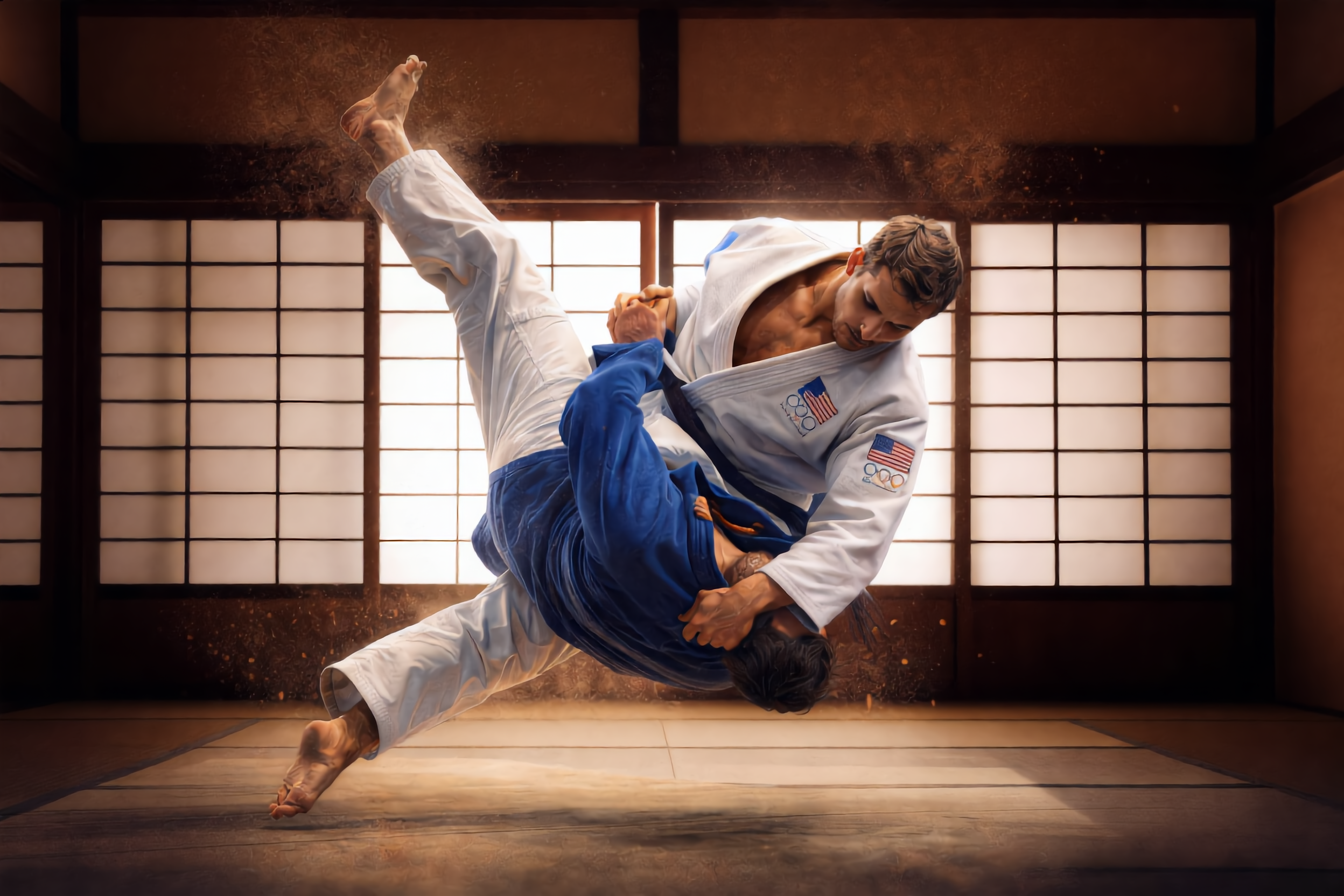
Olympic Judo
The Man Who Died on the Way Home
May 1938, aboard a Japanese liner in the North Pacific. An old man of seventy-seven is dying of pneumonia in his cabin, eleven days out of Vancouver, on the last leg of a journey that has taken him around the world. He has been in Cairo, at the meeting of the committee that runs the Olympic Games, and he has come away with the prize he went for: the Games of 1940 will be held in Tokyo. The first ever in Asia. He was the first Asian ever seated on that committee, nearly thirty years earlier, and he has spent those years arguing, in careful English, that the world's sport and his country's education belong in the same room.
He dies on the fourth of May. The ship docks in Yokohama with his body. The Tokyo Games are canceled within months by a war that will end with the country in ruins. And the art he founded in a temple corner fifty-six years earlier, the one he insisted to the end was not a sport, will be on the Olympic program twenty-six years after his death, in a hall built for it in the city he had tried to bring the Games to. He never saw a single Olympic match in the art that bears his name.
His name was Jigoro Kano, and you read his portrait in the letter on the wall of the room before last. This room is what the world did with him.
The Schoolteacher on the Committee
Understand first that the founder was never a fighter by trade. He was an educator, a principal, an official in the ministry that ran his country's schools, and he built his art as an education and said so at every opportunity. Its purpose, in his own words, was to perfect oneself and contribute to the world, and the throw was the method, not the point.
That is why he did the strange thing he did in 1905. The old jujutsu schools, the ones he had learned from as a young man and beaten at the police hall, were dying, and rather than let them die he gathered their heads under one roof and made an agreement: the schools would come under the Kodokan, and in return their old techniques would be preserved, in set forms, inside the new art. Overnight the scattered lineages of the samurai became one art with one name, the first time in the country's history that had happened, and it took fifty years for foreigners to stop calling it jujutsu. He was not conquering the old schools. He was archiving them, inside a system that could be taught.
And that is why he joined the committee. In 1909 the founder of the Olympic movement was looking for an Asian member, and the schoolteacher who ran the Kodokan was the obvious man. Kano took the seat and held it for the rest of his life, and he used it for two things: to bring his country into the world's sport, and to keep his own art out of it. He was suspicious of competition. He had watched what medals did to men and what rules did to arts, and he said plainly that judo was more than a sport and should not be reduced to one. He wanted it in schools, in armies, in police forces, in the character of the next generation, on every continent. He did not want it on a podium. He got everything he asked for, and the one thing he did not, and the two arrived together.
The Men He Sent Out
The founder spread his art by the oldest method there is. He sent men.
In 1904 one of his senior students taught the President of the United States, on a mat laid down in the White House, and the President wrote home to his sons about his swollen thumbs. Another was sent to Europe and then to the Americas on a tour to demonstrate the art, and ended his travels in the north of Brazil, where he taught a local family whose sons would build a different art on the ground the founder's sport was about to abandon. A third went to Paris in the 1930s and gave a nation of clerks a numbered system and a set of colored belts, and that nation became the largest judo country on earth outside Japan. And an orphan from a Russian island walked into the Kodokan as a boy, earned a black belt there, went home, and taught the Red Army, and what his students built after the secret police killed him is the last room on this range.
Mark the pattern, because it is the whole argument of the room after this one. The founder did not send a sport. He sent men, and each man carried the art into a country that already was something, a republic, an empire, a colony, a poor island, and the country did to the art what countries do. The founder called that education. It is also how one art became seven.
The Day the Sport Arrived
The war ended and the art nearly did. The occupying army banned the fighting arts in Japanese schools, the Kodokan taught in secret and then in public, and by 1951 there was an international federation, and by 1956 the first world championships, held in Tokyo, won by Japanese men in every division, which was what everyone expected and what the world had come to watch.
Then 1961, the world championships in Paris, and a Dutchman named Anton Geesink, six foot six and trained like a monk, took the title. The first man not born in Japan to win the art's highest prize. The Japanese did not lose to a foreigner. They lost to a foreigner who had out-Japanesed them, and the whole sport understood in one afternoon that the art had left its island for good.
Three years later the Games came to Tokyo, the ones the founder had won for 1940 and the war had taken, and his art was on the program for the first time, in a hall built for it. Four divisions. Japan won three. In the fourth, the open weight, the one with no limit, the division that asked the founder's own question about the smaller man and the larger one, Geesink pinned Japan's champion in front of fifteen thousand silent people, and then stopped his own countryman from running onto the mat to celebrate, and bowed to the man he had beaten. Japan lost the match. The founder's art had already won the winner, and the room a few doors down tells that afternoon in full.
The sport was dropped from the next Games and restored for the one after, in 1972, and it has never left. And from that year the rewriting began.
The Rules, Written and Rewritten
A rulebook is a decision about what an art is for, and this sport has made that decision a dozen times in sixty years. Read the ledger, because every line of it is a lesson about how a thing built for one purpose gets bent toward another.
Weight classes. The founder's question was whether the small man could beat the large one, and the Games answered it by fencing the two apart. Four divisions in 1964, six by 1972, seven from 1980, and the open division, the one that still asked the question, was dropped from the Games entirely after 2008. The sport is fairer. The question is quieter.
The women. The founder had trained women at the Kodokan from the 1920s, cautiously, and the sport did not let them compete at the Games until 1992, forty years after the federation was founded. The nations that took the women's game seriously first, a poor island among them, were rewarded for it, and the room that tells that story is in the hall ahead.
The blue jacket. In 1997 the sport put one of the two men in blue, so that a television audience could tell them apart. The traditionalists mourned. The founder's own school still competes in white only, and both are right, and that argument is a small picture of the whole century.
Golden score. For most of its history a match that ended level was decided by three officials raising flags for the man they thought had done more. In 2003 the sport replaced the flags with extra time, first man to score, and a decision that used to be an opinion became a fact on the mat.
The legs. In 2010, and completely by 2013, the sport banned attacking a man's legs with the hands. The wrestler's pickups, the low attacks the Russians had brought in from their own art, the bent-over gripping wars those attacks had produced, all gone in one rewrite. The game straightened up. The classical throws came back. The nations built on wrestling lost their best weapon overnight and had one cycle to adapt, and the ones that did are still on the podium. It was the single most consequential rule in the sport's history, and it was written for a reason the founder would have recognized: the art had stopped looking like itself.
The penalties. Every rewrite has a shadow, and this one is the sport's. Scoring got stricter, and men learned to win by making the other man break a rule, and there are Olympic finals decided by a third penalty for passivity without a single throw landing. The federation has rewritten the penalties four times since. The problem is still there. A rulebook can forbid a thing. It cannot make a man want to throw.
What the Rulebook Gave, and What It Took
Now the honest reading, because this Farm reads both columns.
The sport gave the art the world. A schoolteacher's method in one country is now practiced on every continent, in more nations than almost any other Olympic sport, by tens of millions, with a shared jacket and a shared bow and a shared standard of the whole throw or nothing. The sport made the art honest in a way the old secretive schools never were: every technique tested in public, against the best men alive, with the film available to anyone. And the sport carried the founder's education to places his letters never reached, because a boy in Ulaanbaatar or Havana or Marseille bows the same way and falls the same way and gets up the same way as a boy in the temple corner did, and none of them would have met the art without a podium at the end of it.
And the sport took things. It took the ground, shortened to a few seconds of work before the referee stands the men up, so that the room behind the throw is now taught in the art and rarely in the sport. It took the legs. It took the old forms, the set techniques the founder had archived from the dying schools, which are examined for rank and almost never seen. It took the strikes, which the founder kept in the curriculum and the sport never allowed. And it took something harder to name, the thing the founder feared: a generation of men who know the sport perfectly and the art not at all, who have never followed a throw to the floor, never thrown a man who was not wearing a jacket, and never been told that the referee is not coming.
Weigh the two columns and do not pretend one of them is empty. The founder wanted the education and not the podium, and history gave him both, and the man who trains today can take the sport's honesty and the art's completeness together, if he knows they are different. The next room on this range was built by men who took the art and threw away the sport. The rooms ahead in this hall were built by nations that took the sport and made it their own. Both roads run through this door.
The Branches
Before the nations, hear how the art divided, because it split along two different seams and men confuse them.
The first seam is separation. Two arts left the founder's house and became their own, one in Russia and one in Brazil, each carried out by a man the Kodokan had trained, each shaped by a country that had no interest in bowing to Tokyo, and each denying its parentage for decades because its own federation had a flag to fly. The techniques never stopped being judo's. The politics did. A man who reads the arts and ignores the federations sees one family with two sons who moved abroad and changed their names.
The second seam is competition. Inside the house, two versions of the sport grew up under the same roof. The Olympic game, governed by an international body that the founder's school influences but does not command. And an older cousin the founder himself permitted, a university game in Japan that allowed the men to pull the fight to the floor and stay there, and that kept the ground alive through the decades the Olympic rules were burying it. Both call themselves the true judo. Both are, and the argument between them is the argument between the sport and the art, held inside one building.
Sort the branches that way and the map is simple. Two sons who left. Two games that stayed. And under all four, one agreement made in 1905 by a schoolteacher who decided the old techniques were worth keeping, in whatever house they ended up living in.
Then the Nations
The founder sent men. The Games sent a rulebook. And every country that received both did the same thing with them, which is the only thing a country can do: it bent the art toward what it already was.
A nation with a wrestling seven centuries old put a jacket on its wrestlers. A nation with a state sports machine built the athlete first and bolted the throws on afterward. A nation with a school in every town made the art a civic institution and produced more judoka than the country that invented it. A nation that had learned the art from an occupier kept it and beat the occupier with it. A nation with a different art of its own played the founder's sport with that art's accent. And the nation that made it answered every one of them by refusing to change, and by re-sharpening the same blade. Same rules. Same jacket. Same bow. Seven answers.
The founder called it education, and he was right, and he would have been startled by the results. That is the hall ahead.
Where This Sits
This is the second of three rooms, and the only one with a committee in it. The first room gave you the jacket and the fall. This one gave you the road the art traveled from a temple corner to the world's podium, and what it gained and lost on the way. The last room is what seven nations did with the same rulebook, walked in an order that begins with the nation that wrote the art and ends with the nation that turned it into something else.