
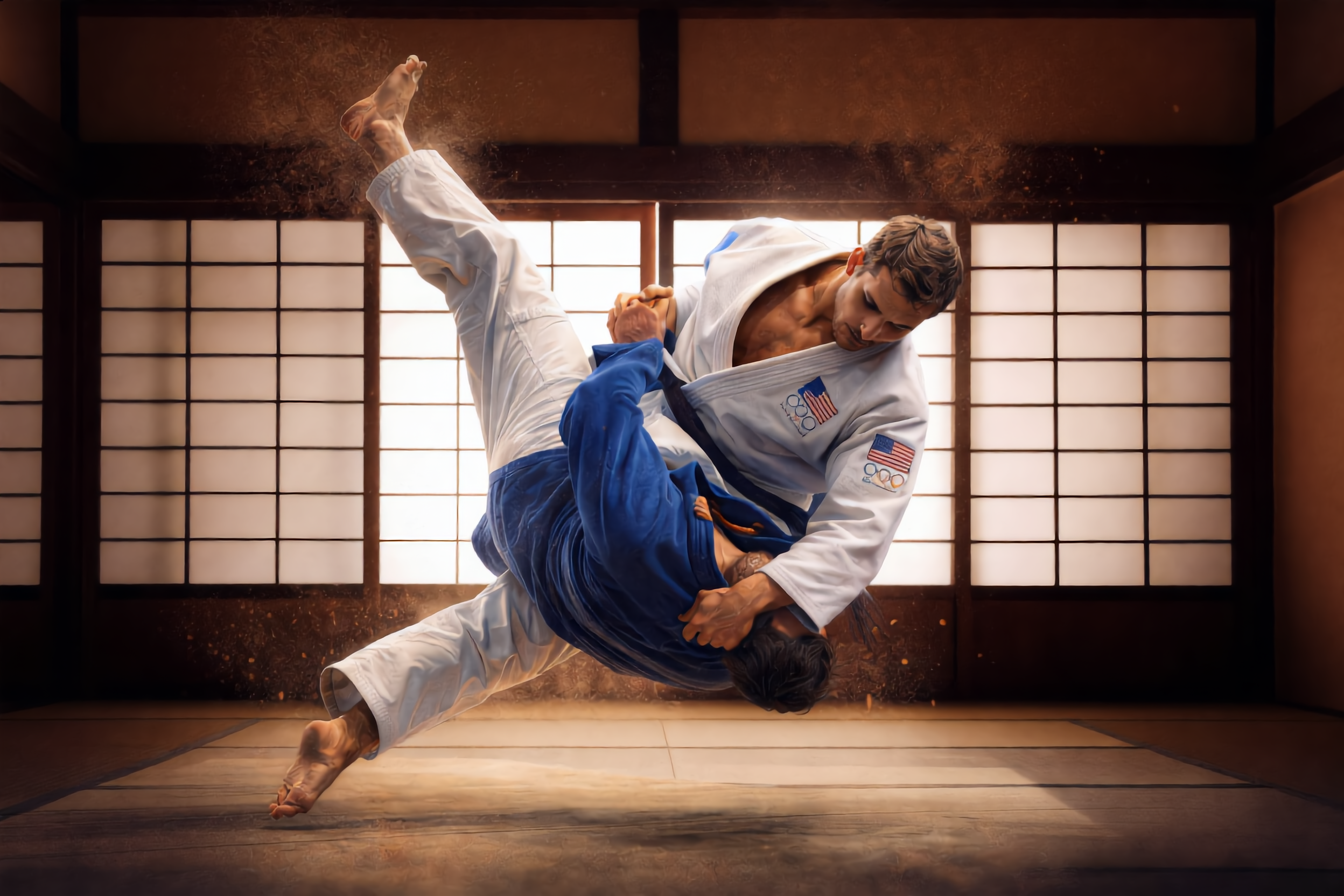
Judo Styles
French Judo
Korean Judo
American Judo
Russian Judo
The Grip Tells You the Country
The Warrior stands beside you at the rail above a world championship mat, and he tells you to watch the hands, not the throws.
"Three seconds," he says. "Before either of them has done anything, I can tell you where they grew up." The first pair step in. One takes a sleeve and a lapel, high, and stands up straight and waits, patient as a man at a bus stop. "Japan." The other bends at the waist and reaches over the top for the back of the jacket, hunting the belt, and the Japanese man breaks the grip before it closes. "Georgia. Or Russia. They learned that somewhere else." Next pair. One woman seizes the jacket with both hands like she means to keep it and drives forward before the other has settled. "Cuba." Later, a stocky man in a stance too low for the textbook, twisting out of a throw in mid-air and landing on his stomach when the whole hall thought he was beaten. "Mongolia. He is not going to fall. He was raised not to." A Frenchman fighting for the sleeve for a full minute like it is a chess opening. A Korean who drops under an arm for a throw so fast the camera misses the entry. An American who has plainly wrestled, gripping like a man who wishes he could grab a leg.
"Same rules," the Warrior says. "Same jacket. Same bow. Same founder. Seven countries, and they are not doing the same thing, and every one of them is right."
That is this room. The founder's art, one door back, went out into the world as a sport with one rulebook, and every nation that took it did the only thing a nation can do with a rulebook, which is to play it with the body, the history, and the wrestling it already had. The result is not seven arts. It is one art with seven accents, and a man who learns to hear them can read an opponent's whole country in his first grip, and, more usefully, can read his own.
Seven rooms are behind this page, in an order that is itself the lesson. It tells you why one art became seven, how a man reads styles wrong, what each room holds, and why the last of them stands on the seam between two arts.
Why One Art Became Seven
A rulebook does not build a fighter. A country does. The rules say what scores. They do not say how a man stands, what he grips first, what he does when a throw fails, or what he is willing to do to avoid landing on his back. Those come from wherever he was before he put the jacket on: the wrestling his grandfather did, the school system that found him at nine, the state that fed him or the club that took his dues, the climate, the food, the war. Put the same rulebook in seven countries and you get seven fighters, and the differences are not in the rulebook.
Every nation bent the art toward what it already was. The Japanese asked whether a throw was true to the principle. The French asked whether a child could learn it. The Koreans asked whether they could beat the men who taught them. The Cubans asked whether an athlete could be built strong enough to make technique optional. The Mongolians asked nothing, because they had been wrestling for seven centuries and the jacket was a detail. The Americans asked where the students went. The Russians asked nothing either, because they had already answered it with a different art. Same question on the mat. Seven questions off it.
The accent is a strength and a blind spot at once. The Cuban engine fades in a man's thirties. The Mongolian root had no ground game. The Japanese standard weeps over silver. The Russian pickups were banned in a single rewrite. Every style is a decision about what to be best at, and a decision about what to be best at is a decision about what to be worst at, and a nation, like a man, usually cannot see the second half of its own decision until another nation shows it.
And the art holds. Seven accents, and the founder's principle under all of them, because a man who is balanced cannot be thrown by a smaller one in any country on earth, and a man who is unbalanced falls the same way in Havana as in Tokyo. The nations changed everything they could change. What they could not change is the art, and it is worth knowing which is which before you decide what to copy.
How a Man Reads Styles Wrong
He copies the accent without the body. He watches the Cuban seize the jacket and tries it at a hundred and sixty pounds with an office worker's back, and a technician takes his shoulders. The style came out of a machine that built the athlete first. Without the machine, the accent is a costume.
He mistakes the accent for the art. He learns the Georgian back-grip and the low stance and believes he has learned judo, and then the rulebook changes and his whole game is illegal. The nations built on the art survived the rewrite. The men built on the accent did not.
He reads the medal table as a moral table. He sees a poor island out-medal rich nations and decides the system that did it must be good. The system was a state that owned the athlete and lied around the medals, and the room that tells that story says so. A method can be excellent while the government wielding it is not.
He thinks his club is the art. He has trained in one room, under one teacher, in one accent, for ten years, and he has never been gripped by a man raised in another, and he believes what he has is judo. It is a dialect. The first time a foreign grip closes on his collar he will find out how much of his game was local.
He treats his own country as a verdict. The American reads six rooms of nations that out-medal his and concludes there is nothing here for him. The honest room in this hall was built for exactly that man, and it tells him where the art actually lives in his country, and that the podium was never the point of the founder's school.
He picks a style by admiration instead of by fit. He loves the Japanese throw and has a wrestler's body, or loves the Cuban engine and is forty-five. The Warrior's rule on this whole range holds here: a man chooses by what God actually gave him, not by what he wishes he had been given, and the seven rooms are seven ways to find out which one that is.
Seven Rooms, Walked in Order
Japanese Judo — the principle. The nation that made the art and answered every foreign shock by becoming more itself. The afternoon Japan lost its own art at home, and what it did instead of converting. The man they called the god of judo, five feet two, unthrowable in his seventies. And the honest price of a standard so high that silver is a debt.
French Judo — the schoolhouse. A Japanese teacher and a physicist in Paris in 1936, a numbered method and a set of colored belts, and a nation that put a dojo in every town and eight words on every dojo wall. More judoka than the country that invented it. The biggest man the sport has ever seen, unbeaten for ten years, and the night it ended in front of his own city.
Korean Judo — the answer to the teacher. An art that arrived with an occupier, kept after the occupier left, and turned back on him at the Games. The classical style with an athlete's engine, the shoulder throw nobody else could stop, and a university built for nothing but this. And an honest ledger about what, besides the medal, is on the mat when a Korean refuses to lose.
Cuban Judo — the strong man's version. The weak man's art rebuilt around strength by a poor island with a state machine and no imports. The Russian who arrived before the Russians, the man in the chair who built a dynasty from patched jackets, and the truth about who owned the athletes. Power as a season, not a religion.
Mongolian Judo — the root. Seven centuries of wrestling in a jacket. The steppe boy who does not fall because his ancestors did not, the family that produced an Olympic silver and the greatest sumo champion in fifteen hundred years, and the first Olympic gold in the nation's history, told with the second visit that no honest room can leave out.
American Judo — the honest small room. The art that taught a President and was kept alive in internment camps, in a country that gave its boys to wrestling and its men to the ground game. The gym in Massachusetts that produced almost every medal the nation has, the champion who walked into it broken at sixteen, and the plain truth about where the art lives here and how a grown man finds it.
Russian Judo — the other art's accent. The men who arrived at the founder's sport already fluent in a different one, took four medals on their first day, and bent the whole world's game over at the waist for forty years until the rulebook stood it back up. Everything they brought came from the room after this one, and this room says so, and stops at the door.
The order is the argument. Japan first, because it is the source, and you cannot hear an accent until you have heard the language spoken by the people who wrote it. France second, because it was the first foreign nation to take the art seriously enough to build a school system around it, and it turned the founder's education into a civic institution. Korea third, because it received the art the hard way and gave the sharpest answer a student can give a teacher. Then the three rooms that bend the art with a body, a machine, and a root, Cuba and Mongolia in the middle where their honest ledgers can be read against the classical rooms on either side. America sixth, because it is where the reader is standing, and he should see six nations before he is told plainly what his own has and lacks. And Russia last, on purpose, because its judo is the seam: the art played with the accent of another art, and the other art is the next room on this range.
The Three Pillars Across Seven Mats
TRUTH — the mat is the same in every country, and it does not care about the flag. A throw that scores in Tokyo scores in Havana, and a rank that was not earned is a lie in every language. But hear the harder truth this hall teaches: every one of these rooms has an honest ledger, a state that lied, a champion who fell, a standard that crushed, and a man who reads the medals without reading the ledgers has been sold a poster. The Farm tells the whole of it, in every room, and expects you to do the same with your own.
LOVE — the founder put mutual welfare on the wall of his school, and seven nations that agree on almost nothing else bow to each other before and after, and lend each other their bodies to be thrown, and the beaten man walks off the mat with his dignity because the winner made sure of it. That is not sportsmanship. It is the art's own law, kept across borders that armies have crossed. And it is what the strength is for: the base that keeps a man's family on its feet does not care which accent it was built in.
LAW — every nation in this hall plays under a rulebook it did not write, and the ones that flourished were the ones that adapted to a rule they hated instead of arguing with it. The Russians lost their best weapon in one rewrite and rebuilt inside a cycle. The Mongolians patched a hole seven centuries old. A man's life is a rulebook he did not write either, and this hall is seven lessons in what to do when the rule changes and the throw you built your name on is no longer allowed.
"All of you, clothe yourselves with humility toward one another, because, 'God opposes the proud but shows favor to the humble.'" — 1 Peter 5:5
The only art on this range where a man is told what to wear, and the apostle tells him what to put on under it. Seven nations put on the same jacket, and the jacket is a handle, and every one of them learned that the man who will not be thrown is the easiest man on the mat to throw. The apostle was not describing a training method. He was naming the only posture from which a man is ever lifted, and it is a posture nobody holds by himself.
Walked as a System
The seven rooms are one art heard in seven voices, and the order is a lesson in listening. Japan teaches you the language. France teaches you it can be taught to anyone. Korea teaches you the student can pass the teacher without dishonoring him. Cuba teaches you what a body can add and what it cannot keep. Mongolia teaches you what a root can add and what it cannot see. America teaches you where you are actually standing. And Russia teaches you that an accent can be strong enough to become a language of its own, and sends you to hear it.
Walk them in order and something happens that the founder would have recognized as education. You stop asking which style is best. You start asking what each nation had before the jacket arrived, and what it did with the constraint, and whether it read its own ledger honestly. And then you turn the same three questions on yourself: what you had before you walked onto this mat, what you are doing with the rules you did not write, and whether you can read your own blind spot before another man shows it to you. Seven countries answered. The eighth answer is yours.
After the Nations
One thing before you go find the Japanese room, because the last door in this hall opens onto a different building.
Six of the seven nations took the founder's sport and bent it. The seventh did something else. Its men arrived already fluent in an art of their own, built by two wounded soldiers in a hard country from the founder's throws and every wrestling style an empire could gather, and they played the founder's sport with that art's accent for sixty years. Their judo is real judo, on the podium, under the rules. But the accent came from somewhere, and the somewhere has its own name, its own jacket, its own rules, and a ground game the Olympic sport agreed not to have. The Russian room is the inventory of what those men carried in. It is not the story of where it was made. That is the last room on this range, and it has been waiting since the wrestling room for you to arrive.