
Old Testament
Exodus
Leviticus
Old Testament
The thirty-nine books that comprise the first portion of the Christian canon and the entirety of the Hebrew scriptures (in a different ordering). Roughly fifteen centuries of writing, multiple genres, and a unified redemptive trajectory pointing forward to the messiah the New Testament identifies as Jesus of Nazareth.
The man who has read the New Testament without engaging the Old Testament is reading a sequel without the setup. The references, the imagery, the categories, the prophetic substance the New Testament authors are working with all assume Old Testament literacy in the reader.
Old Testament Setting
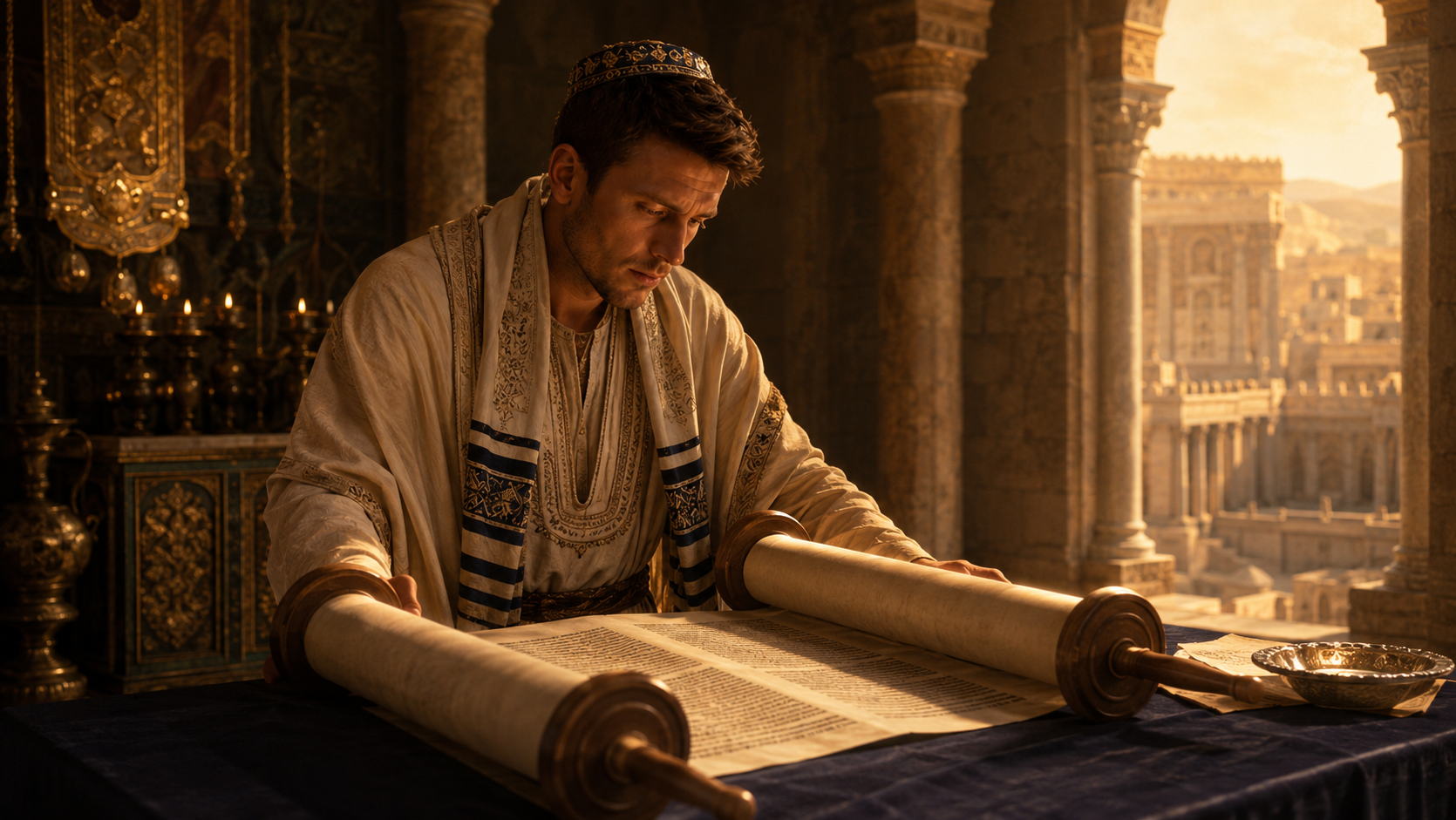
The arrangement of the Old Testament in Christian Bibles is not the original. The Christian ordering is a prophetic re-arrangement of Israel's history that emphasizes the trajectory toward Christ. The Hebrew Bible — what Jews read — is arranged differently. Jews such as Jesus read from scrolls collectively known as the Tanakh, and the order matters for understanding how the original audience encountered the text.
Both arrangements contain the same thirty-nine books. The difference is sequence and grouping.
TANAK | The Hebrew Arrangement
Tanakh (often written TaNaK) is an acronym for the three Hebrew sections that comprise the Old Testament. The thirty-nine books of the Christian arrangement are grouped into three (sometimes counted as four) sections in the Hebrew arrangement.
1. Torah — The Law of Moses
Known by Christian scholars as the Pentateuch. The first five books of the Hebrew Bible. The history of God's people from creation to the fall, through the patriarchs, the Exodus from Egypt, the giving of the law at Sinai, and the wilderness wandering up to the threshold of the promised land.
Genesis
Exodus
Leviticus
Numbers
Deuteronomy
2. Nevi'im — The Prophets
The job of the prophets was to be like Moses — to accuse old Israel of its failure and corruption, to warn of the day of the Lord that would end in defeat and exile in Babylon, and to promise purification through a new covenant. The Nevi'im in the Hebrew arrangement includes both what Christian Bibles call the Historical Books (Joshua, Judges, Samuel, Kings) and what they call the Prophetic Books (Isaiah, Jeremiah, Ezekiel, and the Twelve Minor Prophets).
The Hebrew categorization of the Historical Books as Former Prophets is theologically deliberate — these books are not neutral national history but are themselves prophetic indictment of Israel's recurring covenant failure across the centuries.
3. Ketuvim — The Writings
Completed around the second to third century BC. Includes Psalms, Proverbs, Job, the five Megillot (Ruth, Song of Songs, Ecclesiastes, Lamentations, Esther), Daniel, and Ezra-Nehemiah-Chronicles.
Psalms. Teaches Israel how to pray. Contains the Righteous One imagery. Promises the coming King.
Proverbs and Wisdom Literature. Including Job, Ecclesiastes, the Song of Songs. Speaks of the failure of Israel and the way of wisdom under God.
Chronicles. A retelling of the kingdom history with a different theological emphasis. The book closes with the decree of Cyrus permitting return from exile — making it the literal last word of the Hebrew Bible and pointing toward the ultimate return from exile that Christians read as fulfilled in Christ.
The Christian Arrangement
The Christian Bible groups the same thirty-nine books into four sections.
Pentateuch — Genesis through Deuteronomy. Same as the Torah.
Historical Books — Joshua, Judges, Ruth, 1 & 2 Samuel, 1 & 2 Kings, 1 & 2 Chronicles, Ezra, Nehemiah, Esther. The narrative of Israel from the entry into Canaan through the exile and return.
Wisdom and Poetry — Job, Psalms, Proverbs, Ecclesiastes, Song of Songs. The poetic and reflective heart of the Old Testament.
Prophetic Books — divided into Major Prophets (Isaiah, Jeremiah, Lamentations, Ezekiel, Daniel) and Minor Prophets (Hosea, Joel, Amos, Obadiah, Jonah, Micah, Nahum, Habakkuk, Zephaniah, Haggai, Zechariah, Malachi). The men sent to confront Israel and Judah across the divided-kingdom and exilic centuries.
The Christian arrangement places the prophets last so that the Old Testament closes pointing forward — Malachi's promise of the coming messenger feeding directly into the New Testament's Gospel of Matthew. The Hebrew arrangement closes with Chronicles' decree to return — also forward-pointing, but with a different emphasis.
The Trajectory
The unified arc of the Old Testament — moving across both arrangements — runs from creation, through the fall, through the calling of Abraham, through the formation of Israel as the covenant nation, through the rise and fall of the monarchy, through the exile, and toward the promised return culminating in the messiah.
The man reading the Old Testament profits from holding the trajectory in mind. Each book is a chapter in the unfolding redemptive history. Genesis establishes the categories; Exodus delivers the people; Leviticus organizes the worship; Numbers documents the wilderness formation; Deuteronomy renews the covenant at the threshold; Joshua enters the land; Judges shows the cycle of decline; Samuel-Kings traces the monarchy; the prophets confront the failure; the exile humbles the nation; the post-exilic books prepare the ground.
The closing question of the Old Testament — implicit in the prophetic disappointment that the second-temple restoration did not produce the fullness the prophets had promised — is when will the messiah finally come. The New Testament opens by answering it.
Where to Engage Within This Cluster
This folder contains four sub-pages developing particular faces of the Old Testament.
Genesis — Structural treatment of the foundational book — the toledot framework, the eleven-section architecture (Prologue + 10 family histories), the alternation pattern between compressed non-elect lines and expanded elect lines, the narrowing focus from cosmos to covenant, and the Christological trajectory the structure traces. Source attribution: Wade Orsini (Apologia Utah).
Prophets — Overview of the prophetic office, the Major and Minor Prophets, and how the prophetic literature should be read.
Psalms — The Hebrew prayer book, the literature of Israel's interior life, and the foundational source of much New Testament christology and Christian devotional life.
The 12 Tribes of Israel — The tribal architecture of Israel, their geographical territories, and their theological and prophetic significance.
The man reading through the Old Testament systematically should consult these pages alongside his actual reading of the books. The architecture below this folder — the future build-out of individual book overviews — will accumulate over time as Roger and SMEs add to the substrate.