
Pankration
Coaches & Gyms
Apparel & Equipment
Training Programs
"What a fine funeral, if you do not surrender at Olympia." — Arrichion's trainer, as Philostratus recorded it, shouted from the edge of the sand
The Dead Man's Crown
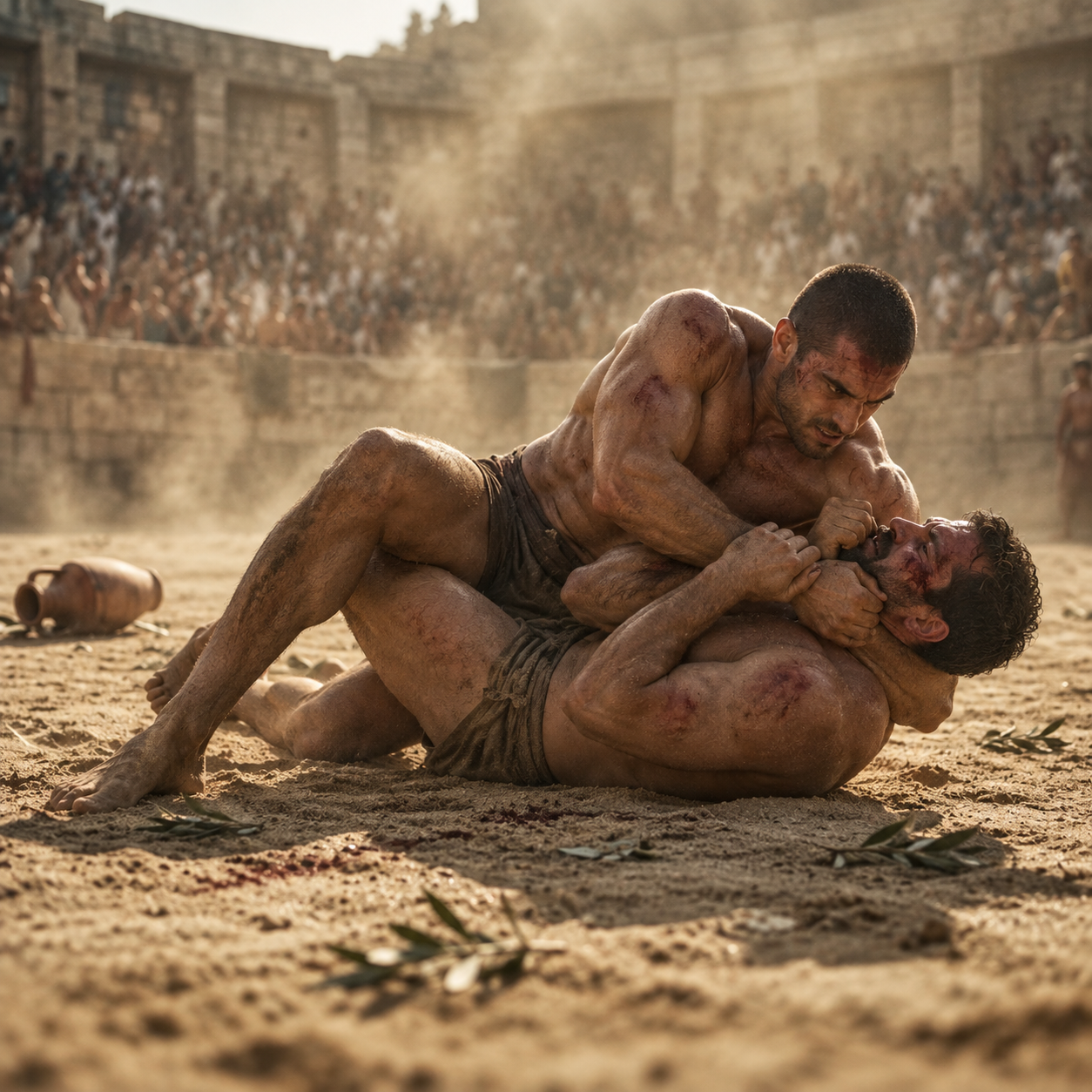
Olympia, 564 BC. The final of the pankration, the event the Greeks called the all-powers, in which two naked men fight with everything but their teeth and their thumbs in the eyes until one of them raises a finger. The defending champion, a man named Arrichion from a small city in the Peloponnese, is caught. His opponent has his back, legs locked around the body, forearm across the throat, and the crowd can see the champion's face going dark. His trainer, at the edge of the sand, shouts the sentence at the top of this page.
Arrichion does not surrender. He gets a hand on the foot that is hooked around him and wrenches the ankle, and the man on his back, in agony, raises a finger. The judges award the victory to Arrichion. He is already dead. They put the crown on the corpse, his city raised a statue that stood in its marketplace for centuries, and the story was told at Olympia for as long as there was an Olympia.
The Warrior tells it at the top of the bloodline beneath the tent, and he tells the honest thing about it in the same breath. "Nobody alive knows what Arrichion knew. Nobody can trace a teacher back to that sand. The art died, and everything that calls itself pankration today was built by men who read about it. But look at what he was caught in. A body triangle and a choke from the back. Look at what he won with. A foot lock. That's the tent, two thousand five hundred years early, and it's the basement in New York, and it's the beach in Rio you're about to walk onto. The shape is the whole inheritance."
This room is history and information, with no Three Pillars block, because the reader carries the pillars in from the tent above. It is the oldest submission fighting the West has a record of: what the art was and how it was contested, the men it made, how it died, the long gap between the sand and the sawdust and what crossed it, what the revivals are and are not, what a man should carry out of a dead art, and why the next room down the bloodline is a beach in Brazil.
The All-Powers
Pankration entered the Olympic program in 648 BC, the thirty-third Olympiad, and it was the last of the three combat events to arrive, after wrestling and boxing. It was the answer to a question the two older events left open. Wrestling ended at the throw and did not strike. Boxing struck and did not grapple. The all-powers did both, and the Greeks considered it the most demanding thing a man could enter.
The rules fit on a hand. No biting. No gouging of the eyes. At Sparta, where the event was trained for war and not for the games, those two were allowed as well. Everything else was legal: punches, kicks to any part of the body, knees, elbows, throws, chokes, every joint lock a body has, and the fight went on without rounds or a clock, in the sun, until one man raised a finger or could not. The two ways of fighting it had names. Standing, the ano pankration, in which the strikes and throws decided things. And on the ground, the kato pankration, in which they went down and the fight became what the whole floor above this room is about: position, the choke, the lock, and the man who could not breathe raising his hand.
The men who did it best were, by every account, grapplers. The strikes opened the fight and the ground closed it, and the champions the Greeks remembered by name were remembered for the choke and the lock, not the punch. Hold that, because the next two rooms are about men who came to the same conclusion in Rio and Tokyo without ever having read a Greek.
The Men It Made
The Greeks kept records the way a fight promotion keeps them, and a few of the names have survived.
Arrichion of Phigalia, above, three-time champion and the only man crowned dead. Polydamas of Skotoussa, who won in 408 BC and whose statue base at Olympia carries the legends the crowd told about him: that he killed a lion with his hands on the slopes of Olympus in imitation of Heracles, that he held a chariot still by the wheel, that at the Persian court he fought three of the king's bodyguards at once and killed them. He died, the story goes, holding up the roof of a collapsing cave so that his friends could get out. Sostratos of Sikyon, called the Fingertips, who won three times in the fourth century BC by catching a man's fingers and bending them back until he quit, and who was said never to have been thrown. And Dioxippos of Athens, who won at Olympia by default because no one would face him, and who, in the camp of Alexander the Great, fought one of the king's Macedonian soldiers in full armor while he himself carried only a club, and disarmed him and stood on his neck, and was so hated for it by the Macedonians that they framed him for theft and he killed himself. Alexander's soldiers trained the all-powers as part of their drill, and the art marched to India with them.
Read the names the way the Farm reads every champion: the crown and the cost. Arrichion died winning. Dioxippos won and was destroyed for it. The all-powers did not produce gentle men and did not claim to, and the men it produced were honored in stone and, several of them, buried young. The room two doors down the bloodline holds a man in a mask who could not stop either, and a reader who has met Arrichion first will know what he is looking at.
How It Died
The art lived for a thousand years and died in a generation, and the reason it died is worth a grappler's attention.
The Romans adopted it, coarsened it, and put it in arenas beside things that were not sport. Then, in 393 AD, the Christian emperor Theodosius closed the pagan games, Olympia among them, and with the games went the event, because the all-powers had never lived anywhere but in the games. There was no tent for it to hide in. No shed in a mining town. No family in Rio keeping it in a garage. The art had been a thing done at festivals for the gods, and when the festivals ended it had no other home, and within a few generations there was no one alive who had trained it. What came down to the modern world was a set of vase paintings, a handful of statue bases, some lines in the poets, and the shape.
That is the difference between an art and a sport, and it is the first thing this room hands you. A sport lives on its calendar. An art lives in the hands of a man who teaches it to another man in a room, and when the sport is banned the room goes on. Pankration was a sport, and it is gone.
From the Sand to the Sawdust
Now the honest account of the fifteen hundred years between the last Olympiad and the first carnival tent, because the tent above this room is called the root of the jacketless line and a reader is entitled to ask how a root grew out of a dead art.
It did not, in any way a historian could trace. What never died was wrestling itself. Men wrestled in every village in Europe through the whole of the Middle Ages, for prizes at fairs and for standing in the parish, and England alone kept half a dozen styles with their own rules: the Cornish and the Devon men in their jackets, the Cumberland men in their back-holds, and in the mill towns of Lancashire a rougher game that allowed a man to go to the ground and keep fighting there and to make the other man quit. Nobody in Lancashire had read Philostratus. They had arrived at the all-powers' ground game by the same road the Greeks took, which is to say by asking what happens when two men who will not stop fighting end up on the floor, and finding that the answer is always the same: position, and then a hold that ends it.
So the bloodline beneath the tent begins with a break in it, on purpose. The Greek room comes first because the shape comes first, and because a man who has seen Arrichion die in a body triangle and win with a foot lock will recognize the tent, the shed, the beach, and the basement as the same thing found again. But he should never say that catch wrestling descends from pankration, because it does not, and the men who say so are selling him antiquity's name the way the wrestling hall told you a Frenchman sold it in the 1800s. The tent found the shape on its own. So did Rio. So did Tokyo. That is the argument for the shape being true.
The Revivals, Said Honestly
Modern pankration exists, and a man will find it advertised, and this room says plainly what it is.
In the late 1960s a Greek-American martial artist in the northeastern United States set out to rebuild the all-powers from the sources and from what he knew of boxing, wrestling, and judo, and the system he built is the root of most of what carries the name in America today. In Greece there is a federation, and the world wrestling body recognizes a sport it calls modern pankration, contested in shorts and gloves under a rulebook that would be familiar to anyone who has watched an amateur cage fight. It is a real sport, with real athletes, and the Farm's Fight Sports hall holds a room on its ancient exercises and the training the Greeks used to build the men who did it, at Pankration.
What none of it is, is a lineage. No modern pankration teacher had a teacher who had a teacher back to the sand at Olympia. The chain was cut in the fourth century and nothing reconnects it. A man who trains modern pankration is training a reconstruction, built honestly by modern men out of modern arts and old sources, and there is nothing wrong with that as long as he says so. The catch wrestler in the tent above can name his teacher's teacher back to a shed in 1948 and a carnival in 1905. The luta livre man in the room below can name his back to a stocky grappler in Rio in the 1930s. The pankratiast can name a book. Know which of the three you are being sold.
Where the Art Is Kept
For a man who wants to stand where it was, rather than train what it is not.
Olympia itself, in the western Peloponnese, where the stadium is a grass field between two banks and the starting lines are still in the ground, and a man can walk the tunnel the athletes walked and stand where the sand was. The museum beside it, for the statue bases with the champions' legends cut into them. The National Archaeological Museum in Athens and the British Museum in London, for the vases that are the only film of the all-powers that exists, painted by men who had watched it. And the modern federation's events in Greece, for a man who wants to see the reconstruction contested, with the honest word in his pocket about what he is watching.
Take It Back Into the Tent
Three things leave this room with you, and every one of them is used in the two rooms below.
A sport dies with its calendar. An art lives in a room. The all-powers had a thousand years, a hundred champions in stone, and the whole Greek world for a crowd, and it vanished in a generation because it had no room to go to when the festival closed. The tent above you survived seventy years inside a fake sport because a shed in Lancashire stayed open on weeknights. The Brazilian art below you survived sixty years of being the poor side of town because men trained on concrete when there was no mat. Whatever you carry that is worth keeping, keep it in a room with another man in it, not on a calendar.
Say what you can trace, and say what you cannot. This room's whole honesty is a line drawn between the shape, which every fighting people finds again, and the lineage, which either exists or does not. The man who claims a lineage he cannot show is the man the first door in the jacket hall taught you to look up on the drive home. Hold your own claims to the same line. The next room's founder could name his teachers, and so could his students, and that is why the art below survived a war and this one did not survive an emperor.
The crown on the corpse. Arrichion won and died in the same second, and the Greeks thought it the finest thing a man could do. The tent's people learned better, at a cost, and the man in the mask at the bottom of this bloodline is what the lesson looks like when it is not learned. A hold that ends a fight is worth more than a position held for points, this whole floor says so, and a man who cannot end his own fight while he can still walk out of it has confused the crown with the man wearing it.
Where This Sits
First of three beneath the tent, and the one with no living teacher in it. The bloodline starts here because the shape starts here, and it starts with a crown on a dead man, which is the kind of story this floor keeps telling.
Now walk from the sand to the beach, because the seam between this room and the next is one rule with three names. The Greeks called their event the all-powers, everything but the teeth and the eyes. The men in the tent called theirs catch-as-catch-can, anything you can get hold of. And the Brazilians, when they built their own art on the wrong side of Rio out of what the tent had brought them, called it luta livre, the free fight, and called the fights they proved it in vale tudo, anything goes. Three languages, twenty-five centuries, and the same handful of words on the rulebook. The Greek room is where the shape was first written down. The next room is where it was first born poor, into a city whose rich side was building a jacket art across town, and where it went to war with its own brother for sixty years and lost the most famous fight of its life on a public beach and became something anyway.