
Strength & Conditioning
The Gymnasium
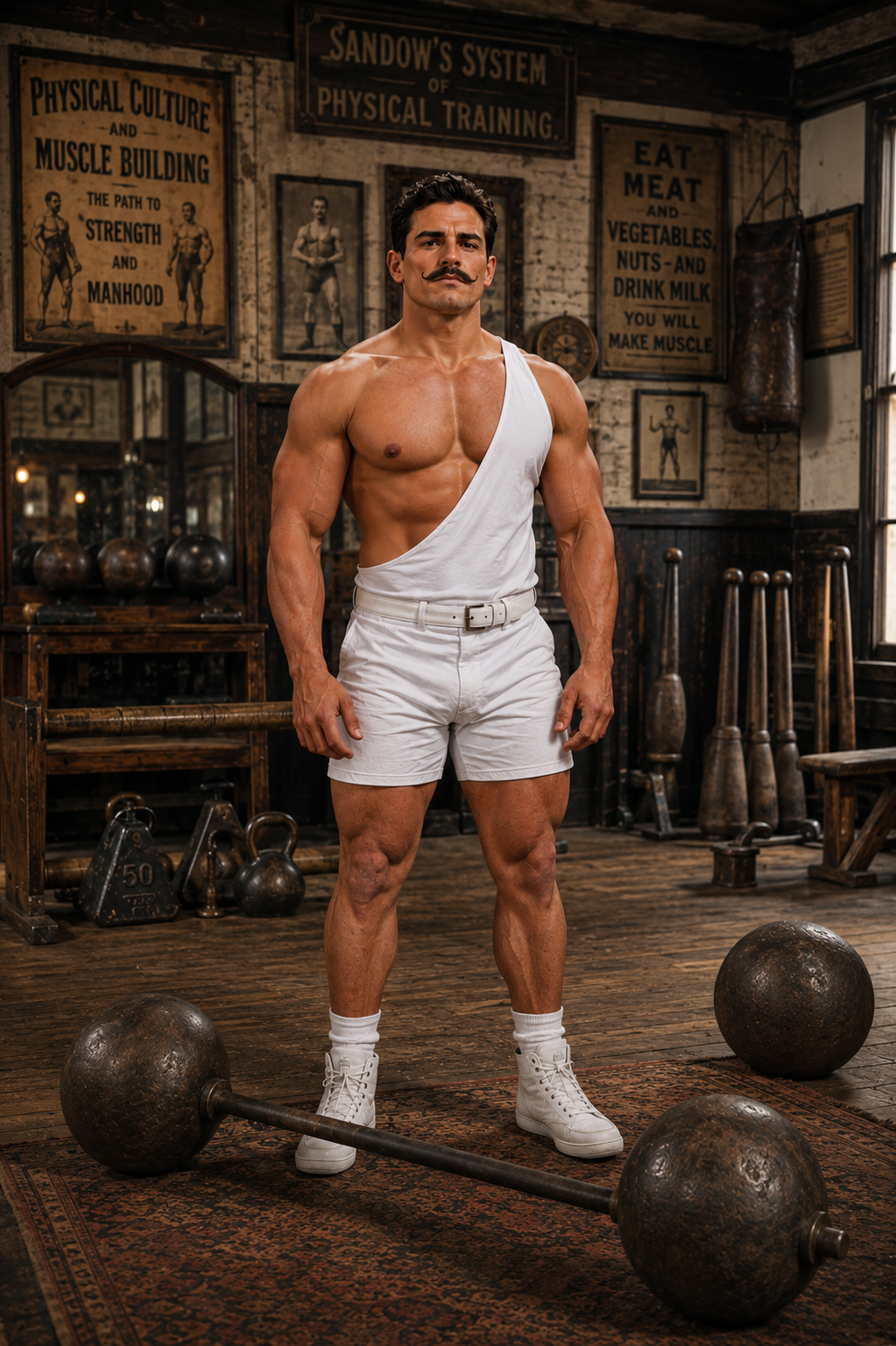
You hear it before you reach the door. Iron on iron. The flat clap of a loaded bar dropped from lockout. A rope slapping concrete in a rhythm somebody has been holding for four minutes without missing. Breath — a great deal of it, none of it comfortable.
Then you get inside, and the first thing that surprises you is how little of it involves weight.
A man on the far turf is running backward, of all things, then sideways, then forward again, and he has been at it long enough that his shirt has changed color. A boy hanging off a bar who cannot do a single pull-up yet is doing the slow lowering half anyway, one at a time, because that is the half he can do. Somebody stands against a wall in a chair position with no chair, saying nothing, going nowhere, legs shaking. Another man touches a box, lands soft, resets, touches it again — twelve times total, and then sits down and does nothing for three full minutes on purpose. Only in the back, past all of it, is anyone under a bar.
That is the arrangement. Six rooms under one roof, and the loudest one is last on purpose.
What Gets Built in Here
Every man arrives at this door with a picture in his head of what he is here for, and for most men the picture is of himself being looked at. That is not a character flaw — it is what he has been shown for twenty years by everyone selling him something. But it makes a poor blueprint, because a body built to be seen and a body built to work are only accidentally the same body, and the day comes when only one of them is any use.
This room builds the second kind. Force you can produce on demand, an engine that keeps running after the interesting part of the day is over, a frame that holds under a load it did not choose. Some of it will show. Much of it will not. A man can be genuinely dangerous to underestimate and look, in a shirt, entirely ordinary.
Build it that way because the day does not take requests, and it never arrives with a warm-up, a spotter, or a second attempt. Whatever a man walked in with is what he has. So the question here is not how do I look. It is how much can I do, for how long, starting from cold. Everything downstream of that question is training. Everything downstream of the other one is grooming.
Nobody Coaches From the Doorway
There is no photograph on the wall by this door and no name over it, for the reason the gate to this whole property has neither. But there is a second reason down here, a practical one, and Scripture got to it three thousand years before the first gym opened.
A boy is about to go fight a man twice his size, and the king — who means well — puts his own armor on him. Royal armor, the best equipment in the kingdom. The boy takes two steps and hands it back:
"I cannot go in these," he said to Saul, "because I am not used to them." So he took them off. — 1 Samuel 17:39
He was not being humble. He was being accurate. Armor a man has never trained in is not protection — it is weight in unfamiliar places, and it will get him killed faster than going without. He went out with the one tool he had put ten thousand honest hours into, because the only equipment that helps you is the equipment you have built the body to carry.
That is the argument against the face on the wall. Handed another man's program, another man's numbers, another man's frame and history and chemistry, you are wearing Saul's armor. It fit him. It does not fit you, and the moment it matters you find that out.
So this room is not dedicated to anybody. That does not mean nobody knows anything. For most of recorded time athletes trained their sport and left heavy lifting to circus strongmen, on the sincere theory that it made a man slow and bound up. Then a physical-culture era put barbells in basements and garages. Then, in the late 1960s, an injured college pole vaulter rehabilitating his own back got strong enough that the football team started asking him for help — and inside a decade the job he was inventing had a name, a certifying body, and a literature under it.
Kinds of men, and eras: the showman, the physical culturist, the first coach who wrote it down, the scientist who checked whether it was true. You will meet the good ones — inside the rooms they hold, next to the thing they actually know. Nobody coaches from the doorway.
Six Rooms, and the Order Is the Argument
Six doors, walked in sequence, and the sequence is not a filing decision. It is how you would build a boy if you had him from the beginning — and it is how you rebuild a forty-year-old who has let it all go, because a body that fell apart gets reassembled in the order it was assembled the first time.
Run. Move your own body. Learn to go fast. Learn to be still. Straighten the frame. Then, and only then, pick something up.
Endurance Training— the engine, and the first thing any body ever does. First because it asks for nothing. No equipment, no technique to get wrong, no minimum strength to qualify. A boy runs before he can do anything else with his body, and a broken-down man can walk on day one when he can do nothing else at all. It is also the account every other room spends out of: force that is gone in ninety seconds is barely force, and a man who cannot breathe cannot lift, jump, or hold. Five modalities hang off this room, arranged from the one that asks nothing to the one that uses all of you — running, hiking, biking, swimming, rowing. They are alternates rather than steps: pick the one your joints, your geography and your life can sustain, and run the principles inside it.
Calisthenics— your own body as the load. Second, because after moving himself across ground the next thing a body learns is moving itself against gravity. Push, pull, squat, hang, brace — still nothing to buy. What it adds is control of your own mass, the one kind of strength that scales with you no matter what you weigh or where you are standing. It is also the most honest room in the building: a man can hide behind a machine's rails and a well-chosen weight, but he cannot hide from a pull-up. He does it or he does not. Three rooms open off it — the basics done well, the same bar with momentum in it, and the named holds that take years.
Plyometrics— the fast end. Third, because jumping is what a boy does the moment he can run and climb, and because you can only go fast in a body that already controls itself slowly. Entered at the bottom — skips, jump rope, ankle bounces, low hops on grass — this is where the nervous system learns to fire everything at once instead of building to it over a second and a half. Do not mistake the entry for the ceiling: the shock work at the top of this room will hurt a man who has not walked the two before it. Three rooms off it explain the machinery before he trains it, because this is the one place where not understanding it is how men get hurt.
Isometrics— the still end. Fourth, directly after plyometrics on purpose, because the two are opposite poles of one measurement. Room three asked how fast you can produce force. Room four asks whether you can produce it and not move at all — the wall sit, the dead hang, the plank held past the point it stopped being interesting, the pause buried at the bottom of a lift. This is where tendon and joint get built: the quiet part nobody films, and the part that decides whether a man is still training at sixty. Three rooms off it divide the work by what the force is doing — driving into something immovable, pulling against it, or refusing to be moved at all. Taught back to back with the fast room so he feels the range between them in his own body instead of reading about it.
Posture & Core Strength — the frame, and the last door before the weight. Fifth, and the position is the whole argument. Everything in the first four rooms loads the body with the body. Room six is the first time a man picks up something from outside himself — and a chain breaks at its weakest link, so the link gets built before that line is crossed, not after the damage report arrives at forty-five. The spine, the deep core, the breath that stiffens the trunk under load, the carriage a man holds for the eighteen hours a day he is not training. Unglamorous, and the difference between a body that lasts and one that quits early.
Resistance Training— the load. Sixth, and worth the wait. Squat, hinge, press, pull, carry — weight put on a body so the body has to become something that can carry it. Nothing else in the building touches it for raw strength, and nothing pays out like it across a lifetime: muscle and bone answer to load, and the man who keeps loading them keeps them. Three deeper rooms open off this one, walked lightest to heaviest and then back onto the body: the constant tension of Elastic & Tension Bands, the iron tradition of Weightlifting and its three schools, and the loaded carries of Weighted Resistance Training — where the plates come off the floor and go onto the man. Those are doors off room six. When you are finished with them the last stop is the shelf, and then you go outside.
And one door that is not on the walk at all:
Fitness Library— the shelf, and the last room in the building. Open the whole time, walked at the end. Six rooms is six sets of demands and a week has seven days in it, so somewhere the whole thing has to be arranged — which days, in what order, how hard, and how a man knows it is working. That is its own discipline and none of the rooms above covers it. Here, Exercise Database catalogs the movements, Training Regiments holds the proven programs — including The Olympian Workout, the oldest complete one that survives, a Greek four-day cycle that trains all six rooms above and has been looping for two and a half thousand years — and Training Methods explains how movements assemble into something that progresses. A man comes here the way a craftsman walks his tool wall: knowing what he is building, and looking for the right piece.
The Laws That Travel Between Rooms
The six rooms teach six different things, but a handful of rules do not change when you walk through a door. Learn them here and you will not have to relearn them five more times.
Build the base before the specialty, and keep the movement useful. The broad foundation first — the squat, the hinge, the press, the pull, the carry, the honest mile — and the specialization after, if it ever comes at all. Exercises that resemble something a body has to do outside the building outrank exercises that only make sense inside it. A man who cannot get off the floor unassisted does not need a better arm routine.
Ask for a little more than last time, and keep asking. The engine underneath every room, and it has one name: progressive overload. A little more weight, one more rep, one more minute, a harder leverage, a shorter rest. The body changes only when it is asked for something it is not already comfortable with, and it stops the moment you stop asking. This is why the man who has run the same three miles at the same pace for four years is not training. He is commuting.
Train both ends. Strong and gassed is half a man; fit and fragile is the other half. The rooms are not competing for the week.
Form and full range are not the preamble — they are the work. A controlled rep through the joint's honest range is a different exercise from the shortened bounced version with more weight on it, and only one of them builds anything you can use. Keep the joints able to reach the positions at all; mobility is not a stretching hobby bolted onto training, it is what lets training happen. And a man who cannot hold form when he is tired has been doing lower-quality work than he thinks, for longer than he thinks.
Then go home, because that is where it happens. The session is not the construction work — it is the order form, a demand slip handed to a body that has to fill it using food you have not eaten yet and sleep you have not taken yet. Skip either and the order sits unfilled, and all the session bought you was the damage.
Write it down, show up, and listen. Keep a log, because memory flatters and a page does not. The ordinary days are the program; the heroic ones are rounding error. And learn the difference between the discomfort that means work and the signal that means stop — a man who cannot tell them apart will either quit at the first honest set or train through a warning until it has a name.
How Men Break Themselves in Here
The failures in this building are not exotic. There are five of them, they are everywhere, and not one of them is a man who was slacking.
He falls in love with one room — almost always the loud one at the back. Four years later he owns a body that can move an enormous amount of weight three feet and cannot jog to the end of the street. The opposite man exists too: a beautiful engine in a frame that hurts itself carrying a couch. Both trained hard. Both left four doors shut.
He skips ahead to the load. He walks in at thirty-eight, remembers what he could do at nineteen, and starts at room six on day one. His muscles can take it; muscle adapts in weeks. His tendons and his spine adapt in months and years, and they are the ones that send the bill.
He borrows a program built for a different man. The routine of somebody twenty years younger, thirty pounds heavier, ten years further in, and sometimes chemically assisted. He runs it faithfully and it eats him. Saul's armor. The program was not lying — it was just never issued to him.
He confuses activity with progress. Four days a week, sweating, tired afterward, and nothing has changed in two years because nothing was ever asked to. Motion is not training and effort is not overload. A man can be exhausted and stationary at the same time, and most men in most gyms are.
He makes it the point of his life instead of a tool in it. The hardest one to see, because from outside it looks like dedication. The training grows until it is eating the marriage, the sleep, the money, the Sunday, and the patience of everyone in the house — and he defends it, because he is the only one in his family getting stronger and he has confused that with being good. This room exists to produce a man who is more use to the people around him. If it is producing a man they have to work around, no added weight fixes it.
The Three Pillars at the Weak Link
Every man in this building has a weakest link. Not a metaphor — an actual one, and it is never the thing he trains most. It is the thing he has avoided so long that he has quietly organized his whole program around never testing it. Three questions find it.
Truth— Is it true? Where are you actually weakest — not where you feel weakest, and not which lift you enjoy least. The man who runs but never lifts and the man who lifts but never runs both know exactly where the gap is. They just do not look at it, because looking means starting over at a low number in front of people. Truth here is the willingness to test the thing you have been protecting, take the result, and write it down. The body cannot lie about this. Put it under a real demand and it reports.
Love— Is it loving? Your weakest link is where you will fail somebody, and that is the whole reason it matters. Nobody is harmed by your bench press being unremarkable. But the man whose engine quits at minute four, whose back gives out under an awkward load, who cannot hold a position long enough to keep somebody else up — that gap has a name attached to it, usually somebody small. The strength is not finally yours; your body is a temple, and you are not your own. Train the weak link, because that is the link somebody else's weight hangs from.
Law— Is it right? A chain is loaded in order, and you cannot load a link you have not built. That is the law of this building and it is why the six rooms have numbers on them. Adding weight to a frame that cannot hold position is not ambition — it is writing an injury in advance and calling it bad luck later. Clean form, weight added honestly, progressions walked instead of jumped, recovery respected, and no chemistry running quietly underneath a story about hard work. The bill for skipping any of that never arrives while a man is still interested in the number. It arrives years later, at the one link he never built, on a day he needed the whole chain.
Run those three over the work and you feel the moment it starts to go wrong — when the room becomes an escape from the house instead of preparation for it, when the number starts mattering more than the man carrying it, when discipline curdles into contempt for men with less of it. Catch it early. Correct. Keep going.
Why It Takes Six
The six rooms are not a menu of preferences. Together they cover the entire range of what a muscle can be asked for, and each one owns a stretch of it that the others cannot reach.
How long can you produce force — room one. How well against your own body — room two. How fast — room three. Can you produce it and not move — room four. Is there a frame underneath able to transmit it — room five. How much — room six. Take one out and you have not trained a body; you have trained a stretch of a range and called it a body. The gaps stay quiet for years, then surface on an ordinary afternoon at speed with no warm-up, in exactly the quality the man skipped.
And this ground does not get finished. Most rooms in this program are walked once and integrated. This one a man lives in for the rest of his life, because every quality in it is rented and never owned — engine, fast end, still end, frame, load, all of it erodes the moment the body stops being asked. In his twenties he is acquiring. In his forties he is holding. In his seventies he is defending ground against a decline he will lose to eventually anyway, and it is still worth the fight, because the man who kept asking is the man still climbing his own stairs at the end.
Where This Leads
When all six are in you — the engine, control of your own mass, the fast end and the still end, the frame, and the load — the machine is built. What you do not yet have is any guarantee it goes where you point it.
That is the next room's subject, and the gap is real. Strength does not automatically become speed, and speed does not automatically become the right movement at the right instant. A man can be genuinely powerful and still stiff, still slow to turn, still unbalanced the moment the ground is uneven or the load is awkward or the situation demands he do something now, in a direction nobody told him about in advance. He built the force. He never trained the steering.
You will not need weights for most of it, which will feel like a demotion after room six. It is not. Those qualities are harder to build than a bigger squat and they decay faster, and a man past thirty-five who stopped asking for them has usually lost them without noticing — which he finds out on a patch of ice, or on a field with his kids, at the exact moment he wanted them.
Take the six with you. Everything out there is built on this floor.