
Travel & Sightseeing
Road Trips
Landmarks
International Tourism
A man can live his whole life inside a circle thirty miles wide — the house, the job, the same four roads, the same faces — and never once find out how big the world actually is or how small his own troubles look from the other side of it. Travel breaks the circle. It is the one thing a family buys that doesn't sit in a garage depreciating; it goes into the children and stays there, and it widens a man until the day he dies.
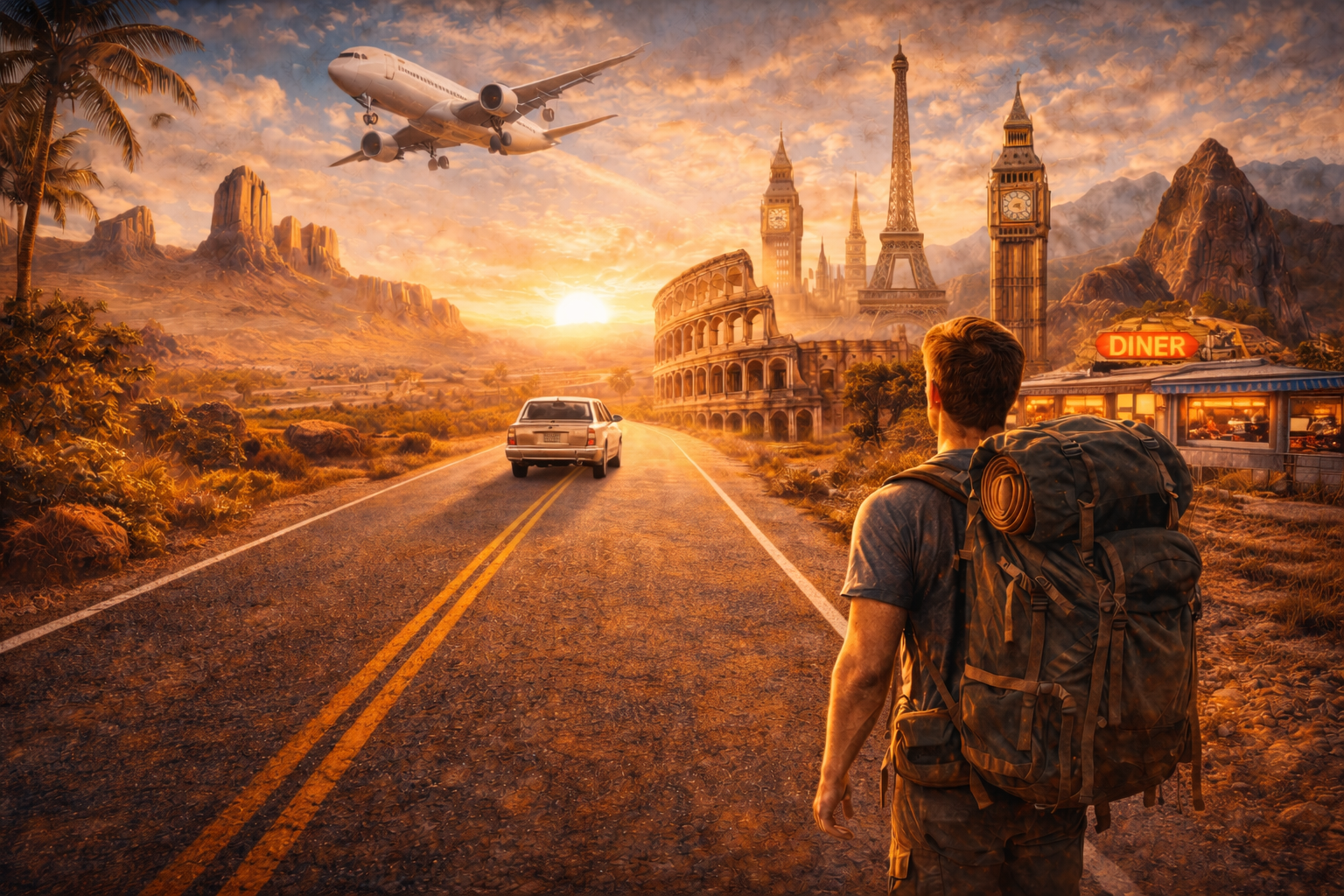
The Adventurer pulls the side-by-side up to a two-lane that runs straight to the horizon and stops. "This is where I hand you the keys," he says. Ahead of you the road just keeps going — past the county line, past the state line, past the place where the map in your head runs out. Maybe it's a tank of gas and a cooler in the back and the kids already asking how long. Maybe it's a red-eye to a country where you can't read a single sign. "There's a man you should travel with in your head," the Adventurer says, leaning on the door. "He's gone now, and he was a mess in ways we'll be honest about — but nobody alive understood the point of going somewhere better than he did. He figured out that you don't really see a place from a tour bus or a resort pool. You see it sitting down at a table with the people who live there, eating what they eat, shutting up, and listening. That man was Anthony Bourdain. Travel his way."
This is Travel & Sightseeing — the going somewhere together ground of the Fairgrounds, and the one that widens a family's whole world. The long road trip and the windshield hours. The landmark worth crossing the country to stand in front of. The first time the kids hear a language that isn't theirs and taste food that has no business being that good. The hotel or the lodge that becomes part of the story. This ground is built on one stubborn idea that Bourdain spent his life proving: the trip is never about the photo you bring home. It's about the man — and the children — you become along the way.
Why a Family Has to Get Out and See It
A child raised inside one small circle grows up believing the circle is the world. He thinks his town's way of doing things is the way, his family's normal is the normal, his problems are the size of the whole sky. Then you put him in the car for three days, or on a plane to somewhere genuinely foreign, and the circle breaks. He sees that people live a thousand different ways and most of them are getting along fine without his town's assumptions. He sees mountains that make the tallest building he knows look like a toy, and an ocean that doesn't end, and a city older than his country. Something permanent happens to a kid the first time the world turns out to be bigger than he thought. He gets a horizon. And the horizon shapes every decision he makes for the rest of his life — what he thinks is possible, how small he's willing to let his life be, how much of the world he believes is open to him.
That is what travel actually is, underneath the brochures: the deliberate widening of a person. And it is exactly the thing the travel industry has trained families to skip. They've taught the modern household to consume travel the way it consumes everything else — as a stream of curated destinations chosen for the check-in and the photo, swallowed and posted and forgotten, the family coming home with a camera roll and no marks on them at all. They went to Mexico and saw a resort. They went to Paris and saw the line for the Eiffel Tower selfie. They "did" a country in three days and it never once touched them. That is travel as consumption, and it produces nothing. Travel as formation — the real thing — is what this ground rebuilds.
And here is the part that should land hardest: the most formative travel a working family can do is also the cheapest. It is not the bucket-list trip to Bali. It is the road trip — the tank of gas, the cooler, the long hours in the car where the conversation finally runs deeper than it ever does at the dinner table because nobody has to make eye contact and there's nowhere to go for six hours but inward and toward each other. A man does not need to be rich to widen his children. He needs a car, a direction, and the willingness to actually go.
The Table — How Bourdain Taught Men to Travel
Before the man, the method, because the method is the gift this ground is built on and it can be said in one line: go where the locals go, sit down, and eat with them.
Almost everything that ruins modern travel is a way of avoiding that table. The resort exists so you never have to leave the compound and meet the country it's parked in. The cruise exists so the country comes to you as a four-hour photo stop and you sleep back aboard the floating mall. The tour bus exists so you can see the landmark through tinted glass without a single unscripted human encounter. All of it is engineered to deliver a destination while protecting you from the place. And Bourdain's whole life was a war on that protection. He went to the night market and ate off the plastic stool. He sat on the floor in a stranger's home and ate what the grandmother cooked and called it the best meal of his life — and meant it, the same week he'd eaten at the finest restaurant in the world. He went to the places the tourists were told to avoid — Beirut, the Congo, the hard towns — and found, every single time, the same thing: people, with a table, who were glad to feed a guest who showed up hungry and humble and willing to listen.
That's the philosophy, and it scales all the way down to a family road trip. Skip the chain on the interstate and eat at the diner where the locals eat. Talk to the person behind the counter. Take the back road through the small town instead of the bypass around it. Let the kids order the thing they can't pronounce. The shared meal is the oldest door into another culture there is, because every culture on earth says the same thing when it sets a place for a stranger: you are welcome here. A family that travels to the table — instead of around it — comes home having actually met the world. A family that travels resort-to-resort comes home having met a hotel.
The Man Who Carries This — Anthony Bourdain
Anthony Bourdain was a line cook who became, almost by accident, the greatest travel companion a generation of men ever had. He started as a New York chef with a hard mouth and a harder past, wrote one savage honest book about what really goes on in restaurant kitchens, and it made him famous overnight. He could have cashed that in. Instead he spent the rest of his life on the road — No Reservations, Parts Unknown — going to nearly every country on earth and showing men what travel was actually for. And what made him great was not the food and not the famous places. It was that he traveled with no armor. He showed up curious instead of certain, a guest instead of a customer, genuinely hungry to understand people whose lives looked nothing like his — and he had the rarest gift of all in an entertainer: he listened, and he let people tell their own story instead of telling it for them.
His ethic is the one this ground runs on. Go to the table, not the resort. Eat what they eat. Talk to people, and then shut up and listen. Treat the grandmother's kitchen and the world's best restaurant with the exact same reverence — what matters is whether the thing is real, not whether it's fancy. Let the place change you — he said it plainly: travel isn't always comfortable, it isn't always pretty, but it leaves marks on you, and that's the whole point. He took the snobbery out of seeing the world and handed men a better, humbler, hungrier way to do it. More men learned how to actually travel from Bourdain than from every guidebook ever printed.
Now the part project7 will not skip, because to skip it would be to lie about the man and waste the most important thing his life has to teach. Bourdain found the table everywhere on earth — and could not, in the end, find a way to stay at it. He battled addiction and a depression he kept mostly hidden behind the camera, and in 2018 he took his own life. He is the clearest case this whole Kingdom keeps pointing at: the gift was real, and the ache underneath it was real too. Here was a man who spent twenty years sitting at humanity's table in every corner of the world, who tasted more connection and beauty and shared bread than almost anyone alive — and was starving the entire time at a level no meal could reach. That is not a verdict on him; it is a grief, and project7 holds it as one. But it is also the most honest sermon his life can preach. The hunger that drove him across the whole earth was a real hunger, and it was pointing at something. He spent his life chasing communion from country to country, table to table, and never quite let himself believe there was a table that could finally fill him — the table, set by the One who made the hunger, where the bread is the body broken for him and the seat is permanent and the welcome never runs out. Bourdain taught men how to find the table anywhere. The journey teaches them Whose table all the others were echoes of. Take everything he knew about how to travel. Carry the part he was reaching for and couldn't hold — and travel as a man who already has a seat that nothing can take from him.
How a Man Gets Travel Wrong
The going-somewhere ground has its own traps, and most of them are ways of leaving home without ever actually arriving anywhere. Name them before you pack.
The Resort-Captive. Every trip is a compound — the all-inclusive, the cruise, the gated pool — with the country it's parked in reduced to a backdrop he never actually touches. He "went to Mexico" and met a buffet. There's nothing wrong with comfort, but a man who only ever travels this way has never once traveled. Pick at least some trips with real contact with the place: the local table, the back road, the unscripted day.
The Photographer. Every destination is chosen for the shot — the blue-domes photo, the tower selfie, the check-in. The trip is a series of photo ops and the actual place stays thin, because he experienced the whole thing through a lens held up between him and it. Put the phone down and let the trip accumulate the substance a photo never captures. The point was to be there, not to prove you were.
The Over-Planner and the Under-Planner — the two opposite errors of the itinerary. The Over-Planner schedules the trip in fifteen-minute blocks across two weeks and exhausts everyone by the third day, because he left no room for the place to actually arrive — and the best moments of travel are almost always the unplanned ones. The Under-Planner brings no plan at all, lands and improvises, and wastes the trip on logistics that a little forethought would have solved. Plan the bones — the route, the beds, the few things you crossed an ocean to see — and leave the rest of the days open for the country to surprise you.
The Trip the Kids Won't Remember. He takes elaborate, expensive international trips with children too young to retain a minute of it, and tells himself it was for them when it was for the photos. The trip that forms a child has to be matched to the age that can actually hold it. Save the big one for when they'll carry it; the four-year-old will get more from the lake an hour away.
The Man Who's Never Shown Them Home. He chases foreign stamps in the passport and has never once shown his own kids the country they were born in — the canyons, the coasts, the battlefields, the working towns, the staggering and various land right outside the door. The far horizon is good, but a man who skips his own country has refused a horizon that was free and on his doorstep. Honor both. See the world; see home first.
The man who's named these actually goes and actually arrives — he gets his family out of the circle, to the table, into the place, and lets it leave its marks.
What This Ground Holds
The going runs four ways, from the tank of gas to the far side of the world, and a man works the whole range across his children's growing up.
Road Trips — the most underrated memory there is. The long drive and the shared route, and the ground this whole section quietly stands on, because it's the one any working family can afford. The windshield hours are where the real conversations happen — the questions a kid will only ask from the back seat, the talk that runs deeper than any dinner because there's nowhere to be for six hours but together. The diner instead of the chain, the back road instead of the bypass, the stop neither of you planned. The car is the most honest room a family ever shares.
Landmarks — the places worth standing in front of. The deliberate visit to the sites worth crossing a country for: the historical ground (the battlefields, the founding-era sites, the places where the story of a people actually happened), the natural cathedrals (the Grand Canyon, Niagara, the Great Lakes, the redwoods), and the cultural landmarks the world has marked as worth the trip. Standing where something happened teaches a child what a screen never can — that history and grandeur are real, and that he is small inside something vast and old.
International Tourism — the wider world. The trip outside the home country, where the language, the food, the money, and the manners are all different and a family gets the full education of being foreigners for a week — the encounter the domestic trip can't deliver. The list a man builds for years before he executes it; Japan stands as a first entry, and the catalog grows as the family goes. This is travel at its most expanding, and the trip a man plans for the age his kids will remember forever.
Hotels & Lodges — choosing the base that honors the trip. The seasoned competence of knowing where to stay — when the lodge is the trip and when the room is just a place to sleep between the days that matter, when to spend and when to save it for the experience. The family's own running Hotels & Lodge Reviews built across real stays. Where a man bases the trip shapes the whole feel of it; learning to choose well is part of the craft.
The Three Pillars on the Road
The Open Country's three questions ride along in the car and cross the border too. TRUTH. LOVE. LAW. Always in that order.
TRUTH — Am I seeing the world as God's, or just collecting it? Travel done right is one long act of wonder — the size of the canyon, the age of the city, the staggering variety of people all bearing the same image — and the honest man lets all of it point up to the One who made the whole astonishing thing, instead of turning the trip into a trophy shelf. And there's a plainer truth: be honest about what the trip actually gave your family, not what the brochure promised. The reflection after — what landed, what didn't, what to do differently — is how the next trip gets better. The man who tells himself the resort week was profound learns nothing; the one who's honest about it grows.
LOVE — Am I traveling with them, or performing the trip? This is the cut the camera tempts hardest, because nothing posts like a vacation. Love is presence — the family actually in the place together, not a man documenting his children's childhood for strangers instead of living it with them. Set the pace for the people you brought, not for the itinerary's appearance. Choose the destination for who it'll form, not for how it'll photograph. The trip they remember is the one you were fully on, eyes up and phone down, at the table beside them.
LAW — Am I keeping the rhythm, and honoring the places I pass through? The law pillar here is twofold. Inward, it's the kept rhythm — at least one real, planned trip a year, because the family that waits for the perfect time never goes, and the years a man means to travel are the same years that vanish. Outward, it's the guest's honor Bourdain lived by — respect the country you're in, follow its ways, tip the people who serve you, leave a place better than you found it, and carry yourself abroad as a man your whole nation would be glad to be judged by. The world is loaned, not owned, and the traveler is a guest in all of it.
The man with all three gets his family out of the circle every year, to the table and into the place, present and humble and grateful — and brings them home wider than they left.
How This Ground Feeds the Rest
Nothing here stands alone. This is where the MONEY a man built finds one of its best destinations — wealth poured into trips a family remembers for fifty years instead of objects that rust in a garage. It's the wider-world cousin of the close-to-home fun in Amusements & Local Attractions and the big-event sibling of the milestones in Special Events & Social Functions — the annual trip is itself a circled day on the family's calendar. It shares blood with the Recreation Backcountry, because the road trip to the trailhead and the trip into the wild are often the same trip. And it feeds LOVE most of all: this is where Making Memories gets built on the largest canvas, the family's traveling traditions formed, the horizon handed to the next generation. A man can build the deepest bonds in the world at home. On the road he takes those bonds out and lets the whole world widen them.
After the Road
A man who has traveled his family well raises children with a particular kind of largeness in them. They've broken the circle. They know the world is big and various and mostly hospitable to a person who shows up humble and hungry, and that knowledge makes them brave in a way the kid who never left the cul-de-sac will never quite be. They carry a vault of shared road — the breakdown that became the best story, the meal in the country whose name they couldn't pronounce, the canyon that shut them up for once, the long drives with their father when the real things got said. And they carry the method, Bourdain's method, out the door into their own travels: go to the table, eat what they eat, listen. The deepest thing the road hands forward is the same thing the whole Fairgrounds keeps pointing at — a family that knows the world was a gift, and the seat at the final table was the gift underneath all the others. The trip ends. The man it made, and the children it widened, do not.
And then there is one more trip — the last road of the entire journey, and the only one a man does not drive with his family loaded in beside him. Every road until now opened the world outward: more country, more tables, more people who started as strangers and ended as friends. This last one runs the other way. It narrows to one traveler and one destination — the high ground above the closed-down fairgrounds, where the road finally arrives at the man it has been making the whole time. You have been a guest at a thousand tables you did not set. There is one left, waiting at the top of the climb, and at that one you are the one who was expected. The Adventurer handed you the keys at the start of this ground; here you leave them in the ignition. This last stretch is not driven. It is walked, and walked alone.