
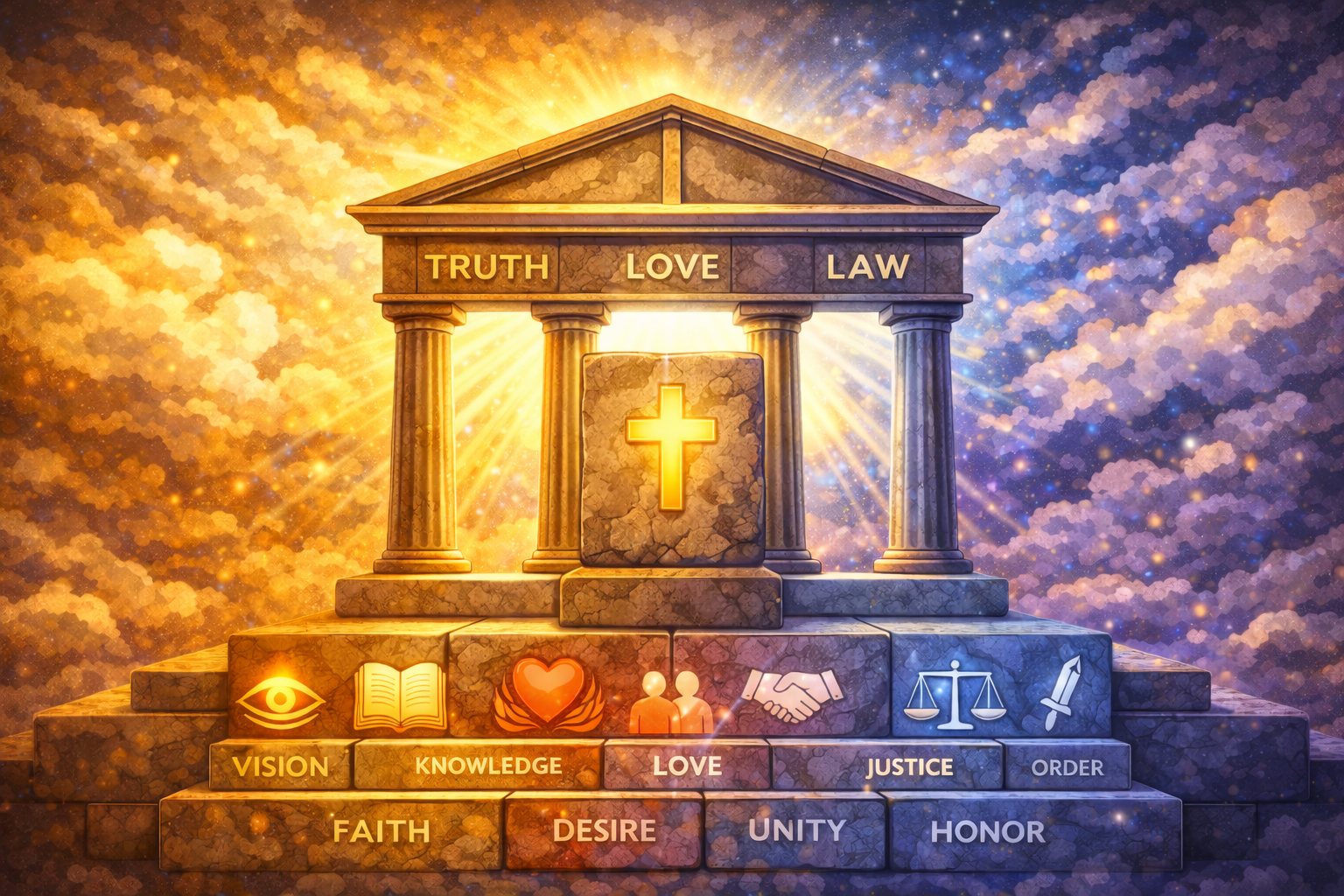
Absolute Truth
The first question a man can ask about truth — the one sitting under every other — is not "what is true?" It is "what makes something true?" Because the answer to that question determines everything else: whether truth is fixed or fluid, whether it is discovered or constructed, whether it holds authority over a man regardless of his preferences, or only over those who choose to submit to it.
Absolute truth is truth that exists independent of what any person, culture, era, or consensus believes about it. It does not bend to preference. It does not evolve with the times. It does not differ between people. It is what it is regardless of who is looking at it, regardless of whether anyone is looking at it, regardless of what the looker's circumstances happen to be.
The ground of Absolute Truth is the unchanging nature of God. If truth originates in the being who defines what is real, what is right, and what endures — then truth is as unchanging as he is. This is not a circular argument. It is the only argument that actually resolves the problem: without a fixed reference point that exists outside the human mind and outside the shifting currents of history, there is no basis for claiming that any truth is absolute. Without God, everything is relative by default. Every moral claim is a preference. Every standard is a social construct. Every statement about what is real is ultimately a statement about what a particular person or group happens to believe.
This page establishes the frame — what Absolute Truth is, where it is grounded, and what collapses when it is removed. Then the section is walked, in ascent, through three rooms: from the ground of existence, through what a man is beneath the body, up to the summit where the Ground himself is met. The climb starts at the bottom of this page.
What Absolute Truth Is
Absolute truth is not truth that most people agree on. Consensus is not the same as correspondence with reality. The most widely believed things in history have often been wrong — and they were wrong regardless of how many people believed them, for how long, with how much confidence. The earth did not become round when science established that it was. It was round while men were still burning others for saying so.
Absolute truth is what is actually the case. Not what is useful to believe. Not what a culture has normalized. Not what a man needs to be true in order for his current life to make sense. What is actually the case — independent of perception, independent of preference, independent of whether anyone acknowledges it or not.
This matters because reality operates by its own rules. A man who does not know where the edge of a cliff is does not get a warning when he walks off it. A man who believes a lie about who his enemies are does not get protection from those enemies because his belief was sincere. Truth does not accommodate sincerity. It does not adjust for comfort. It is not negotiable. And a man who builds his life on an accurate picture of it builds something that holds — while a man who builds on what he prefers to be true builds something that reality will eventually correct.
God as the Source and Ground
The deepest form of the question "is there absolute truth?" is the question "is there a God?" — because absolute truth requires a ground that is itself absolute, and only a being that is self-existent, unchanging, and not contingent on anything else can serve as that ground.
If God does not exist, there is no such ground. Every claim to truth becomes a claim about what a particular consciousness or culture perceives, prefers, or has agreed upon. Nothing carries the weight of being actually, objectively, bindingly true. Ethics become biology. Meaning becomes construction. Identity becomes preference. And every man builds on whatever seems solid to him until the ground shifts under it.
If God exists — specifically the God of Scripture — then truth has a source that does not shift. "Jesus Christ is the same yesterday and today and forever." (Hebrews 13:8) "I the Lord do not change." (Malachi 3:6) The name God gave himself — YHWH, I AM — means the eternally self-existing one. Not the one who was or will be. The one who simply is. Outside of time. Not contingent on anything. Not subject to revision.
God is not only the source of Absolute Truth — he is the definition of it. "I am the way, and the truth, and the life." (John 14:6) This is not a metaphor. It is a claim that Truth is not an abstract principle floating in the universe — it is a person, and that person can be known. That claim is the summit of this entire section, and the walk below ends there — face to face with it.
What Absolute Truth Implies About a Man
Absolute truth is not arbitrary. It rests on three pillars of its own — not invented by human preference, but built into reality itself.
Nature — Truth is grounded in the nature of things. What something is determines what is true about it. Fire burns. Water flows downward. A man who lies to those who trust him damages the relationship. These are not moral opinions — they are descriptions of how things in their nature actually behave. Truth follows nature, which is why it is consistent across time and culture.
Order — Reality is ordered, not random. The consistency of physical laws — that the same experiment produces the same result regardless of who runs it, when, or where — is not a coincidence. It is evidence that order is built into existence itself. Order points toward an orderer. Absolute truth operates within that order, which is why it is stable across conditions.
Source — Without a source that is itself not contingent on anything else, truth has no ultimate ground. A truth that depends on something else for its truth-status is not absolute — the thing it depends on is doing the work. God, as the non-contingent being — the one who simply is, who is not caused by anything outside himself — is the only possible source for truth that is genuinely absolute. Everything else depends on him.
Without Absolutes — What Collapses
A man does not have to believe in Absolute Truth for its absence to cost him. The consequences of building without it follow whether he acknowledges them or not.
Foundations crumble. A building requires fixed reference points to remain level. A life built on "what is true for me" has no stable ground — because what is true for a man changes with his mood, his circumstances, his desires, and the pressure he is under. A man who has abandoned fixed reference points does not gain freedom. He gains drift.
Ethics become opinions. Without absolute truth, no moral claim has authority over anyone who disagrees. "That was wrong" becomes "I prefer a world where that does not happen." The man who is harmed by another cannot appeal to anything beyond his own preference that the harm was real. The most sophisticated moral frameworks, without an absolute ground, are ultimately just arrangements of preference — persuasive to those who already share them, binding on no one who does not.
Identity becomes fluid. Without a fixed definition of what a human being is, identity is whatever a person decides it is at any given moment. That is not freedom — it is the absence of ground. A man cannot know who he is if he has no stable reference for what a man is. He cannot become more himself if there is no fixed self to become more of.
Discipline loses meaning. Discipline is the practice of bringing the present self into alignment with a standard. If the standard is not real, the discipline is performance. A man can perform discipline for a while under social pressure. He cannot sustain it under genuine pressure without an internal conviction that the standard is real and worth meeting.
Accountability disappears. You cannot hold a man accountable to a standard he is free to reject as not binding. Without absolute truth, every standard is ultimately optional — which means accountability is ultimately social leverage, not justice. The man who can afford to dismiss social pressure faces no accountability at all.
Every strong system is built on fixed reference points. Faith, science, engineering, law, character, masculinity, mastery — each one works because it operates by rules that do not bend to preference. Remove the fixed reference points and the system does not evolve into something freer. It stops functioning.
Why Truth Must Come Before Freedom
Freedom without truth is not freedom. It is drift with the appearance of motion.
A man who has no fixed reference point is not more free than a man who does — he is more exposed. He is subject to whatever narrative reaches him first, whatever pressure is applied to him most consistently, whatever his body demands most urgently. He is not self-determining. He is determined by whatever happens to be loudest.
Real freedom is the capacity to act in alignment with what is actually real, what actually serves the man's genuine good and the good of those around him. That kind of freedom requires knowing what is real — which requires truth. A man who knows what is true can choose in relation to it. A man who does not know what is true cannot choose at all in any meaningful sense — he can only respond.
This is why Truth is the first Pillar. It is not that Love and Law are secondary — they are not. It is that without Truth as the ground, Love degenerates into sentiment and Law degenerates into preference. Truth is the condition under which the other two work as they are designed to work. Set it first. Build on it. And understand that everything you build above it will only hold as long as this Pillar is standing correctly.
The Climb - How This Section Is Walked
This page has made the claims. The three rooms below are where the claims stop being read and start being walked — in ascent, in order, each one earning the next.
Existence & Reality is the ground floor. You exist — and that is not a trivial statement. A rock exists; a rock does not know it exists. A man exists and is aware that he does, which means there is a subject here, not just matter in a particular arrangement — a being who experiences his own being from the inside, because the life in him was breathed in (Genesis 2:7). This room establishes that you are real, that reality is real, and that it holds more than what can be measured. Then its road goes down — through the honest receipt of what this world actually contains, all the way to the darkest room on any road in this program. You will walk down there once, deliberately, and come back up changed. Do not skip the descent. Everything above it is built on having seen it.
Spirit & Soul is where you surface. The descent ends with a question about you — and this room answers it. A man is not only a biological process. He has a spirit — the eternal dimension breathed into him at creation, the part made for communion with God — and a soul: the seat of his will, his emotions, his personality, the thing being shaped by every choice he makes and the ground being fought over in the war he now knows is real. A man who treats himself as only a body will optimize for the body and find the gains do not satisfy — because what he is optimizing is not all of what he is.
God is the summit. Everything below it — the ground, the descent, the surfacing — hangs from this room, and the whole climb has been toward it: what God would have to be in order to be God at all, and who He declares Himself to be. His oneness, His name, His triune nature, His attributes, His character, His sovereignty, His image in you. Off the summit sits a chamber holding His names, each one given the day somebody found out it was true. And from the summit — only from the summit — the road leaves Absolute Truth for Universal Truth, where the unchanging ground you have met starts showing through everything He has made.
The frame is set. The climb is real, and it begins at the bottom.