
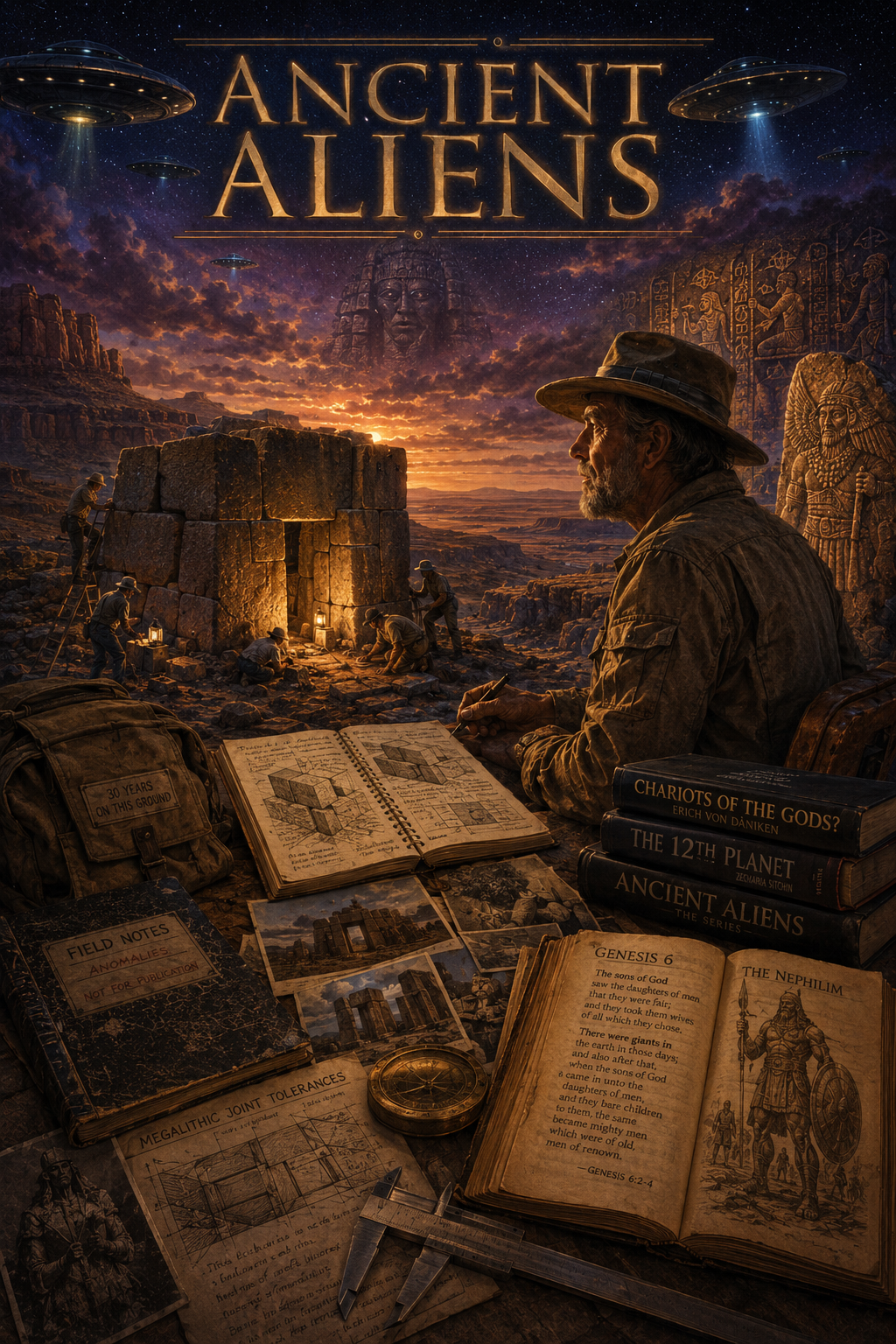
Anthropology
The word came out of the static on the eleventh of July and not one of them could spell it.
The Scribe got it into the notebook the way he got down everything he could not spell, which was phonetically, in pencil, so he could fix it later. GO BECK LEE TEP AY. Underneath it he wrote the only other thing that survived the interference, which was six words in the voice's flat unhurried delivery: older than the farming, older than the pots. Then the static came back over it and stayed.
They had a rule by then. The Skeptic had invented it at a microfiche reader in June, mostly because he was in a bad mood and wanted to be difficult, and it had turned out to be the best thing any of them thought of all summer. GET THE NAME. Every claim has somebody's name attached to it. If you cannot produce the name, you do not have a claim. You have a rumor with good posture.
So they went and got the name.
They were on the library step at ten of nine the next morning. The Brain worked the card catalog for two hours and turned up nothing at all — not a card, not a cross-reference, not a see-also. The librarian came down the aisle without any of them hearing her, which was a thing she did, and looked over his shoulder at the drawer he had open, and then went and checked the atlas index herself, and then the supplement that had come in the spring.
Then she straightened up and said it plainly, the way she said everything.
"It isn't in here. That doesn't mean it isn't anywhere. It means nobody's published it yet."
Four boys stood in a county library in Indiana and worked out, without any of them saying it, that the voice on the radio was ahead of the books.
The Brain's mother knew a man. He had taught at the university for thirty-one years and retired to nine miles of county road and a garden he did not weed, and she said he was odd but he was kind, and she called first. They rode out on the Thursday with the notebook in a backpack.
He listened to the whole thing standing up in his driveway without interrupting once, which no adult had done all summer. Then he asked the Scribe to say the word again. Then he asked him to say it a third time, and he went in the house and came back out with an envelope and wrote it on the back of it himself.
His garage had three filing cabinets in it and forty years in the drawers. He pulled a folder out of the second one — onion-skin, carbon copies, typed on a machine with a low e — and it was flood accounts. Sorted by continent. Peoples who had never met, never traded, never crossed the same water, telling a story with the same bones in it.
He handed the folder to the Captain and went to make coffee.
"Read it before I tell you what it means," he said from the doorway. "I want to see if you get there yourselves."
They read on the concrete for an hour and a half in the heat, passing pages, not talking much. And when they were most of the way through it the Captain sat back on his heels and asked the question, out loud, the way he always did, because that was the only thing that ever moved them off a spot.
"How many places did we start in?"
Nobody in that garage had an answer. That is the night this transmission starts.
Anthropology
"For inquire, please, of bygone ages, and consider what the fathers have searched out" — Job 8:8
That is the oldest research instruction in the record, and it is doing two things at once.
Inquire of bygone ages — go back further than living memory, past anything anyone can tell you from having been there. And consider what the fathers have searched out — you are not the first man to work this. Somebody already dug, already asked, already wrote it down, and a great deal of what he found is sitting in a cabinet nobody has opened.
Folklore reads what the peoples remembered. This file reads who they were — their migrations, their languages, their bones, their tools, their kinship, their abandoned cities, and the oceans nobody officially watched them cross. Two angles on one expedition. One catalogs the stories. This one catalogs the people who carried them.
It gets read at two depths. The first is what the academic discipline can publish without professional cost. The second is what the data shows once the gatekeeping is set aside. A serious man works both and never confuses which one he is standing in.
What the Record Actually Shows
Humanity is not a smooth ascent out of undifferentiated primates into civilization.
Read straight, the record shows a planet already populated by capable peoples earlier than the textbook timeline allows. It shows a global dispersal carrying shared memory of the same catastrophe. It shows megalithic construction on multiple continents that the standard toolkit does not comfortably explain. It shows language families whose reconstructed parent forms point back toward a smaller pool than the present diversity suggests.
None of that requires a single exotic claim. It requires reading what has been excavated without deciding in advance what it is permitted to mean.
And it requires knowing that the timeline is not a floor. It is a snapshot. The dig at Göbekli Tepe that no county library in America could have told you about in the summer of 1995 is in every textbook now, and it moved the date of monumental construction back four thousand years past where the settled account had it. The books were not lying. The books were current.
The Account That Was Already Written
Three passages carry the frame, and they are not decoration on the data. They are a competing account of the same events, and they make claims that can be checked.
Genesis 10 — the Table of Nations. Seventy lines traced from three sons of one man, with geography attached: the Japhetic lines into Europe and northwest Asia, the Hamitic into Africa, Arabia, and parts of the Levant, the Semitic carrying the patriarchal inheritance through Shem to Eber to Abraham. This is not a poetic gesture at common humanity. It is a genealogy of peoples with landing zones, and it closes by saying exactly what it is:
"These are the clans of the sons of Noah, according to their genealogies, in their nations, and from these the nations spread abroad on the earth after the flood" — Genesis 10:32
Genesis 11 — Babel. Linguistic rupture as judgment, geographic dispersal as the consequence.
"Therefore its name was called Babel, because there the LORD confused the language of all the earth. And from there the LORD dispersed them over the face of all the earth" — Genesis 11:9
Note the order, because it is the reverse of the standard account. In the textbook version, populations separate and their languages drift apart over millennia. Here the language goes first, and the separation follows — people scatter because they can no longer coordinate. Whatever else it is, that is a specific and unusual claim about causation, and it predicts a pattern the data can be measured against.
And the purpose inside the scattering. The dispersal is not abandonment.
"In past generations he allowed all the nations to walk in their own ways. Yet he did not leave himself without witness, for he did good by giving you rains from heaven and fruitful seasons" — Acts 14:16-17
Allowed all the nations to walk in their own ways — that is the honest description of the ethnographic library, and it accounts for the sheer variety without flinching at it. He did not leave himself without witness — and it accounts for the other half, which is why peoples with no contact keep independently arriving at a flood, a sacrifice, a lost golden age, and a coming judgment. There is a folder of the first one in a garage on a county road, and there are versions of that folder in serious libraries, and nobody has ever explained the folder away.
Four Ways to Read a People
The bones and the blood. Skeletal data, migration mapping, and the genetic-genealogy work that has been rewriting textbooks since the early 2000s — earlier-than-expected human presence on several continents, interbreeding with populations the older framework classed as separate species, and migration timelines revised again and again as the sequencing forced it.
The customs. Kinship, marriage patterns, ritual cycles, gift economies, social organization — the ethnographic library built by fieldwork from the late nineteenth century forward. Read it with the interpreter in view. Boas, Malinowski, Lévi-Strauss and Mead were not neutral instruments, and the discipline's assumptions shifted several times inside a century.
The languages. Comparative philology, the reconstructed parent tongues, the family trees. Language carries population history that genetics tends to confirm and that mythology tends to echo, and where all three agree the case is strong in a way no single line can make it.
The ground. Göbekli Tepe, Çatalhöyük, the Indus Valley, the pre-Inca Andean sites, the African Iron Age, the European Mesolithic. The dig data that keeps arriving ahead of schedule. Read the actual site reports rather than the press releases institutions issue to manage them, which are two different documents and frequently disagree.
Two Bodies of Work, Both Partial
The subject runs in two worlds that barely speak.
The credentialed side produces careful fieldwork and real methodological rigor. It also operates inside a firm interpretive frame: methodological naturalism, considerable caution on questions judged politically dangerous, and a settled refusal to treat religious texts as primary sources of any kind. Rigorous, and frame-bound.
The independent side operates outside all of that — long-form video, self-published work, investigators chasing the questions the academy will not touch. It produces genuine primary-source recovery and sober assembly of buried data, alongside a fringe edge that drifts into esoteric framing. Daring, and promiscuous about frameworks.
Neither can be swallowed whole. Take the data that survives scrutiny from both, and refuse the interpretive overlay each one lays on top of it. That is the entire discipline of this room, and it is harder than picking a side.
Robert Sepehr
The independent anthropologist this room engages is Robert Sepehr — author, producer, and the largest independent anthropological voice in the current media environment, with over two million subscribers on Atlantean Gardens. His books include Species with Amnesia: Our Forbidden History, Gods with Amnesia, 1666: Redemption Through Sin, The Pre-Adamite Apocalypse, Death of the Cosmic Race, and Whitewashing Black History.
He belongs here because he treats the subject as an investigation rather than a recitation. He honors ancient testimony as data. He chases cross-cultural recurrence instead of explaining it away. He brings Manetho, Berossus, Sanchuniathon, the Edda and the Vedas into the file rather than filing them under primitive imagination. And he has done the unglamorous assembly work — the flood-tradition catalog, the megalithic survey, the giant-tradition compilation — that a Christian researcher could have done and largely did not.
He also carries commitments that have to be filtered, and they are not incidental. His pre-Adamite framework draws on Theosophical root-race material from Blavatsky and her successors. His handling of ethnogenesis sometimes valorizes Hyperborean and Atlantean origin narratives in a direction that shades toward race-religion. His 1666 work builds on documentable Sabbatian-Frankist primary texts and then totalizes the conspiratorial frame well past what the material carries.
Run the columns on him, claim by claim.
Documented — the primary-source recovery, the cross-cultural pattern catalog, the site surveys. This is the work worth having and it holds up.
Contested — his migration and ethnogenesis theses. Engage them critically, cross-check them against other lines of evidence, and never accept them on his authority alone.
Speculative — the root-race material and the esoteric framework built on top of it. Filtered out, and the orthodox engagement routed back through Genesis 10-11.
Where Sepehr Stops and Scripture Continues
His documented work is genuinely useful. A man reading him picks up source material the credentialed discipline chose not to assemble. Sepehr does the assembly. Take the assembly.
The frame is where the engagement stops.
Scripture's account begins at one creation, one couple, one image-bearing race, scattered at Babel into many peoples whose differences are real and whose common origin is not negotiable. The Theosophical root-race framework inverts exactly this — multiple human types of differing spiritual rank, hierarchy written into bloodlines, a cosmology that seats some peoples above others.
"He who fashions the hearts of them all and observes all their deeds" (Psalm 33:15).
Them all. One workmanship, one maker, one set of hearts under one observation. There is no second tier in that sentence and no room to build one.
So where he names a useful piece of data — that Manetho's king list runs back past the conventional dates, that the stonework at Puma Punku and Göbekli Tepe presents real technical problems for the standard-toolkit explanation, that the flood-tradition catalog runs past three hundred independent witnesses — take the data. Where he routes that data through Blavatsky, refuse the routing and run it through Genesis instead.
This is not a partial endorsement. It is the disciplined use of a source whose recovery work is valuable and whose frame is wrong — the same discrimination applied to Eliade, to Campbell, and to the comparative-religion field generally. Take the data. Refuse the frame.
The Line That Does Not Move
One thing in this room is not open, and it gets stated plainly because this is the subject where men go wrong worst.
Every reading that ranks human bloodlines — spiritually, essentially, or in origin — is refused. From every direction.
The pre-Adamite framework fails it. The root-race material fails it. The Hyperborean-superiority drift fails it. And the inverted academic versions that assign moral rank to ancestry from the other end fail it in exactly the same way and for exactly the same reason.
One race. One image. Many peoples. Real differences, equal dignity, one history.
That standard is applied to every source in this file regardless of how valuable the rest of the man's work is, and it is not adjusted for somebody who has assembled data nobody else assembled.
The Questions That Keep Coming Back
Who built the megalithic record? Göbekli Tepe, dated to 9600 BC and earlier — older than the conventional timeline allows. Puma Punku and Tiwanaku, with stoneworking precision the available indigenous toolkit does not straightforwardly explain. The Giza casing stones and internal geometry. Baalbek, where some dressed blocks exceed a thousand tons. The moai, Stonehenge, the wider European horizon, the Andean tradition, the Indian temple complexes. The pattern is global. The standard answer is independent local invention with conventional tools. The reading here is a pre-flood and immediate post-flood inheritance that the descendants partially preserved.
When did people actually reach the Americas? The Clovis-first timeline has been broken by site after site over three decades — Monte Verde, Topper, the Bluefish Caves, the Cerutti material. The peopling of the Americas is older and more complicated than the textbook said. The Solutrean hypothesis remains contested and is not foreclosed. The data is still moving, and any man who speaks with certainty here is out ahead of it.
What are the giant traditions reporting? Genesis 6, the Anakim and Rephaim of the conquest accounts, the Greek Titans and Gigantes, the Norse Jötnar, the Native American traditions, the Andean and Mesoamerican memory, the medieval European reports, the nineteenth-century American mound reports. Too widespread for parallel local invention to be a comfortable answer. Read here as cultural memory of the Genesis 6 aftermath and the surviving lines the conquest record names.
What did the antediluvian world look like? Genesis 4-6 describes a pre-flood civilization with metallurgy, urbanism, animal husbandry, music, and a longevity record incompatible with the post-flood norm. The flood is a civilizational reset. The survivors carried fragments — which is precisely what a scattered megalithic record and a global convergence of the same story would look like from the far side of one.
Where do the present divisions come from? Genesis 10-11 names them, and the genetic and linguistic data has been drifting toward that shape rather than away from it — recent population bottlenecks, common origins recoverable through Y-chromosome and mitochondrial work, and proto-language reconstructions pointing at a smaller original pool.
Two Ways to Get This Wrong
Deferring entirely to credentials. Every claim outside the peer-reviewed mainstream is fringe by definition, so the question of whether the frame is producing the consensus never gets asked. It feels like rigor. It is a concession, and it cuts a man off from the recovery work the independent side does best. It also leaves him permanently surprised, because the consensus he deferred to keeps moving and he never learns to read the direction it moves in.
Absorbing the fringe. The mirror image, and the more dangerous one. Every institutional claim is suspect and every outsider is a truth-teller — and the man swallows root races, ancient-astronaut readings, occult genealogies of every cultural movement, and totalizing frames, with no filter at all. He has not escaped a frame. He has traded a cautious one for a worse one.
Both men have stopped doing the work. One outsourced it upward, the other outsourced it sideways.
Where the File Goes Deeper
Culture & Traditions — the customs, ritual cycles, kinship structures, and inherited practices of the world's peoples as they are lived now, with Pop Culture and Subcultures beneath it and Tom Holland in residence.
The drawers this file has not been opened on yet: Ancient Migrations and The Babel Dispersion, which are the same event read from two directions. The Table of Nations, the seventy lines and where each one landed. Megalithic Civilizations and Lost Civilizations, the stonework and the abandoned cities. Ethnogenesis & Origins, where the room's hardest discipline gets applied. And Antediluvian Anthropology, the world Genesis 4-6 describes and the flood that ended it.
Closing the Transmission
He never did tell them what the folder meant.
They rode out three more times that summer. He fed them and let them work in the garage and answered direct questions with direct answers and never once volunteered a conclusion. On the last visit the Skeptic was standing over the open drawer with a page from Peru in one hand and a page from the Malay archipelago in the other, and he said it without meaning to say anything.
"Either somebody copied everybody. Or everybody remembers the same thing."
The old man nodded once and poured more coffee.
That is how a file is supposed to be handed to a man. Not a conclusion with the evidence stacked underneath it — the evidence, and the time to get there, and somebody honest enough to tell him when he has gone out past where it can carry him.
"Do not move the ancient landmark that your fathers have set" — Proverbs 22:28
The landmark was a boundary stone. A physical marker in a field, and moving one a few feet at night was theft that looked like nothing. It is the right image for this file. The frame does not get adjusted quietly to accommodate an interesting new claim. It is either moved openly, for reasons a man can state out loud, or it stays where the fathers put it.
Know Genesis 10-11 to real depth first. Engage the credentialed discipline for its rigor and the independents for their recovery. Run the columns on every source, including the ones you like. Refuse the bloodline hierarchies from all directions. Then locate yourself in the file — son of Adam, son of Noah, one of a scattered family whose common origin and common destination are both on the record.
The cabinets are real. The coffee is bad. The work is the work.
The Same Question, Turned Around
Look at the verb in the instruction this file opened with. Inquire of bygone ages. Go and ask.
It is worth noticing what that verb assumes, because the whole summer ran on it. It assumes there is somebody to ask. It assumes he has been at it a long time, longer than you, and that he kept what he found. And it assumes he will not simply hand you the answer, because a man who hands you the answer has taught you nothing about how to get the next one.
The professor was that. Four boys asked him how far back it went and he gave them a folder instead of a conclusion and made them sit on the concrete until they got there.
The Captain's question was a backward question. How many places did we start in.
It was the Believer who asked the other one, and he asked it in the second week of August, sitting on the garage floor with the folder open across his knees and the pages from six continents fanned out in front of him. He had been quiet all evening. When he finally said it he did not look up.
"Okay. So how far along are we?"
Nobody had an answer to that one either.
It is the same question. It is the identical instruction — go and ask a man who has been keeping watch — pointed down the other end of the timeline. And the file that answers it is not in three cabinets in a garage nine miles out a county road.
It is in a white frame church on a different county road, thirty-seven members on a good Sunday, where an old man in his seventies has been preaching through whole books at a verse a week for fifty years, and where the Believer's grandmother sat in the pew he sits in now.
He has never once been wrong about a date.
He has never once given one.