
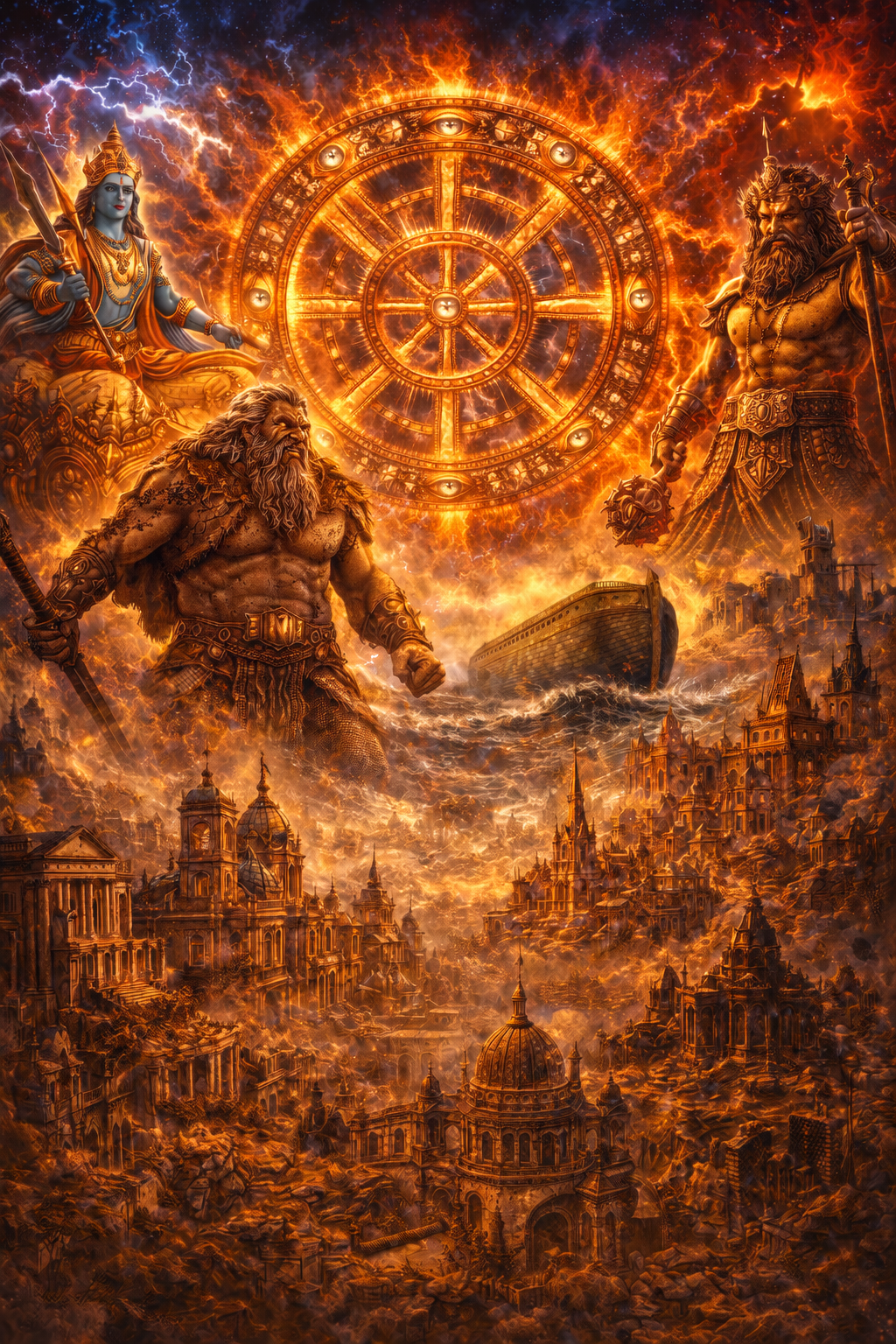
Folklore & Mythology
The Divine Council
Eastern Deities & Cosmic War
Flood Myths & Reset Legends
Gods Across Cultures
Greek and Roman Pantheons
The Origins of Zeus
Poseidon and the Sea Gods
Sacred Mountains & Holy Places
Serpent Figures & Dragon Lore
Sky Gods & Star Beings
Titans & Demigods
The Watchers & The Nephilim
Echoes of a Forgotten Truth
The Scribe heard it the second time in a kitchen in the Sacred Valley, at an altitude that had been giving him a headache for four days, from a man who repaired small engines and had never in his life been asked about it before.
There had been a flood. Not a flood — the flood. A man was warned. He was warned by something that had no business talking to him, and he was warned early enough to build. He took his family and he took animals. The water came up over everything, including the places everyone had assumed were high enough. It went down. The vessel came to rest on high ground. Afterward there was a sacrifice, and afterward there was a promise.
The man told it the way you tell something you have known since before you could read, which is to say badly, out of order, with a digression about his uncle in the middle of it. He was not performing. He had no idea he was saying anything remarkable.
The Scribe wrote it down, because that is what he does and has done since he was twelve, and when he read it back that night in a room with a bare bulb he found he had written the same story he had written eleven months earlier in a different hemisphere, in a different language, out of the mouth of a woman in her eighties who had never left her province.
Different names. Different mountain. Same bones.
He sat with the notebook open on his knees for a long time. He is the least excitable of the five and he was not excited. He was doing arithmetic, and the arithmetic would not come out. These two people had no connection. Their languages are not related. Their ancestors did not trade, did not war, did not meet. There is no missionary in the chain who could have carried it, because the details that match are not the details a missionary would have bothered to carry.
He wrote one line under it, and it is the line this transmission runs on.
Nobody coordinated this. So what did they all see?
Folklore & Mythology
"For although they knew God, they did not honor him as God or give thanks to him, but they became futile in their thinking, and their foolish hearts were darkened. Claiming to be wise, they became fools, and exchanged the glory of the immortal God for images resembling mortal man and birds and animals and creeping things"
— Romans 1:21-23
Read the direction of travel in that sentence, because everything in this file depends on it.
It does not describe men groping upward out of ignorance toward a God they had never heard of. It describes men coming down. Although they knew — the knowledge is at the start, not the end. What follows is not a search. It is a decline: thinking that goes futile, hearts that go dark, and then a series of substitutions, each one a step further from what was originally held.
That is a specific claim about the history of religion, and it is the reverse of the one most men were taught. The standard account runs primitive to sophisticated — animism, then polytheism, then monotheism, an upward climb. Paul's account runs the other way. Something clear was held. It was traded, in stages, for something manageable.
Which is why the myths of the human race are neither pure fiction nor reliable scripture. They are what a memory looks like after it has been carried for a very long time by people who had reasons to change it. Fragments of something real, worn smooth in some places, deliberately reshaped in others, and preserved with a fidelity that ought to be much lower than it is.
The covenant account of the rebellious order is one file. This is what the rest of the world wrote down about the same beings, without the correction.
What the Record Actually Shows
Across civilizations separated by oceans and centuries, the same figures keep arriving under different names.
Sky beings who came down. Watchers who taught craft nobody was supposed to have. Giants born of unions between those beings and human women. A flood that wiped the slate and left one righteous family. Serpents and dragons contesting the high places. Culture-heroes who handed over metallurgy, agriculture, writing and sorcery — and whose gifts cost the recipients something on a delay.
The mainstream reading explains the recurrence as common cognitive architecture: human minds built alike, facing alike pressures, producing alike stories. That reading is not worthless and it should not be sneered at. Minds are built alike. Pressures are alike. Convergent storytelling is real and demonstrable, and any man who pretends otherwise has picked the wrong fight.
It is also not sufficient, and the reason is specificity. Common architecture explains why unrelated peoples all tell stories about water. It does not explain why they tell the same story about water, with a warned man, a built vessel, preserved animals, a mountain landing, birds sent out to test the ground, a sacrifice on arrival and a covenant afterward. Shared psychology predicts shared themes. It does not predict shared checklists.
The reading here is that the recurrence is distorted memory rather than parallel invention. The same beings keep showing up because they showed up — in real history, to real populations, who then scattered carrying fragments of the encounter into whatever language they ended up speaking. The gods of the nations are not invention. They are cultural memory of a rebellious order, recorded by peoples who had no canon to tell them what they were dealing with.
Five Lines That Keep Crossing
The flood. Genesis 6-9, and then Mesopotamia (Atrahasis, Gilgamesh XI), Greece (Deucalion), India (Manu and the fish), China (the Gun-Yu cycle), Mesoamerica, the Andes, Polynesia, dozens of North American traditions, Aboriginal Australia. More than three hundred catalogued worldwide. They share the spine, and in many cases they share the checklist above.
Serpents and dragons. The nachash of Genesis 3, Leviathan in Job and Isaiah, the dragon of Revelation 12 — and then Apep in Egypt, Tiamat in Babylon, Jörmungandr in the north, Python and the Hydra in Greece, the Chinese long, Quetzalcoatl and Kukulkan in Mesoamerica, the Rainbow Serpent in Australia. The most widely recurring antagonist on earth, and repeatedly the one who smuggles knowledge to men.
Giants. Genesis 6, and the Anakim, Rephaim, Zamzummim and Emim of the conquest accounts. The Titans and Gigantes. The Jötnar. The Choctaw Nahullo, the Lenape Ronnongwetowanca, the Paiute Si-Te-Cah. Megalithic construction attributed by local memory, on several continents, to builders who were not ordinary men.
Sky beings who came and withdrew. The bene elohim. The Anunnaki. The Olympians and the Titans before them. The Aesir. The Ennead. The devas. The Atua. The Kachina. Every region remembers powerful beings who engaged humanity at decisive moments and then went away.
Teachers of forbidden craft. The Watchers of 1 Enoch handing over metallurgy, weapons, sorcery, cosmetics and the reading of signs. Prometheus and the stolen fire. Quetzalcoatl with maize, writing and the calendar. Oannes coming out of the sea to teach Sumer. Viracocha in the Andes. Hermes Trismegistus carrying the same cargo through Egyptian-Hellenistic syncretism. The shape never varies: a being from above hands over capability the recipients had not earned, and the bill arrives generations later.
Five lines. Five sets of witnesses who never met, pointing at the same events.
The Architecture Underneath
Genesis 6:1-4 supplies the event. The bene elohim who left their proper position, the offspring the text calls Nephilim, and the Watchers tradition — carried in canonical fragments and developed at length in 1 Enoch — that identifies these same beings as the ones who taught early humanity what it was not ready to hold.
Deuteronomy 32 supplies the distribution. Nations apportioned, governors appointed over them, Israel kept back for the Most High. Seventy nations. Seventy accounts.
Psalm 82 supplies the standing and the sentence.
"God has taken his place in the divine council; in the midst of the gods he holds judgment" — Psalm 82:1
The psalm does not begin by denying that the other parties exist. It seats them, arraigns them for ruling unjustly, and then sentences them to die like men. That is not the grammar of a poem about imaginary beings. It is a courtroom, with defendants.
And the canon treats the pantheons as live opposition rather than as folklore. When judgment falls on Egypt it is not aimed only at a policy or a king.
"On all the gods of Egypt I will execute judgments" — Exodus 12:12
Ten plagues, aimed with precision at a pantheon — the Nile, the livestock, the sun, the firstborn of a god-king. The text is not humoring anybody's superstition. It is naming opponents.
The Traditions, in Outline
Egypt. The Ennead — Ra, Osiris, Isis, Horus, Set, Anubis, Thoth, Hathor. The canon engages Egypt more directly than any other system, through Joseph, through the Exodus, and through the judgment named above.
Greece and Rome. The Olympians and the Titans before them. Hesiod, Homer, and the mystery religions of Eleusis, Dionysus, Mithras and Cybele. Paul walks straight into it at Athens and again at Ephesus. ⚠ Worth holding carefully: the Christian tradition absorbed Greek philosophy as raw material while refusing the Greek religious system outright. Those are two different inheritances and men collapse them constantly.
Norse and Germanic. Odin, Thor, Loki, the Aesir and Vanir, Ragnarok. The Poetic and Prose Edda. Superseded across the conversion of the north between the eighth and twelfth centuries, and revived in the present day by the Heathenry and Ásatrú movements.
Celtic. The Tuatha Dé Danann, the Mórrígan, the Dagda, preserved in the medieval Irish and Welsh manuscripts. Christianized through the Irish and Anglo-Saxon missions, and revived alongside the Norse pattern in modern Druidry.
Slavic and Baltic. Perun, Veles, Mokosh, Svarog. Christianized latest of all — the Baltic peoples not fully until the fourteenth century — with Rodnovery as the parallel modern recovery.
Mesoamerica and the Andes. Quetzalcoatl, Tezcatlipoca, Huitzilopochtli, Tlaloc; the Maya Itzamná, Kukulkan and Ixchel; the Olmec and Toltec layers underneath. Then Viracocha, Inti, Pachamama, Supay across the Inca, Quechua and Aymara record.
North America. The Algonquian Manitou, the Iroquois Sky Woman, the Lakota Wakan Tanka, the Navajo Diyin Diné'é, the Hopi Kachina cycle — varying enormously across hundreds of distinct peoples, and flattened by anyone who speaks of it as one thing.
Africa. The Yoruba Orisha, the Akan Nyame, the Zulu uMvelinqangi, alongside the Coptic and Ethiopian Christian inheritances. ⚠ The Yoruba system crossed the Middle Passage and became Santería, Candomblé and Vodou — a living case rather than a historical one.
India and the Vedic world. The deva-asura framework, Indra, Agni, Varuna and the Rig Veda; then the Puranic pantheon and the avatars.
China and the Pacific. Tian and Shangdi underneath the institutional religions, the dragon traditions, the ancestor layer that never went away. Then the Atua and Akua, Pele, Maui, and the canoe cosmologies — which carry their own flood accounts and their own culture-heroes.
How the Christian Tradition Has Read This
This is old ground and the best readers of it are worth knowing by name.
C.S. Lewis called it true myth. The dying-and-rising pattern, the cosmic struggle, redemption through sacrifice — recurring everywhere, and then occurring once, in history, under Pontius Pilate. His 1944 essay Myth Became Fact makes the argument that the pattern's presence in pagan tradition is not an embarrassment to Christian claims but the expectation. The shadow precedes the substance.
J.R.R. Tolkien worked the same ground in On Fairy-stories, and in the Oxford walk that helped bring Lewis over. Myth-making is sub-creation — a real human capacity, exercised on real material. The pagan myths were not simply false. They were broken renderings of a true pattern that eventually walked into history.
G.K. Chesterton in The Everlasting Man read the pantheons as the dreams of a humanity that had lost its way and was reaching for what the gospel finally answered. The dreams held fragments. The dreams were also haunted, and he did not soften that.
Michael Heiser is the serious contemporary biblical scholarship on the divine council and the Watcher material — The Unseen Realm, Reversing Hermon, and the Naked Bible archive. Start here for the exegesis.
Mircea Eliade and Joseph Campbell are the two great secular collectors, and they are read differently. Eliade for the phenomenological data, with his frame set aside. Campbell for the comparative material, with his conclusion refused: the monomyth thesis ends by making Christianity one expression of a deeper pattern, which is precisely the inversion Lewis and Tolkien spent their lives declining.
Robert Sepehr is where many men in the audience meet this material first. Take the assembly, cross-check the theses, and refuse the Theosophical frame he routes them through — the same discipline the Anthropology file runs on him at length.
Two Ways to Get This Wrong
Flattening it into invention. Every myth is a projection of common cognition under common pressure, full stop. It is half true, and it is thin. It cannot account for the specificity, and it forecloses in advance the thing the canon insists on — that real beings operated in real history and were remembered, badly, by the peoples who met them.
Dissolving it into one truth. The mirror failure, and the more seductive one. All the myths say the same thing; Christianity is one dialect of it. Campbell says so, Theosophy says so, the archetypal reading says so, and the modern pagan revivals are living downstream of all three. A man who absorbs this has not become broad-minded. He has demoted the one account that came with a name, a date and a grave that was checked — and he usually cannot say when he agreed to that.
The disciplined position is narrower than either and harder to hold. The data is real. The correspondence is real. The shadow preceded the substance. The substance has come, and it did not come as a pattern. It came as a man.
Where the File Goes Deeper
The Divine Council — the bene elohim architecture across Genesis 1, Psalm 82 and Deuteronomy 32. The load the rest of this file rests on.
The Garden and The Fall — the nachash, the cherubim, the curse and the first promise buried inside it.
Fallen Angels & Giants — Genesis 6 with 1 Enoch, the Anakim and Rephaim of the conquest record, and the global giant traditions read together.
Ancient Egypt — the Ennead, the pyramid complex, the modern fascination, and the canonical engagement. Its Halls of Amenti file works the esoteric layer that has grown on top of it.
Atlantis — the Platonic source in Timaeus and Critias, the modern revival, and the antediluvian-civilization reading.
Gods Across Cultures — the comparative survey, with the specific peoples worked underneath it: Sumerians · Akkadians · Babylonians · Canaanites · Amalekites · Anunnaki.
Closing the Transmission
Go back to the line in the notebook, because it is doing more work than it looks like.
Nobody coordinated this.
That is not a throwaway. It is the entire reason the agreement counts for anything. A repairman in the Sacred Valley and a woman in her eighties on the other side of the world are worth something as witnesses precisely because there was no possible arrangement between them. Nobody paid either of them. Nobody edited either of them. Nobody could have, because nobody knew both of them existed.
"Every charge must be established by the evidence of two or three witnesses"
— 2 Corinthians 13:1
Two or three — and the whole weight of that rule sits on a word it does not bother to say out loud, because in the world it was written for the word was obvious. Independent. Three witnesses who agree because they were in the room separately are evidence. Three witnesses who agree because they spent the night before the hearing in the same room are not evidence at all. They are one witness, wearing three coats.
Which turns the method inside out for the next file, and a man should feel the turn.
In this room, agreement across unconnected sources is the strongest thing on the table. Nobody was managing the record. There was no ministry of myth, no classification stamp, no press office, no funded institute deciding what the grandmothers were allowed to say. The accounts survived by being told badly ten thousand times by people with no stake in whether they matched — and they matched anyway. That is why they are worth reading.
Now consider a record that is being managed. By people who are paid to manage it. Who have a budget line for the agreement, and who can arrange for the same account to appear in a dozen independent-looking places in the same week.
The moment somebody has an interest in the convergence, the convergence stops being evidence and becomes a product — and the man who never learned to ask were these witnesses actually independent will read a manufactured agreement exactly the way he reads three hundred flood stories, and he will be wrong in the most confident way a man can be wrong.
There is a documented case. It has a name, a budget and a congressional report, and it is the second file in the next room.
The myths survived because nobody had the money to make them agree.
Go and look at what happens when somebody does.