
Government Operations
Cointelpro
Deep Underground Military Bases
Operation Mockingbird
The Brain does not build theories. He builds lists, and the list he built that winter had one column in it.
Not programs. Not claims. People — and for each one only two facts, both of them public, both of them lifted straight off a corporate bio, a university press release, a network announcement or a conference program. Where he worked before. Where he went after.
Forty names. Then a hundred and forty. He would not let himself write anything in the margin, because the moment he wrote something in the margin he would be doing the thing he had spent thirty years refusing to do.
Intelligence service to network news desk. Network news desk to a foundation vice-presidency. Foundation to a federal advisory board. Advisory board to a defense contractor. Contractor back to the agency that had been paying the contractor. A general counsel at an agency, then a general counsel at the company the agency regulates, then back again, twice, over eleven years. Nothing hidden. Every one of those moves announced with a photograph and a congratulatory paragraph.
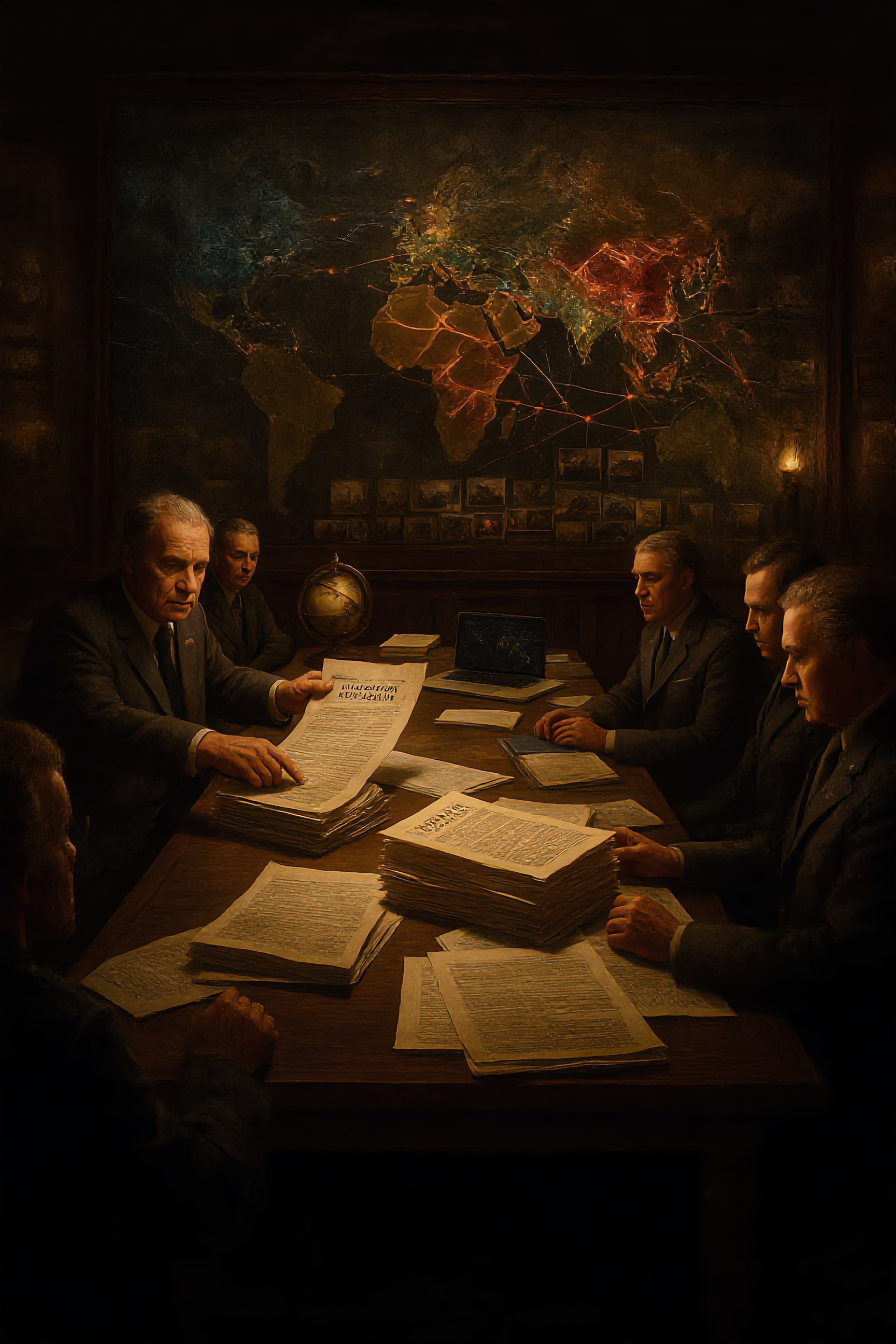
He printed it out and put it flat on the table in front of the other three and did not say anything.
The Skeptic read it twice. Then he said, "Which of these is illegal?"
"None."
"Which of these was secret?"
"None. That's the whole point of the list."
And the Brain — who is the calmest of the five and the one least prone to saying anything he cannot support — put his finger on the middle of the page and asked the question this transmission runs on.
"Then why can't I show this to anybody without sounding insane?"
Nobody at that table had an answer.
Government Operation
"Woe to those who hide deep from the LORD their counsel, whose deeds are in the dark, and who say, 'Who sees us? Who knows us?'" — Isaiah 29:15
Notice what that verse does not say, because a careless reading turns it into a slogan and a careful one turns it into a method.
It does not say the deeds were illegal. It does not say they were even hidden from the public — it says hidden deep from the LORD, which is a different and much stranger ambition. And the line it puts in their mouths is not a boast about power. It is a question: Who sees us? Who knows us?
That is the actual operating assumption underneath everything in this file. Not malice. Unobservedness. A conviction, usually unspoken and often sincere, that this particular arrangement will never be laid end to end by anybody with the patience to do it — and that if it were, it would be too boring to hold anyone's attention.
The record says otherwise, and the record is public. This file is how the state actually exercises power, read from documents anybody can pull.
The Two Layers
Read the state as two layers and keep both in view, because almost every argument a man gets into about government is really an argument between someone looking at one layer and someone looking at the other.
The formal layer is what a man learns in civics. Elected offices. Constitutional roles. The legislative, executive and judicial architecture. The thing that goes on a ballot every two years. It is real, it is lawful within its remit, and it is the layer a citizen engages directly by voting, showing up, and running for something.
The operating layer is everything else. The permanent administrative apparatus. The contractor networks. The funded civil-society sector. The academic research economy. The press relationships. It is not on a ballot. Most of the population does not hold it as a category at all. And the gap a man feels between what an election seemed to promise and what actually arrived in his life some years later is, in large part, the gap between these two layers.
The point is not cynicism about the first layer. It is literacy about the second. A man who knows only the formal layer will spend his civic life confused about why the outputs never resemble the inputs, and he will keep explaining it with the only tools he has — the other party is evil, or the voters are stupid — neither of which is the explanation.
"So the law is paralyzed, and justice never goes forth. For the wicked surround the righteous; so justice goes forth perverted" — Habakkuk 1:4
Justice goes forth perverted. Not withheld. It comes out — it just comes out bent, having passed through something on the way. A prophet who could describe that in the seventh century BC was not describing a modern pathology. He was describing what happens to any system where the visible authority and the actual machinery are not the same object.
The Contractor and the Grant
The postwar period expanded state capacity enormously — and much of the expansion was routed through channels that are not, technically, the state.
The defense side runs through Lockheed Martin, Raytheon, General Dynamics, Northrop Grumman, Booz Allen Hamilton and the wider Beltway bench, with Palantir as the contemporary case. A large share of what most Americans picture the Pentagon doing directly is done under contract. The intelligence side is comparable — and one detail is worth holding onto, because it is not incidental: Edward Snowden's 2013 disclosures broke as a story about an NSA contractor, not an NSA employee. The consulting side — McKinsey, Deloitte, Accenture, BCG, several now drawing major annual revenue from federal work — writes and implements a great deal of the policy that arrives under an agency's letterhead.
Alongside it runs the grant layer. Nonprofits operating on federal program money, State Department funding, foundation pass-throughs and the broader documented federal-NGO funding architecture carry out large portions of what gets called civilian policy work at home and abroad.
⚠ And the picture is genuinely mixed, which is the part both failure modes refuse. Some of that work is straightforwardly good and is done by people who would do it for less money somewhere else. Some is ordinary and unremarkable. Some is plainly aligned with objectives the state could not pursue under its own name without paying a political price. All three are true simultaneously, and a man who needs it to be uniformly one thing will have to start ignoring evidence within about a week.
The Press as Carrier
Operation Mockingbird is the anchor case. The recruitment of American journalists across major news organizations beginning in the late 1940s, running through the Cold War, surfaced by Carl Bernstein's 1977 Rolling Stone piece and by the Church Committee hearings of 1975-76.
The contemporary questions are worked in the child file: the personnel rotation between intelligence veterans and major news organizations, senior officials moving into on-air roles, coordinated framing appearing across nominally independent outlets in the same week, the Twitter Files releases, the Missouri v. Biden litigation, the Global Engagement Center, the Election Integrity Partnership, the Stanford Internet Observatory.
Nothing here requires a man to believe every story is a placement. It requires him to know that the space contemporary American journalism operates inside includes documented integration with the intelligence apparatus, and to weigh specific content with that in view.
And Mockingbird is the anchor case for something else — the reason the Brain's list makes a man sound insane. It is the canonical The Discrediting Label file. From 1948 to 1975, anybody who described the program accurately in public was, by official position, a paranoid crank. In 1975 the Senate confirmed it. And the label did not transfer. It did not move to the journalists who had denied it, the publishers who had signed the agreements, or the officials who had defended the line. Nobody's reputation was adjusted downward for having been wrong, and nobody's was adjusted upward for having been right.
Sit with that asymmetry, because it is the training. The label was never measuring truth. It was measuring loyalty — and it moves, intact, to whatever the next inconvenient claim happens to be.
The Academy as Carrier
NGO & University Capture documents the parallel program. Same logic as Mockingbird, frequently the same people, a different carrier.
The backbone was a small set of major American foundations — Rockefeller, Ford, Carnegie — and the smaller ones in their orbit. They were the pre-existing legal and financial plumbing money could be routed through without congressional scrutiny, because their grant decisions were, on paper, private. The personnel moved in both directions for decades. Paul Hoffman came out of the Marshall Plan. John McCloy came out of the High Commission for Germany. McGeorge Bundy came out of the National Security Advisor's office. The list is long and it is not secret.
The money produced two outputs. Individual operators — fellowships, foreign postings, research trips, the international résumé that opened doors into senior journalism, senior philanthropy and the foreign-policy institutes on the way home. And whole fields — area studies, peace studies, gender studies, post-colonial studies, the activist wings of sociology and anthropology — each with a fundable origin point and a downstream output that kept producing graduates without further help.
Here is the mechanism, and it is the most important sentence in this file. It was not direction. It was selection. Nobody had to tell a young scholar what to conclude. The work that aligned with what funders wanted got the fellowship, the trip, the publication and the post. The work that did not, did not. Over one generation a field reshapes itself around what was rewarded, and everyone inside it experiences that reshaping as the ordinary discovery of truth by honest people — which, at the level of any individual, it largely was.
⚠ And then the money became unnecessary. Once the field existed, it hired its own, trained its own, credentialed its own and reproduced without upstream funding. That is not a small operational detail. It is the hinge this entire file turns on, and it comes back at the end.
The Ground Underneath
Deep Underground Military Bases (DUMB's) carries the physical layer — where the state goes when it intends to act unobserved.
The floor is not in dispute and not in the least fringe. Cheyenne Mountain. Raven Rock. Mount Weather. The Greenbrier. The Presidential Emergency Operations Center. Internationally: Yamantau, China's Underground Great Wall, Pine Gap, Fordow, the North Korean strategic facilities, the Swiss shelter-for-every-citizen law.
Above the floor sits well-supported inference — Richard Sauder's catalog, built from appropriations line items, released Army Corps contracts and the documented capability of modern tunnel-boring machines, arguing a footprint larger than the published inventory. Above that sit the maximalist claims — Dulce, the 1979 firefight, the joint-operation stories — and they are named as what they are rather than quietly folded in.
Press. Civil society. Concrete. Three faces of one operating layer.
Sorting It Honestly
Same three drawers as the rest of the section, and this room is where a man's sorting gets tested hardest, because the material is dry enough that nobody enjoys being careful with it.
Green. Mockingbird's mid-century run. The named foundation officers and the named recipients. The funding flows. Cheyenne Mountain and its international parallels. The Brain's list — every entry of it, because every entry came off a press release.
Yellow. Whether and how the press integration continues, which is green in several documented components and unsettled in others. The selection-effect account of how fields got reshaped, which is well evidenced in some disciplines and inferred in others. Sauder's larger footprint.
Red. Every journalist is a knowing asset. Every NGO is a front. Dulce. These overstate what the record carries, and a man who quotes them alongside the green material has just contaminated everything he brought.
The discipline is portable. It goes with him into CIA Declassified, Conspiracy Theories, Aliens and anywhere else the evidence is mixed. And it is what keeps this file from collapsing in either direction, because the subject itself is always pulling toward one of the two.
What It Costs to Read This Badly
Refusing the second layer. He engages only the formal one, votes, and is genuinely bewildered every four years. Because he has no category for the operating layer, he explains the gap with the only tools he has left — the other side is wicked, or his neighbors are fools. He is not naive about people. He is uninformed about structure, and it is making him meaner than he means to be.
Making it a personality. He learns the second layer and it eats the first. He stops voting because it is theater. He skips the school board meeting, which was the one arena where his presence would have changed an outcome. He knows the funding history of six foundations and has not met his county commissioner. He has traded real, small, available influence for accurate, large, useless knowledge — and he calls the trade being awake.
A man who reads this material well does not become paranoid. He becomes useful. He stops being surprised when policy fails to resemble the campaign. He stops being scandalized when the voice on the evening news turns out to have run the program three years earlier. He keeps voting, keeps showing up, and stops expecting the visible layer to be the whole of it.
Why This Belongs in a File About the Soul
Somebody will ask what any of this is doing next to Scripture, and the answer is the only reason it is here at all.
A man's interior is formed by what he swims in. That is not a modern insight and it is not controversial — the whole New Testament instruction to have the mind renewed rather than pressed into the shape of the age assumes that the unrenewed mind takes the shape of its surroundings by default, without consenting to it and usually without noticing.
So the question is not whether a man's frame was supplied to him. It was. The question is by whom, and whether he can name them.
"For the wisdom of this world is folly with God. For it is written, 'He catches the wise in their craftiness'" — 1 Corinthians 3:19
He catches the wise in their craftiness. The verse does not say the craftiness fails. It says it is caught — held, examined, and answered by somebody the planners did not include in the room. Which is the only footing from which a man can read this material without either despair or obsession: he is not the one who has to catch them. He only has to stop being formed by them without knowing it.
The higher witness is Scripture, prayer, the gathered church, the older men who know his name, and the Spirit at work in his conscience while he reads. Those are not neutral inputs among others. They are the ones with the standing to form him.
Where the File Goes Deeper
Operation Mockingbird — the press as carrier, from 1948 to the current litigation. NGO & University Capture — the foundations, the personnel, the fields that were seeded and then ran on their own, and the Gloria Steinem file where the recruitment pattern reads cleanest. Deep Underground Military Bases (DUMB's) — the physical layer, sorted floor to ceiling.
Closing the Transmission
Go back to the list on the table, because it has a limit and the Brain knew it before anybody said it out loud.
The list proves movement. It proves that the same people run the agency, the contractor, the foundation, the department and the news desk, in rotation, in the open, with photographs. It is green all the way down.
What it cannot prove is why any of it worked.
Because a placed story only lands if somebody reads it and finds it plausible. A funded department only reproduces if students walk in and find the ideas worth having. And that is the part the whole architecture cannot manufacture, no matter how large the appropriation: you can buy the carrier. You cannot buy the belief.
Remember the hinge from the middle of this file. The foundations stopped paying, and the fields kept going. Three generations of scholars who never saw a cent of that original money believed it sincerely, taught it faithfully, and passed it on for free — and they were not bought, and calling them bought is both false and lazy, and it is the single fastest way for a man to lose an argument he was otherwise going to win.
So the machinery is real and the machinery is not the explanation. Something got carried. The carrying is documented. The cargo is not.
What was in the crate was an idea — and it did what ideas that spread actually do, which is answer a question people were already asking, in a way that felt like relief. It told them who they were, what was wrong, who had done it, and what the world would look like once it was set right. It gave them a beginning, an enemy, a duty and an ending.
That is not a policy. That is a creed, and a man who has spent this whole file tracking money and personnel and has never once asked what the thing being carried actually promised people has been reading the truck and ignoring the freight.
The next room is the freight.