
Balance
Static & Dynamic Balance
Mind-Body Balance
Equipment-based Training
Three systems arguing toward an answer, several times a second.
Stand on One Foot and Close Your Eyes
Do it now, before reading further. One foot, arms wherever you like, eyes shut. Count.
Most men in reasonable shape get somewhere between five and fifteen seconds before they have to put a foot down, and most of them are surprised, because with their eyes open they could have stood there indefinitely. Nothing changed about their legs in the second the eyes closed. What changed is that one of the three systems holding them up got switched off, and they discovered they had been leaning on it entirely.
That is the whole subject of this room. Balance is not a thing a body has. It is three separate systems arguing toward an answer several times a second, and most men have trained exactly one of them by accident and none of them on purpose.
Three Systems, and You Are Probably Using One
Your eyes. The horizon, the floor, the wall — fixed references the brain uses to work out which way is up. This is the easiest input to use and the least reliable one, because it fails exactly when things go wrong: in the dark, in a crowd, when the head is moving fast, in the half-second of a stumble before the eyes have found anything to fix on.
Your inner ear. A set of fluid-filled canals that sense head position and acceleration directly. It is the only system that knows you are tipping before anything else does. It degrades with age and, more to the point, with sitting still — and it comes back when it is asked for. It is asked for by moving your head, which is precisely why balance work with the head turning feels awful and why almost nobody does it.
Your body's own sense of itself. Receptors in the joints, tendons and muscles reporting where every segment is without needing to look. This is proprioception, and it is the layer that separates a man who adjusts to a stumble mid-fall from a man who finds out about it on the ground. It sharpens with work and dulls without it.
The three feed a system that produces postural corrections in the small muscles of the feet, ankles, hips and trunk, several times a second, entirely below awareness. Train one and you get better at the conditions that favor that one. Train all three and you get a man who is steady on a dark stair, on wet rock, on a boat, on a ladder, and in the specific instant when his foot goes somewhere he did not send it.
The Quality That Decides the Last Twenty Years
Every quality in this domain has a longevity argument. This one has the starkest.
Falls are among the leading causes of serious injury and death in older men, and the mechanism is not usually mysterious. A hip breaks. The break requires surgery. The surgery requires immobility. The immobility costs muscle and conditioning that were already marginal, and a man who was independent in the spring is not in the autumn — and frequently does not recover from the sequence at all.
The proximate cause was a fall. The actual cause was a balance system that had been quietly degrading for thirty-five years while nobody asked anything of it.
Which makes this the highest-leverage quality in the domain per minute invested, and almost nobody invests the minutes, because the popular image of balance training is an elderly man on a foam pad in a clinic. That image is the end of the story — remedial work on a capacity that was allowed to disappear. The version that matters is preventive, it takes about ten minutes three times a week, and a man who runs it from thirty-five to seventy arrives at seventy in a body that does not fall.
That is not a small return for ten minutes.
How Men Go Wrong Here
Eyes open, always. The single most common gap. A man trains balance exclusively with a visual reference and builds a capacity that evaporates in the dark, in a crowd, or in the moment of a stumble. Closing the eyes is not a stunt; it is how the other two systems get forced to do their jobs.
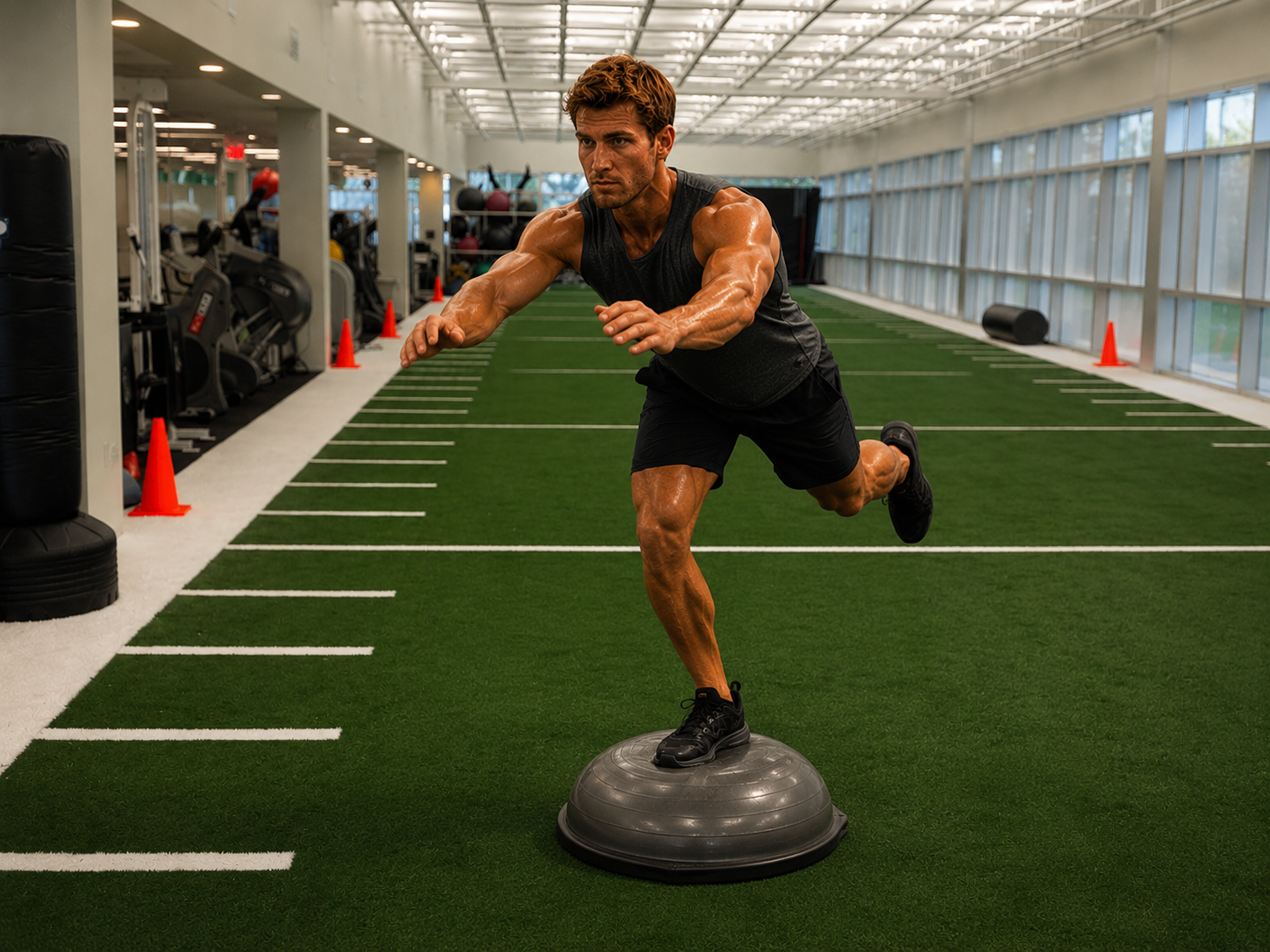
Holding still and calling it done. Static holds are the floor. Real balance happens in motion, under load, on ground that is not level — and static-only training does not carry over. The man who can hold a long single-leg stand and loses it the moment he has to reach, step or turn has trained a pose.
Never being disturbed. Nothing in a controlled balance drill pushes back. Real balance is defined by recovery from something unexpected — a shove, a slip, a shift in a load. If nothing ever disturbs a man's position in training, he has trained holding and not recovering, and those are different skills with different neural machinery.
One surface, forever. A gym floor and a yoga mat. Grass, gravel, sand, wet stone, a slope, a moving deck — each demands a different response, and balance trained on one surface transfers narrowly to the others.
Head perfectly still. The inner ear is trained by moving the head, and men avoid it because it feels disorienting. The disorientation is the signal that the system needs the work, and it fades in weeks.
Stopping after thirty. The quiet one. Most men do their last deliberate balance work in a school gym and then assume the capacity maintains itself. It does not, the decay is invisible for decades, and the invoice arrives on a set of stairs somewhere in the seventies.
Three Rooms Off This One
Three doors, and they run the way the quality is actually built: find the position, then find out what it costs you, then work out what is worth buying.
Static & Dynamic Balance — the split most men never make. Holding a position and continuously re-finding one while everything moves are different skills, and almost every demand a man meets is the second. The room covers why static work is the diagnostic rather than the destination, why duration past a minute stops teaching anything, and the failure that quietly defeats most training: nothing in a controlled drill pushes back, so a man trains holding when the thing he needs is recovering.
Mind-Body Balance — what it costs in attention. Stand on one foot and count backwards by sevens and most men lose it inside twenty seconds. That effect has a name and the size of a man's dual-task cost predicts falls better than how long he can stand on one leg — which means the standard test measures the version nobody needs, because nobody falls while concentrating on not falling. The room also handles what degrades balance today rather than over decades: fatigue, poor sleep, a phone, a drink.
Equipment-based Training — the aisle, sorted. Balance has more products attached to it than any other quality here, and the rule that separates them is one line: real-world instability comes from the load, the ground, or the situation — almost never from the floor. The wobble boards are genuinely valuable in rehabilitation and mostly the least efficient option for a healthy man, in a category where the best tools are free.
The Three Pillars on One Foot
TRUTH—Is it true? Take the eyes away and find out. That is the honest test and it takes eight seconds, and most men avoid it because the answer is embarrassing in a way that a lift number never is. Balance is the quality where a man's self-assessment is furthest from reality, because his eyes have been quietly covering for the other two systems his entire adult life.
LOVE— Is it loving? This one is not spent on anybody in the moment. It is spent on them thirty years out — on whether a man is a grandfather who moves through a house without calculating, or one whose family has begun the quiet, careful, exhausting business of managing him. A fall is not only a fall. It is the event that reorganizes a family around a man's body. This is the training that keeps that meeting from happening early.
LAW— Is it right? Train it where you are worst rather than where you look best. Eyes closed. Head moving. On ground that argues. Being pushed. Every one of those is uncomfortable and every one is the actual work — and the comfortable version, the one where a man holds a pretty position on a flat floor with a wall in view, is the version that changes nothing.
Where This Goes Next
Holding a position is the floor of this quality, not the ceiling. And the floor is where the room ends, because the moment a man has to do anything other than stay upright, the demand changes shape entirely.
Now two arms, two legs, two sides and more than one job have to happen at once, in the right order, without tangling. Balance keeps a man standing. It does not, by itself, let him move — and a body that can hold a position and cannot sequence one is a stable body that looks, in motion, like it is arguing with itself.