
Functionality
Suspension & Stability Training
Locomotion
Twisting & Turning Motions
The other five, cashed — on a task nobody designed.
The Couch on the Stairs
A couch has to go up a flight of stairs and there are two of you.
Nothing about it is heavy in the way a barbell is heavy. What it is, is awkward — the weight is off-center and it moves, the grip is wherever your hands can find one, the load is asymmetric because the man at the bottom has more of it, the stairs turn, and at the landing somebody has to hold it at an angle while the other one works out the corner. It takes four minutes. Neither of you chose the position, and at no point does the load do what it did last time.
There is no machine that trains for that. There is no rep scheme for it. And the man who can do it comfortably at fifty-five is not the man with the biggest numbers — he is the man who has agility, balance, coordination, precision at the ends of his chain, and enough force to spare, all arriving at once, in a situation nobody rehearsed.
That is functionality, and it is the last quality because it is not really a sixth thing. It is the other five, cashed.
The Word Has Been Ruined and It Still Means Something
Functional got sold. It got attached to wobble boards, to any exercise performed standing up, to whatever a trainer wanted to charge more for. So it is worth stating the honest version, which is narrower and more useful than the marketing one.
It is movement-pattern training rather than body-part training. A body has a handful of fundamental patterns — squat, hinge, lunge, push, pull, rotate, carry. Functional work builds capacity across those patterns, often loaded unevenly, often across several joints at once, often while something is trying to make you unstable. It is the opposite of sitting in a machine and moving one muscle through a fixed groove.
It is integration. Getting a heavy box from the floor onto a high shelf uses legs, hips, trunk, back, shoulders and arms in one sequence. A man trained on leg extensions and chest flies has excellent parts and no assembly.
It is specific to the life actually being lived. A father of three with a desk job and a yard has different real demands from a roofer, a soldier or a man with a boat. Generic functional training beats generic isolation training. Training built around the demands a man actually meets beats both.
And it changes with the season. A twenty-five-year-old trains for capacity. A fifty-five-year-old trains for preservation and integration. The exercises shift and the loads shift, but the question is identical: is this body capable of what this life is currently asking?
Why It Has to Come Last
Because it is the only one that cannot be trained in isolation.
Every other quality in this domain can be worked on directly. You can drill deceleration. You can stand on one foot with your eyes shut. You can learn a new skill slowly. You can squeeze a gripper. You can jump onto a box with everything you have.
You cannot drill integration. Integration is what happens when the other five arrive together in a task that was not designed to be a drill — and if any of the five is missing, the task simply exposes which one. The man who cannot get the couch up the stairs is not failing at couches. He is failing at whichever of the five he skipped, and the stairs are just where he found out.
Which is what makes this room the test rather than a training method. It does not build anything new. It reports what the other five actually amount to.
Three Rooms Off This One
Three doors, and between them they cover the movement vocabulary a modern life has quietly deleted.
Locomotion — getting from here to there, by whatever the ground requires. A body travels by walking, running, climbing, crawling, jumping and scrambling, and most adult men use one of those. The room singles out the pattern worth watching above all others: getting down to the floor and back up unaided, which tests leg strength, hip and ankle range, trunk control, balance and coordination in about four seconds — and whose loss quietly removes a hundred ordinary things from a life without a decision ever being made.
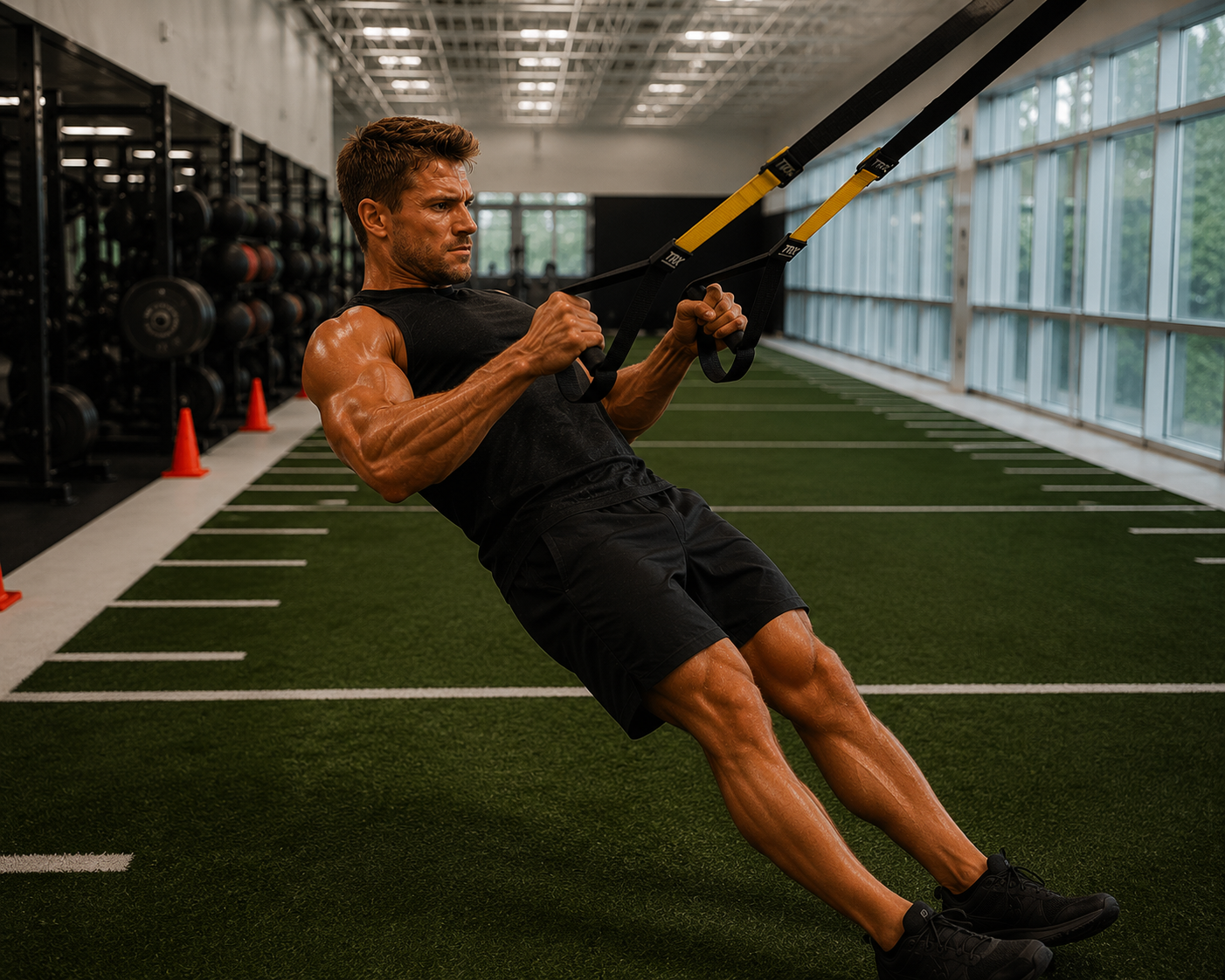
Suspension & Stability Training — when the ground is not doing its share. The tool was improvised by a deployed Navy SEAL out of a jiu-jitsu belt and parachute webbing, and its whole character follows from that: infinite scaling by body angle, enormous stabilizer demand, and a hard ceiling on load. The room is honest about both halves — a strength tool with a stability tax, excellent at a third of what a body needs and unable to deliver the rest.
Twisting & Turning Motions — the plane nobody trains. A man who deadlifts four hundred pounds hurts his back on an eleven-pound bag in a back seat, and the weight was never the variable. Rotation belongs at the hips and the thoracic spine while the lumbar holds still — and almost the entire strength tradition is built around symmetrical equipment that never asks for any of it.
How Men Go Wrong Here
They train it instead of the five. The reversal that ruins it. A man does circuits of awkward objects and calls it functional training while never building the strength, the balance, or the explosive capacity underneath. He gets tired in a functional-looking way and improves at nothing, because integration integrates something, and he did not bring anything.
They confuse instability with function. Standing on a wobbling surface with a light dumbbell is not more functional than standing on the ground with a heavy one. It is just harder to do badly measured. Real-world instability comes from the load, not from the floor.
They train patterns nobody in their life uses. A man whose actual demands are children, stairs, luggage and yard work, training tire flips. Fine as sport, but it is not the specific work, and specific work is the whole point of this quality.
They wait until they need it. Getting off the floor is trivial at forty and worth practicing at forty for precisely that reason. Nobody starts training it at seventy from a position of strength. They start because it has become hard, which is several years after the window closed.
The Three Pillars in the Real Thing
TRUTH — Is it true? Go and do something the gym did not design. Move furniture. Help somebody with a job. Carry the awkward thing across the parking lot. The gym is a controlled environment and controlled environments flatter — a man's numbers are honest and they are answers to questions he chose. This is the quality that can only be verified outside, on a task somebody else defined, and a man who never leaves the controlled environment never finds out what he has.
LOVE — Is it loving? This is the whole domain's actual product. Everything upstream was preparation for the moment somebody needs something lifted, moved, held, carried, reached, or gotten off the floor — and a man is either the one who does it or the one who watches somebody else do it. That is not about pride. It is about what a household quietly reorganizes around: whether the man in it is a source of capacity or a consumer of it. Every hour in every room of this gymnasium was buying the first answer.
LAW — Is it right? Train what your life actually asks of you, and be honest about what that is rather than about what would be more impressive to train for. And bring the five with you — this room only ever gives back what the others put in, so a man who arrives here without them has not found a shortcut. He has found out.
Where This Goes Next
That is the field, and it is the end of it. Agility, balance, coordination, precision at the ends of the chain, force delivered fast, and all of it assembled into movement that transfers. A man who has walked those six is not a collection of gym numbers. He is an athlete his life can actually spend.
What is left is not another quality to add. It is a question about the one you now have.
Everything in this domain answered can you. Can you change direction, hold a position, sequence a movement, grip a thing, produce force fast, put it all into a real task. Six times, six yeses, and every one of them tested on a day you picked.
The last room asks something the six cannot: can you do it on Thursday. Not can you do it — you have established that. Can you produce it at four o'clock on a specific afternoon that was chosen for you, once, with people watching and no second attempt. That is a different question with a different answer, and a great many men who can do the first thing cannot do the second.