
Blades & Knives
Chef’s & Kitchen Knives
Outdoor & Hunting Knives
Tactical & Utility Knives
Reading the Wall
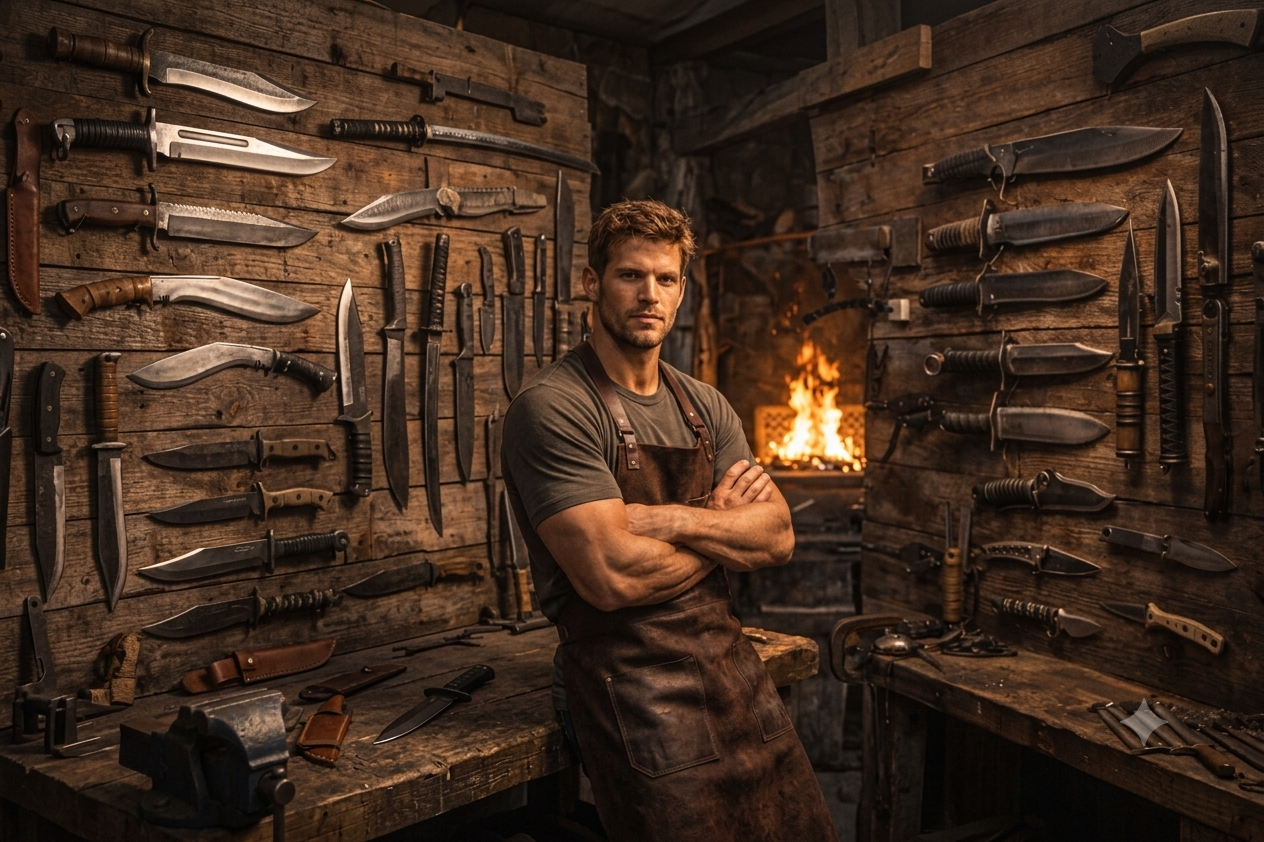
The Armorer walks you the length of the blade wall and does not take anything down.
It runs the whole side of the shop: folders no longer than a finger, a rack of kitchen steel, skinners with their fat bellies, a machete, a fighting knife with a leather-washer handle, a cleaver, a straight razor in a worn case. He looks at the wall and then at you. "Men see this and think knives, like it's one thing. It isn't. Every blade on that wall was ground to answer a different question, and the man who knows the questions can pick up any one of them and tell you what it's for before he's cut anything with it. The man who doesn't grabs the cool one." He pulls down a cheap folder with a jagged spine and a skull on the handle, opens it, and hands it to you. "Cut that cord." The cord is a piece of half-inch rope. The blade skates, then tears, then you are sawing. He takes it back, hands you a plain wooden-handled paring knife from the kitchen rack, and the rope falls in two. "Same wall. One of those was built to sell and one was built to cut. This room is about telling which is which from across the shop."
This is the first room on the blade rack, and it is the front door: the place a man stops seeing a pile of knives and starts seeing a set of answers, each one shaped to its question. The Edged Weapons bench already said what the blade is and why it has to be trained. This page teaches him to read the wall: the one idea every blade on it shares, the six parts that let him read any blade he has never held, the one structural fork, the three rooms the wall sorts into and the order they are walked, the named types that get argued over at the counter, the honest position of a working carrier, the questions asked before any blade is bought, and where the wall hands off when the reading is done.
A Blade Is a Question Answered
Here is the one idea the whole rack runs on: a knife is a purpose with a handle. Nobody ever made a blade in the abstract. Every shape on that wall exists because some man, somewhere, had a job the blade before it could not do, too long, too short, too thick, too thin, too straight, too curved, and he ground steel until it fit the work. The hooked tip on a carpet knife, the wide belly on a skinner, the flat chisel point on a fighting blade, the thin flex of a fillet knife: none of it is decoration. Each line answers a need, and a line that answers no need is there to sell.
So the trained man reads a blade the way a tracker reads ground. He asks what it was built to do, and the steel tells him. A man who only ever asks whether it is cool owns a wall of mysteries. A man who asks what it is for owns a wall of tools, and he can walk up to a blade he has never held and be right about it.
How to Read Any Blade
To read a knife a man needs the words for its parts, and six get him most of the way.
The point. Where it bites and pierces. A drop point lowers the spine gently to the tip, puts the point under control, and is the shape on most working knives in the world; a clip point cuts the spine away in a concave sweep to a fine, forward tip, the shape of the Bowie and the Marine's knife, better at piercing and easier to break; a spear point puts the tip on the centerline for a dagger's stab; a tanto ends in a second, near-straight edge meeting the first at an angle, a point that punches through hard things and resists snapping; a sheepsfoot has no point at all, a straight edge under a rounded spine, for cutting cord and rope where a point would only find a finger. The point is the first thing the wall tells a man, because it says what the maker expected the blade to be pushed into.
The edge. The working line that does the cutting, and the angle it is ground to decides whether it slices keen or chops tough. That trade is the whole craft of the room after this one, and the wall only says: look at the edge and ask what it was ground for.
The spine. The unsharpened back. Its thickness is the blade's strength: a thick spine pries and pounds, a thin one slices and flexes, and a spine that is thick and short is a pry bar that will not slice, however sharp.
The grind. How the steel thins from spine to edge. Flat, a straight taper, the all-rounder. Hollow, ground concave so the edge is thin and the blade slices like a razor and chips like one. Convex, ground fat behind the edge so the blade splits wood and takes abuse. Scandi, a single flat bevel with no secondary edge, the bushcraft grind, carving wood like a chisel. The grind gives the blade its character before the edge is touched.
The tang. How far the steel runs into the handle. A full tang runs the whole length and width, and the handle is two slabs pinned to it; that blade takes a beating. A partial or stick tang narrows into the handle and saves weight and gives up strength, and on a cheap knife it is where the blade breaks. A folder has no tang at all; it has a pivot, and the pivot is the folder's tang and its weakness both.
The handle. What the hand actually holds. The one that fits cold and wet, that the hand finds the same way every time, that does not slip when the blade is being driven, is the one that works under stress. The pretty one that turns in the palm is a costume.
Six parts, and no blade is a stranger. A man can pick up a knife he has never seen, read its lines, and know most of what it is for and most of what it can take.
Fixed or Folding
Cutting across every family is one structural fork, and it is the first real choice a man makes.
The fixed blade is one piece of steel from tip to tang, with nothing to open and nothing to fail, strong as the metal itself, and instantly in the hand. Its cost is carry: it rides in a sheath, it is harder to conceal, and the law watches it more closely than the folder in many states.
The folder puts the edge inside the handle so the knife rides in a pocket all day, and the cost is the joint. A pivot and a lock are two things the fixed blade never has to worry about, and a cheap or worn one fails under load, closing on the fingers or wobbling at the tip. The locks have names, and the tactical room names them; the wall only says that a folder is a fixed blade that made a bargain, and a man should know what it traded.
Most everyday carry is a folder. Most serious field and fighting work is fixed. Neither is better. They answer different questions, same as everything else on the wall.
The Wall, Walked in Order
The wall sorts by the work, not by the brand or the steel, and the rack walks it in three rooms.
Chef’s & Kitchen Knives — the blade every man uses every day. The largest family by numbers and the one men understand least: the chef's knife and the Japanese shapes that answer it, the paring knife, the bread knife, the boning and fillet blades, the slicer, the cleaver. The room where a man learns to cut, because the kitchen is where he cuts most, and where the dull blade puts more men in the emergency room than any other on the wall.
Outdoor & Hunting Knives — the fixed blade in the field. The bushcraft knife that batons wood and carves a stake and lives in the weather, the hunter's skinner with its swept belly and the caper for the fine work, the replaceable-blade knife that changed the hunter's kit, the big choppers, machete and kukri and hatchet, that work by the swing, and the steels that decide whether a blade comes home from a week in the rain.
Tactical & Utility Knives — the pocket, and the fight. The everyday folder that does a hundred honest jobs and rides where the pistol cannot, the box cutter and the multitool, the locks and the one-hand openers and the men who invented them, the automatics and the law that wraps them, and the fighting blades, the fixed fighter and the karambit and the dagger, told with the restraint the men who know them carry. The room closes the wall and hands the rack to the stone.
The order is the Armorer's. The kitchen first because it is where a man cuts most and learns the cut safest, with the blade pointed at a board and not a person, and because a man who cannot keep a chef's knife sharp has no business with a fighting one. The field second because it is where the fixed blade earns its place and the steel is tested by weather and bone. The pocket and the fight last, because they are the most consequential blades on the wall and the ones most surrounded by fantasy, and a man should arrive at them already knowing what a blade is for. There is no fourth room. When the tactical room closes, the wall is read, and every blade on it has to be kept.
The Corners of the Wall
Three rooms cover the wall, and a few blades hang between them.
The fine edges. Straight razors, scalpels, the carving and whittling tools, the thin end of the whole world. Ground keen, kept polished, protected from everything but the one delicate job. A razor is kept keen by being asked for nothing but a face, and the room after this rack keeps it on leather rather than stone.
The trade blades. The carpet hook, the roofing knife, the linoleum blade, the carpenter's marking knife. Built for one industrial task, often with a cheap replaceable edge because they are used hard and used up. Honest, unglamorous, and the tactical room's utility half claims most of them.
The collector's shelf. The custom, the damascus that is pattern and not performance, the heirloom, the war bring-back, the blade a man owns because it is beautiful. A man may own all of it. He should be able to say, without looking, which of his blades he would carry into the field and which he would not, and keep the second kind in the case.
The costume. The wall's own strange corner: the serrated survival knife with a hollow handle and a compass in the pommel, the folder with a skull and a glass-breaker and a spine like a saw, the thing that was ground to sell. The Armorer's rope answered it, and the rule the gun rack gave about its corners holds here without a word changed.
The Names That Get Argued Over
A few blades get argued about at every counter, and the wall puts names on them so that the arguing can stop.
The Ka-Bar is the fixed blade the Marines adopted in 1942, a seven-inch clip point with a handle of stacked leather washers, a steel pommel, and a sheath, made continuously since and the reference every other military fixed blade is measured against. It is a fighting knife that spent most of the war opening ration cans, which is the whole wall's lesson in one object.
The switchblade and the out-the-front are the automatics: a spring opens the blade at a button, sideways on the old Italian stiletto and its modern descendants, straight out the front of the handle on the out-the-front, which is the fastest one-hand opening there is. A federal act of 1958 bars them from interstate commerce and import and says nothing about owning or carrying one, and the states have said the rest, and what they say has changed more in the last five years than in the fifty before. The tactical room carries the law as of the date on its page.
The Tanto is the point, not a knife: the chisel-like tip with two edges meeting at an angle, borrowed from the Japanese sword, strong under a punch and resistant to snapping, and read against the drop point and the clip point when a man is choosing what his blade will be pushed into.
The Karambit is the curved Southeast Asian blade with a finger ring, a specialist's defensive geometry that the Filipino room teaches and that is awkward for every honest job in between.
The traditional patterns are the slipjoints and lockbacks of the old American and Swiss makers, the stockman and the trapper and the folding hunter and the red-handled Swiss knife, which lock or do not and open with two hands and have cut more cord and apples than everything else on the wall combined.
A Working Carrier's Position
One man who has carried a blade for decades, trained with it, and taken the courses put his position plainly, and the wall keeps it because it is the honest counterweight to the whole catalog.
I am not a knife guy. That is not to say I do not carry a knife, have thoughts about knives, and have taken training in their tool and defensive use. It is to say that of all my gear, I do not invest a lot of time and thought into my choice of a knife. For many years I just grabbed whatever cheap or often free knife was on hand. After a few failures of cheaper knives as tools, I adjusted my criteria a bit, but was still not that concerned beyond: will it fit in my pocket, and will the blade cut and not break if used as a tool?
That is where most men who carry a blade for years end up. The high end of the market is real and serves men with specific work; for the man whose blade is a daily tool with a defensive use held in reserve, the criteria reduce to fit, function, and whether it survives the jobs he actually does. The position sits between two ditches the Edged Weapons bench named: the man whose knife is a costume, and the man whose knife is a romance. Serious about whether the thing cuts and holds. Not serious about the catalog.
Six Questions Before the Blade
Whatever the room, six questions get asked before a blade is bought, and they are the working carrier's criteria written out.
Does it fit the pocket, the sheath, or the block where it will actually live, and the hand that will actually hold it? Does the steel hold an edge long enough between sharpenings for the way it will be used, and can the owner put that edge back himself? Will it survive the jobs he actually does, not the jobs on the box? Does it open, or come out of the sheath, one-handed, without a look, and is that mechanism lawful where he stands? If it folds, does the lock hold under the load a hard job or a bad moment will put on it? And does the way it is carried, clip or sheath or drawer, fit the day he actually lives?
The blade that answers yes to all six is the blade that gets carried and used. The one that answers yes to the catalog and no to the pocket is the one in the drawer.
The Three Pillars on the Wall
TRUTH on the wall is reading the blade honestly. A man tells himself what a knife actually is and what it was actually built for, instead of buying the story on the package, and the rope on the bench is the test: does it cut, and did it cut because of the steel or the story. The drawer full of the right tools begins with refusing to be lied to about steel.
LOVE on the wall is who the blade is for. It is a tool and not an identity. It rides for the people a man protects and for the honest work of an ordinary day, the meal on the board, the deer on the ground, the box on the porch, and it is chosen for the hand and the job, never for the ego or the show. The kitchen knife that feeds a family is the wall's truest blade, and the wall walks it first on purpose.
LAW on the wall is the envelope every choice lives inside: the length the state allows, the mechanism it permits, the buildings that bar it, and the county line where all of it changes. The knife is wrapped in older and stranger statute than the gun, and the man chooses inside all of it, because a tool carried outside the law is a liability dressed as readiness. The tactical room carries the current map; Legal Defense holds the reading.
Walked as a System
Three rooms and one wall, and the wall is read in the order a man's life actually uses it. The kitchen teaches the cut, on a board, a thousand times before a blade is ever pointed at anything else. The field teaches the fixed blade and the steel, where the weather and the bone find out what the maker promised. The pocket and the fight teach the folder that is always there, the law that rides with it, and the blade that the Filipino room will put in motion.
And the wall hands off in two directions. Down the rack, to the stone, because every blade on the wall has to be kept, and a man who has just learned what each one was ground for is ready to learn what each one's edge should be. And out, to the rest of the property: to the kitchen in the Proving Ground where the chef's knife does its daily work, to the Backcountry where the skinner earns its keep, and to the Homestead where the folder on the belt is one piece of what a man carries and the law on it is read before the door.
After the Wall
A man can read the wall now. He can pick up a blade he has never held, name its family, read its six parts, and say what it was built for and what it can take. What he cannot do yet is keep one.
Every blade on that wall was ground to an angle by its maker, and every one of them is losing that angle from the first cut. The paring knife that dropped the rope will skate on it in a year. The skinner will tear hide instead of parting it. The folder in the pocket will become the pry bar the bench warned about, and the man will push harder and the edge will go where the force throws it, into his own hand. The next room is the stone. There is no sparring in it and no draw, and it is the room that decides whether the reading meant anything.