
Knife Sharpening
Sharpening Sticks
Whetstones
Grinding Stones & Wheels
The Stone
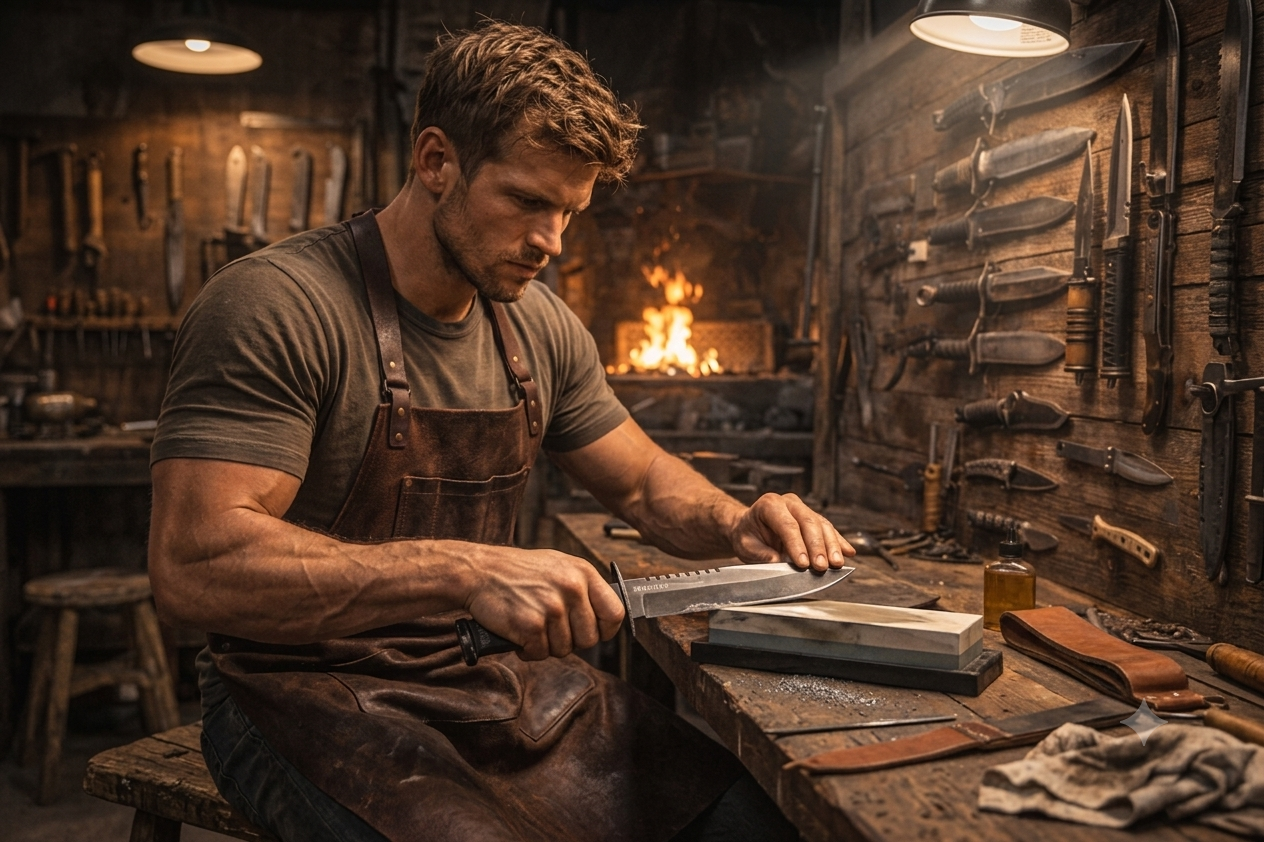
The Armorer pulls a stone off the shelf, wets it, and lays an old beater knife flat against it before he says anything.
"Every man owns blades," he says, working the knife across the stone slow and even and never looking up. "Damn near none of them keep one sharp. They buy steel, carry it for ten years, and never once put an edge back on it, and then they wonder why it tears instead of cuts and slips instead of bites." He turns the knife over. "A blade is a wedge of metal that does exactly one thing. It parts what it touches. Let the edge go and you don't own a knife anymore. You own a pry bar shaped like one." He wipes the blade, draws it through a sheet of newspaper without a sound, and hands you the stone. "You just read the whole wall. Now you find out none of it cuts unless you do this."
This is the second room on the blade rack and the unglamorous one: no sparring, no draw, no romance, and the room that decides whether every other room on the rack meant anything. A maintained edge is a different tool from a neglected one, same steel, same handle, same name, and a completely different machine in the hand. This page is the door to the stone: why a dull blade is a different tool and the one that cuts its owner, the angle as the whole argument, the standard each blade on the wall keeps, the three rooms in the order they are walked and why, the rhythm that keeps every edge in a house ready, the mistakes that belong to the stone alone, and why the kept edge hands the walk to the art.
Why a Dull Blade Is a Different Tool
A sharp edge cuts with almost no force. A man sets it, draws it, and the material opens. A dull edge does not cut. It crushes and tears its way through, and to do that it needs him to push, and that one difference runs downhill into everything.
The dull blade is the one that cuts the man holding it. The kitchen room said it about the tomato and the emergency room, and it is true of every blade on the wall: the man leans, the edge skates instead of biting, and the force he was pushing with arrives in his own hand. The dull blade fails under load, sawing at the cord a sharp one would part in a pass, and the man starts hating a tool that was only ever neglected. And the dull blade fails when it matters, because everything the Filipino room will teach assumes the blade cuts on contact, and the man who trained a draw around a dull edge built his whole answer on a tool that will pick the worst moment to show him it cannot bite. The edge is not a detail of the system. The edge is the system, and the rest is a way to carry it to the cut.
The Angle Is the Argument
Here is the thing most men never learn: there is no such thing as sharp. There is only sharp for a job. The whole craft lives in the angle the edge is ground to, and that angle is a trade. Every degree taken away to cut better is a degree of toughness given up, and every degree added for strength is a degree of cutting surrendered. The skill is knowing which trade the blade in the hand was built to make.
Picture the two ends. A straight razor and an axe are both edged steel and could not be more opposite. The razor is ground thin as a whisper, parts a hair because it gives up everything for the cut, and could be chipped on a fingernail. The axe is ground thick and blunt because its whole life is slamming into oak; it would never shave a man and would never want to. Put the razor's edge on the axe and the first swing folds it. Put the axe's edge on the razor and it will not cut paper. Neither is wrong. Each is honest to its work.
Measured in degrees per side, the spread runs like this. Fifteen and under, the keen edge: razors, fine kitchen knives, fillet blades, anything ground for the cleanest slice, which bites like nothing else and rolls or chips on bone, staple, or a plate. Twenty, the all-around edge, where most folders and working blades live, somewhere in the band from eighteen to twenty-two, which cuts well, takes honest use, and forgives a man who occasionally asks too much; if a man does not know what his knife wants, it probably wants this. Twenty-five, the hard-use edge: tactical fixed blades, heavy folders, machetes, field knives, anything pried with or batoned or driven into things that fight back, cutting a little less cleanly and shrugging off the abuse that would wreck a finer one. Thirty and up, the impact edge: axes, hatchets, cleavers, splitting wedges built to take repeated shock without folding.
Two rules carry the whole rack. Match the angle to the work, not the work to the angle. A box cutter and a machete do not want the same edge, and a man who grinds them alike ruins one. Know the blade's factory angle and hold it. Changing an angle means grinding away real steel and usually leaves an uneven, two-story bevel that cuts worse than what he started with. Maintenance means putting back the edge the maker chose, not picking a fight with the blade about what it should be.
Every Blade Keeps Its Own Bargain
A man does not own one knife. He owns the wall the last room taught him to read, and each blade on it keeps its own bargain, and keeping them sharp means keeping each to its standard, not running one stone over all of them and calling it done.
The everyday folder, around twenty, kept biting with a few strokes of a rod when it drags, and the blade most men neglect worst because it is the one they use most. The kitchen knives, a keen fifteen to seventeen on the chef's knife and the slicer, a touch more for anything that meets bone, honed before every real session and truly sharpened every few months. The field and tactical fixed blades, ground stouter at twenty-two to twenty-five and traded toward toughness on purpose, so that they come home from abuse with the edge intact. The machete, a blunt twenty-five to thirty, knocked back near the handle and finer at the sweet spot, filed in the field and not fussed over. The axe and hatchet, not knives but the same logic, a convex, well-padded edge that bites wood and never folds. And the fine edges, the razor and the scalpel, ground keen, kept polished, finished on leather rather than stone so that almost nothing comes off between uses.
The lesson under all of it: a sharp blade is one ground to the right angle for its purpose and kept there. The axe and the razor are both perfectly sharp. They answer different questions.
The Rooms, Walked in Order
Three rooms, and they are walked in the order a blade meets them across a year: often, seldom, and only when something has gone wrong.
Sharpening Sticks — the rod, and the habit. The between-times tool: the steel, the ceramic, and the diamond rod and the one thing each actually does, which is not sharpening; the strop that finishes what the stone started; the rods that travel and the curb and the coffee mug; the ten-second habit that keeps a man from ever needing the heavy grinding; and the two things the rod cannot do.
Whetstones — where the edge is made. The heart of the rack: the natural stones and the oil and water stones and the diamond plates; grit and the two scales that confuse it; the burr, which is the whole method; the marker and the tests that tell a man he is done; the jigs that hold the angle for a hand that has not learned it; and the stone that goes in the pack. The deepest craft in the building, because nothing holds the angle but the hand.
Grinding Stones & Wheels — the wheel, and its one rule. The powered tools, the bench grinder and the slow wet wheel and the belt and the slots: what heat does to a tempered edge and why the wheel's speed is its danger, the jobs the wheel is actually for, the trade of the man who sharpens for a living, and the one rule that lets a man own a wheel and keep his knives. The room closes the rack.
The order is the Armorer's. The rod first because it is the tool of every day and the habit that decides everything after it, and because a man who understands what the rod does not do understands why the stone exists. The stone second because it is where the edge is actually made and the hand actually learns, and because a man who has felt a burr on a stone will never again mistake a wheel for a sharpener. The wheel last because it is the tool most owners reach for first and ruin the most knives with, and its lesson only lands on a man who knows what an edge is and what heat does to one. There is no fourth room. When the wheel's rule is learned, the rack is kept, and the wall hands off to the art.
The Rhythm
Sharpening is not an event a man remembers once a year when the knife finally quits. It is a rhythm, and the man who runs it almost never has to do the heavy correction.
After hard use, the rod. A few strokes when the edge starts to drag, and weeks bought before a real sharpening. Weekly, the strop. Ten or twenty light passes a side keeps the polished edge polished. Monthly, the eye. Chips, rolls, a flat spot catching light, a loose tip; damage caught small is a small fix. Quarterly, the stones. A full cycle back to a fresh edge, or sooner, the day the rod and the strop stop holding it. Whenever it breaks, fix it now. A chip does not heal, and the damage a man lets ride costs him twice the steel to grind out later.
The cadence bends to the blade. The folder and the kitchen knives earn frequent attention because they earn frequent use; the safe-queen fixed blade goes long stretches. A man reads how a blade actually lives in his hand and sets its schedule to that, and not to a calendar that does not know which knives he is using.
What the Stone's Owner Gets Wrong
The wall named the mistakes of the man who chooses a blade. These belong to the man who keeps one.
He thinks the steel sharpens. The rod room's whole first section, and the commonest error on the rack.
He never raises a burr. He polishes the shoulder of the bevel for twenty minutes and the apex never touches the stone, and the marker would have told him in three strokes.
He changes the angle. He read that fifteen degrees is sharper and ground the field knife to it, and it rolled on the first baton, and now it has two bevels and neither one cuts.
He put the good knife on the dry wheel. The blue quarter inch. The wheel room opens on it.
He runs a dished stone. The water stone has a hollow in the middle a year deep, and every edge he makes on it has a curve he cannot explain.
He owns one pull-through and calls it sharpening. The carbide notch has scraped a tenth of an inch off the width of every kitchen knife in the house in five years, and none of them hold an edge for a week.
He sharpens once a year. The quarterly stones became the annual grinding, because the rod and the strop never happened, and every session is a rescue.
He carried a dull knife into the woods. Three days, one blade, and no plate in the pack, and the mug ring is at home on the shelf.
The Three Pillars on the Edge
TRUTH on the stone is a tested edge and not an assumed one. A man either tests his blade, on paper, on hair, on a number if he wants one, and knows what it will do, or he assumes it is sharp because he owns it, and the assumption fails him at contact. The maintained edge is a man refusing to lie to himself about whether his tool actually works, and the marker on the bevel is the rack's version of the target and the clock.
LOVE on the stone is the reason a man bothers. He keeps the blade cutting for the same reason he keeps anything ready: the people who depend on him and the daily work the tool was made for. The chef's knife that feeds a family, the skinner that fills the freezer cleanly, the folder that is in the hand when a hand needs it. A cared-for blade is a small, constant proof that a man tends what has been put in his hand instead of letting it rust.
LAW on the stone is the discipline of the rhythm, the unwatched, unrewarded habit of keeping every edge to its own standard, done because it is right and not because anyone checks. The dull blade is almost always a discipline problem wearing a maintenance costume, and the rack has no statute on it and does not need one.
Walked as a System
No one of the three tools can do the other two's work. The rod keeps an edge and cannot make one. The stone makes an edge and is too slow to fix a ruined one. The wheel fixes the ruin and would destroy the daily edge if it were let near it. A man who knows which tool the blade in his hand needs today owns edges, and a man who owns one tool and uses it for everything owns the pry bar the Armorer described.
And the stone hands off in two directions. Down the rack, to the art, because the kept edge is the price of admission to the last room on the wall and not the end of the work. And out, to every road on the property that runs on a cutting edge: the cook keeping his line moving, the carpenter on the job, the hunter at dusk, the man whose folder rides his pocket all day, all of them kept honest by the same stone, and all of them the reason the sharpening room is the one room on the blade rack that no man ever finishes needing.
After the Stone
A man leaves this rack with every blade on the wall kept to its own angle by his own hand, and that is more than most men who own knives will ever have.
What he does not have is any idea what the edge does in motion. Everything on this side of the shop, the wall and the stone, has treated the blade as an object: what it is, what it is for, how it is kept. The last room on the wall stops treating it that way. It puts a rattan stick in a man's hand on the first day, and then a trainer with the edge ground off, and a man who learned the Filipino blade across an ocean and proved it at doors will have him moving before he has finished asking what the stick is for, because the blade is the fastest teacher of movement there is and the empty hand turns out to have been inside it the whole time. The edge a man just learned to keep is about to teach him where his feet go.