
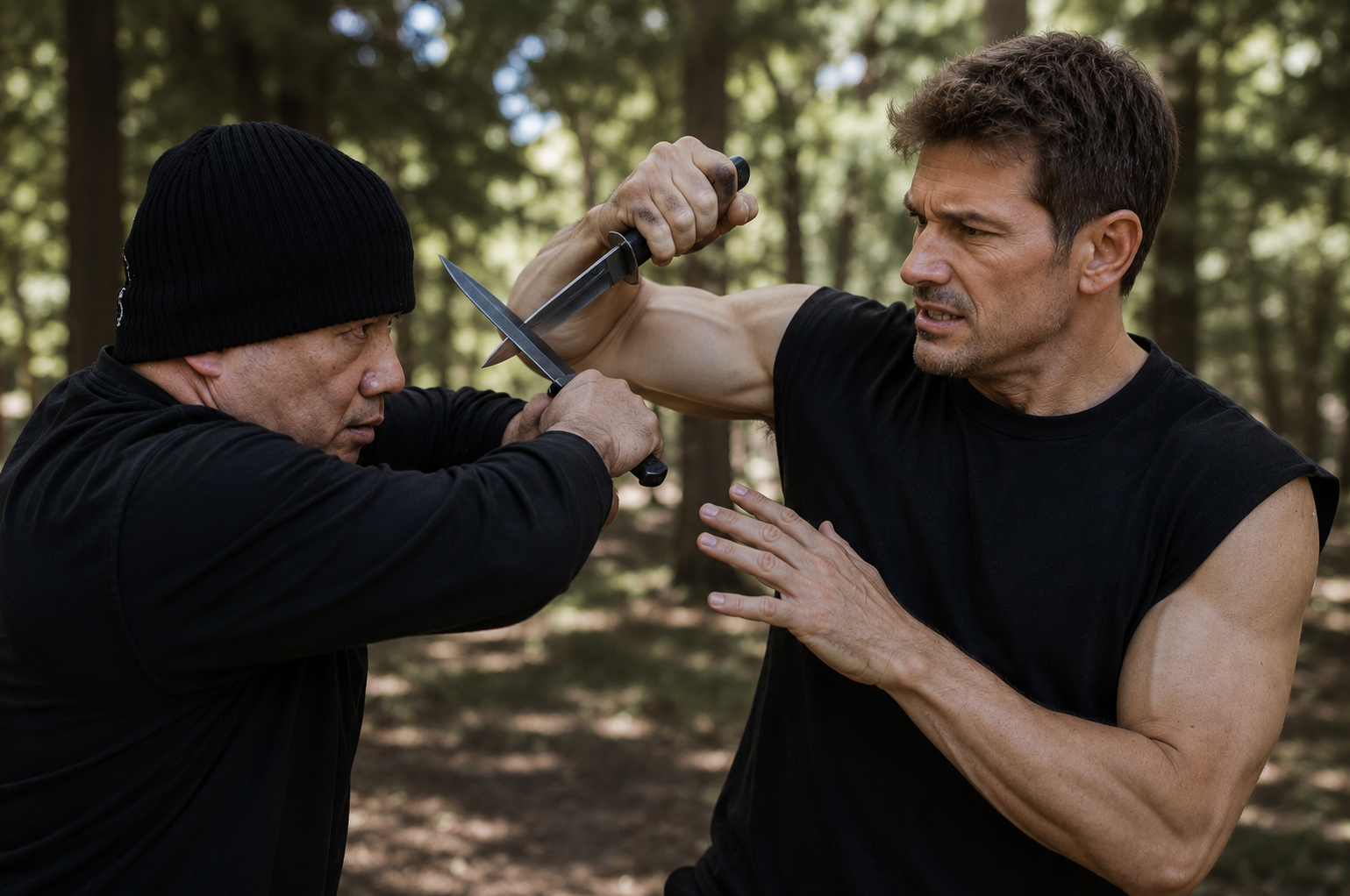
Pekiti Tirsia
Pekiti Tirsia 101
Eskrima
Knife Boxing
Silat & Kali
The Blade in Motion
The Armorer puts a strip of tape on the shed floor and paces it off, and it is longer than you expected. Twenty-one feet. Seven long strides.
"A police trainer asked a simple question forty years ago," he says, standing on the far end of it. "How close can a man with a knife stand before he's too close to stop? So he timed it." He has the rubber training knife in his hand now, held low. "An ordinary man, from here, covers that tape and puts a blade in your chest in about a second and a half. A trained man clears a holster and fires in about that. Which means the man on this end of the tape wins, and the men who found that out with a stopwatch were policemen who were sure they'd win, and it rewrote every academy in the country." He walks it, not fast, and you draw the training pistol and say bang, and the knife is already under your ribs. "Inside that tape the blade wins. The islands knew that four hundred years before anybody put a clock on it, and they built a whole way of moving around it, and that's what this rack is. It isn't about a knife. It's about what a man does with his feet and his hands when the tape is already gone."
This is the last rack on the blade wall, and the one where the blade stops being an object and becomes a way of moving. The wall taught a man to read a knife and the stone taught him to keep one, and this rack teaches the Filipino art that puts a stick in his hand on the first day and finds the empty hand inside it. This page is the door: why the blade is the teacher, what the art actually is in five ideas a boy can grasp, the four rooms in the order they are walked and why, why a gun man still trains the blade, the mistakes the blade student makes, how the rooms hand each other off, and why the rack's last lesson is the door into the close range.
Why the Blade Is the Teacher
Every Western fighting art teaches a man to punch first and hands him a weapon years later, if ever. The Filipino arts do the opposite, and the reversal is the whole secret.
They put a stick or a blade in his hand on day one, not because they expect him to walk through life armed but because the weapon is the fastest teacher of movement a man ever met. A blade punishes a lazy angle instantly and rewards economy, footwork, and timing with brutal clarity, because the cost of a mistake is not a bruise but a hand opening up. Train the weapon honestly and the movements burn into the body. Then he sets the weapon down, and his empty hands already know what to do. The same angle that cut now blocks. The same footwork that closed with a knife closes with a fist. Most arts build the empty hand and bolt a weapon on later. The Filipinos build the weapon and find the empty hand was inside it the whole time.
That single idea makes the art efficient in a way that should interest a busy man. He is not learning a knife art and a stick art and an empty-hand art. He is learning one way of moving, expressed through whatever happens to be in his hand, a pen, a flashlight, a rolled magazine, or nothing at all, and the body does not switch programs when the tool changes. A fight gives no time to switch programs.
What the Art Actually Is
Strip away the foreign words and the art is built on a handful of ideas a twelve-year-old can grasp and a lifetime cannot exhaust.
Everything comes in on an angle. Punches, slashes, swings, thrusts, there are only so many lines an attack can travel, and the art maps them. Learn to see the angle the instant it leaves and a man stops chasing the weapon and starts meeting the line. The same handful of angles he learns to attack on are the angles he learns to defend, so every drill teaches both sides at once.
Stand on a triangle, not a line. The footwork moves a man off the path of the attack and onto a corner of it, where he can hit and the other man has to turn to find him. A straight step backward just loses ground. A step to the triangle's point takes ground and the better seat. The feet are the foundation; the hands only cash the check the feet wrote.
Three distances, and the seams between them. Long, middle, and close, in the old tongue largo, medio, corto. A real fight slides through all three in seconds. Most men train comfortably in one and fall apart in the others, and the art trains the seams, the ugly transitions where a fight is actually won or lost.
Defang the snake. The signature, and it is mercy with teeth. Instead of going for the man, go for the weapon: the hand, the wrist, the forearm driving the blade. Take the fang and the snake is still a snake but it cannot bite. The principle disables the attack instead of destroying the attacker, which is exactly the restraint a man under a badge, or under God, is supposed to carry.
Never stop moving. There is no pause between defending and answering. The block is the start of the strike, and the whole exchange is one motion the way water does not decide to flow. A fight does not wait politely while a man switches from defense to offense.
The Rack, Walked in Order
Four rooms, and the order runs from the class to the door to the family to the ground.
Pekiti Tirsia 101 — the first class at the blade bench. A stick in the hand and an hour of triangles before anyone swings it: where the family art came from and what its name means, the twelve kinds of footwork, the angles and the alphabet of a hundred and forty-four attacks, the two grips and the three distances, and why the weapon comes first. Beneath it, two training outlines: the PTI Outline, the whole system in the order it is learned with the standards a man meets at each level, and the Pekiti Boxing Course Outline, the sixty-three lessons of the course the next room is built on.
Knife Boxing — the way in. The boxing a Westerner already half understands, with the blade poured into it so that the body never changes gears. Held by a Māori from New Zealand who chased the islands' art across an ocean as a boy, climbed to its highest rank, proved it through a decade at doors with a badge on, and built the course.
Eskrima — the family the art belongs to. A history: the three names and the argument about them, three centuries of a Spanish ban and the dance that hid the art, the Cebu schools and the men who carried the art to America, the padded sport, and the law that made it the nation's own.
Silat & Kali — the cousins across the water. The Malay family that shares a sea with the islands, the arts that take the blade low and to the ground, the hooked blade they gave the world, the word Kali and where it points, the lines that came west, and an honest ledger of the dance and the mystic. With it the rack is finished, and the wall turns to the close range.
The order is the Armorer's. The class first because footwork comes before everything and the old man who built the art learned nothing else for three years. The way in second because a Westerner enters through the door his body already half knows, and the man who built that door is the one who should hold it. The family third because a man who has trained the art for a season is ready to learn whose yard it came out of, and not before, because history before practice is a lecture. And the cousins last because they take the blade to the ground, and the ground is where the rack was walking the whole time.
Why a Gun Man Still Trains the Blade
A man who carries a pistol is tempted to skip this rack. That is the mistake the tape on the floor was laid to cure, and it gets men killed.
Inside twenty-one feet the blade beats the holster. The fight that starts at conversation distance, the parking lot, the doorway, the gas pump, starts in the knife's kingdom and not the gun's, and a man who cannot fight with empty hands and cannot survive the first second of a blade rush will never live to draw the firearm he was counting on. The skills braid together: the footwork that defangs a knife is the footwork that buys the half step and the angle to clear a holster; the close-range structure that keeps a blade off a man is the structure that keeps another man from stripping his pistol in a clinch. This is not a competing kingdom to the gun rack across the shed. It is the ground floor under it. The Marines did not adopt Filipino blade work because they expect Marines to sword-fight. They adopted it because it builds the man who is dangerous before, and after, the gun.
What the Blade Student Gets Wrong
The Edged Weapons bench named the untrained carrier's ditch. These are the mistakes of the man who has started to train.
He swings the stick as a stick. Every pattern was built for a blade, and a man who has forgotten that is doing a dance.
He skips the footwork. He wants the angles and the disarms and stands flat-footed on the line to do them, and a partner with a marker draws a line across his forearm every round.
He chases the weapon. His eyes follow the knife instead of reading the line it leaves on, and he is always a half beat late.
He trains one distance. Long range, usually, because it is safe, and he falls apart the first time a partner closes.
He learned his boxing in one hall and his blade in another. The half second of gear change the way-in room exists to remove.
He collects disarms. A hundred and eighty of them in the system and he wants all of them by Christmas, and the class's alphabet is still not solo from memory.
He romances the fight. He has trained just enough to want the engagement, and the men who actually know are the ones most committed to never having it.
He forgot the law. The blade he trains with is a training blade, and the one he carries is wrapped in statute that changes at the county line, and he has read the rack and not the law.
The Three Pillars at the Blade Bench
TRUTH at this bench is the cut. The blade does not flatter a sloppy angle or a lazy foot; it opens a man up and tells the truth instantly, and that honesty is why the islands teach with it. The marker round at the end of every session, the lines counted and written down, is the target and the clock of this rack, and a man who trains against a real edge, even a dulled one moving with intent, cannot keep lying to himself about where he stands.
LOVE at this bench is the fang and not the snake. The art's signature is a choice to take the hand and leave the man, and it is the only fighting principle on the property whose first instinct is to stop short. A man trains it for the people who will be standing behind him on the day, and he trains it so that the man in front of him, who may be a threat and may be a fool with a kitchen knife, meets a hand that knows how to end the threat and keep the fool alive. The measure of the rack is not how much a man can do with a blade. It is how little he needs to.
LAW at this bench is the difference between the training blade and the carried one. The stick and the rubber knife answer to nobody; the folder in a man's pocket answers to a statute that the tactical room dated and that changes at the county line, and the art he trains gives him no license the statute did not. A trained man who draws is judged as a trained man, and the reading at Legal Defense is done before the first class, not after the first draw.
Walked as a System
A stick, and four rooms that each do something to the man holding it. The class puts the triangle under a man and the angles in his hand. The way in pours them into the body he already had. The family tells him whose yard the art came from and why it looks the way it does. The cousins take the blade to the ground and show him where the whole thing was going.
And the rack hands off in two directions. Down the wall to the close range, because the blade that defanged a snake at arm's length has no room to move at bad-breath distance, and the gun on the belt is a thing being wrestled over, and the seam the art trains between its three distances is the seam the whole Armory ends on. And up the hill, to the War Room and the Homestead, where a man's read of another man's hands at the gas pump never becomes anything because he saw it early and left, which is the first and best use of everything on this rack.
After the Bench
Everything in this room, and every room before it, the empty hand on the mat, the gun at the rack, the blade in the hand, is preparation for a day a man prays never comes. And the first thing it buys him is the confidence not to fight. A man who truly knows what he can do carries a calm most confrontations never get past. He reads it early, keeps his hands loose, hands the angry man an off-ramp, and walks away with nothing to prove. The trained man de-escalates far more fights than he finishes.
But the other man gets a vote, and sometimes he spends it, and when the talking stops the fight does not wait on the open mat where a man trained. It comes where he is standing: a parking lot, a friend's celebration with a man who will not leave, his own front door coming off its hinges at three in the morning with his family asleep behind him. It is always close: a room, a hallway, arm's reach, no referee. And it is bigger than blade on blade or a clean fistfight. It is where the empty hand, the blade, and the gun collide at once, where a man grabs for your weapon and you keep it, where you strip his, where you clear a corner of your own house in the dark. A man may train his whole life and never see it. He trains for it anyway, because readiness is the discipline and not the wish.