
Politics
The Brain built the wall a second time.
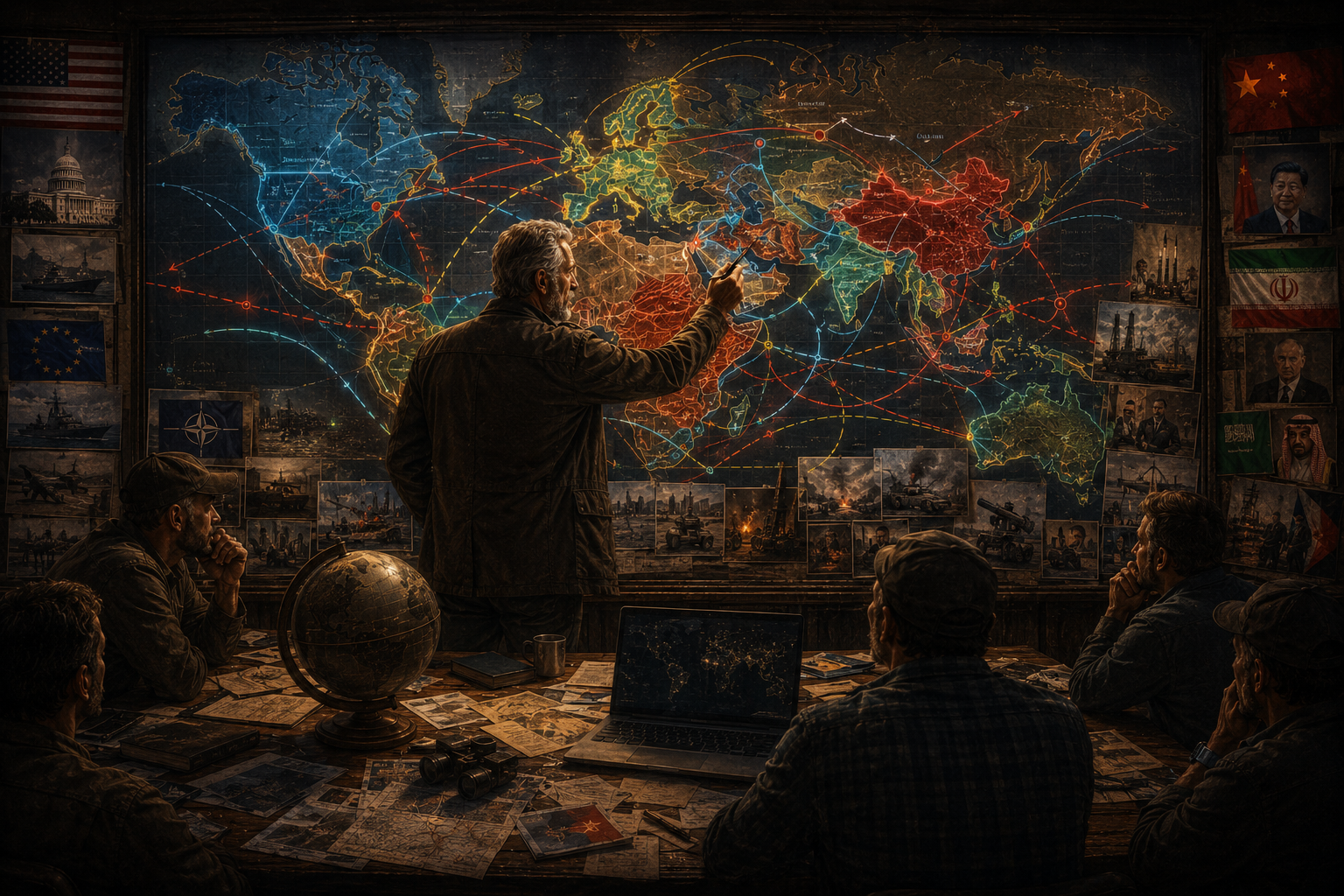
He did it in his own garage, on a sheet of plywood, over three nights, the way he did it in 1995 when he was fourteen and the plywood was somebody's father's. Two administrations, opposite parties. Campaign promises taped up the left side. What actually got signed taped up the right. Red string between anything that matched.
Different two administrations this time. Thirty years of daylight between the walls. Same string, same seam.
The rhetoric is violently different — different enemies, different language, different men on television doing the shouting, and the men shouting on television are the entire product as far as most people ever see it. Then you follow the string past the speeches and into the appropriations, the appointments, the renewals, the reauthorizations that got quietly extended in December while everyone was at their mother's house, and a great deal of it runs straight through the seam without a break. Same contractors. Same agencies. Same programs, renamed.
They had come to his house straight off a week of ghost tours, a fence line in Utah and a gift shop in San Jose, carrying one thing they had learned three different ways: something happens, somebody tells you what it was, and somebody benefits from the telling.
The Scribe got there first, standing in front of the plywood with his coat still on.
"It's the same shape," he said. "The tour guide tells you the story and sells you the shot glass. This one tells you the story and then a line item shows up."
"That's the difference, though," the Brain said. "Nobody had to leak any of this to me. Every page on that wall is public. The promises are on video and the appropriations are printed with a number on them. It isn't hidden. It's just long, and boring, and nobody reads it."
And the Captain — who asked this in a garage in 1995 with a summer job and no vote — stood there with thirty more years on him and asked it again, in the same words, because nobody had ever answered it.
So what exactly did the election change?
Nobody in that garage had an answer either time. That is the night this transmission starts.
Politics
"Put not your trust in princes, in a son of man, in whom there is no salvation. When his breath departs, he returns to the earth; on that very day his plans perish" — Psalm 146:3-4
Nothing in that is cynical, and that is what makes it useful. It does not say princes are wicked, or that governance is a fraud, or that a man should not vote. It makes an observation about durability.
On that very day his plans perish. The man dies and the agenda he built his life around goes with him, and the machine that outlives him hands the same seat to somebody else. That is not a judgment on the man. It is a statement about the class of object he is — and the warning is aimed not at princes but at the man doing the trusting.
This room is about reading political activity as it operates rather than as it describes itself. It is not about picking a side. A man is going to pick sides anyway; that is what citizenship is. It is about being able to see the machinery while he does it.
Five Patterns That Do Not Depend on Who Won
These are not theories about hidden men in a room. Four of the five were named by academics who studied institutions and published what they found, and they hold across countries, centuries, parties, and ideologies — which is exactly what makes them worth knowing. A man who understands them stops being surprised.
The gap between the agent and the people who hired him. Someone is sent to act on behalf of others. His interests and their interests are not identical, and he has far better information than they do about what he is actually doing. Everything downstream follows from that gap. It is not corruption; it is a structural feature of any arrangement where one person acts for many, and it applies to a congressman exactly the way it applies to a contractor renovating your kitchen. The difference is that you can inspect the kitchen.
Organizations drift toward rule by the few. Robert Michels studied socialist parties in 1911 — organizations explicitly built to be democratic, run by people sincerely committed to that — and found that all of them developed a permanent leadership class anyway. He called it the iron law of oligarchy. The mechanism is boring: someone has to handle the day-to-day, that person accumulates information and relationships, and the accumulation is what makes him necessary. Nobody staged a coup. The people who stayed in the room became the room.
Regulators drift toward the industry they regulate. George Stigler documented the pattern and won a Nobel for it. The agency needs technical expertise, and the only people who have it work in the industry. The rules get written by people who know the business, enforced by people hoping to work in it later, on companies large enough to absorb the compliance cost — which quietly makes the regulation a barrier protecting the biggest firms from competition. Every step is defensible. The assembly is the problem, and it is the same shape as every other assembled wrong in this section.
The part that does not stand for election. Elected officials arrive and leave on a schedule. The permanent staff, the career agencies, and the contracting relationships do not. A president gets four years and a few thousand appointments over a workforce of millions; the practical effect is that continuity lives with the people who were there before him and will be there after. This is worth stating carefully, because it is the pattern most often inflated into something it is not. Documented: the continuity, the budgets, the size of the workforce, how little of it turns over. Contested: how much of that is coordination and how much is simple institutional inertia. Men who collapse those two columns end up unable to tell an ordinary bureaucracy from a conspiracy, and they lose the ability to identify either.
Movements that were funded before they were popular. Some are entirely organic. Some are built — a foundation, a media strategy, professional organizers, a slogan tested before anyone chanted it. Both exist, they look identical from the outside, and the tell is the money and the timeline rather than the sincerity of the people in the street, who are usually sincere. The question is never do these people mean it. It is: who was paying for the infrastructure before there was a crowd?
The Warning That Was Given in Advance
The oldest political analysis in the record is not a theory. It is a job description delivered to people who had asked for a king and did not want to hear it.
"He will take your sons and appoint them to his chariots... He will take your daughters to be perfumers and cooks and bakers. He will take the best of your fields and vineyards and olive orchards and give them to his servants... He will take the tenth of your flocks, and you shall be his slaves" — 1 Samuel 8:11-17
Read the verb. It is the same one every time. Take.
Not he will oppress you — the passage never uses that language. It describes ordinary administration: staffing, agriculture, procurement, taxation. Every item on the list is a normal function of a state, and the point is that a state does not merely provide, it takes, permanently, at a rate that grows — and the people asking for one had not thought about that at all. They wanted to be like the other nations. This is what the other nations cost.
Then the part nobody quotes.
"And in that day you will cry out because of your king, whom you have chosen for yourselves, but the LORD will not answer you in that day" — 1 Samuel 8:18
Whom you have chosen for yourselves. The complaint will be legitimate and it will also be about a thing they asked for, having been told in detail what it would cost. That is not divine cruelty. It is the ordinary structure of a decision made with the information available and made anyway.
Every generation runs some version of this, and it is worth being honest that both political dispositions do it. Men trade specific freedoms for a promised safety, get exactly the arrangement they voted for, and are then genuinely outraged by the terms.
Both Things Are Commanded
The scriptural position is not the one either side wants, because it is two things at once and neither half is optional.
Obey. Civil authority is not an accident and it is not the enemy. Taxes get paid, laws get kept, officeholders get honored as officeholders, and prayer is commanded for the ones a man cannot stand. A faith that produces contempt for every institution has not produced discernment; it has produced adolescence.
And refuse, when it commands what God forbids. Daniel keeps praying with the windows open after the law says not to. His friends decline to bow. The apostles keep speaking after the order to stop. In every case the refusal is specific, narrow, non-violent, and the men pay the penalty rather than evade it. They do not overthrow anything. They simply will not do the one thing, and they accept what that costs.
That is the whole shape of it: broad cooperation, narrow refusal, penalty accepted. Most men get it wrong by widening the refusal until everything is a hill, or by narrowing it until nothing is.
"The Most High rules the kingdom of men and gives it to whom he will and sets over it the lowliest of men" — Daniel 4:17
That sentence is delivered to the most powerful man on earth, about himself, and it is the sentence that keeps a man from both errors at once. Gives it to whom he will — which means the outcome a man is frightened of is not outside authority, and the outcome he is celebrating is not his achievement either. The lowliest of men — and it names, flatly, that the office has repeatedly gone to people nobody would have picked.
A man who holds that verse cannot despair when the wrong side wins, and cannot get drunk when his side does.
The Two Ditches
There are two ways to fail this room, and a man usually has a temperamental preference for one.
The first is baptism. He fuses his faith to a party until the platform becomes the doctrine and any criticism of the one reads as apostasy from the other. He can no longer see his own side's failures — not because he is dishonest, but because the categories have merged and the failure has nowhere to be filed. This ditch is comfortable, it comes with a community, and it costs him his ability to tell the truth about the people he votes for.
The second is withdrawal. He decides it is all theater, that no vote matters, that engagement is naive — and he calls this being awake. It has the flavor of sophistication and the substance of quitting. It also conveniently removes every obligation: no candidate to research, no local meeting to attend, no neighbor to persuade, nothing to be responsible for. A man in this ditch has strong opinions and no address.
The way between them is unglamorous. Vote. Know the local offices, which matter more to a man's actual life than the national ones and get a fraction of the attention. Engage where he is standing. Hold his own side to the standard he applies to the other. And do not put his hope in it — not because hope is foolish, but because it was never that kind of object.
What the Wall Cannot Show
Two walls, thirty years apart, and both of them are honest work. But there is a hole in the middle of the plywood and it is worth naming, because a man can spend a decade tracing string and never notice it.
Every pattern in this room is mechanical. The gap between the agent and the principal. The drift toward oligarchy. The capture of the regulator. The permanence of the staff. The money that arrives before the crowd. All five describe what happens to power once power exists — the way a hydrologist describes what water does once it is in the pipe.
None of them can tell you what the pipe is for.
Look at what the wall actually assumes without ever saying so. That there should be an election at all. That an appropriation must be voted and printed. That a man holding office is answerable to people who do not. That there are things a majority is not permitted to do to a minority. That a document written by dead men can bind a living government, and that when it is violated somebody is supposed to be able to say so out loud without being arrested.
Not one of those is natural. Every one of them is contested somewhere on earth right now, has been lost in places that had it, and was for most of human history a fringe position held by a handful of people with no power whatsoever.
They are not in the appropriations because they are upstream of the appropriations. Somebody argued them, in a book, in a lecture hall, in a jail cell, usually with no army and frequently at personal cost, and lost — and then somebody else picked the argument up two centuries later and won it, and a hundred years after that it turned into a line item on a sheet of plywood in a garage in a country that did not exist when the argument started.
Which is why a man can know every mechanism in this room, trace every dollar, name every contractor, and still be unable to answer the only question that finally matters: not who has the power, but what it is for, and who says.
That is not a political question. It never was. And it is the reason this transmission does not end here.
Where the File Goes Deeper
Geopolitics — the same five patterns at the level of nations: alliances, sanctions, resource corridors and wars, read for what is actually being contested rather than what is being announced. Its files run the current conflicts — Ukraine vs. Russia Conflict — along with Economic & Trade Wars and the Sanctions & Embargos architecture, which is where most modern coercion actually happens and where almost nobody looks.
The room also holds the structural material a man needs before any of the above makes sense: political science as a discipline and what it can and cannot measure; two-party systems and what the arithmetic of them forces on everybody inside them; constitutional frameworks and what a written limit can and cannot do to a government that decides to ignore it; and the administrative state — the part of government that writes most of the rules a citizen actually lives under, staffed by people no citizen ever voted for.
Closing the Transmission
Both walls are still up. The one in 1995 came down when the garage got cleaned out. The one on the plywood is in the Brain's shop right now with the string sagging on the left side.
What the crew took off the first wall is not that voting is pointless. The boys were too young to vote and their parents were not, and that year the school board in their county was decided by a hundred and eleven votes — a fact the Brain has repeated for thirty years to anybody who says it does not matter. What they took is narrower and more useful: the visible fight and the actual machinery are two different subjects, and a man who studies only the first will be permanently surprised by the second.
What they took off the second wall is the hole in the middle of it.
Because the strange thing about the whole exercise — three nights, two administrations, a hundred pages of public record — is that the most powerful thing on that plywood is not on it. It is the unexamined assumption that the appropriation had to be printed at all. Somebody won that argument. His name is not on the wall. There is no line item for him. He is very likely somebody nobody in that garage could name.
"There was a little city with few men in it, and a great king came against it and besieged it, building great siegeworks against it. But there was found in it a poor, wise man, and he by his wisdom delivered the city. Yet no one remembered that poor man" — Ecclesiastes 9:14-15
Read who wins that story and who gets remembered for it. The king had the army, the siegeworks, the budget and the name. The man who actually saved the city had none of those and is not named in his own account of it. The next verse says it flatly: wisdom is better than strength, and the poor man's wisdom is despised and his words are not heard.
That is the correct order of operations and almost nobody runs it. Everyone watches the king, because the king is loud, funded and on television. Almost nobody watches the man with nothing but an argument — which is exactly why the argument keeps winning, quietly, decades late, long after the siege is over and the king is dead and his plans have perished on schedule.
Hold your trust somewhere it will not perish on a Tuesday. Then go find out who wrote the assumption you have been standing on your whole life without once inspecting it.