
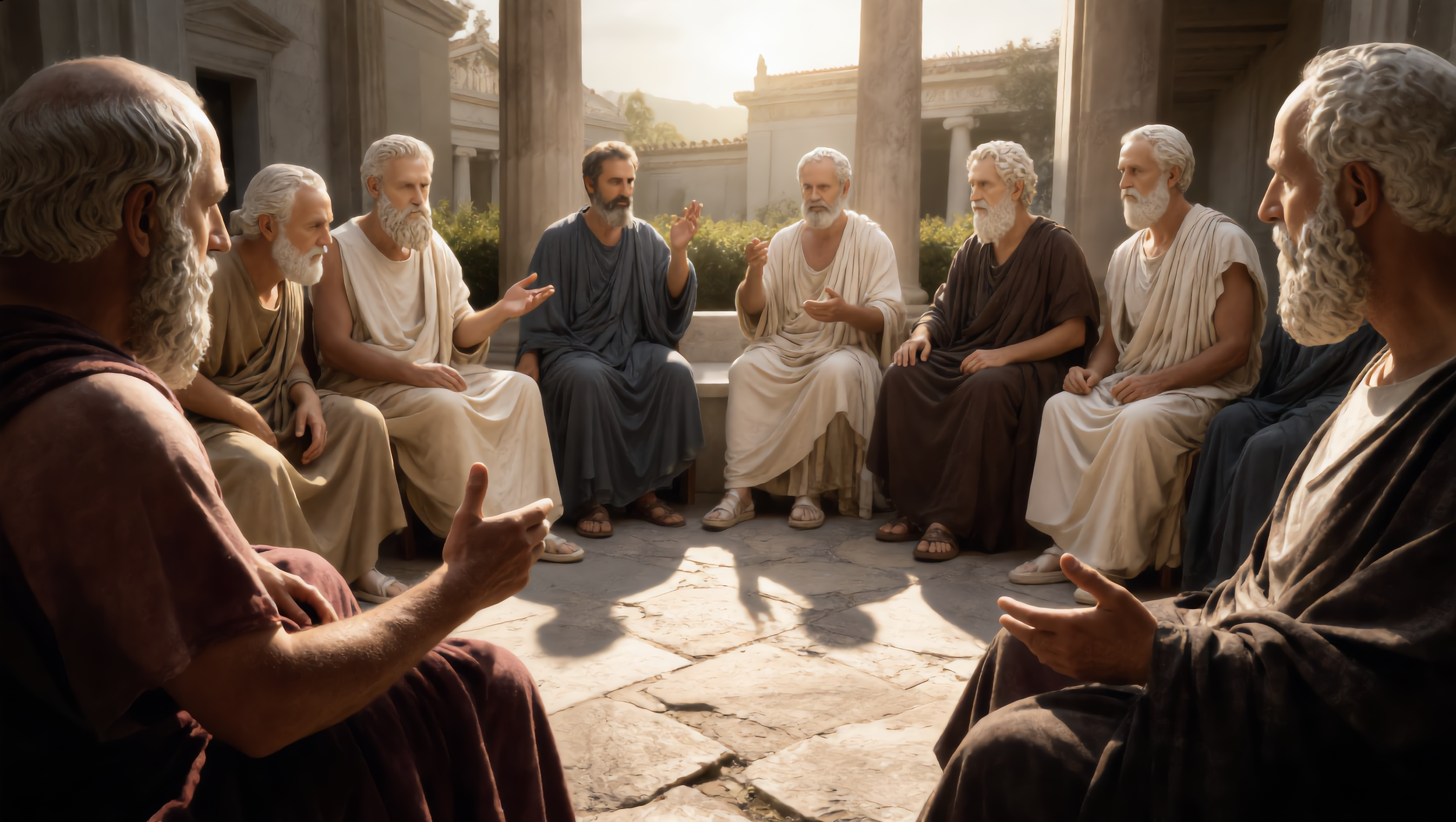
Schools of Thought
Ancient Philosophy
Nihilism
Perennialism
They went in with one question and it was the Brain's, because he is the one who wants names.
He had come off three nights in front of a sheet of plywood and he wanted to know who wrote the assumption. Not the appropriation — the thing underneath it. Who decided an appropriation had to be printed. Who first argued that a man holding an office answers to people who do not. Somebody thought of that. Somebody had to think of it first, and the Brain wanted the name the way he wants every name.
The reading room is small and badly lit and colder than the hallway. The man who runs it has been in that building thirty-five years and does not bring out the modern reprints. He brings the originals, one at a time, on a foam cradle, and he waits while you decide whether you are going to be careful.
He listened to the whole question without interrupting, which took a while.
"You want a man," he said. "There isn't a man. There are about forty of them and most of them were arguing with each other."
Then he went and got something and set it down and opened it to a page he clearly knew by heart.
It was a printed volume from the seventeenth century with a wide margin, and running down that margin in brown ink was a second man's handwriting — dense, fast, in Latin, in places underlined twice. He was arguing. He was raising objections, conceding one point, refusing three others, and at the bottom of the page he had written something short that the librarian translated as roughly this is where he is wrong and I will show it.
"He's answering the author," the librarian said.
"Fine," the Captain said. "When did they meet?"
"They didn't. That man had been dead a hundred and thirty years."
Nobody said anything for a second.
The Scribe is the one who writes down what people actually said, which is why he is usually the last to talk and why the question, when it came, was his.
"So if none of them ever met," he said, "who exactly was having the conversation?"
The librarian did not answer him. He looked pleased, in the specific way of a man who has been waiting a long time for somebody to ask the right thing in his room, and he went to get another volume.
Nobody in that reading room had an answer either. That is the night this transmission starts.
Schools of Thought
"My son, beware of anything beyond these. Of making many books there is no end, and much study is a weariness of the flesh"* — Ecclesiastes 12:12
That is the closing paragraph of the most philosophically restless book in the canon, written by a man who had tried everything and reported back — and it is a warning, from inside the reading room, about the reading room.
Of making many books there is no end. Not that books are bad. That the supply is infinite, and a man who intends to resolve his life by getting to the bottom of the pile has misunderstood the pile. There is no bottom. There has never been a bottom. Every generation adds to it, and much study is a weariness of the flesh is the honest report of a man who found that out at the cost of his own energy.
Every idea currently governing your life was argued into existence by somebody whose name you may not know, in a language you do not read, against opponents whose objections were better than the ones you have heard. A man cannot be governed by an idea he can name. This room is where they get named.
Read the systems. Learn the architecture. And know going in that this room does not terminate in an answer — it terminates in a man who can finally see the walls of the house he was already living in.
First Discipline — Which Mode Is It Running In?
Most misreadings of philosophy come from one error: treating every school as a positive program for living.
Diagnostic schools identify what is wrong with a situation. Nihilism is the clearest case. Nietzsche's articulation is not a proposal — it is a diagnosis, a description of the condition produced in late-nineteenth-century Europe by the collapse of a metaphysical inheritance that the culture had stopped believing and had not stopped depending on. A man who reads that as an instruction has taken a doctor's chart as a prescription.
Structural schools are positive frameworks for living, knowing, or governing. Stoicism is the clearest case — Epictetus, Marcus Aurelius, and Seneca built something a practitioner is meant to live inside, not merely to diagnose with. Aristotelian virtue ethics is structural. Marxism, whatever its diagnostic ancestry in Hegel, was built as a structural program and was implemented as one.
Assign the mode honestly, because each error has its own consequences. A man who reads Marx as merely diagnostic will be surprised by what gets built. A man who reads Nietzsche as structural will build something Nietzsche was describing as a catastrophe.
Second Discipline — The Track Record Counts
This is where this room departs from the seminar, and it does so deliberately.
The academy has spent most of the modern period evaluating philosophies by internal coherence — is the argument valid, is the system consistent, does it answer its critics. Those are real questions. They are not the only ones, and the second question is the one the seminar tends not to ask: what have the civilizations that actually ran on this produced?
Marxist-derived class-warfare frameworks produced somewhere between 65 and 100 million deaths across the twentieth century — the documented Soviet, Maoist, Cambodian, North Korean, Vietnamese, and Eastern European totals. That is data about the system, not an insult to it. Anyone treating it as a live theoretical option without accounting for the implementation record is doing half the analysis and calling it rigor.
Nihilist-saturated environments produce documented patterns of suicide, addiction, and social dissolution. Durkheim's finding on anomie is a century old and has been corroborated repeatedly. Also data.
Stoicism in its classical form produced real goods inside its frame and existed within slave economies organized around imperial expansion. The record is genuinely mixed, and it reads nothing like the contemporary marketing. Memento mori on a wristband is not Marcus Aurelius.
Christianity has a two-thousand-year record and it gets the same treatment, which is the only way this discipline stays honest. On one side: universities, hospitals, the abolition movements in the regions it shaped, and a human-rights architecture built on the claim that every person carries the image of God. On the other: long periods of institutional corruption, violence carried out under its banner, and the alliances with power that a man reading the Gospels straight would not have predicted. Both belong in the file. A room that runs the ledger on Marx and suppresses it here has forfeited the right to run it at all.
"Where is the one who is wise? Where is the scribe? Where is the debater of this age? Has not God made foolish the wisdom of the world?" — 1 Corinthians 1:20
Three job titles, and every one is a credential. Not where is the fool — the wise, the scribe, the debater. The question is about the durability of the most credentialed men in the room, asked from a distance of centuries, and the answer is a matter of public record: most of them are not remembered, and the systems they defended have been superseded by systems that will also be superseded.
That is not an argument against study. It is an argument against awe.
Third Discipline — Novelty Is Not a Recommendation
"Now all the Athenians and the foreigners who lived there would spend their time in nothing except telling or hearing something new" — Acts 17:21
It is a throwaway line — a narrator's aside about the intellectual capital of the ancient world, and it is devastating precisely because it is not an accusation of stupidity. These were serious people in a serious city with a real philosophical tradition.
Nothing except telling or hearing something new. The appetite had become the activity. New was the criterion, and a thing that had been discussed last year had, for that reason alone, stopped being interesting.
That appetite is the ordinary condition of an educated man now, and it is worth naming as a failure mode rather than a virtue. An idea is not better for being recent, and a framework that has been examined for eight hundred years and survived has passed a test that this year's cannot yet have taken.
The Five Layers
The architecture reads more easily if a man knows the shape, even if he walks it out of order.
The Greek inheritance. Socrates, Plato, Aristotle, and the Hellenistic schools — Stoicism, Epicureanism, Skepticism, the Cynics. The foundation the entire Western tradition is built on. Not optional for anyone who wants to understand the architecture of his own mind.
The medieval synthesis. Augustine, Boethius, Anselm, Aquinas, and the broader tradition — the framework Christianity actually ran on into modernity. Skip this layer and the early moderns become incomprehensible, because a man cannot see what they were arguing against, or notice how much of it they quietly kept.
The early-modern turn. The Reformation's philosophical work, Cartesian rationalism through Descartes, Spinoza, and Leibniz, the British empiricists in Locke, Berkeley, and Hume, and the German idealists from Kant through Hegel. Most of the modern academy's unstated assumptions were set here, which is why they are unstated — nobody argues for what everyone in the building already assumes.
The nineteenth-century break. Marx's class framework, Nietzsche's diagnosis, Kierkegaard's existential turn, Hegel's dialectical method. The men who shaped the modern world's politics, psychology, and art were nearly all drawing on this layer.
The twentieth century. Phenomenology, existentialism, pragmatism, analytic philosophy, postmodernism, and the critical-theory descendants of Marx. This is the water the contemporary man is swimming in, which makes it the hardest layer to see and the most important one to name.
The Conversation Nobody Attended
Now back to the Scribe's question, because it is a better question than it sounded like standing there.
A man writes a book. A hundred and thirty years later another man buys a copy, reads it in a cold room, and argues with him in the margin — concedes a point, refuses three, and writes this is where he is wrong at the bottom of the page. Two hundred years after that a third man finds that copy, and the marginalia is now part of what he is reading, and he argues with both of them.
That is the whole architecture, and it has three features worth naming out loud.
It is genuinely a conversation. Not a sequence of unrelated opinions. Each man is answering somebody specific, usually by name, often at length, and the objections are frequently better than anything a modern reader has heard on the subject. The layers above are not a filing system. They are turns.
The dead keep replying. This is the part that startled the crew and it should. In a normal argument, the man who dies loses by default. Here he does not — his book is still on the shelf making the same case at full strength, and it has all the time in the world. Aristotle has been answering objections for twenty-three hundred years and has not gotten tired once. A tradition is what an argument looks like when nobody has to stop talking.
And every voice in it is reasoning in the same direction. This is the feature nobody in the room mentions, because inside the room it is invisible.
Take any volume off any shelf in that building. Every one of them is a man starting from what a human being can observe — the world, other people, his own mind, the arguments of men before him — and working upward. Building. Inferring. Climbing from what he can see toward what he cannot. That is not a criticism; it is a beautiful and enormously valuable thing to do, and it is why the reading room exists.
But it is one method, run by one species, from one position, with one set of instruments. Roughly forty men over twenty-five hundred years, most of them European, most of them literate in each other, all of them looking in the same direction — up.
And a man who has only ever been in this room will quietly assume that upward is the only direction information travels.
The Volumes on the Table
Ancient Philosophy — Socrates, Plato, Aristotle, and the Hellenistic schools; the foundation everything else is built on.
Class Warfare — the Marxist framework and its Hegelian inheritance; the Frankfurt School, Gramsci, Freire, and the contemporary critical-theory line, with the implementation record attached.
Existentialism — Kierkegaard's Christian origin, and what Heidegger, Sartre, and Camus did with it after the origin was removed.
German Idealism — Kant to Fichte to Schelling to Hegel; the dialectical method that fed Marxism, existentialism, and process theology alike.
New Thought Movement — Quimby, Eddy, Hopkins, Fillmore, Holmes; the American mind-cure tradition, and its substantial absorption into Protestant Christianity through Peale, Schuller, and Osteen.
Nihilism — Nietzsche's diagnosis of post-Christian Europe. Read as diagnosis; refused as program.
Oppression — standpoint epistemology and the frame much of the modern academy was rebuilt on, with Freire's Pedagogy of the Oppressed as the operational text.
Perennialism — the Renaissance Hermetic-Platonic recovery, Steuco's philosophia perennis, the twentieth-century Traditionalist School in Guénon and Schuon, and Huxley's popular version.
Postmodernism — Lyotard's incredulity toward metanarratives; Foucault, Derrida, Baudrillard.
Pragmatism — Peirce, James, Dewey, Rorty; the most distinctively American school.
Epicureanism — the school the modern reader most reliably misnames: pleasure as the absence of disturbance, not the pursuit of sensation.
Stoicism — Epictetus, Marcus Aurelius, Seneca; structural rather than diagnostic, and what the modern packaging flattened out of it.
Hippocrates — the oath, and what happens to a profession when its founding document is treated as ceremonial.
Closing the Transmission
"Stand by the roads, and look, and ask for the ancient paths, where the good way is; and walk in it, and find rest for your souls. But they said, 'We will not walk in it'"
— Jeremiah 6:16
Four instructions before any conclusion is permitted. Stand — stop moving. Look — at what is actually there. Ask — of somebody who came before, which is the whole reason the librarian keeps the originals. And only then walk in it, which is the part that costs something.
Then the last clause, and it is the reason this room exists. They did all the standing and looking and asking. They got a correct answer.
We will not walk in it.
That is not an intellectual failure. Every man in that verse understood the material perfectly. Which is the honest limit of a reading room: a man can name every school operating on him, trace each one to its author, weigh each against its record — and still decline the road he has just correctly identified.
The naming is real work and it is worth doing. It was never going to be sufficient.
And there is a second limit, which is the one the crew carried out into the parking lot.
Everything in that building was written by somebody climbing. Every volume, every margin, every refutation — men working upward from what they could see, toward what they could not, with nothing to work with but their own faculties and each other. Forty men. Twenty-five hundred years. One direction.
Now walk out of the building and look at the actual human race.
Several billion people, alive right now, across every continent, in traditions that are older than most of what is on those shelves and vastly larger than all of it — and almost none of them believe they are climbing. They believe something came down. That the answer was not reasoned to but given: handed over, spoken, delivered, in a mountain or a cave or a garden or a chariot, to somebody who was not looking for it and frequently did not want it.
That claim is either the most important fact about the human race or the largest error it has ever made, and there is no third option, and a reading room cannot settle it — because the one thing the men on those shelves all had in common is the one thing in question.
"It is not in heaven, that you should say, 'Who will ascend to heaven for us and bring it to us, that we may hear it and do it?'" — Deuteronomy 30:12
Read what that sentence is doing, because it is aimed with unsettling precision at everything in this file.
It does not say the climb is impossible. It says the climb is not required — that a man does not need someone to ascend on his behalf and bring the thing back down, because it has already been brought near. The next verses put it in his mouth and in his heart, close enough to act on this afternoon, and the whole passage is delivered to ordinary people who were not scholars and were never going to be.
That is the exact opposite of the reading room, and it is the claim the next transmission is about — made by billions, in mutually incompatible forms, by traditions that cannot all be right and are not all lying.
You have spent this room learning who wrote what men think.
The next one is full of people who say nobody wrote it. That it was said to them.