
Occultism & Mystery Religions
Astrology
Baphomet
Freemasonry
Hermeticism
Mysticism
Numerology
Shamanism
Theosophy
The building is on a street with parking meters, in a city none of them live in, and there is nothing on the door but a number.
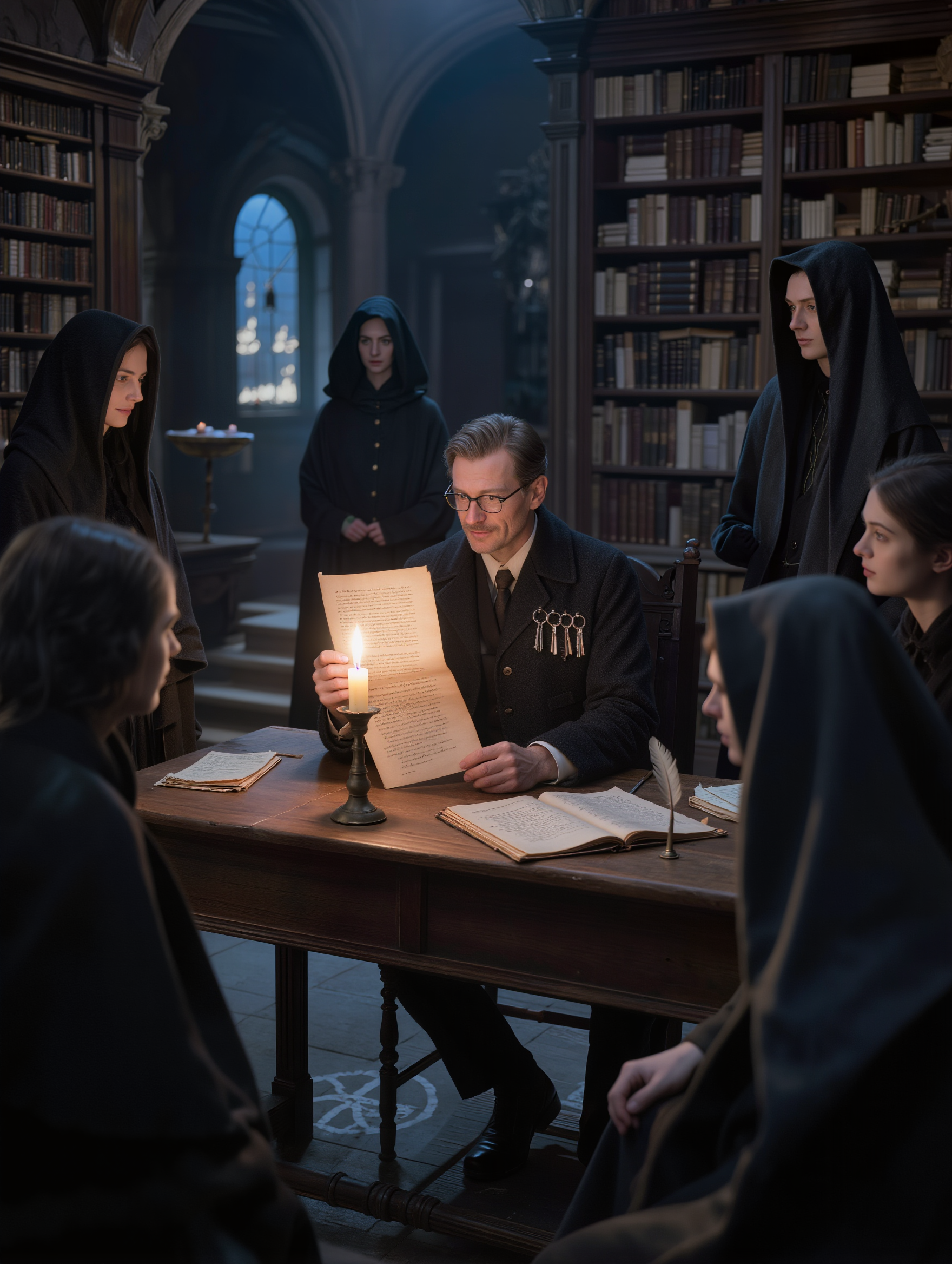
The man who let them in is somewhere past seventy, reads seven languages, and has spent most of his adult life as the private librarian of a collection that no public institution would accept as a donation. He was polite about the coats. He asked whether anybody wanted coffee. Then he took them down a flight of stairs into a long room with shelving on both walls, and the temperature dropped about ten degrees, and the Believer stopped in the doorway and did not come the rest of the way in.
He said it out loud, which took something. "I don't think we should be reading any of this."
The old man did not argue with him and did not look offended.
"Thirty-one years," he said. "I've had four kinds of people down here. The curious. The credulous. The frightened. And the ones who came back a second time and brought somebody with them." He put a candle on the table and lit it, and then said, before anybody could make a joke about it, "The wiring is from 1926 and the overheads are worse than this. It isn't theater."
He looked at the Believer.
"Which of those four do you think I worry about? It isn't the frightened. A frightened man tells somebody. It's the one who was raised being told don't look at that, and never got told why, and finds it at thirty-one on a bad night with a drink in him and nobody in the house to tell. He doesn't come here. He has no idea this room exists. He orders a paperback and reads it alone."
The Believer came the rest of the way in.
They had come with the question they had brought off the porch — about the altars, and why the fights are always about the same five things. The old man let them finish and then said, "Everybody comes here about the altars. The altars are the cheap part. Anybody can build an altar."
Then he went and got three books.
One was a photographed page of something copied out in the second century. One was printed in Latin in Florence in 1471. One was a paperback that had been on a chain-bookstore shelf about eight years ago, with a foil cover. Three languages, three continents, roughly eighteen hundred years end to end, no line of transmission between the first and the third that a scholar would defend in print.
He opened all three, set them side by side under the candle, and put his finger on a sentence in each one.
They were saying the same thing. Not similar. The same.
The Scribe read all three twice and wrote nothing down, which for him is unusual.
And the Believer, still standing, looking at maybe nine thousand volumes on both walls — twenty centuries of it, written by men who were not stupid, printed by men who were not poor, bought by men who were not desperate — asked the question this transmission runs on.
"If none of it is true, why has it never once gone out of print?"
Nobody in the room answered him. The old man did not answer him either, and that was on purpose.
Occultism & Mystery Religions
"No wise man, enchanter, magician or diviner can explain to the king the mystery he has asked about, but there is a God in heaven who reveals mysteries"
— Daniel 2:27-28
Watch what Daniel does and does not do there, because almost every modern Christian instinct gets one half of it wrong.
He is standing in a room full of professional occultists — the king's enchanters, astrologers and diviners, employed at state expense, the most credentialed men of their kind in the ancient world — and he does not tell the king there is no mystery. He does not say the dream was indigestion. He does not say the men are frauds. He grants every bit of it: the mystery is real, it is a genuine thing to have been asked about, and the whole professional apparatus of the empire cannot touch it.
Then he moves the source. There is a God in heaven who reveals mysteries. Not no one. Not nothing. Somebody, in a specific place, who does this — and it is not the men holding the equipment.
That is the posture of this entire file, and it is harder than either of the two things men do instead. The materialist says there is no mystery, and loses every man who has actually run into one. The frightened Christian says do not look at it, and hands the whole subject to whoever will look. Daniel does neither. He walks into the room, concedes the reality, and relocates the source.
The previous room ended at five altars. This one is where the instructions for them are kept.
The Two Questions
Every article under this file runs on two questions, and both are required.
Why does this attract serious people?
Why is it an enemy of the gospel?
A man who cannot answer the first does not understand the thing he is refusing, which means his refusal is a preference and will not hold under pressure. A man who cannot answer the second does not know what he would actually be choosing if he chose it.
The first question is the one Christians usually skip, and skipping it is expensive. Twenty centuries of Western intellectual life have produced scientists, mathematicians, physicians, poets and statesmen who took this material seriously — Newton wrote more on alchemy than on physics — and they were deceived is not an explanation. It is a label pasted over the place where the explanation should be. The men were not stupid, were not uneducated, and in many cases were not even irreligious. Something in the material answered something in them.
The second question is the one the wider culture skips, and skipping it is more expensive. The contemporary framing treats all of this as decorative — a personality quiz with candles, a way of being spiritual without the inconvenient parts. It is not decorative. It is a rival account of what a man is and how he gets out of his condition, and it has been in direct competition with the gospel since before the gospel had a New Testament to be written in.
What Each One Is Reaching For
Take the first question seriously and the traditions stop looking arbitrary. Each of them is reaching for something a man actually needs.
Hermeticism reaches for the unity of knowledge — one world, physical and spiritual, held together by something, in a period when the coming materialism was preparing to cut the two apart and keep only the half you can weigh.
Mysticism reaches for direct encounter — the knowledge of God as experience rather than as report, in the recurring seasons where institutional religion has buried the encounter under machinery.
Kabbalah reaches for depth beneath the text — the conviction that Scripture is not exhausted by its surface, that the words go down further than a plain reading takes them.
Astrology reaches for order beneath events, and numerology for pattern beneath number. Both are refusals to accept that the world is random, made by men who could not believe the arrangement was an accident.
Shamanism reaches for contact with what materialism denies — an actual encounter with an actual order of beings, held by cultures that never got the memo that there is nothing there.
The mystery religions of the classical world — Eleusis, Mithras, Isis, Cybele, Orpheus — reached for initiation: a transformation that actually changes the man, rather than the civic religion of the marketplace, which changed nobody and everybody knew it.
Every one of those hungers is legitimate. Not one of them is a sin. And every one of them is answered in Christ, in a form the traditions could not produce: one world held together in him rather than in a correspondence table; direct access to the Father, purchased rather than achieved; a text with a bottom no man has yet reached; a providence running under events rather than a horoscope over them; an encounter with a spiritual order that comes with a Name to stand behind; and an initiation into a death and a resurrection, offered to anybody, with no grades, no fees, and no ladder.
The traditions diagnosed the hunger honestly. That is exactly why they work. Then they answered it with something else.
The One Claim
Three books, three centuries, one sentence. Here is what was on those pages.
"For God knows that when you eat from it your eyes will be opened, and you will be like God, knowing good and evil" — Genesis 3:5
That is the claim. Every substantial thing in that basement is a restatement of it, in the vocabulary of whatever century the printing press happened to be in, and it is why no line of transmission is needed to explain the agreement between a second-century codex and a paperback with a foil cover. Nobody had to copy anybody. There is one offer, it has never been withdrawn, and it does not require a manuscript tradition to keep circulating.
Notice what makes it work: it is not a lie about the outcome. Their eyes were opened. Something was genuinely obtained. It is a lie about the terms — about what it would cost, about what would be received, and about who was doing the offering.
From that one claim, five specific breaks follow, and they show up in nearly every tradition on those shelves.
The boundary is dissolved. As above, so below, taken in its strong form, requires that the divine and the human be the same substance at different concentrations. Scripture will not have it. God is not the creation and the creation is not God, and everything the gospel does depends on that gap being real — because a gap is something a bridge can be built across, and a blur is not.
The man becomes his own mediator. In the initiate's architecture, technique does the work: the disciplined practitioner ascends by method and reaches what he has trained for. There is exactly one mediator in the Christian account and it is not the practitioner. The cross is not a technique, and it cannot be improved by one.
Knowing replaces being remade. Transformation by acquired secret rather than transformation by the Spirit on the basis of a death. Follow it downstream: the secret becomes a credential, the credential becomes a class, and the class becomes a ladder that most of the population is structurally beneath. The gospel has no ladder. That is not a marketing weakness. It is the design.
Escape replaces resurrection. The body becomes a prison and matter becomes the mistake, and the goal is to get out. Scripture ends with a redeemed material world and a physical body raised — the exact opposite direction of travel. These are not two dialects of one hope. They produce two completely different lives, and you can tell which one a man holds by watching what he does with his ordinary Tuesday.
Will replaces obedience. Crowley put it most cleanly — do what thou wilt shall be the whole of the Law — and in doing so did everyone the favor of stating plainly what softer versions imply. Set that beside a man in a garden at night saying not my will, but yours. Both sentences are about the will, both are said seriously, and they cannot both be the truth about what a man is for.
The Map on the Wall
You do not have to read the shelves. You do have to be able to place a thing when you meet it.
The classical mysteries built the template: initiation, secret knowledge restricted to the qualified, progressive grades, transformation promised on the strength of the rite itself. Everything downstream is a variation on that architecture.
Hermeticism — Egyptian, Greek and Jewish thought braided together in the early centuries — became the channel through which the ancient material reached the medieval and Renaissance West. The Corpus Hermeticum and the Emerald Tablet are the load the channel carried, and alchemy, Renaissance natural philosophy, Rosicrucianism and eventually Freemasonry all drink from it.
Kabbalah developed inside medieval Jewish mysticism with its own architecture and its own integrity, the Zohar compiled in the thirteenth century. Renaissance Christian scholars — Pico, Reuchlin — then pulled selected parts of it into a Christian-Hermetic synthesis it was never built for, and the Western occult tradition has been borrowing the vocabulary ever since, usually without the tradition.
The nineteenth-century revival is where the modern picture gets assembled: Eliphas Levi, whose 1854 work designed the Baphomet image everybody now recognizes; Albert Pike, who carried Levi's framework into Masonic literature in 1871; Blavatsky's Theosophical Society; and the Hermetic Order of the Golden Dawn, which gathered the loose strands into a working system.
Crowley took the Golden Dawn material into open antinomian territory in the early twentieth century and fathered most of what came after. Manly P. Hall, at it in the same years and in a far more scholarly voice, produced the great English-language synthesis in 1928 — the book that put the whole tradition on one shelf where anyone could find it.
Place a thing on that map and it stops being mysterious. It becomes traceable, which is the first thing you need and the last thing the material wants.
This Is Not News
There is a persistent modern assumption that all of this is exotic — that Scripture is an ancient farming document that never anticipated any of it. Read the actual list.
"or casts spells, or who is a medium or spiritist or who consults the dead. Anyone who does these things is detestable to the LORD; because of these same detestable practices the LORD your God will drive out those nations before you"
— Deuteronomy 18:11-12
That is the back half of a catalog that starts earlier in the same passage with divination, sorcery, omen-reading and child sacrifice. It is not a vague warning about superstition. It is an itemized list of specific professional practices, written to a people about to move into a country where those practices were the going religion, performed by people who were good at them.
Two things follow, and most men only take one.
The first: this was never treated as harmless. The language is not unwise or unhelpful. It is detestable, and the passage says these practices are the actual reason those nations lost the land.
The second, which the frightened reader misses: the passage assumes the man reading it is going to be surrounded by this. It is written to people who will have neighbors doing it, in-laws doing it, and a local economy partly built on it. It is not a quarantine order. It is instructions for living in a country where the temple is already open and doing good business.
The Costume Rack
None of this is behind glass. It is on the shelf at the airport, in the language of the current decade, usually without a source citation — which is the whole reason to know the map.
Manifestation and Quantum Mysticism is as above, so below rebuilt for the wellness market, with quantum vocabulary borrowed to do exactly the job that Renaissance natural philosophy did for the older Hermetic writers. Vibrate at the frequency of what you want is not a modern discovery. It is a very old sentence in a new coat, and the man saying it usually has no idea he is quoting anybody.
Analytic Idealism is the same monism in respectable clothes — all is consciousness, argued carefully enough to be published by philosophy departments that would never print a Theosophist.
The Empath Movement is the gnostic-elect structure in therapy language: a class with special spiritual capacity, and a wider population whose limitation explains why they cannot be reached. Same ladder. New rungs.
The Hermetic Revival in Wellness Culture catalogs the ordinary retail version — energy medicine, cosmic resonance, the spiritual but not religious frame that lets a man hold a full metaphysics while believing he holds none.
The costume changes about every twenty years. The claim underneath has not changed since the garden. A man who knows the claim stops being surprised by the wardrobe.
Two Thousand Years of Christians Reading This
Nobody working through this material is the first Christian to do it, and the tradition of engagement is deeper than any modern reader has time to exhaust.
The early Fathers — Justin, Irenaeus, Hippolytus, Tertullian — took the second and third-century gnostic systems apart in detail, and they did it by reading them. Irenaeus' Against Heresies is still the spine, and its method is the one this file uses: state the other man's position accurately enough that he would recognize it, then show precisely where it departs.
The medieval and Renaissance engagement was more mixed than most Protestants know. Serious Christian scholars attempted a synthesis, on the theory that the Hermetic writings preserved an ancient wisdom compatible with revelation. The Reformers generally refused it and reasserted the plain frame. Giordano Bruno pushed the synthesis past what the institutional church could absorb and was burned in 1600 — a real line, drawn in the worst possible way, and the church's manner of drawing it is its own indictment.
The modern Christian engagement continues in scholarly form. The point of naming the lineage is simple: a man who thinks he is improvising here is going to make errors that were already catalogued eighteen hundred years ago by somebody who did the reading first.
What Reading It Is Actually For
"A number who had practiced sorcery brought their scrolls together and burned them publicly. When they calculated the value of the scrolls, the total came to fifty thousand drachmas" — Acts 19:19
Two details in that verse are worth more than the sermon usually preached on it.
They calculated the value first. Somebody added it up. Roughly fifty thousand days' wages, in a pile, in public, and they knew exactly what they were doing when they lit it. This was not a panic. It was an accounting.
And they burned them rather than selling them. They could have recovered the money from buyers who wanted them. They did not, because they understood something about what would happen next with those particular books in those particular hands.
That is a converted practitioner disposing of his own working library. It is not a program for the man who has never practiced anything. A great deal of Christian handling of this subject confuses the two — takes an account of men destroying tools they had personally used, and turns it into a rule that nobody should ever read anything.
Which produces exactly the man the archivist worries about. Told don't look, never told why, no framework, no vocabulary, no one to ask — and the curiosity does not go away, it goes underground and surfaces later on a bad night, alone.
So the reading has two purposes and neither of them is fascination.
Recognition. Your fiancée's mother wants the astrologer consulted about the date. Your sister-in-law is manifesting the promotion. There is a healer on the internet charging by the session for energy work. These are not novel phenomena requiring a novel response. They are old items in current packaging, and a man who has read the map recognizes them before he has to react to them.
Discrimination. In every one of these traditions, something real is being noticed and something false is being sold. The man who can separate the two can talk to a person formed by this material — take the actual question seriously, refuse the actual answer, and not treat the person as an idiot for having asked. Nobody has ever been argued out of a spiritual framework by somebody who was visibly frightened of it.
A man who reads this honestly does not become superstitious. He becomes useful. He stops flinching at the bookstore. He stops going silent when the subject comes up at a dinner table. He gets a calm voice on a subject where nearly everyone he knows has only two settings.
Why the Candle Was Lit
None of the above should be mistaken for the idea that this is merely an interesting error.
"When someone tells you to consult mediums and spiritists, who whisper and mutter, should not a people inquire of their God? Why consult the dead on behalf of the living?" — Isaiah 8:19
Two things in that sentence are usually walked past. The first is whisper and mutter — it is a description of technique, and it is unflattering on purpose. The prophet is describing what the operation actually looks like from outside, in the room, with the practitioner performing.
The second is the question at the end, which is the real one. Why consult the dead on behalf of the living? Not does it work. Not is it real. The prophet does not bother contesting either. He asks why a man with access to the living God would take his household's most urgent question somewhere else — and the honest answer, most of the time, is that the other channel promises an answer on a schedule, and God does not.
Paul is blunter still. He says the sacrifices of the nations are not offered to nothing, that there is a recipient, and that a man under covenant cannot eat at both tables. That is the reason the polite modern framing — that divination and ceremonial magic are harmless private hobbies — cannot be accepted here. Not because they are silly. Because they are a form of access, to something, and the access is not authorized.
The candle was not theater. It was the right amount of light for what those books actually are.
Closing the Transmission
The Believer's question has an answer, and the old man knew it, and made them sit with it instead.
It has never gone out of print because the hunger is permanent and the offer is always in stock. Every generation produces men who want the unity of knowledge, the direct encounter, the depth under the text, the pattern under the chaos, and a transformation that actually takes. Those men are not going away, and neither is the sentence that promises all five without a cross. The agreement between a second-century page and a foil-cover paperback needs no manuscript tradition to explain it. One offer, one condition it exploits, endlessly reissued.
But the room has a limit, and the old man named it himself on the way up the stairs, with the lights off behind them.
Everything on those shelves was written by the party that wanted the meeting.
Every volume down there is somebody's account of an invitation he sent. The rite he performed, the circle he drew, the fast he kept, the substance he took, the words he said and the hour he said them at. Nine thousand books, and all of them one side of the correspondence. Not a single one was written by whatever answered — and a man who reads only the invitations will come away thinking the whole subject is a matter of technique, as though nothing happens unless somebody performs the ceremony correctly.
Which leaves the other pile. The one that never gets shelved in a room like that, because it has no doctrine, no lineage, no grades and no author.
"A spirit glided past my face, and the hair on my body stood on end. It stopped, but I could not tell what it was. A form stood before my eyes, and I heard a hushed voice" — Job 4:15-16
That is Eliphaz, and the detail that matters is what happens to him later: the last chapter of the book has God telling him plainly that he has not spoken rightly. The encounter is recorded as real. The man's conclusions from it are not endorsed. Scripture puts a genuine nighttime visitation in the mouth of somebody who then draws the wrong lesson from it for thirty-odd chapters — which is the single most useful thing in the Bible for the room the crew is walking into next.
Because most of the people it happens to never sent an invitation. They have no tradition and no vocabulary. They are a family in a rented house, a nurse on the night shift, a man driving a county road at three in the morning who will not talk about it for eleven years. They did not draw a circle. They were not looking. Something arrived anyway, and they have nowhere to put it.
The archive is the mail that was requested. The next room is the mail that was not.